
Inspection, ARMS!
Confederate Purchased British Brunswick Rifle
By Tim Prince · Originally published October 2019 · pp. 22–23

Confederate Purchased British Brunswick Rifle In 1836, the British military officially adopted the percussion cap to replace flint as the ignition system for small arms, although it would be 1839 before a new infantry musket using the percussion system would be officially approved and start being issued in any quantity. With the theoretical acceptance of the new ignition system, George Lovell, inspector of small arms at Enfield (the British government armory), proceeded to start the process of designing a new percussion musket and rifle. His initial success was in a back-action percussion lock that was utilized on his short-lived Pattern 1838 musket but saw significant service with the newly designed Pattern 1837 Brunswick rifle. The Brunswick was a significant technological improvement over the Baker rifle that had seen use in the British rifle brigades and battalions for the previous three decades. The Baker was a flintlock rifle with a slow twist seven-groove barrel. The rifling design had been selected not so much for accuracy, but for its ability to see significant use without becoming too fouled to load. In fact, the accuracy, or rather inaccuracy, of the rifle was such that during the last years of production the multileaf rear sight was abandoned for a fixed sight; with the Board of Ordnance feeling that the adjustable sight was unnecessary for the rifle or the rifleman! Lovell experimented with a variety of rifling systems for what would become the new Brunswick rifle. He finally settled upon a two-groove bore of .704 caliber that used a belted ball to insure a tight mechanical fit between the ball and rifling. The new rifle resembled the older Baker in that it did not employ barrel bands, but rather had a key fastened stock and had a heavy bar on the right side of the barrel for the mounting of a saber bayonet. The first version of the Brunswick, the Pattern 1837, had Lovell’s back action lock, a fixed sight with additional leaves for longer range shooting, and a hook breech. The rifle had a 30inch barrel and weighed approximately ten pounds. As noted, the gun had wedge retained barrels without barrel bands. The barrels were browned, the locks color case hardened, and the furniture was brass. This included a large brass patchbox in the obverse butt for the storage of patches and cleaning implements. The brass triggerguard tang also incorporated a skeletonized pistol grip. A bayonet bar on the barrel allowed the mounting of a brass hilted, wasp-waisted saber bayonet whose blade resembled a Roman gladius. The Brunswick rifle went into production in 1838, with the first rifles reaching troops in the field during 1840. In 1841, an improved version was adopted with a conventional side lock and the hooked breech was eliminated. These Pattern 1841 rifles went into production around 1844 and were in the field the following year. Most collectors refer to the improved Brunswick as the Pattern 1844. The final change came in 1847, when Lacy & Reynolds, a London arms contractor, introduced an improvement to the bayonet mounting bar. Once the new improvement was officially adopted, the final version, the Pattern 1848 came into being. The Brunswick rifle remained a standard issue long arm for rifle troops until about 1853, when sufficient quantities of the new Pattern 1851 Minié rifles had been produced and could be issued, effectively turning all British infantrymen into “riflemen.” Even after the adoption of the small-bore .577 caliber Pattern 1853 “Enfield,” the Brunswick remained in service in a secondary issue roll, particularly among native and colonial troops, through the mid-1860s. With the adoption of the Pattern 1853 Enfield, the Brunswick rifle, along with the Pattern 1839 and 1842 muskets and the Pattern 1851 Minié rifle all became obsolete and essentially worthless arms in British military inventories. Some of these arms were sold off to the fledgling Confederacy during 1861 and 1862, as southern purchasing agents were looking to obtain small arms of any type to equip the newly formed Confederate armies that were then taking the field against the U.S. military. According to the Gorgas Summary of Small Arms Purchases that were made by Caleb Huse, some 2,020 “Brunswick Rifles” were purchased by the south at a cost of 54 schillings each. This summary report was dated February 3, 1863, and most likely covered the purchases made by Huse between the time he arrived in England during the summer of 1861 and the end of 1862. Huse acquired all of his Brunswick Rifles from S. Isaac, Campbell & Company, who purchased the guns from J.E. Barnett & Son of London. The guns were acquired in eight lots between October 31, 1861, and March 27, 1862. To date, only nine examples of these Confederate purchased Brunswick rifles are known, all bearing the CH/1 inspection mark of Isaac Curtis and Charles Hughes, who acted as viewers for Confederate arms purchases in England, usually of guns sold by Barnett. These nine examples vary in features and caliber, with some being .704 two-groove military rifles (both 1837 and 1844 patterns) and some being smaller bore volunteer models. In all cases, even the surplus military guns have been upgraded with the addition of Pattern 1856 short rifle rear sights. The Volunteer pattern, smaller bore guns have stamped inventory numbers, and the extant examples range from #207 through #1065. This suggests that Barnett may have produced these guns, or possibly built them from a variety of scavenged military parts and newly made parts, as Pattern 1853 type locks and newly made .63 barrels have been encountered on some of these guns. The Brunswick rifles documented in the Gorgas summary were shipped to the south in the cargos of the blockade runners Gladiator, Southwick, Stephen Hart, Ella Warley and Melita. The rifles were shipped in crates of twenty each, with each rifle accompanied by the appropriate brass handled saber bayonet. A pair of cone wrenches and a single bullet mold were also included in each case. These cases were marked in three lines B / WD / H within a rhomboid, indicating “Brunswick,” “War Department” (Confederate Ordnance Department) and “Huse.” One extant Confederate ordnance document dated August 27, 1862, records the transfer of “260 British rifles (twogroove)” from the Charleston Arsenal to General Sterling Price at Tupelo, Miss. Their description as “2-groove” rifles indicates that these were the .704 caliber British military pattern 1837 and 1844 Brunswick rifles. Thirteen thousand rounds of ammunition and thirteen bullet molds also accompanied the rifles to Tupelo. With only fifty rounds of ammunition sent with each gun, the bullet molds probably became rather important very quickly, if the guns were to remain in service very long! These Brunswick Rifles almost certainly saw combat less than a month later at the Battle of Iuka, Miss., (Sept. 19, 1862) and again soon after at the second Battle of Corinth, Miss., (Oct. 3-4, 1862). One of the finest examples of a carved Confederate rifle is a .63 caliber Volunteer pattern Brunswick rifle identified by its exquisite period inscription to John C. Gillespie of Company K, 18th Arkansas Infantry. The 18th Arkansas fought at both Iuka and Corinth and suffered staggering causalities at the second battle with losses approaching 85% of the regiment. As the Gillespie gun is a numbered (#1065) “Volunteer” pattern, .63 caliber gun, it must have been part of a different shipment of Brunswick rifles to Price’s troops that we have not found the ordnance records for, as the record mentioned above clearly describes .704 caliber Brunswicks. Not all the 2,020 Brunswick rifles purchased by Huse during 1861–62 successfully arrived in the Confederacy. The Stephan Hart was captured by the Federal Blockading Squadron and its cargo was subsequently sold at auction on May 22, 1862. Among its cargo were some 16 cases of Brunswick rifles, 320 in total, which were sold for $10 each at the auction. The Blockade Runner Ella Warley suffered a similar fate, and the September 30, 1863, auction of its cargo included 15 cases of Brunswick Rifles (noted as “small caliber, 7-groove”) which were sold for $12 each including their saber bayonets. This means that at least 620 of the 2,020 rifles never made it to southern ports, so a maximum of 1,400 documentable Brunswick rifles were delivered to the Confederacy.
Tim Prince is a full-time dealer in fine & collectible military arms from the Colonial Period through WWII. He operates College Hill Arsenal, a web-based antique arms retail site. A long time collector & researcher, Tim has been a contributing author to two major book projects about Civil War era arms including The English Connection and a new book on southern retailer marked and Confederate used shotguns. Tim is also a featured Arms & Militaria appraiser on the PBS Series Antiques Roadshow.
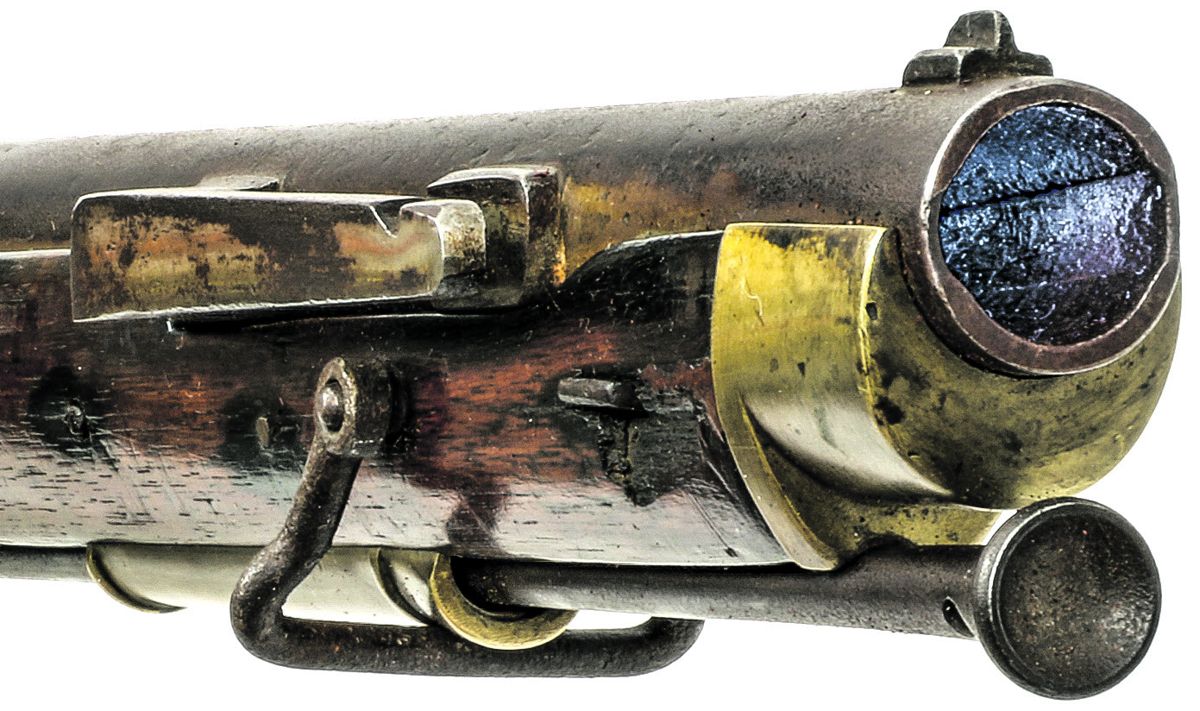
Close up of the two-groove .704 caliber bore of a CS imported Brunswick rifle, showing the heavy bayonet bar on the side of the barrel as well.
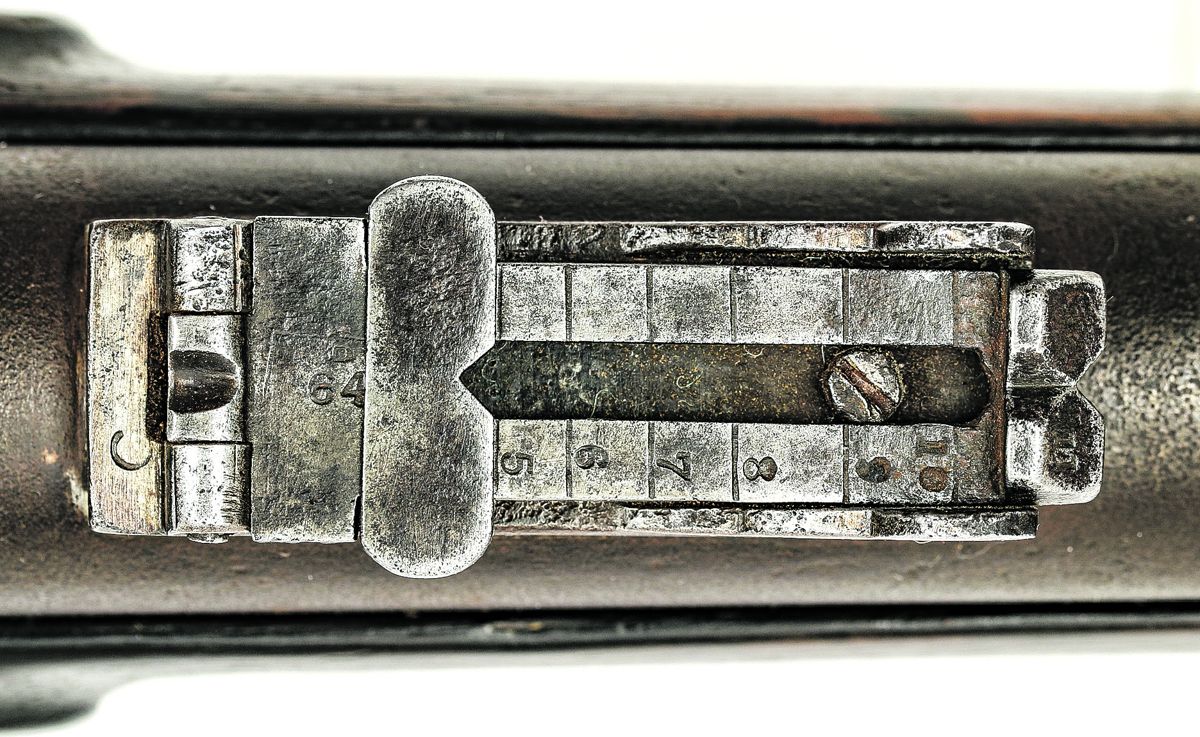
Detail of the 1,100 yard sight leaf of the P1856 rear sight.
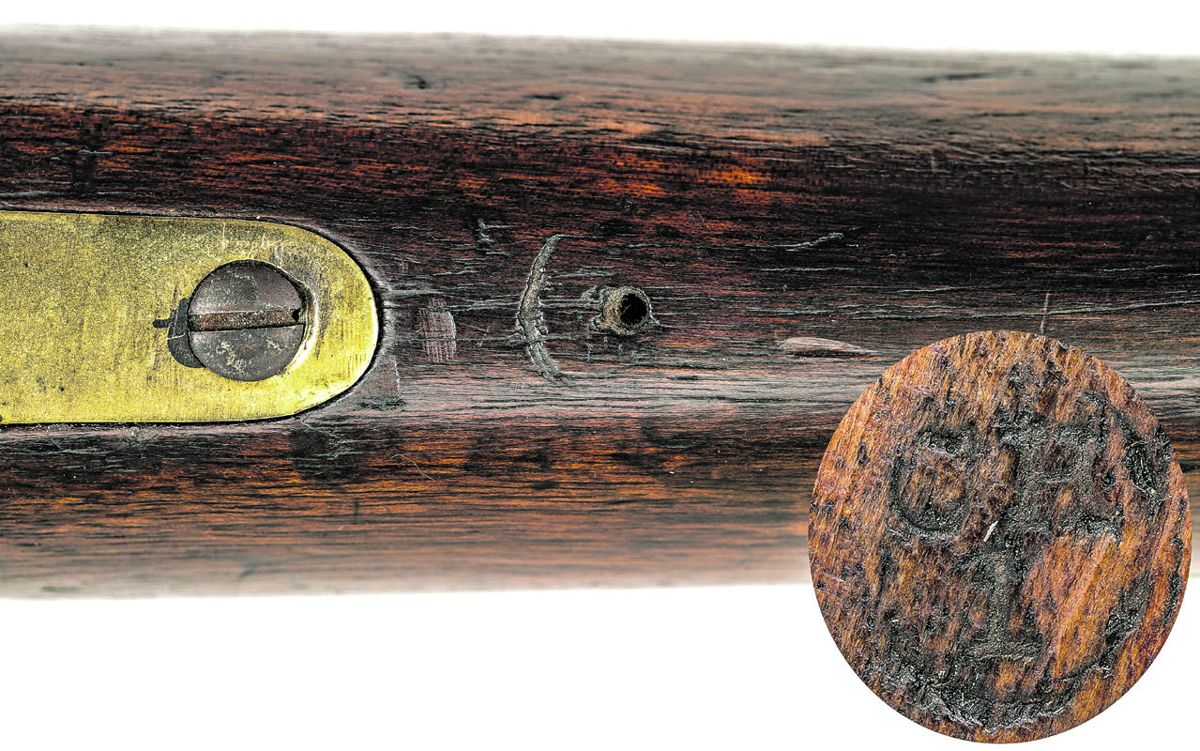
Close up of the area where the CH/1 mark is found on the CS imported Brunswick rifles. This rifle had an old collection tag in the wood that mostly obliterated the mark. The inset photo shows what the mark would have looked like before the tang of the tag ruined it.
Overall obverse view of a Confederate imported Brunswick rifle. All photographs by Tim Prince.

Overall reverse view.
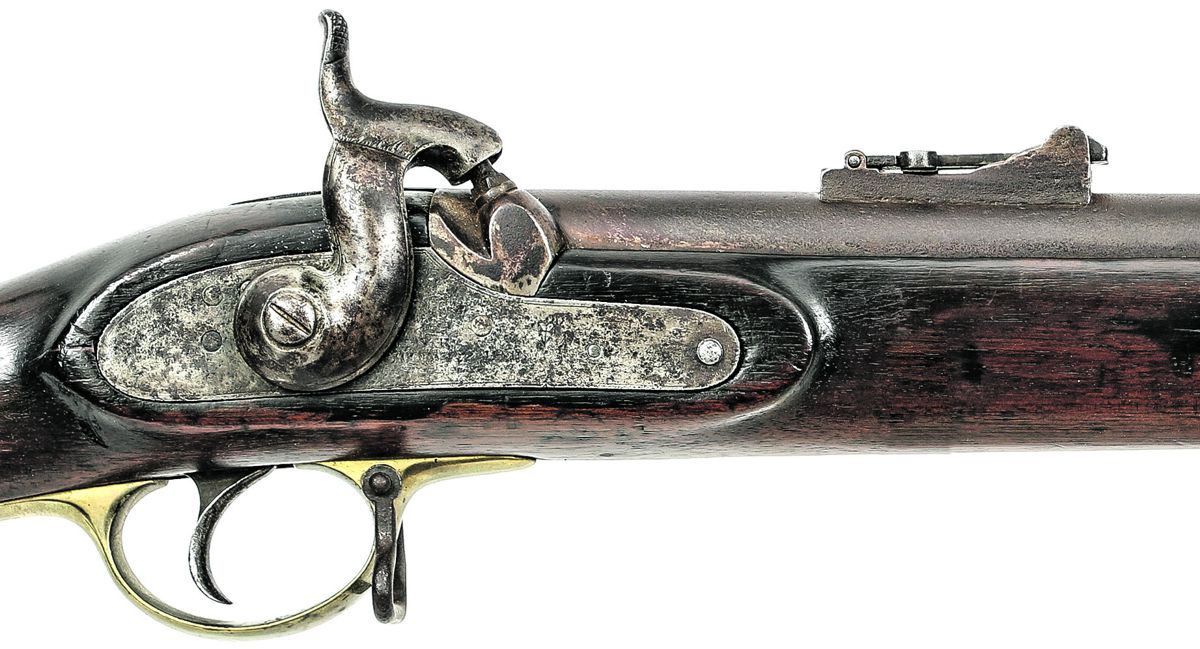
Close up of the lock and P1856 rear sight of a CS used Brunswick. This 1,100 yard Enfield pattern rear sight is one of the defining features of CS purchased Brunswick rifle.