
Through The Lens
These People Are All My Neighbors
By Stephanie Hagiwara · Originally published November 2019 · p. 14
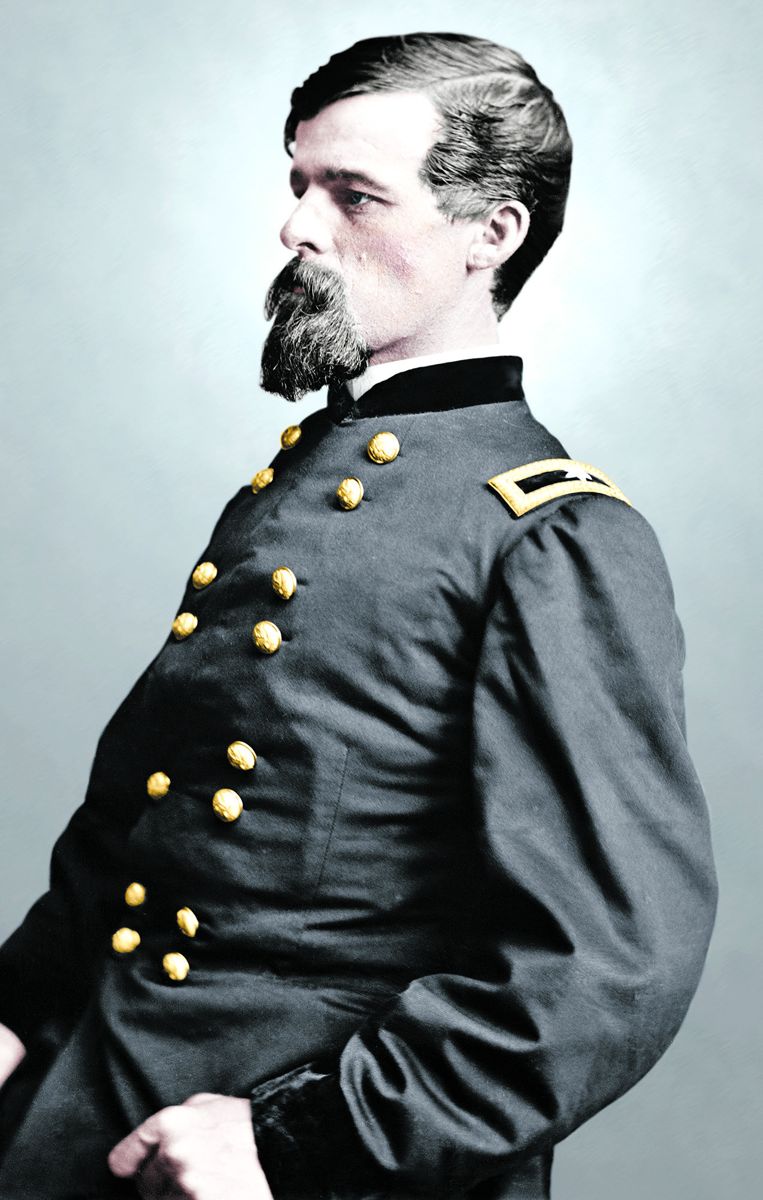
These People Are All My Neighbors “[The Militia] dread the jeers and sneers which they must encounter from the Army more than they do the bullets of the Yankees.” C.S. Gen. Howell Cobb On November 15, 1864, Gen. William T. Sherman departed Atlanta, Ga. on his famed “March to the Sea.” His army crossed the state in four parallel columns to confuse the enemy on his goals. The right wing threatened Augusta, Ga. The left wing, commanded by Maj. Gen. Oliver O. Howard, and aided by Gen. Judson Kilpatrick’s cavalry, was tasked with demonstrating against Macon, Ga. The temperature dropped; snow fell. From the direction of Macon came the boom of cannon fire. In repeated clashes, Confederate Gen. Joseph Wheeler’s cavalry was able to repulse Kilpatrick. However, Kilpatrick had been selected for his propensity to fight. As Sherman declared, “I know that Kilpatrick is a hell of a damned fool, but I want just that sort of man to command my cavalry on this expedition.” On Nov. 20, Kilpatrick turned toward Griswoldville, located approximately 10 miles east of Macon. He ordered 100 men of Capt. Fredrick S. Ladd’, 9th Mich. Volunteer Cavalry to burn public buildings and destroy the railroad. During the War, a cotton gin manufacturing plant had been converted to a pistol factory, producing 3,500 guns. The other approximately 40 buildings consisted of soap, brick, and candle factories, mills, shops, and worker’s homes. Ladd’s men torched buildings, a locomotive and 13 railroad cars. On Nov. 22, to protect his rear, Howard ordered a demonstration which turned into the Battle of Griswoldville, the only infantry battle during the campaign. It began with Wheeler’s cavalry attacking three Federal cavalry units at 7 a.m. but Gen. Charles C. Walcutt’s 46th Ohio infantry repelled Wheeler. Wheeler knew his cavalry could not withstand a battle with Walcutt’s infantry and artillery and left the area by 10 a.m. Walcutt’s 1,513 men took a defensive position on a hilltop overlooking an open field, a belt of scrubby trees, and behind a creek/swamp 1.5 miles east of Griswoldville to protect the nearby roads. The men immediately entrenched their position, tearing up the split rail fences and log structures of Duncan Farm to create barricades.
Georgia Governor Joseph “Joe” E. Brown had reserved the services of Georgia’s militia for defending the State. Consequently, Georgia’s militia a.k.a. “Joe Brown’s Pets,” had limited battle experience. By the morning of Nov. 22, it had been determined that Macon was not Sherman’s target. Therefore, C.S. Gen. Gustavus Smith decided to send the militia where they were needed. Smith would stay behind to work on logistics. He ordered inexperienced commander C.S. Gen. Pleasant Jackson Phillips to “halt before Griswoldville and wait for further orders.” Phillips was a former banker and plantation owner who had kept warm through the night by drinking liquor. As the militia approached Griswoldville, smoke could be seen billowing in the distance. The men, who were from local counties, rode by the smoldering remains of the destroyed village, witnessing how the Federals left a town. Smith sent word to “avoid a fight with a superior force,” but Phillips had between 2,300 to 2,400 men and four 12-pdr. Napoleons. For reasons never fully explained, Phillips decided to attack. Around 3 p.m., the Federals were surprised to see the Confederates running across the 200-yard open field with bayonets fixed, flags aloft, as C.S. Capt. Ruel Anderson’s 14th Light Artillery shelled the Yankees. The Federals returned fire. The oncoming rebels “fell one after another. I ran some 30 or 40 yards and lay down by a stump and while lying there, I was struck on the arm, which caused me to lose the use of it. The bullets struck the stump and cut the ground on either side,” wrote Pvt. A. J. Jackson, 2nd Regiment, Georgia State Line. U.S. Capt. Albert Arndt, Battery B, 1st Mich. Artillery, returned fire with his two 3-inch ordnance rifles. Shot, Arndt came to and discovered that a “bullet had passed through my overcoat, blouse and vest.” Arndt lay awaiting the end as, “the shells exploding in all directions around me. At the same time their infantry came charging and re-charging across the field, determined to capture our commands, which they would have done if it had not been for one regiment of infantry behind the works with their 16-shooters [Spencer repeating rifles], and the pluck and determination of General Walcutt to hold his ground.” Walcutt was shot in the thigh and removed from the field. Col. Robert F. Catterson took command and immediately called for reinforcements. Realizing he was not dead; Arndt pulled his shirt apart and found his saber belt plate had “saved my life.” During the fight, three of his men lost limbs and six horses were killed. Determined not to lose the cannon, men took the place of horses to draw the guns from the field. The battle ended at dusk. As the Federals advanced across the abandoned field they found, “old grey haired and weakly looking men and little boys, not over 15 years old, lay dead or writhing in pain. I hope we will never have to shoot at such men again. They knew nothing at all about fighting, and I think their officers knew as much,” wrote U.S. Capt. Charles Wills, 103rd Ill. Infantry. Perhaps as an explanation for their persistence, one mortally wounded rebel, “making a feeble gesture with his hand, said: ‘my neighborhood is ruined, these people are all my neighbors.’” Afterwards some would blame
Philips for the unnecessary battle. Others would point out that the Confederates left the field without surrendering. However, one militiaman protested a Macon newspaper crediting Wheeler’s cavalry as the Confederate force at the Battle. “Wheeler’s cavalry had nothing to do with it,” the writer protested. It was the militia that “had the honor of the fight.” That force, he added, contained “good fighting stock, though much ridiculed.”
Sources: •
• •
•
Trudeau, Noah Andre. Southern Storm: Sherman’s March to the Sea: HarperCollins Books, 2008 Bragg, William Harris. Griswoldville: Mercer University Press, 2000 Jones, Robert C. The Battle of Griswoldville: An Infantry Battle On Sherman’s March To The Sea: rcjbooks.com, 2013 Scaife, William Robert and Bragg, William Harris. Joe Brown’s Pets: The Georgia Militia, 1861–1865: Mercer University Press, 2004
Stephanie Hagiwara is the editor for Civil War in Color.com and Civil War in 3D.com. She also writes a column for History in Full Color. com that covers stories of photographs of historical interest from the 1850’s to the present. Her articles can be found on Facebook, Tumblr and Pinterest.