
The Graphic War
George McClellan – November 1, 1861
By Salvatore Cilella · Originally published November 2019 · pp. 20–21
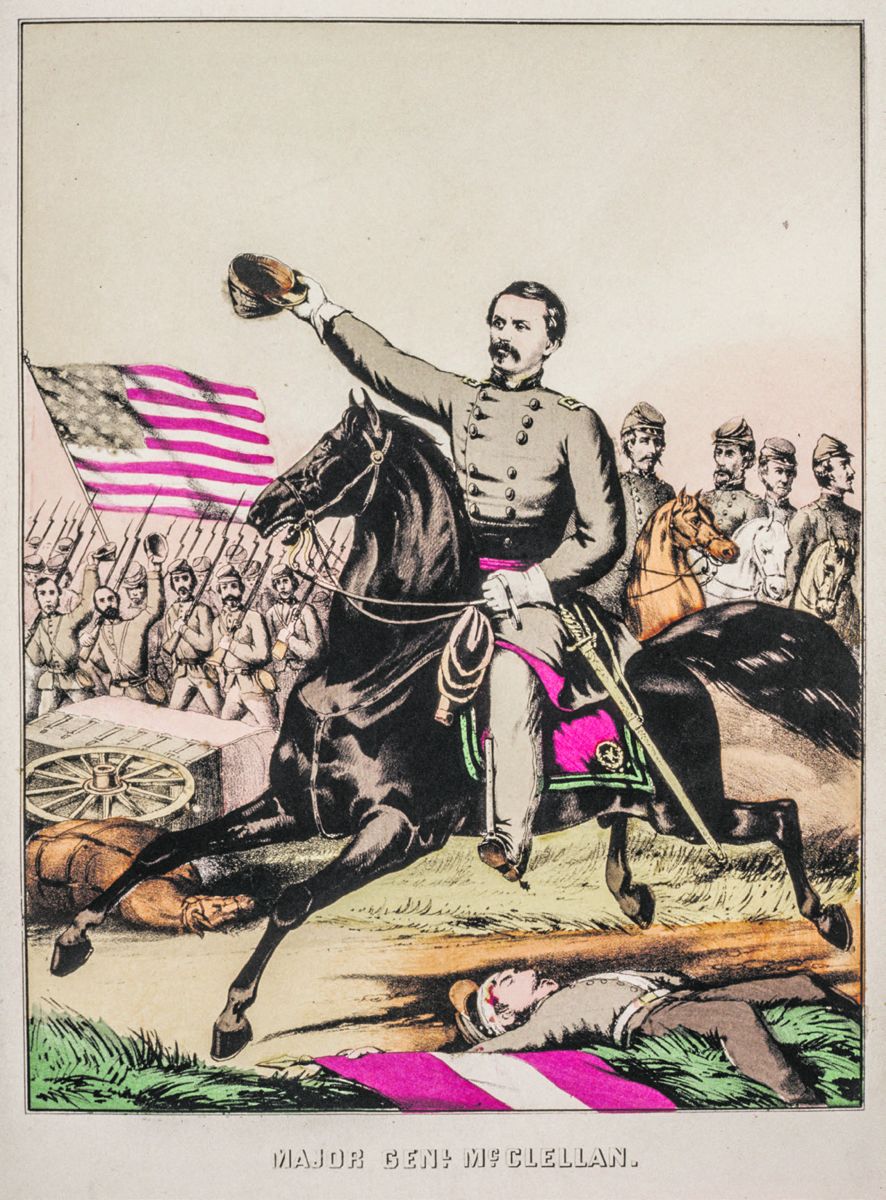
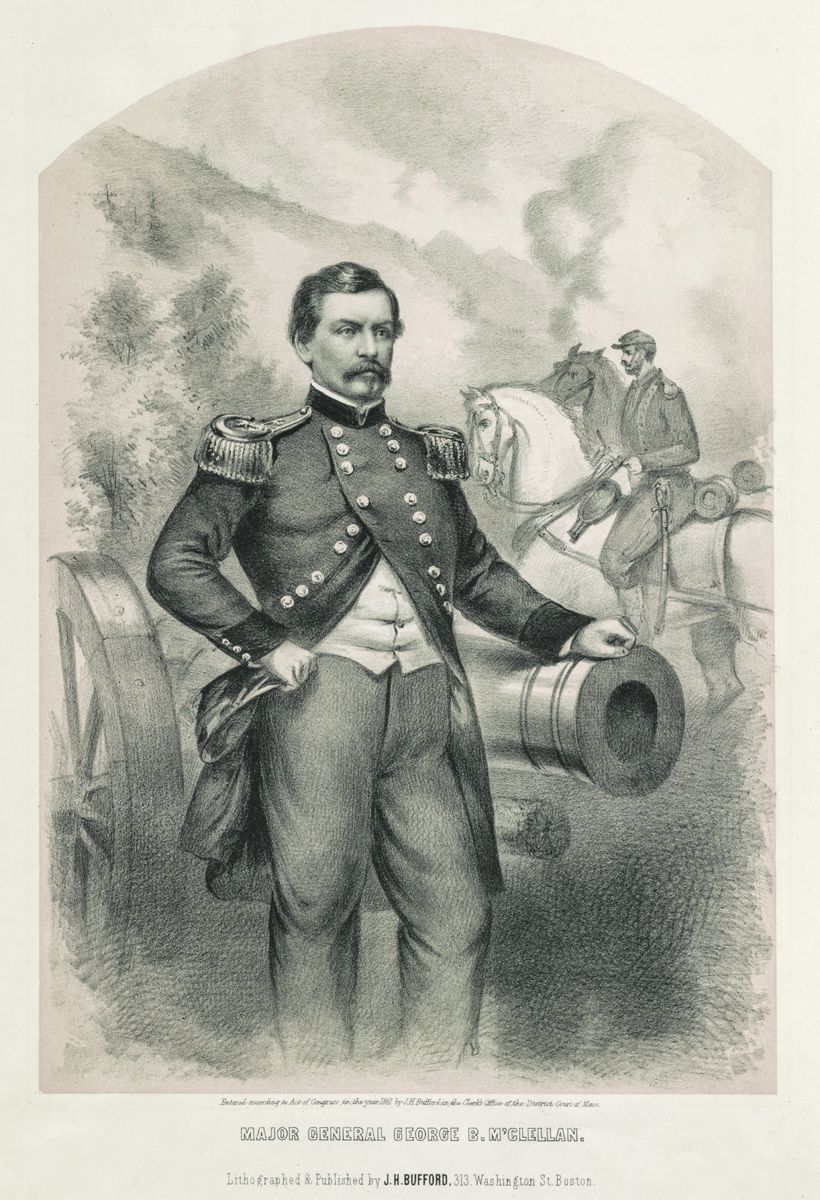
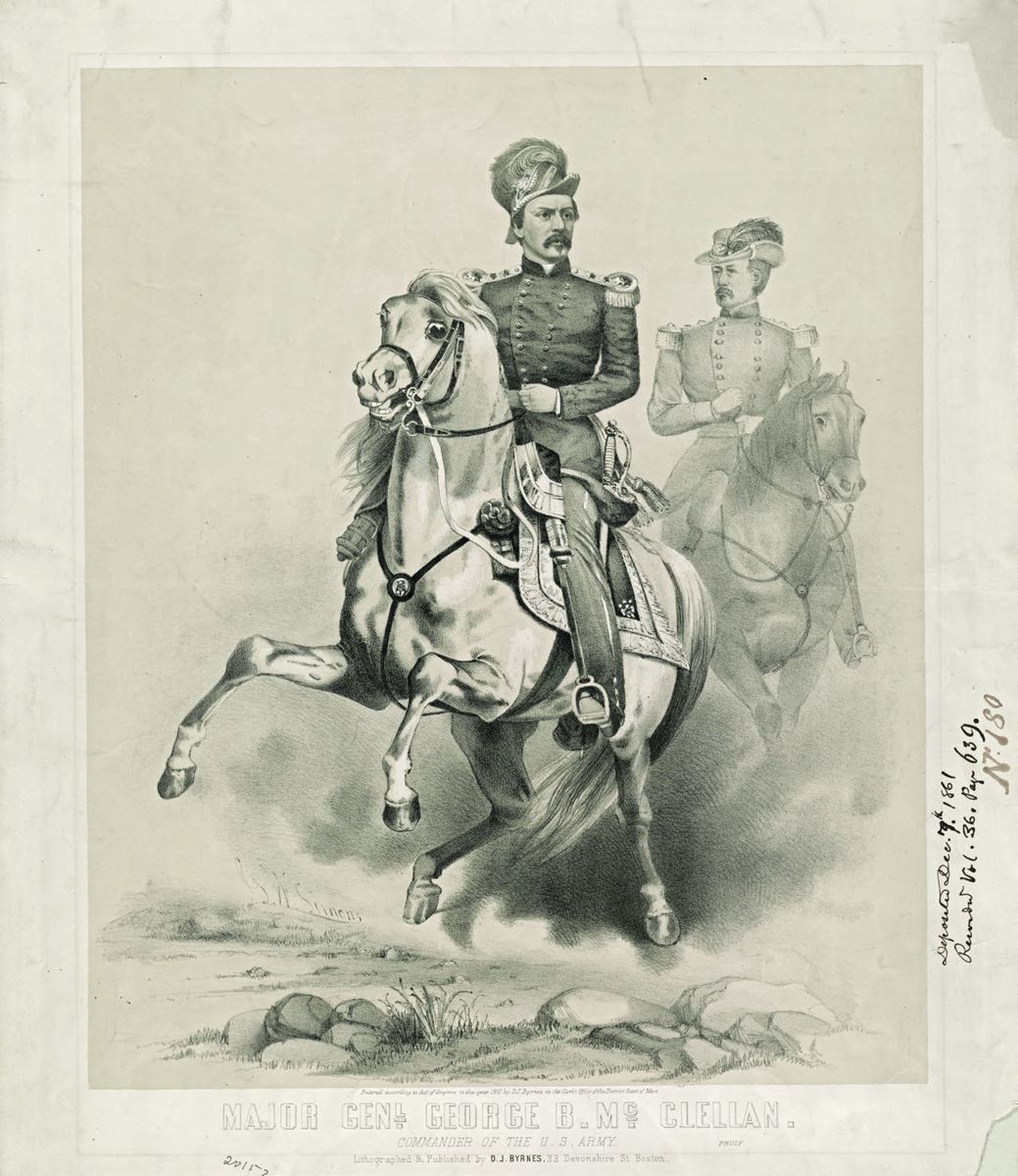
George McClellan – November 1, 1861 The Graphic War highlights prints and printmakers from the Civil War discussing their meaning and most importantly, the print maker or artist’s goals. Aside from Grant and Lee, General George Brinton McClellan was the runner up favorite subject of artists, print makers and sellers during and after the war. He is well known to Civil War scholars and not held in the highest regard. He came to Lincoln’s attention after early, minor victories in West Virginia and a brief command post in Ohio. After the debacle at First Manassas, Lincoln named McClellan commander of the newly forming Army of the Potomac. The recently minted “hero” made a grand entrance into Washington and soon began building a sizable army, much larger than his imagined foes lurking in the Virginia countryside. His training and drill of new recruits molded them into a fighting force that boosted morale and hope in the North. In his new role, he wrestled with his mentor Winfield Scott, who officially “retired” for health reasons; unofficially, because he and McClellan were oil and water. With Scott removed, Lincoln named McClellan General-inChief of all Federal armies. His appointment on November 1, 1861, marked the high point in his meteoric rise to the top. When Lincoln expressed concern over the larger responsibilities of commander and general in chief, McClellan responded as only he could: “I can do it all.”1 Printmakers jumped on the McClellan bandwagon; the first was John H. Bufford, who we have portrayed in earlier columns. McClellan had only just taken command when Bufford managed to bridge the “gap between image and accomplishment,” that historian Harold Holzer calls an illusion. McClellan soon realized that his new position caused him to remain in the rear and direct the action from a safe place, not as Bufford depicted him in the thick of battle, “his hand resting on an artillery piece aimed at the enemy.”2 The obscure lithographic and publishing firm of D. J. Byrnes of Boston rushed out a print of McClellan by artist G. W. Simons, (an unknown artist) that it deposited in the Library of Congress one month after McClellan’s promotion, December 7, 1861. Byrnes captured the Napoleonic image of the commander on horseback, wearing an elaborate uniform, plumed headgear, and surrounded by several comrades, many of them Revolutionary War Continentals.3 Unfortunately, both Byrnes and Simons have slipped from the historical record. Not to be outdone by the large eastern lithographic companies and partnerships, Cincinnati became a major player in establishing a national market for its prints. As early as 1850, the George Gibson Company advertised in the Daily Cincinnati Commercial, “lithographic printing in gold and colors.” Gibson, like so many printers/lithographers of the period, was an immigrant. By the end of the decade, the firm had customers in Canada and Nova Scotia.4 After the war, the firm specialized in greeting cards until 2000, when it was bought by the American Greeting Card Company.5 Their print of little Mac on a horse brings the image closer to the American ideal. McClellan is now waving a kepi rather than the plumed formal headgear of earlier portraits. He is on an energetic steed galloping over a dead or dying, Confederate soldier as his wellfed, disciplined, and loyal men in the background march under the stars and stripes. His staff and subordinates are dutifully behind him, stage right. McClellan would resurrect this image later in the war, not as a leading military man, but as the nominee of the Democratic Party in opposition to his old boss, Abraham Lincoln. The lithographic companies galvanized their presses and turned to images of McClellan the candidate, in countless cartoons both supporting and in opposition to the nominee. They are ample material for a stand-alone article.
Stephen W. Sears, George B. McClellan: The Young Napoleon, New York: Ticknor
D. J. Byrnes signed on stone, G. W. Simons, c. 1861-Mac on Horseback.
& Fields, 1988, 125. Hereafter, Sears, McClellan. Harold Holzer, Mark E. Neely, Jr. The Union Image: Popular Prints of the Civil War North. Chapel Hill: The University of North Carolina Press, 2000, 37. Hereafter, Holzer, Union Image.
Holzer, Union Image, 37. Peter Marzio. Chromolithography, 1840– 1900: The Democratic Art, Pictures for a 19th Century America. Boston: David R. Godine, Publisher. 1979, 13132, 134. Jay T. Last. The Color Explosion: Nineteenth-Century American Lithography. Santa Ana: Hillcrest Press, 2005, 84.
After 43 years in the museum field, Salvatore Cilella now spends his time writing and is the author of several articles and books. His last professional position was President and CEO of the Atlanta History Center. His most recent books are Upton’s Regulars: A History of the 121st New York Volunteers in the Civil War (U. Press Kansas, 2009) and The Correspondence of General Emory Upton, 1856–1881 (U. Tennessee Press, 2017) edited. His two-volume Correspondence of Major General Emory Upton, is the recipient of the 2017–2018 American Civil War Museum’s Founders Award for outstanding editing of primary source materials. He is currently editing a manuscript of Upton’s letters to his wife 1868–70, which the Oklahoma University Press will publish early 2020.