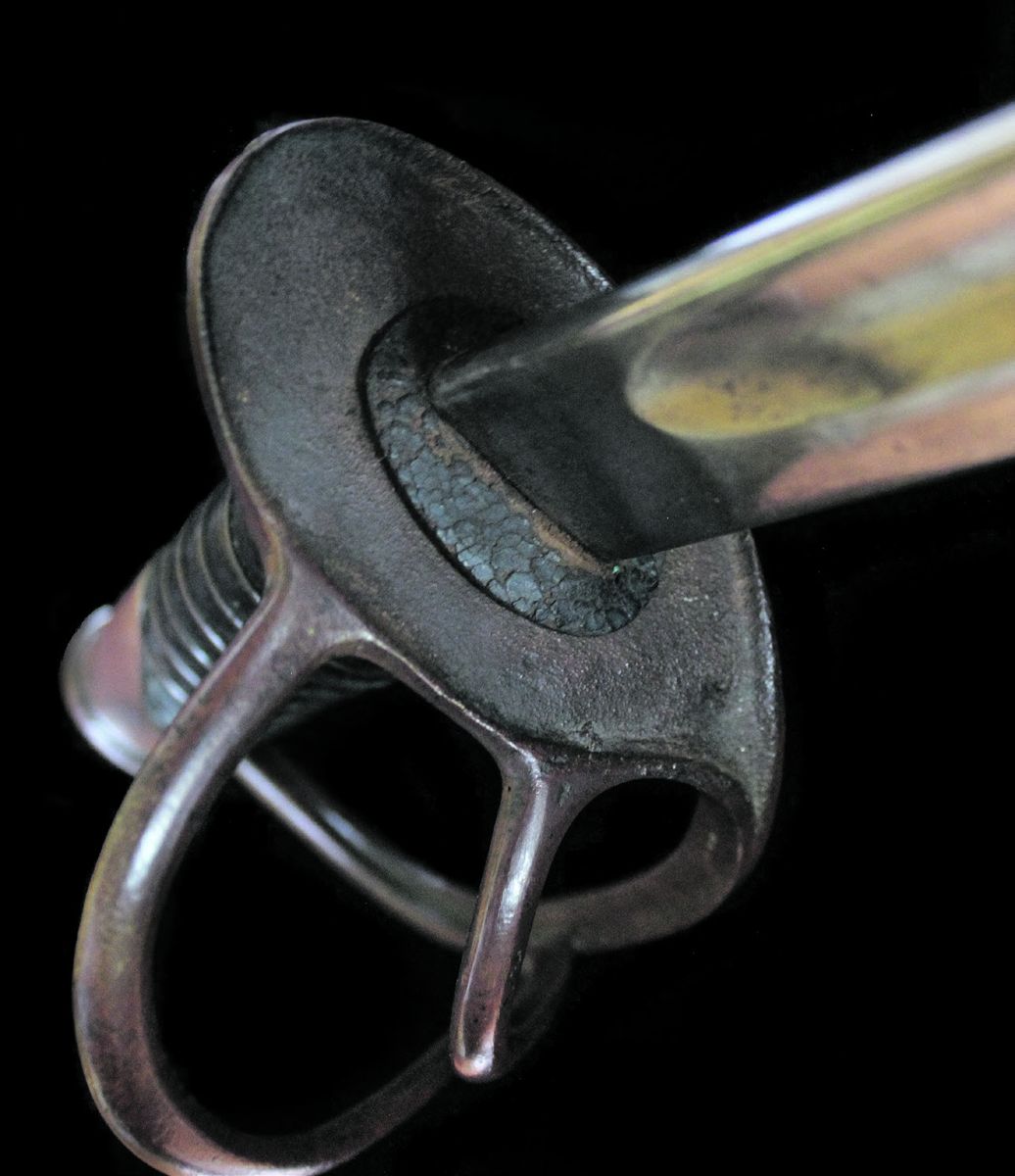
2nd North Carolina Cavalry KIA Identified Cavalry Sword
By Shannon Pritchard · Originally published November 2019 · pp. 18–19

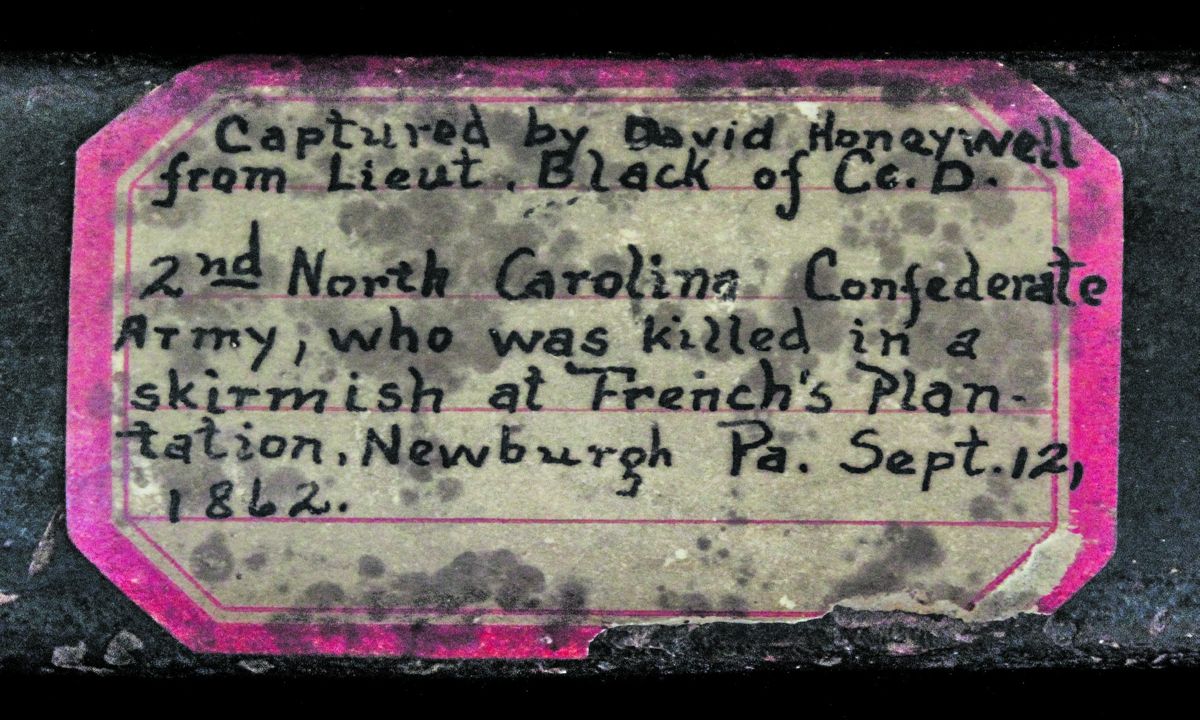
Label on the scabbard.
N.C., July 28, 1862, instead of Newburg, Penn., Sept 12, 1862. It is quite clear how this misinformation came to pass. The label is old, but there was once an older label or tag with the sword, and it had so faded that whoever put the second label on could not read it properly. However, the recorded events related to “Lieut. Black” and David Honeywell, leave no doubt as to its real history. The 2nd NC Cavalry had been picketing in the vicinity of Newbern throughout the spring of 1862 and had fought several engagements. At the time the regiment was poorly equipped. The North Carolina legislature had sent a request to North Carolina’s governor, that he send an envoy to determine the “deficiencies of said regiment in horses, arms and equipments” in February. As a result, on March 11, 1862, Governor Henry Clark wrote the Confederate Secretary of War that “We tried in vain to get swords or carbines. This regiment was received by you but partly armed (from necessity). They are without sabers, although we spared neither effort nor money. We did engage from the Eastvan & Froelich sword factory at Wilmington, and paid high prices, but three fourths of the swords proved worthless.” …. “If you can let them have sabers they will be useful.” The appeal had the desired result; the regiment was issued Boyle and Gamble enlisted cavalry swords, as witnessed by the new condition of Corporal Black’s saber. The Official Records have the
July & August muster roll for Co. B, 2nd NC Cav., which gives an account of Corporal Black’s death: “On the 28 July, 1862, a portion of the company thirty in number was engaged in a skirmish with a combined force of cavalry & infantry of the enemy in which one sergeant, one corporal & eight men with twenty horses were taken prisoners. Corporal R G Black died a few hours afterwards of wounds received in the action.” Amazingly the Official Records also contains a Yankee account of the engagement written by Charles D. Sanford, 27th Massachusetts: “Ascertaining from the residents that French’s, a notorious rebel nest, was only a mile and a half farther on, I immediately moved forward and came on the house very suddenly, it being almost entirely concealed by trees. Sending Company D to the right and the cavalry forward, we nearly surrounded the house. We expected to meet the entire rebel force in that section there, and I therefore ordered charge and a fire while charging, considering it the shortest manner of ending the affair. The whole was well executed and promptly by the men. They fired a volley through the windows and yard, the volley being the first intimation the rebels had of our presence. They ran quickly, but only 4 escaped, 1 of them being wounded in the leg. The prisoners were brought in from the swamp and placed under guard and the house searched. Nothing was found of any value but a few sabers, the rifles and pistols being mostly worthless and condemned. Some 20 good horses were captured, only 4
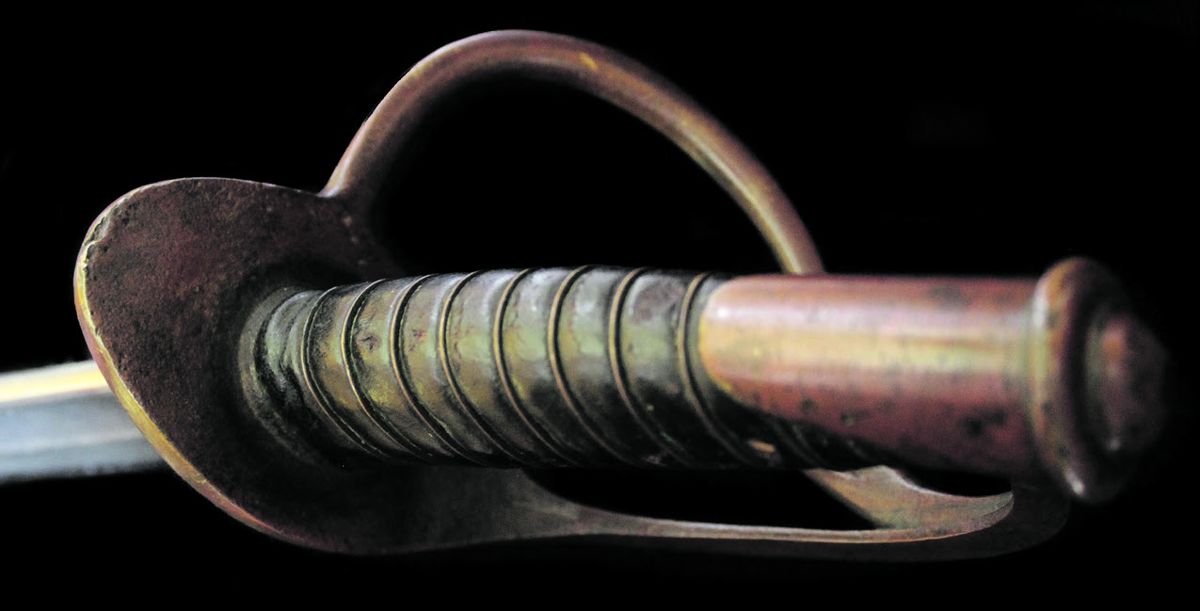
escaping. The wounded of the enemy were placed in a wagon and sent under charge of the cavalry to the railroad. … we took 10 prisoners, 1 dead man being unintentionally left behind unburied, and 1 dying (Corp. Grier Black, of Mecklenburg County, North Carolina) on the return home…The prisoners…had been at French’s some three weeks.” After his death, the 21-year-old Corporal Black`s body was interred in Iredell County’s Coddle Creek Church Cemetery. David Honeywell sent his captured sword to his own home in New York. Honeywell survived the War and afterwards he displayed it in the Union Veterans Union Hall, Washington, D.C., where he served as an officer. The sword’s brass guard has a leather covered grip, and is wound with a copper wire wrap, both of which are virtually intact. The grip and guard remain as tight as they were when new. The blade is in virtually new condition. The scabbard is crudely lapped and has a brass throat and ring mounts. The rings and drag are iron. The scabbard is also in nearly new condition and, with the exception of a few paint chips, the original paint is intact. Shannon Pritchard has authored numerous articles relating to the authentication, care and conservation of Confederate antiques, including several cover articles and is the author of the definitive work on Confederate collectibles, the widely acclaimed Collecting the Confederacy, Artifacts and Antiques from the War Between the States, and is co-author of Confederate Faces in Color.