
Federal City Brass Band Brings Added Dimension to Military Through the Ages
By Bob Ruegsegger · Originally published May 2019 · pp. 20–21
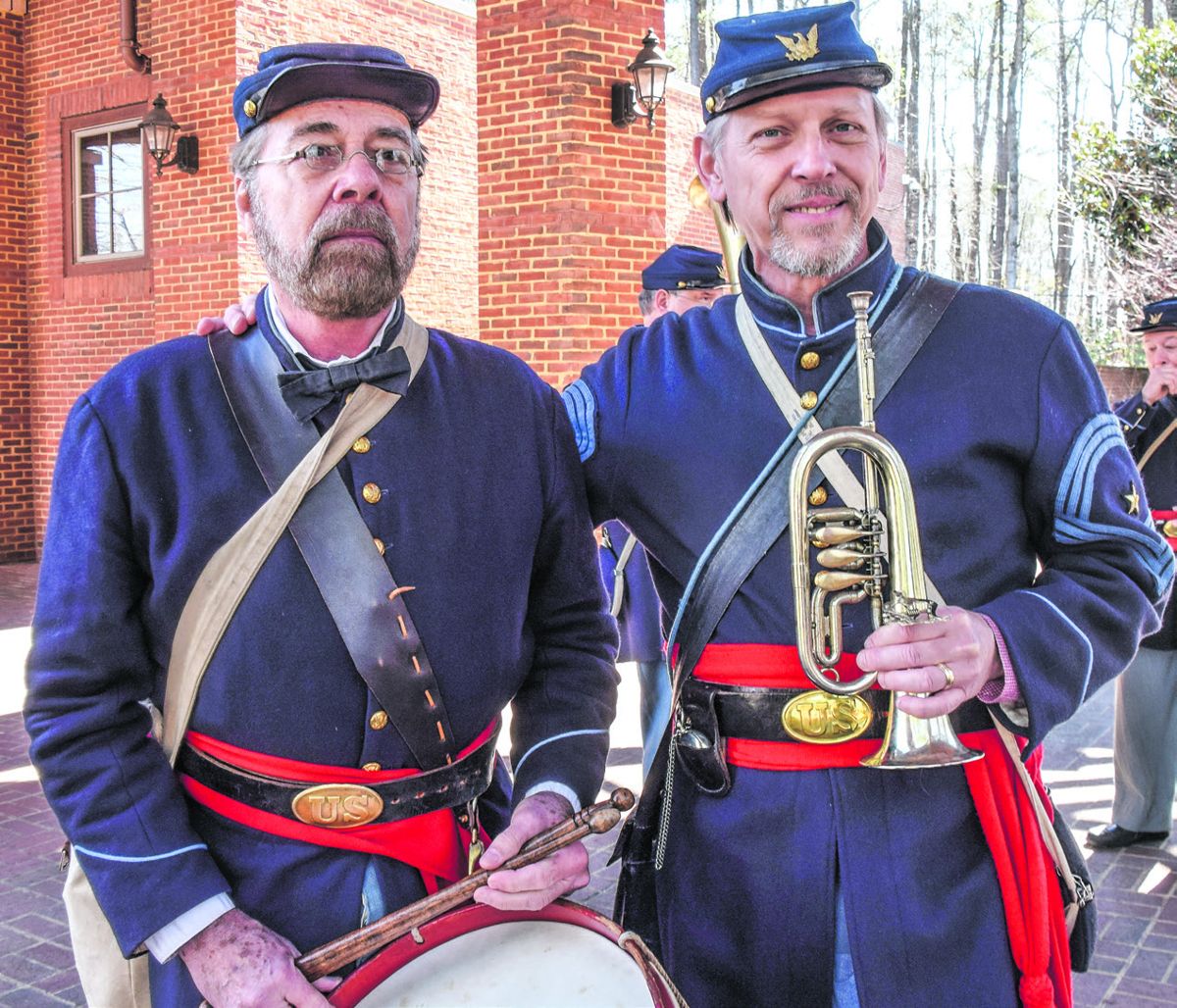
Music gives a soul to the universe, wings to the mind, flight to the imagination and life to everything. – Plato For decades visitors have flocked to Military Through the Ages at Jamestown Settlement for an opportunity to view military history in three dimensions. Living historians bring warriors from a plethora of time periods and places—Ancient Rome, 17th century Virginia, Civil War, and World War II—to life. The Federal City Brass Band, from its headquarters in Baltimore, brings a fourth dimension to the ever-popular annual event that is music, brass band music from the 19th century. The band represents what Civil War era bands looked like in three dimensions. More importantly, they duplicate, exactly, how mid19th century brass bands sounded in their heyday. It was a time when nearly every town had some sort of brass band according to Jari Villanueva, the principal musician of the Federal City Brass Band. When the Civil War broke out, the town bands joined the volunteer regiments and marched off to war with them. “What we do is recreate what a band sounded like back then, what they looked like,” said Villanueva. “We have instruments that are all original, the actual instruments from that time period,” he noted. “We have found them and had them restored. We also are dressed in correct period uniforms.” The Federal City Brass Band dresses in blue uniforms. When they recreate the 26th North Carolina Regimental Band that served with the 26th North Carolina Infantry from April 1862 through the war’s end, they play the same original instruments and wear gray uniforms. This is what we love to do when we get together,” said Villanueva. “We just love to perform this music.” Apparently visitors, staff members, and living historians at Jamestown Settlement love to hear the performances as the band marches through the site and stops at selected period encampments for informal serenades. The brass band music transports listeners back to the mid-19th century. “It is a great honor to come down and play for Jamestown Settlement,” said Villanueva. “For Jamestown Settlement to ask us to come down here is a real joy. It’s so great to be able to play this music and hear what history sounds like.” Lee Turner, a retired middle school band director and professional trumpet player, is a musician with the Excelsior Coronet Band in Syracuse, N.Y. “We play on original instruments, and we come down here and play, augmenting Jari’s Federal City Brass Band,” said Turner. “I’ve been doing that for 15 years.” Turner was never a “real history buff” when he was in high school, but playing period music on original instruments has changed that. He started delving into the history of the instruments and how they were built. Turner became interested in learning more about what the actual purpose of a band was during the era. He has also started collecting antique instruments and begun to really appreciate how the music sounds when played on the original instruments. “These instruments are quite a bit quieter than modern brass instruments and they have just such an interesting blend,” said Turner. “They’re a lot less harsh than a modern trumpet or coronet. They are mostly conical bore and they don’t carry as well.” Turner plays a vintage Schuster side-action, rotary valve, b-flat coronet in high pitch made between 1865 and 1870. It is, according to Turner, almost a halfstep higher than the modern pitch. Pitch is a big issue so Turner and his bandmates have to listen and figure out who’s going to play sharp and who’s going to play flat to blend with the group. The music of the times appeals to Turner. He likes the harmonies and the simplicity of the music. “It’s also the era of Stephen Foster. It’s the bridge between opera and popular song. It’s actually the beginning of the modern era of pop music,” he observed. “We play a lot of tunes that soldiers would have known. Opera arias are so tragic that they’re made into a quick step so that they could march to them,” he said. “The soldiers knew the tunes and they became popular tunes of the day, so I like that.” Garman Bowers Jr. of Hagerstown, Md., has been a drummer with the Federal City
Jari Villanueva is the founder and principal musician of the Federal City Brass Band. (All photos Bob Ruegsegger)
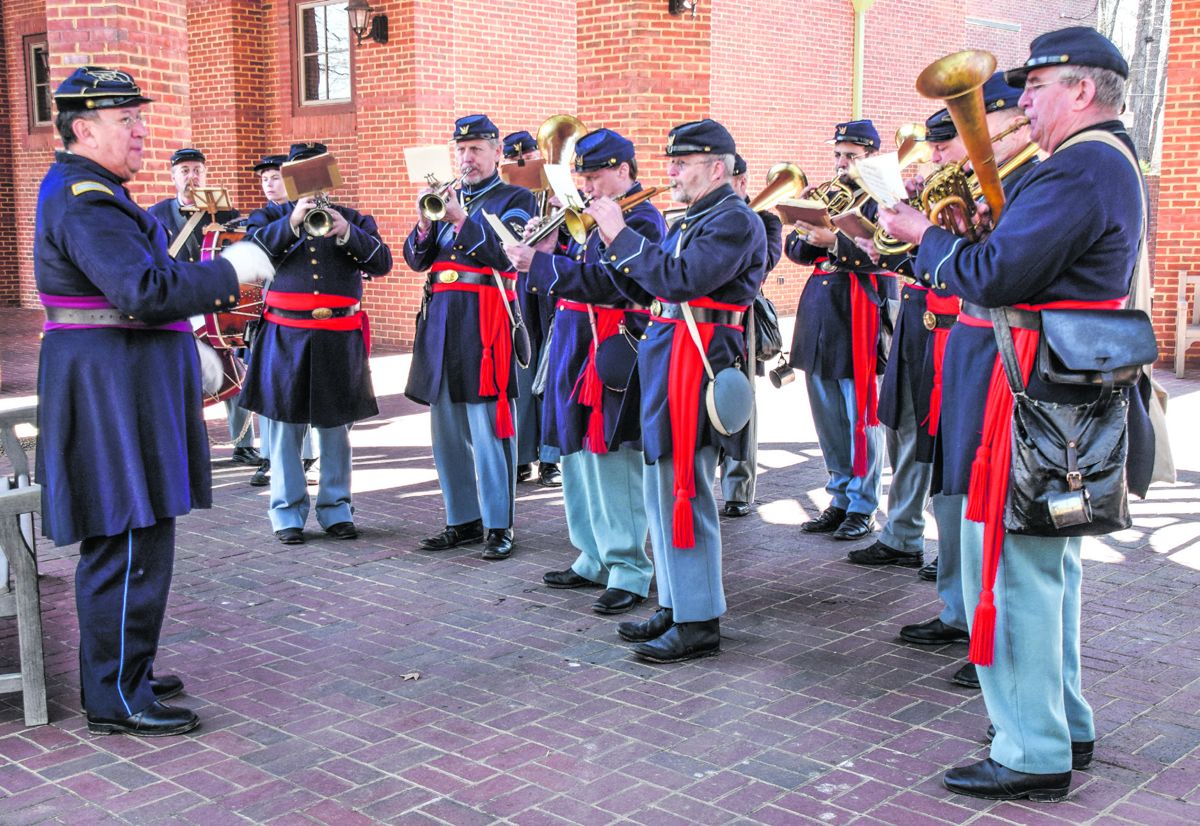
Lee Turner is a retired band director and professional trumpet player. He lives in Marcellus, N.Y.
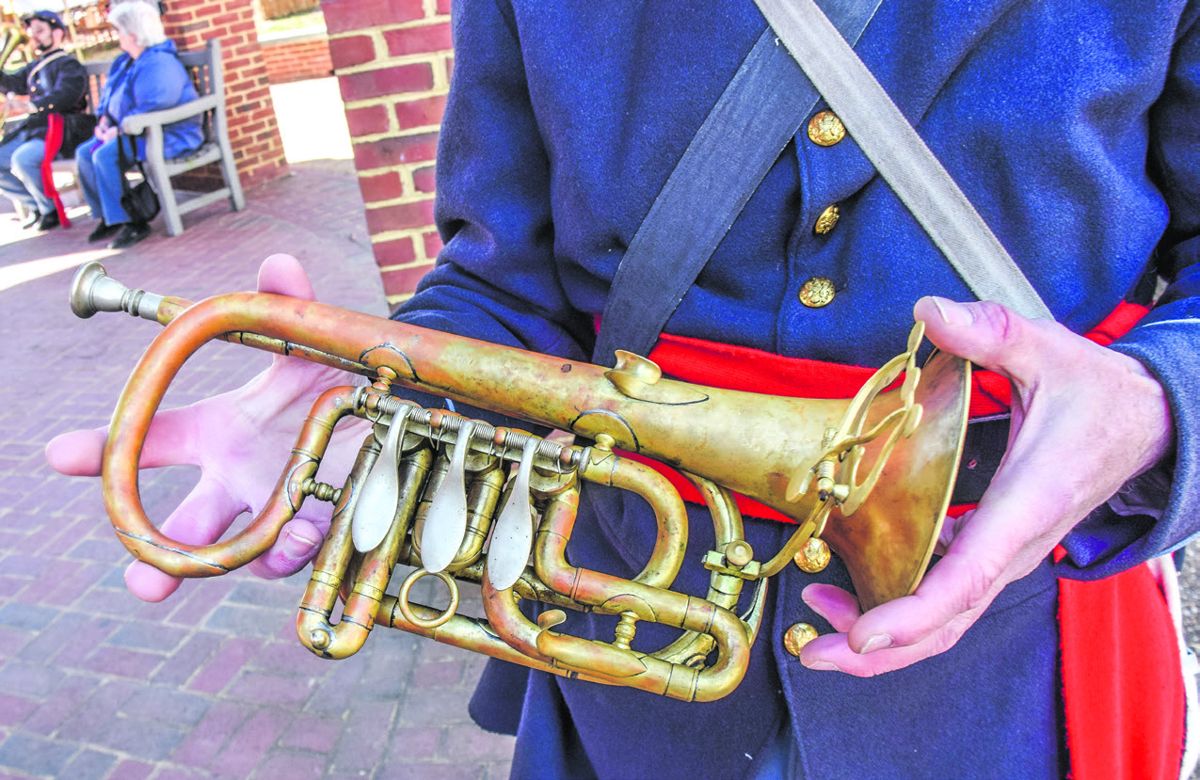
Jeff Stockham is the founder of the Excelsior Coronet Band in Syracuse, N.Y. He outfits his band members with antique instruments. Brass Band since 2002. He is also a retired band director. Bowers plays an 1832 Meacham and Pond drum. “I just liked music and got the opportunity to play with these guys,” said Bowers. “They’re top-notch musicians, and we play on original instruments.” In 2001, Jeff Stockham of Syracuse, N.Y., formed the Excelsior Coronet Band. He and the band have been performing ever since. He also plays with the
Federal City Brass Band. Civil War era brass bands appeal to Stockham for a number of reasons. He’s a collector of antique instruments who outfits his entire band with vintage instruments. Sometimes he also provides the musicians in the Federal City Brass Band with original instruments. “The appeal for me is getting these instruments into the hands of players so that they make the same sound our forefathers heard 160 years ago,” said Stockham. “It’s the closest thing that you can get to time travel, putting life through these instruments that would otherwise be artifacts sitting silently in museums.” The other part of the Civil War era’s appeal for Stockham is that he’s able to play great music that has almost been forgotten. “There are so many popular tunes, minstrel tunes, operatic transcriptions, marches, and patriotic songs,” said Stockham. “It’s all great literature. It was a wonderful time in American history for popular music,” he said. “The brass bands were the most popular means of hearing music in the 19th century for most people.” Bob Ruegsegger is an American by birth and a Virginian. His assignments frequently take him to historic sites throughout Virginia, the Mid-Atlantic, and the Southeast. His favorite haunts include sites within Virginia’s Historic Triangle—Jamestown, Yorktown, and Williamsburg. Bob served briefly in the U.S. Navy. He is a retired educator and has been an active newspaper journalist for the last twenty years.