
Book Reviews
Book Reviews — May 2019
Originally published May 2019 · pp. 36–42
Civil War News book reviews provide our readers with timely analysis of the latest and most significant Civil War research and scholarship. Contact Stephen Davis, Civil War News Book Review Editor. Email: [email protected].
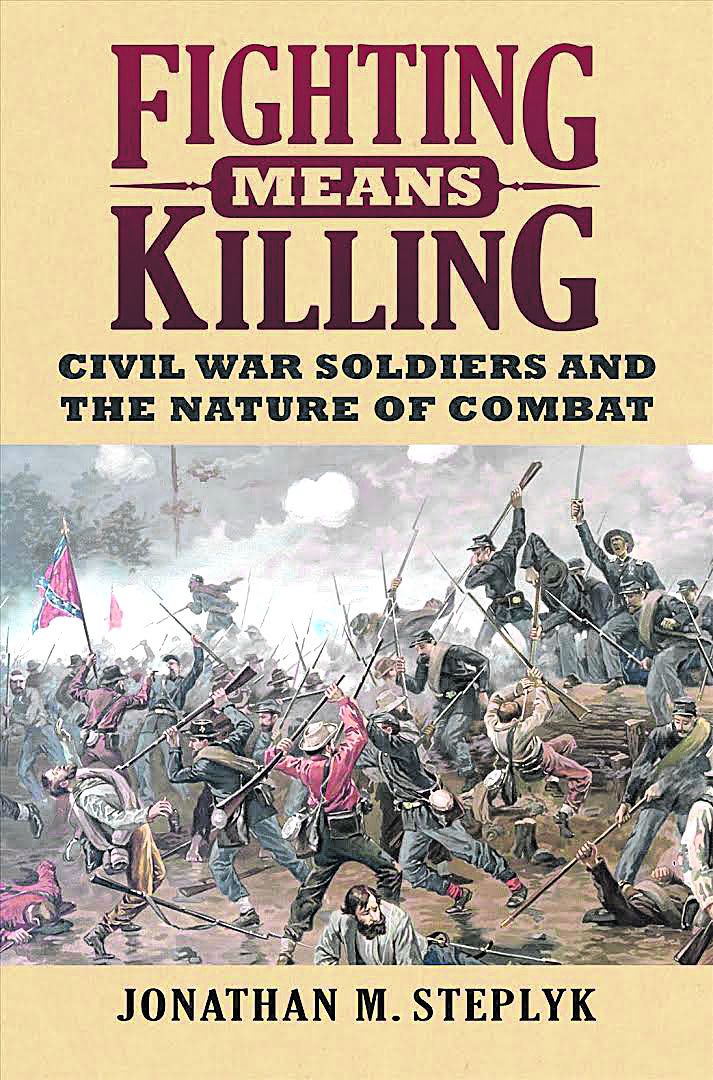
The Experience of Killing Your Enemy Fighting Means Killing: Civil War Soldiers and the Nature of Combat. By Jonathan M. Steplyk. Maps, photos, notes, index, 294 pp., 2018. University Press of Kansas, www.kansaspress.ku.edu. $29.95. Reviewed by Brian S. Wills
Fighting in the American Civil War presented participants with unusual dilemmas as they faced fellow citizens and confronted the imperative of killing them in combat. Even with the admonition of the sixth commandment not to kill, from the earliest days, Jonathan M. Steplyk has asserted in his volume, men went into battle without exhibiting inhibitions about taking the lives of the foes they encountered. Fighting Means Killing explores the numerous ways in which these soldiers answered the lethal call of their respective countries. The author opens his study with an examination of the influences that shaped the men who would go into combat from the first instances of bloodshed—“seeing the elephant”—to the range and variety of the ways in which they subsequently experienced killing their adversaries on the battlefield. The author expresses his intention to “document the spectrum of these attitudes and experiences.” As may be expected, this often lends itself more to speculation on the motivations of the participants. Some men surely carried doubt or remorse, while others embraced their roles with a sense of duty, if not outright enthusiasm. Steplyk has done a great service to Civil War scholarship, but his focus suffers when a chapter strays, as the first one does from prewar influences to numerous examples from a conflict that has yet to happen. The zest to say something analytical also leads to interesting interpretations, such as when the author tries to assess and explain the terminology a Union officer at Gettysburg employed for firing blindly at the Confederates and hoping that he had managed to hit one “by accident.” A few contradictory and perplexing elements exist, such as the assertion, “I was unable to find a soldier who explicitly admitted that in the heat of battle he deliberately tried not to kill,” after presenting two specific examples of that precise phenomenon. Likewise, death threats toward Confederate president Jefferson Davis do not include the Dahlgren-Kilpatrick Raid in the discussion, despite the high profile nature of that event at the time and since. Perhaps the most troubling aspect of the volume is the degree to which the analysis enters a different phase of emphasis in the final chapters. Here, Union men occasionally transcend the lines of acceptability in their conduct, while Confederates become systematic offenders. Indiscriminate destruction in the Shenandoah Valley, Georgia and the Carolinas, according to the author, is acceptable military practice that later “Lost Cause” adherents exaggerate, while apparently large numbers of Confederates hunt down and slay foragers and other Union transgressors in “grossly disproportionate acts of violence.” The assertion, “Robert E. Lee allowed his Army of Northern Virginia to forage aggressively during his 1862 and 1863 invasions of the North” seems to appear as mitigation for the later actions elsewhere of Philip Sheridan and William T. Sherman. To be sure, some soldiers (and civilians) crossed lines of propriety, but it is not clear that most participants on either side engaged in such extraordinary conduct. The author would certainly have been better served to avoid making unfortunate comparison of individual (albeit heinous) acts in the South with orders from Hitler’s Nazi regime in the Second World War relating to the resistance movement. Interestingly, Steplyk’s excellent discussion of shooting at broken and fleeing opponents at Franklin, Tennessee, apparently does not fit the circumstances at Fort Pillow, where “one” is encouraged to “imagine” what Nathan Bedford Forrest was capable of doing by “either presiding over or allowing the massacre.” These important caveats aside, the author succeeds in presenting the myriad cases of such matters in the bitter and protracted struggle of 1861–1865. Jonathan Steplyk has taken us into the mindsets of the individuals who faced the enormous challenges of killing their opponents. He has often done so with compelling arguments that contribute to our understanding of the conflict. It should not be surprising that so many accepted the roles that war assigned to them, even if it is difficult for those who have never had that circumstance thrust upon them to comprehend why they did. Brian Steel Wills is the Director of the Center for the Study of the Civil War Era and Professor of History at Kennesaw State University. He is the author of biographies of Nathan Bedford Forrest, George Henry Thomas and William Dorsey Pender, as well as studies of noncombat deaths in the Civil War, the controversial engagement at Fort Pillow, and the impact of the war on soldiers and civilians in southeastern Virginia.
Heroes of Chickamauga: The 22nd Michigan Infantry The 22nd Michigan Infantry and the Road to Chickamauga. By John Cohassey. Photos, chapter notes, bibliography, index, 192 pp., 2019. McFarland & Company, www.mcfarlandpub.com. $35 softcover. Reviewed by Robert L. Durham
John Cohassey has written an exceptional history of the 22nd Michigan Infantry. This regiment spent its early service chasing Confederates around Kentucky and was eventually stationed in Nashville, Tennessee, to guard the city. Then, on September 20, 1863, they got their first taste of battle at Chickamauga, Georgia. The 22nd was in reserve, under Brig. Gen. Gordon Granger. Granger, without orders, marched to the sound of the guns and reinforced Maj. Gen. George Thomas on Horseshoe Ridge. After the main army, even that part under General Thomas, retreated, the 22nd Michigan, along with the 21st and 89th Ohio, were left behind and made a courageous stand, holding back the Rebels, buying time for Thomas to make a safe retreat. The three regiments were surrounded and most of the men were captured. The 22nd suffered over 50% casualties. Many ended up incarcerated in several of the South’s POW camps. Those not captured retreated to Chattanooga. Reorganized after the battle, they were designated as engineers. They did a lot to open the “Cracker Line” and built several pontoon bridges that were effective in helping Maj. Gen. Ulysses S. Grant’s efforts to break out of the Confederate siege of Chattanooga. The 22nd was then reorganized and assigned to Thomas’ Army of the Cumberland for the Atlanta campaign. Through most of the campaign, they were assigned as Provost Guards at General Thomas’ headquarters, but they took part in all the army’s marches. They were also subjected to artillery bombardments from the enemy entrenchments. After the capture of Atlanta, they returned to Chattanooga, where they were when they heard of General Robert E. Lee’s surrender. The jubilation was cut short when they got word of the assassination of Abraham Lincoln. There was a mass dress parade on June 20, 1865 and then they were sent to Nashville, where they were mustered out. Despite its steep price, I recommend this book to those who are interested in regimental histories, especially in Michigan regiments, or the Civil War in the West. It is well written and well researched. Robert L. Durham has been a devoted history buff for many years and is finally getting a history degree. Bob has written articles in various historical magazines and internet blogs, including CWN. He is retired from almost 40 years of service with the Defense Logistics Agency, where one of his roles was to install communications systems all over the world. Unfortunately, not many of the countries he visited are popular tourist destinations.
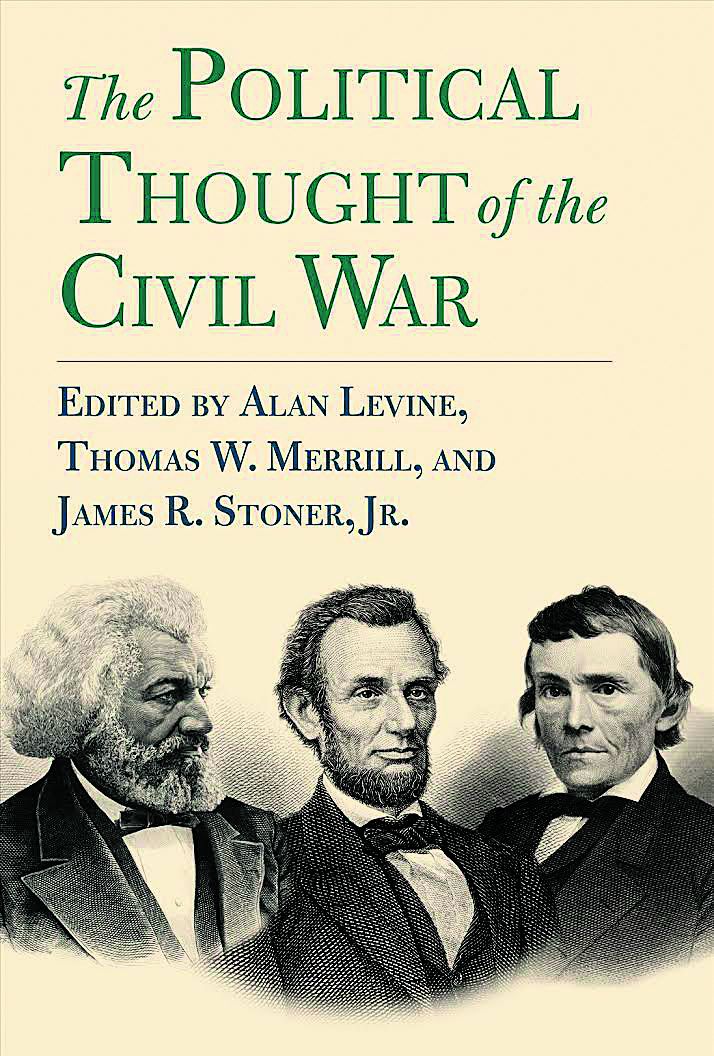
The editors of this volume all share a common perspective on the political theories that shaped America from the Declaration of Independence to Reconstruction. They are all dismissive of Southern culture which embraced slavery. Yet they, as Abraham Lincoln, see the federal government as authoritarian and sovereign as opposed to the Southern humanistic, locally-based regional government that espoused local values. They hold that Jefferson’s dictum that all men are created equal trumps his statement that citizens have a right to revolt when they feel their culture is at stake. Any attempt to understand antebellum Southern fears of cultural loss is racist and therefore devoid of understanding. By blaming Southern cultural perspectives for the Civil War, all Southern justification based on economic, social or cultural localisms is dismissed. Thus, three questions are central to all of the included essays. What was the place of slavery in antebellum America? How did the ambiguity over slavery cause tension between substantive morality and procedural Constitutionalism? And finally, are the principles of the American experience adequate to the challenges of developing a postwar multicultural and multiracial society? While each of these questions is explored in one or more of the essays, they ignore how Americans today, with our growing political polarization and mistrust of each other, are reflections of the attitudes that drove the North and South to war in 1861. Will the inability of antebellum America to forge a consensus on slavery and its expansion mirror today’s inability to bridge the increasingly partisan debate over immigration, racial equality and state rights? Are these merely the same ambiguous issues, cast in a slightly different format, that tore the country apart before? Answers to these profound questions are not addressed and present a major weakness. The story of regional differences over slavery has been told in countless tomes, and without present day applicability provides little new evidence to understand the impending crisis. Despite this criticism, two
Miller’s Millinery Lynnette R. Miller, proprietress www.bonnets.com Bonnets, Caps & Accessories Constructed with period techniques Available for programs & workshops Serving Living Historians since 1990
essays are highly recommended for their use of primary source material and their exploration of both sides of an issue. Chapter 7 (Why Did Lincoln Go to War?) by Steven Smith addresses Lincoln’s misjudgment of the will of the South to wage war and Lincoln’s mistaken belief that ordinary Southerners would rally to the Union cause. The essay also catalogues Southerners’ belief that Lincoln was a genuine threat to the South’s economy and its social and cultural way of life. Lincoln had always been a gradual abolitionist and therefore a threat to Southern identity. Additionally, Lincoln believed the Union was permanent and rejected Jefferson’s view that governments which no longer served the ends of the people should be replaced. The South felt they were merely altering government to preserve original intent. Lincoln felt otherwise and decided war was the solution. The second recommended essay, by James R. Stoner on the Confederate Constitution, provides a well-researched effort to answer the question: was the South’s constitution the true successor to the original document, correcting its faults and restoring original intent? Ample evidence is presented on both sides of this question and is a must-read for political scientists. While students of the Civil War might find a new tidbit of information here and there, the overall aim of a better understanding of antebellum and Reconstruction political thought adds little new evidence to existing knowledge. Additionally, Southern conservatives are delegitimized as mere apologists for the Lost Cause. State Rights, local government control, and the acceptance of regional cultural differences and historical value systems are portrayed as undesirable remnants which should be thrown into the dustbin of history. Lessons which might help America today provide true equality, solve partisanship, agree on the meaning of the Constitution and respect cultural differences would have been a great addition to this volume. Wayne L. Wolf is Professor Emeritus from South Suburban College in Illinois and the author or editor of twenty-four books on the Civil War. He is past President of the Lincoln-Davis Civil War Roundtable and is currently seeking new primary source material to tell the story of the common soldier in the Civil War.
The Tale of an Amputee In Memory of Self and Comrades: Thomas Wallace Colley’s Recollections of Civil War Service in the 1st Virginia Cavalry. Edited by Michael K. Shaffer. Maps, illustrations, notes, bibliography, index, 277 pp., 2018.University of Tennessee Press, www.utpress.org. $47 hardback. Reviewed by Bruce H. Stewart Jr. In the submission of casualty reports, officers on both the Union and Confederate sides wrote in identical fashion, tabulating those killed, wounded, captured and missing. Absent were any attempts to quantify amputation, disability, or the wide variety of ailments which for many participants lingered long after the conflict had ended. Diaries were a common means of recording life at the front. In a sense, they represent a single genre of Civil War literature. However, as they came from different soldiers, each diary offers a unique perspective of a tragic American experience. With In Memory of Self and Comrades, editor Michael Shaffer has brought to light the problems faced by the curse of amputation as so many soldiers tried to work their way back into the mainstream of society. It has been estimated that some 20,000 limbs were lost during the four-year struggle. The diary of Thomas Colley, a member of the 1st Virginia Cavalry, recalls the career of one man who volunteered in order to defend his state. His service cost him his left foot, and this is his story. Early in the war the cavalry arm of the South was clearly superior to that of the North. During this time Colley’s diary conveys the innocent feelings of initial enthusiasm, but then the mood changes as the casualties mounted in 1862. His war record was relatively uneventful until March 17, 1863, when he sustained a serious abdominal wound at the battle of Kelly’s Ford. After an extended convalescence he returned to the 1st Virginia. On May 28, 1864 he took part in the battle of Haw’s Shop, where he lost his foot. The account is of particular interest as this is the first time he goes into great detail concerning an actual battle. He gives a graphic description of the amputation, but despite an extraordinarily poor procedure, he harbored no animosity toward the surgeons. He showed both compassion and forgiveness, citing the conditions under which they worked. Like so many other men, North and South, he continued to feel the effects of his wound and treatment, resulting in pain for the next seven years. In July 1864 he began his journey home. Colley’s postwar narrative continues from 1866 through a variety of occupations. The following decade was filled with sorrow for him. With a serious illness in 1870 he lost over sixty pounds, and only a few years later he witnessed the death of two small daughters. As the diary closes, he recounts a series of failed business ventures, moving from Virginia to West Virginia to South Carolina. He finally found success with minor political victories, but saw two more children succumb to disease. Throughout the book, and emphasized toward the end of his life, is his devotion to religion. His beliefs seemed to provide a sense of calm as he endured a repetition of both personal and financial setbacks. Dr. Shaffer has organized Colley’s diary entries into a book which is easy and quite smooth to read. An extremely valuable addition is the inclusion of the appendices. They provide the entire regimental roster and unit history, as well as Colley’s recollection of his wounding at Kelly’s Ford, written in 1887. Perhaps the most interesting is the collection of his wartime letters. Their presentation exposes the man, the home and the war, and is a fitting end to his life’s journey. Bruce H. Stewart Jr. served as the president of the Civil War Round Table of Atlanta in 2009, with a particular interest in the western theater. His book Invisible Hero Patrick R. Cleburne was published in 2009 by Mercer University Press.
With the long-awaited demise of the Lost Cause finally upon us, it is the job of historians to decipher just why and how it occurred in the first place. Diane Miller Sommerville’s book, Aberration of Mind, helps to make the picture a little clearer. An associate professor of history at Binghamton University, Sommerville has also written Rape and Race in the Nineteenth-Century South. She places her subject directly in the middle of an America that did not approve of suicide, seeing the person who committed the act as having committed a sin so terrible that forgiveness was outside the bounds of the possible. And yet the hidebound definition of “The Good Death” was being challenged at the same time. Things were not what they had been. Sommerville’s book is divided into three parts: Confederate Men and Women during the Civil War, African American Southerners in Slavery and Freedom, and Confederate Men and Women in the Aftermath of War. Suicide was not common prior to the war, but it did exist. Violence was much more common in the South, and white men were raised believing that mastery and control were their birthright. During the war, most Southern men left their homes and joined the war effort. There they faced daily challenges such as homesickness, boredom, a lack of privacy, exposure to the elements, illness and malnutrition. During battle they faced the need to prove their manhood in combat and after the battle, many faced injury and death—their own and the deaths of friends and relatives. Would they be able to live up to expectations, or would they tremble in fear, run away or become innervated during their trials? Nineteenth century Southern masculinity was demanding, and a surprising number of men who failed to live up to these ideals chose voluntary death rather than risk wearing the label of coward or failure. Even after the war, when many men returned home disabled in body and/or mind, suicide seemed a viable alternative to living as broken men, unable to provide for a family in a desolated land that no longer seemed like home. They often saw no future at all for themselves and chose suicide rather than live with failure. Women were equally cast adrift. Bred to believe that their lives were controlled by men, and in exchange for this control they would always be safe and happy, the war came as a shock to everything they knew. Several—one hesitates to say many—women in the Confederacy were unable to cope with what was their new normal and took their own lives. Compared to the total population of the South, suicides were not a significant percentage, but there were enough for some newspapers to refer to a “suicide epidemic.” The issue of suicide among the enslaved population had an added wrinkle. According to Southerners, slaves did not commit suicide because they were all so happy; besides, if they did, that would indicate that slaves had heartfelt feelings, just like “real people.” Suicide simply did not fit into the image of slavery held by many slaveholding Southerners. Reality, of course, was quite different. Enslaved people who killed themselves did so to put an end to personal abuse, and over unbearable situations of family dislocation. Each of these situations is amply illustrated by newspaper articles, letters, and diary entries, and accompanied by intelligent discourse. The
Digital Issues of CWN are available by subscription alone or with print plus CWN archives at
Digital Issues of CWN are available by subscription alone or with print plus CWN archives from 2012 at CivilWarNews.com
CivilWarNews.com author’s command of these compelling topics is quite deep. Aberration of the Mind is sad, and the information about the suicides of enslaved people is very troubling. Overall, the sadness and desperation of a conquered people is presented clearly. This book brought me as close as anything has ever done to understanding the need for the creation of Lost Cause mythology. I was particularly struck by the topic itself. I had recently read Julian Carr’s speech given at the June 2, 1913 dedication of the Confederate monument known as “Silent Sam.” It is an ode to the Lost Cause, and specifically mentions the soldiers and home front of the Confederacy: No nobler young men ever lived; no braver soldiers ever answered the bugle call nor marched under a battle flag and the war between the states was fought, really, by the women who stayed at home. Had they uttered a cry, had they complained, the morale of Lee’s army would have been dissipated in a day. This sort of attitude led many of those same white men and women to commit suicide, knowing they could not live up to the impossible standards elucidated by Mr. Carr. Rarely do I have much empathy for the South, but Aberration of Mind certainly caused me to consider the plight of those men and women who lost a war and still had to continue forward. For some Southerners, this was simply not possible. They chose death rather than a life of dishonor, often poverty, and confusion. Diane Miller Sommerville’s words and work make the Confederacy and her people as real as they have ever been for me, and often losing a war is more difficult than winning one when the human heart is factored in. This book is a serious step forward in the effort to understand the provenance of the Lost Cause. Meg Groeling received her Master’s Degree in Military History, with a Civil War emphasis, in 2016 from American Public University. Savas Beatie published her first book, The Aftermath of Battle: The Burial of the Civil War Dead, in the fall of 2015, and she has written First Fallen: The Life of Colonel Elmer Ellsworth, which Southern Illinois University Press has contracted for publication sometime within the next two years. She is a regular contributor to the blog Emerging Civil War.
Reviewed by Joseph Truglio
The first thing that came to mind as I started reading this book is the similarity in style to Jim Bishop’s The Day Lincoln Was Shot, written decades ago. However, all that faded as I became engulfed in this unique narrative. The story begins on the day of Lincoln’s second inaugural and ends on the day of his death. An epilogue gives insight into the mood of the nation and what transpires under the presidency of Andrew Johnson. Each of the forty-three days covered is detailed in separate chapters. Some are only a page or two, while others consist of several to many pages. The length is determined by events of the day. Each chapter contains several nuggets of information not ordinarily seen. For example, “March 17” discusses Lincoln’s use of the “f” word in a discussion. This is the first time I ever read of this so boldly. Another chapter describes the first attempt at assassination. A more detailed account is of the trip to City Point and the happenings during that voyage. We are given insight into Lincoln’s mindset about the war and its aftermath. Also described in detail are the president’s dismay over Mary Todd’s emotional meltdown. Much of her mercurial personality is discussed, along with her relationships with others aboard the ship, the River Queen. Perhaps the most telling aspect concerns Lincoln’s “death dream.” The author talks freely of his dismay in the days before his assassination concerning this dream, and his resignation to this fate. There is much more! Perhaps the most interesting tale is of an incident at City Point, Va. of a possible attempt on his life by John Surratt. Johnson makes a valiant effort to place you inside Lincoln’s thought process through these difficult times. Another fine point is Lincoln’s discussion with General Grant on reconstruction and his position of “letting them up easy.” Overall, this is a fascinating look at the last days of Lincoln’s life. This effort is another welcome addition to the plethora of works on Lincoln and the Civil War. I heartily recommend that you add this one to your library. Joseph Truglio, of Manchester, N.J., is a past president of the Phil Kearny Civil War Round Table.
Thanks to his copious research, Peter G. Tsouras has produced a study that should motivate a reexamination of scholarship about combat in Pennsylvania, Maryland, and Virginia from 1863 to 1865 during the Civil War. His exhaustive biography of George H. Sharpe enhances our knowledge of the Bureau of Military Information (BMI), the intelligence staff of the Army of the Potomac and later an integral part of Lt. Gen. Ulysses S. Grant’s army command headquarters. In early 1863, Maj. Gen. Joseph Hooker selected Col. George H. Sharpe, commander of the 120th New York Regiment, to organize an intelligence staff. Given Sharpe’s temperament and background as a lawyer in civilian life, this was a wise choice. Sharpe assembled a group of scouts and analysts who gathered information from a variety of sources and produced timely and accurate reports about the enemy.
When Maj. Gen. George G. Meade replaced Hooker as army commander in June 1863, the BMI continued to produce intelligence that contributed essential information facilitating Meade’s victory over Gen. Robert E. Lee’s Army of Northern Virginia at Gettysburg. Subsequently, Meade chose to downgrade the role of Sharpe and the BMI as intelligence providers, and ill-advisedly decided to serve as his own intelligence chief. This was a mistake that led to the strategic and tactical advantage shifting in favor of Lee’s army. The troubled relationship between Meade and the BMI led newly appointed General-inChief Lt. Gen. Ulysses S. Grant to reassign Sharpe to his staff as chief of intelligence for the Union armies arrayed against Richmond. Unshackled from Meade’s restraints, Sharpe developed an intelligence-gathering network that fed a steady stream of vital information about Lee’s army to Grant that helped him plan and implement effective offensive and defensive operations. The story is told in detail from the perspective of daring individuals involved in the collection of information about the strength, disposition, and intentions of Confederate forces—often while operating behind enemy lines in the guise of Southern patriots or combatants. It was Col. Sharpe, however, who recruited, organized, directed, and rewarded these stalwart individuals. Together they collected information that allowed Grant to outmaneuver Lee—despite the fact that Lee was also adept at employing agents to gather information and track enemy movements. Sharpe played an integral role in providing Union army commanders with the intelligence to make sound decisions on the battlefield from Chancellorsville to Petersburg and, eventually, to Appomattox. Yet Hooker, Meade and Grant, to their detriment, did not always use this information wisely. Although this story has been told in part by Edwin C. Fishel in The Secret War for the Union: The Untold Story of Military Intelligence in the Civil War (1996) and by William B. Feis’s Grant’s Secret Service: The Intelligence War from Belmont to Appomattox (2005), Peter Tsouras has unearthed numerous primary sources that should lead to a reassessment of current studies regarding the Overland Campaign and the battles in the east that led to the end of the war. Thus the author brings George H. Sharpe out of the shadows, and credits him with playing a pivotal role in Union success on the battlefield. He underscores the contention Sharpe was a significant contributor to the Northern victory over Southern forces by highlighting his postwar life as a productive citizen, especially in political circles at the state and national level. Sharpe’s admiration for Grant was mutual, and they remained friends and colleagues in later years. Sharpe’s attachment to his wartime regiment, the 120th New York, was also heartfelt, and he was in demand as a speaker for Civil War veteran organizations, as well as civic groups. Tsouras makes a case that the North was unlikely to have been victorious without the BMIproduced intelligence over the final two years of the war. The author is to be commended for documenting the life of George H. Sharpe, and his special talent for producing actionable intelligence that had a direct effect on the outcome of the Civil War. Thomas J. Ryan is the author of Spies, Scouts, and Secrets in the Gettysburg Campaign: How the Critical Role of Intelligence Impacted the Outcome of Lee’s Invasion of the North, June-July 1863.
The Story of a Proud Virginia Regiment Independence or Annihilation, “The Gallant Sixtieth”: Campaigns of the 60th Virginia Regiment of Infantry. By William L. Caynor, Sr. Maps, photos, footnotes, sources. Two volumes: Vol. I, 447 pages; Vol. II, 500 pages, 2018. Civil War Collectibles LLC. www.60thvirginiainfantryregiment.com. $35 per vol. hardcover; $25 per vol. softcover. Reviewed by H. V. Traywick, Jr.
This is a two-volume expansion of a previous one-volume work on this Virginia regiment (2016; reviewed in Civil War News, May 2017). The author is a descendant of several members of the 60th, including the last commander to lead it in battle. Far more than a recitation of the regiment’s campaigns, Volume I is a living document that opens a portal into its times, and introduces the reader to various members of the unit, while integrating them, with interesting personal vignettes, into the broader narrative of events prior to, during and after the war. Volume II includes detailed biographies, photos, and statistical information on the members of the command. The 60th Virginia was comprised of men from the counties that now lie on either side of the Virginia – West Virginia border. As such, they faced in battle some of their neighbors and kinsmen who served in Union units from West Virginia, making for them a war that was truly “brother against brother.” The regiment served throughout the war, including the first campaign in the western Virginia mountains in 1861, the bloody Seven Days Battles around Richmond in 1862, and Jubal
Early’s Valley Campaign of 1864. In February of the last disastrous winter of the Confederacy—with the Valley burned by Sheridan, with Lee’s starving but defiant army under siege at Petersburg, and with Sherman’s army burning and raping its way up from Georgia through the Carolinas— the spirit of the 60th Virginia remained undaunted. In “A Message from the Army of the Valley of Virginia,” they unanimously adopted resolutions that justify the title of these volumes. In Article I they resolved: “That in the beginning of this revolution we volunteered in response to the first call of our country to battle for the sovereign right of self-government, and that, after four years of terrible war with the savage foe who seeks our subjugation, we are still firm in our determination to achieve our independence or to perish nobly struggling for it.” The many images of these men in this work—some in uniform, but many taken long after the war was over—show that they were no “snowflakes” in need of “safe spaces and coloring books” when their fortunes turned against them. They were men of iron in battle, and Mr. Caynor’s work might well be considered as much a character study of the soldiers of the 60th Virginia Regiment as a history of its campaigns. The obviously enormous and detailed research that has gone into these volumes shows the unmistakably personal connection the author has to his subject, and one can tell that his thorough, comprehensive and scholarly research has been a labor of love. H. V. Traywick, Jr., of Richmond, Va., is author/editor of Empire of the Owls: Reflections on the North’s War against Southern Secession (2013); Virginia Iliad: The Death and Destruction of “The Mother of States and of Statesmen” (2016); A Southern Soldier Boy: The Diary of Beaufort Simpson Buzhardt (2017); and The Monumental Truth: Five Essays on Confederate Monuments in the Age of Progressive Identity Politics (2018).
Today Ball’s Bluff battlefield is a small regional park on the banks of the Potomac River near Leesburg, Virginia. Surrounded by urban development, it contains the third smallest national cemetery in the United States. I have not been there in a couple of decades, but I still recall its primitive beauty, the wooded bluffs and the bare, rocky ledges high above the river. Our guide was Kim Holien, the author of the first work I had ever read about Ball’s Bluff – The Battle of Ball’s Bluff (1985). I marveled at the tiny National Cemetery there and thoroughly enjoyed the hike along the trails, all the while watching where I placed my feet to avoid possibly stepping on a snake. I cannot help but think what the soldiers from Massachusetts thought as they scaled the trail from the river to the bluffs on October 21, 1861. Bill Howard’s The Battle of Ball’s Bluff: All the Drowned Soldiers, the newest book on the subject, is a well-written, readable account of a brigadelevel engagement on a rocky, wooded ledge above the Potomac River. It involved an impressive number of Civil War notables, a couple of whom fell during the engagement. Colonel Edward D. Baker (senator from Oregon), a personal friend of Abraham Lincoln, commanded what later became the Philadelphia Brigade and died in battle that day. Eighteen-year-old Second Lieutenant John William “Willie” Grout (Company D, 15th Massachusetts), evacuating the wounded to the Maryland side of the Potomac, died while trying to swim the current. The plaintive song “The Vacant Chair” was written in his memory. Oliver Wendell Holmes, son of the Transcendentalist poet, was hit four times during the battle, including once in the chest. Eleven months later at Antietam he received another one through the back of the neck. The fiery William Barksdale commanded the 13th Mississippi regiment there. Author Howard carefully explains the days preceding the battle as well as its aftermath. His book is thoroughly illustrated with photographs of the participants and has a number of nicely produced, though, small maps. I liked the book and learned something I did not know: Battery B, 1st Rhode Island was armed with six bronze 12-pounder rifled James guns. (I had always thought they were 10-pounders.) The Battle of Ball’s Bluff is a fascinating account of a footnote in Civil War military history. Occurring three months to the day after First Manassas, it resulted in another Confederate victory in Virginia and a humiliating defeat for the Federal army. John Michael Priest, of Clear Spring, Md., is the author of, among other works, Antietam: The Soldiers’ Battle.
Want to Advertise in
Civil War News? Email us at [email protected]
A Truly Western Arch Rebel “An Arch Rebel Like Myself”: Dan Showalter and the Civil War in California and Texas. By Gene C. Armistead and Robert D. Arconti. Illustrations, maps, notes, bibliography, index, 246 pp., 2018. McFarland, www.mcfarlandpub.com. $39.95 softcover. Reviewed by Lawrence K. Peterson
Lt. Col. Dan Showalter was a lesser known character in the Civil War West and Far West. Perhaps he is best known for leading the small Confederate force at the skirmish at Palmito Ranch, Texas, September 6 and 7, 1864. His Confederate service was otherwise largely unremarkable. Born in Pennsylvania, prior to his Confederate service, he moved to Mariposa County,
California, working as a miner, and won election to the State Assembly. Voting against a resolution to keep California in the Union, he was challenged to a duel. While he won the duel by killing his opponent Charles Piercy, this made him a fugitive and he escaped first to Los Angles, and then east to join the Confederate forces there. He rose to command a regiment, the 4th Arizona Cavalry. He led his regiment at Palmito Hill or Ranch; but apparently drunk, he was relieved of his command. After the war he moved to Mazatlán, Mexico, and briefly managed a hotel there. He died of lockjaw as a result of a bar fight in 1866. Showalter’s life has proved difficult to document. Authors Gene Armistead and Robert Arconti must be commended on the very extensive research they conducted and the voluminous notes documenting their findings. They utilized a very extensive bibliography. Unfortunately, they were stymied by relatively few documents confirming many portions of Showalter’s life. As a result, they were forced to often speculate as to what likely happened. While this speculation is based on their extensive research, unfortunately, it remains speculation. The authors heavily document Showalter’s time and actions in the California Assembly as well as the duel noted above. They do their best to examine him as a person and as a possible alcoholic. For those interested in Showalter himself, the California State Assembly in the 1850’s, and the limited Civil War activities in California, Arizona, New Mexico, and Texas, this work will provide a wealth of valuable detail. Lawrence K. (Larry) Peterson is the author of Confederate Combat Commander: The Remarkable Life of Brigadier General Alfred Jefferson Vaughan Jr.; Decisions at Chattanooga: The Nineteen Critical Decisions that Defined the Battle; Decisions of the Atlanta Campaign: The Twenty-one Critical Decisions that Defined the Operation; and Decisions of the 1862 Kentucky Campaign: The Twenty-seven Critical Decisions that Defined the Operation, all part of the University of Tennessee Press’ Command Decisions in America’s Civil War series. He is president of the Rocky Mountain Civil War Round Table.