
“Transcends the Bounds of Sober Belief”: American Photography before the Civil War
By Stephen Davis · Originally published March 2019 · pp. 4–5
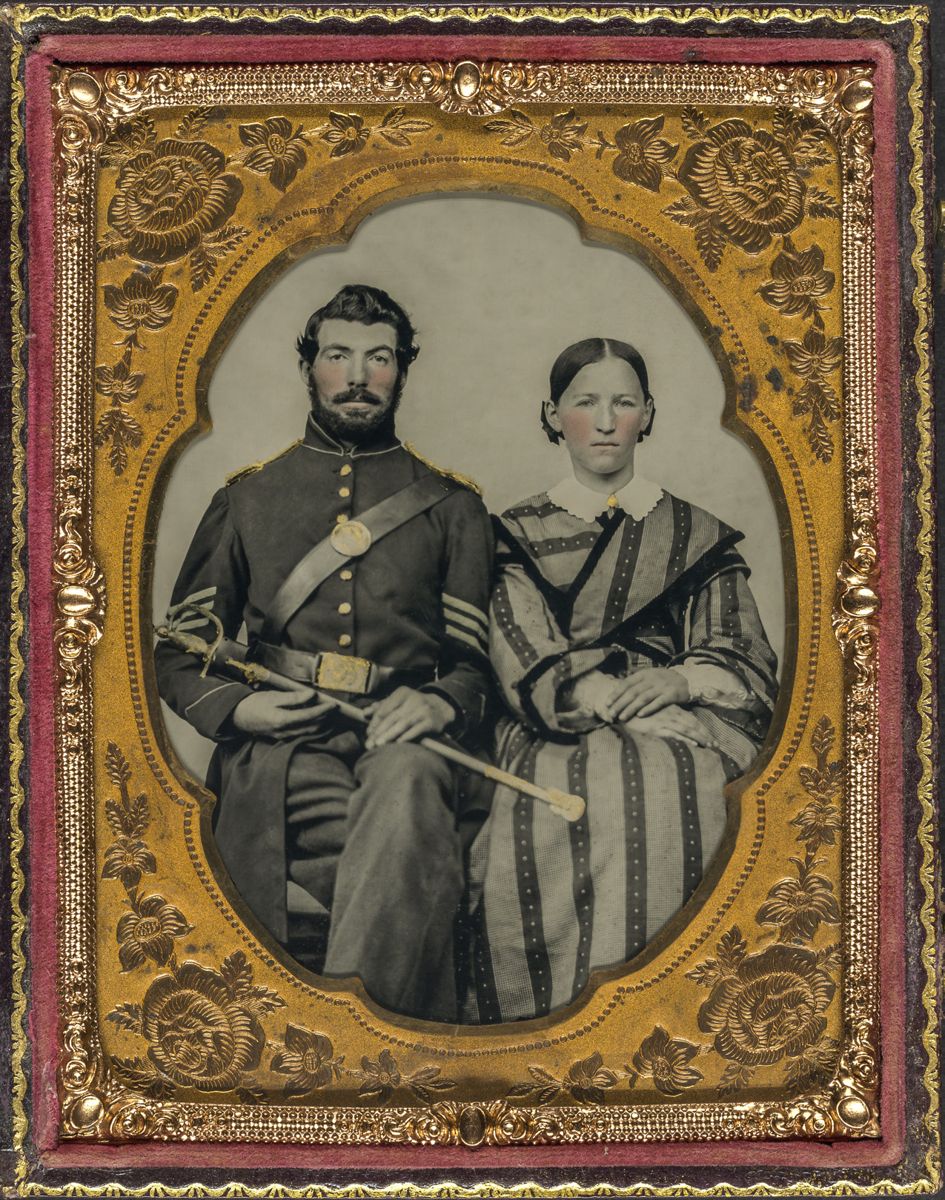
We have seen the views taken in Paris by the “Daguerreotype” and have no hesitation in avowing that they are the most remarkable objects of curiosity and admiration, in the arts, that we ever beheld. Their exquisite perfection almost transcends the bounds of sober belief. Let us endeavor to convey to the reader an impression of their character. Let him suppose himself standing in the middle of Broadway, with a looking glass held perpendicularly in his hand, in which is reflected the street, with all that therein is, for two or three miles, taking in the haziest distance. Then let him take the glass into the house, and find the impression of the entire view, in the softest light and shade, vividly retained upon its surface. This is the Daguerreotype!1 This is how a New York journalist in 1839 expressed his amazement over a new artistic creation, the Daguerreotype. Louis Daguerre was a French painter who, in the 1820s, began experimenting with ways of reproducing images on canvas without having to paint them. About that time, another Frenchman, Joseph Niepce was trying to do this same thing with lithographic stone. The two artists collaborated until
Niepce’s death in 1833. Daguerre persevered until he was able to announce his new process in January 1839. The story of photography, however, goes back many years before. The camera obscura (Latin for dark vault) had been around since Leonardo da Vinci’s time. The principle involved having a darkened room with a small hole bored in a window shutter. Light passing through the opening projects on a surface across from the hole an upside-down, laterally reversed image of the outside scenery. Improvements on the process replaced the room with a small box and a glass surface as the receiving screen. Daguerre’s contribution to the camera obscura—eventually just “camera”—was to think of a way to make permanent the image projected by the ray of light. Everyone wanted to know how he had done it. On Aug. 19, 1839, the French Academy of Sciences hosted a public meeting to hear Daguerre. The artist, however, chose not to speak, so a noted scientist explained it for him: a) he plated a copper sheet with liquid silver and polished it; b) he put the silver surface in a little box filled with iodine vapor for up to half an hour till it Medium: 1 photograph: quarter plate daguerreotype; plate 4 1/4 x 3 1/4 in. (Library of Congress)
turned golden or yellow; c) he then placed the silver-sensitized sheet in a camera obscura for from five to twelve minutes, depending on the air temperature; d) with the reversed image now present on the plate (but not yet visible), he developed it with liquid mercury vapor; e) he washed the developed plate with hyposulfite of soda, dried, then mounted it under glass; f) voila! The finished daguerreotype! Daguerre’s process got into the papers immediately. The London Globe published an article on it four days after the Paris meeting. With communication between America and Europe still dependent on steamers at sea, it was the arrival of the H.M.S. British Queen in New York on September 20 that brought the Globe with its reporting on Daguerre’s exciting new process. Within days, papers in major U.S. cities were reprinting the article.2 This set industrious artisans to work trying to produce their own daguerreotypes. Within a month, Samuel F.B. Morse, the same Morse who had invented the electromagnetic telegraph in 1835–37, produced a daguerreotype at his New York office. Daguerreotypists in other major American cities began to advertise for patrons. Along the way, experimenters improved the production process. During the time of his experiments with daguerreotypes, Morse was visited by a young Mathew Brady. Brady, born in upstate New York around 1822, was enthralled and learned the process from Morse. He then opened his own studio in New York City in 1844. Within a year he came up with the idea of making pictures of every famous person he could. In this endeavor he famously succeeded, thus earning from Robert Taft, historian of American photography, credit as an accomplished “photographic historian.”3 The idea of photographs capturing people and moments in history was further tested, and advanced, during the MexicanAmerican War of 1846–48. One of a handful of existing daguerreotypes shows General John E. Wool and his staff on horseback in the streets of Saltillo during the winter of 1846–47. A few years later, in 1855, Englishman Roger Fenton went to Crimea and took pictures of the Crimean War. He and his assistant produced more than 350 images, the best known of which are titled “Valley of the
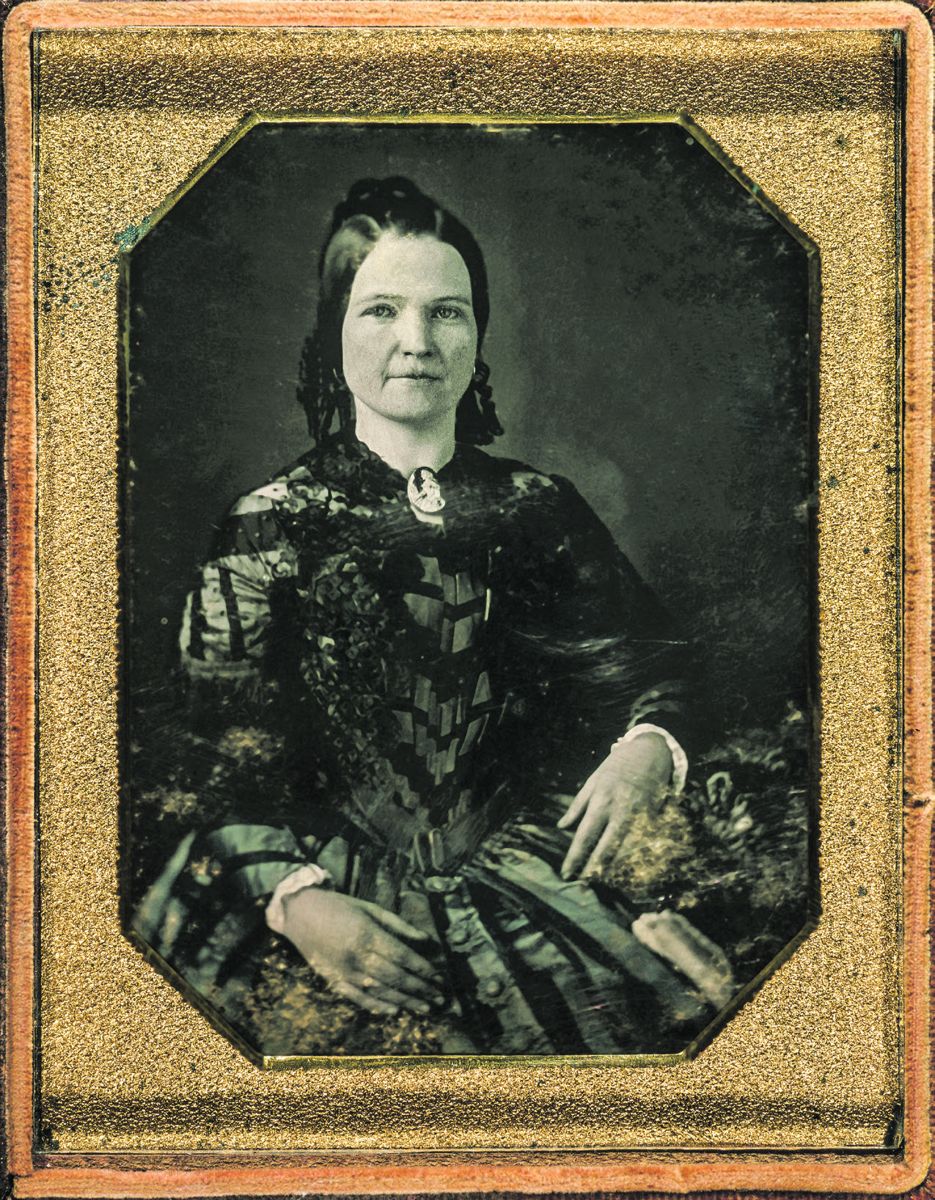
Hand-colored photograph of a Union sergeant seated in regulation dress with unknown woman who is probably his wife. The sergeant is holding his Model 1840 non-commissioned officer (NCO) sword still attached to the frog on the over the shoulder belt he is wearing. Medium: quarter-plate ambrotype, 11.9 x 9.5 cm (case). (Liljenquist Family Collection, Library of Congress) Shadow of Death”—referring to the famous charge of the Light Brigade.4 By that time, the daguerreotype was already in decline, replaced by wet-plate collodion photography, as experimenters sought continually to improve the process and product. A major defect of Daguerre’s image was that there was no way to replicate it, and visually, because of its mirror-like surface, the picture could only be seen in a certain light. As the craft was evolving, the term photography took hold as artisans began producing images on chemically treated paper. Early photographers in the 1840s also began speaking of negatives (original images in the camera) and positives (prints derived from the negative).5 In 1850 nearly a thousand daguerreotypists were in business across the country. “The rage for photography was overwhelming,” writes historian George Gilbert. In every major city, photographic galleries, like exhibition rooms in the finest museums, made it possible for everyone to see and acclaim photographic likenesses—and to consider a suitable time for arranging a sitting. In the earliest years some studio-galleries had up to hundreds of sittings a day. Few photographs made in the mass production centers were larger than a playing card, and most were only half that size. Encased in their protective leather, wood, or molded housings with the delicate Daguerrean image under glass, the miniatures were an endless source of amazement. Although at first they cost about $5 (more than a week’s wages for a workingman), it was not long before studio competition brought prices down to a dollar, then fifty cents, and, finally, to the outrage of the leading photographers, twenty-five cents.6 Technological improvements continued. Physicians in the late 1840s had learned that collodion, a syrupy mix of nitrated cotton in alcohol with ether, when dried formed a transparent membrane that could be applied to wound and burn victims as a “skin.” Photographic experimenters realized that collodion could be applied to glass plates to prevent their fracturing. Better still, collodion could absorb the photographer’s light-sensitive chemicals. Thus was born the “wet-plate.” Transfer of the image from glass plate negative to treated paper produced positive prints lots of them inexpensively. In 1857 a European nobleman had his likeness glued onto small (2 ½ x 4 inch) cards, giving rise to the carte de visite—also known as a CDV—a popular type of cheap photographic portrait. Oliver Wendell Holmes, the Massachusetts physician and man-of-letters, called the card-portraits “the social currency, the sentimental green-backs of civilization.” Then in 1855 came the ambrotype: a glass negative backed with black velvet or black paper to render it into a positive, and encased in the manner of daguerreotypes. Ambrotypes came in a variety of sizes. Most common were 2 ¾ inches x 3 ¼ inches and 3 ¼ inches x 4 ¼ inches. Their rise as successor to earlier technology was swift. Frank Leslie’s Illustrated Newspaper in New York used photographic images as the basis for its wood engravers to make printable pictures. In 1856, of 123 pictures rendered from photographs, 100 came from ambrotypes, ten from paper photos, and thirteen from daguerreotypes.7 Photography for everybody took another step forward in 1856 with the tintype (or ferrotype, from the Latin for iron). Tintypes used the same sticky wet emulsion as before, but on lightweight metal instead of glass. The finished product also needed no protective case. The result was a photographic image that could be produced for a single cent. The inexpensive ferrotype became a political campaign tool just before the Civil War. In February 1860, a beardless, fifty-one-year-old lawyer from Illinois, Abraham Lincoln, was in New York to give a speech he hoped would advance his chances of securing the Republican Party’s presidential nomination. On February 27, the day of his address at the Cooper Union (a Manhattan school with a large auditorium), Lincoln stopped by Mathew Brady’s studio at Broadway and Tenth Street to have his picture taken. An enterprising resident of Waterbury, Conn., D.F. Maltby came up with the idea of putting tintype photos of leading politicians on small buttons for their supporters to wear. When manufactured by the Waterbury Button Company, Lincoln buttons—an estimated 300,000 were eventually circulated—put the Railsplitter’s face before countless Northerners. Both the speech and the button succeeded. Later Lincoln was heard to remark, “Brady and the Cooper Union made me president of the United States.”8
(Liljenquist Family Collection, Library of Congress) 1.
Endnotes
The Knickerbocker (a New York magazine), quoted in Robert Taft, Photography and the American Scene: A Social History, 1839–1889 (New York: Dover Publications, 1964 [1938]), 3. Taft, Photography and the American Scene, 4-6, 14. Taft, Photography and the American Scene, 39, 43, 46, 55, 57, 59. Taft, Photography and the American Scene, 223-25; Allan R. Millett and Peter Maslowski, For the Common Defense: A Military History of the United States of America (New York: Free Press, 1994 [1984]), 153; Errol Morris, Believing Is Seeing (Observations on the Mysteries of Photography) (New York: Penguin Press, 2011), 3-4. Taft, Photography and the American Scene, 7-8, 101, 103, 105-106. Michael Fellman, “Foreword” in Ronald S. Coddington, Faces of the Civil War: An Album of Union Soldiers and Their Stories (Baltimore: Johns Hopkins
University Press, 2004), x; George Gilbert, Photography: The Early Years A Historical Guide for Collectors (New York: Harper & Row, 1980), 37. Gilbert, Photography, 39; J. Matthew Gallman, “Foreword” in Ronald S. Coddington, African American Faces of the Civil War: An Album (Baltimore: Johns Hopkins University Press, 2012), xvii; James D. Horan, Timothy O’Sullivan: America’s Forgotten Photographer (New York: Bonanza Books, 1966), 13, 23; Fellman, “Foreword,” x-xi. Gilbert, Photography, 55-56, 58; Stephen B. Oates, With Malice Toward None: The Life of Abraham Lincoln (New York: Harper & Row 1977), 171; Harold Holzer, Lincoln at Cooper Union: The Speech that Made Abraham Lincoln President (New York: Simon & Schuster, 2004), 6, 105; James D. Horan, Mathew Brady: Historian with a Camera (New York: Crown Publishers, 1955), 31; Taft, Photography and the American Scene, 158. Medium: sixteenth-plate tintype, trimmed to circle; 2.5 cm diameter (frame).