
Inspection, ARMS!
The Gibbs Patent Carbine
By Tim Prince · Originally published March 2019 · pp. 24–26
The Gibbs Patent Carbine With all of the trials and tribulations experienced during the life of the Gibbs Carbine, it is a story might best be entitled The Carbine That Was Never Meant To Be. The Gibbs carbine was contracted for no fewer than four times before it finally went into production, experienced major delays in manufacturing, and was eventually killed by a factory fire. All these events combined to make the Gibbs one of the scarcest U.S. contract Civil War carbines to see issue and use, and one of the harder U.S. military carbines to find for sale on the market. The Gibbs Carbine had its genesis as the invention of Lucius H. Gibbs, an inventor and gunsmith living in Oberlin, Ohio. Gibbs had previously received U.S.
Patent #5316 on Oct. 2, 1847, for a percussion-repeating rifle. The revolving rifle shown in the patent drawings bears a vague resemblance to Colt’s Patterson revolving rifles but is truly unique. Gibbs’ patent specification describing the unique action reads in part: The nature of my invention consists in making the breechstock of the gun tubular, the tube communicating with the breech of the gun barrel for the purpose of receiving a number of shot-charged cylinders in such a manner that as soon as one is discharged of all its loads it may be easily and quickly taken from the gun, as here-in set forth, and another cylinder made to take its place by simply dropping the muzzle of the gun.
However, in my research I could find no records of Gibbs’
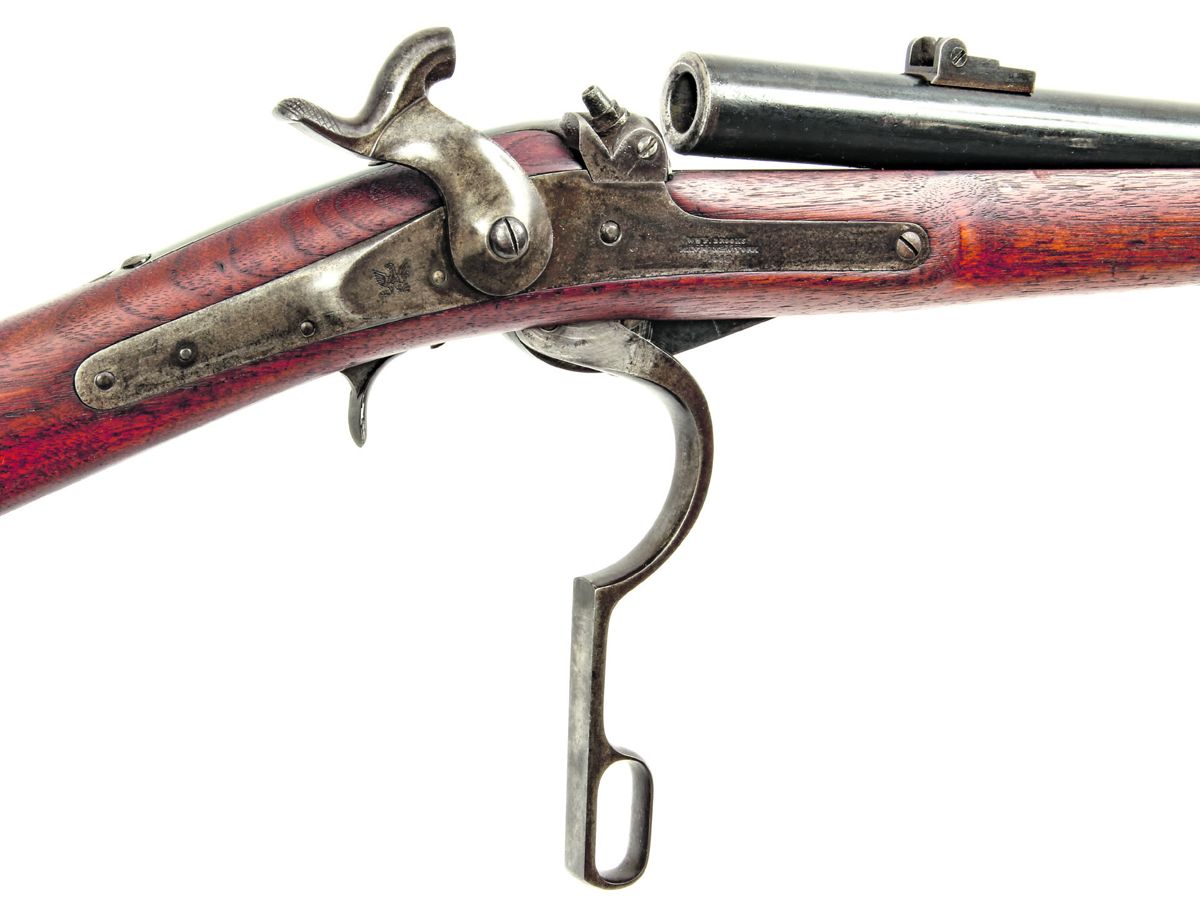
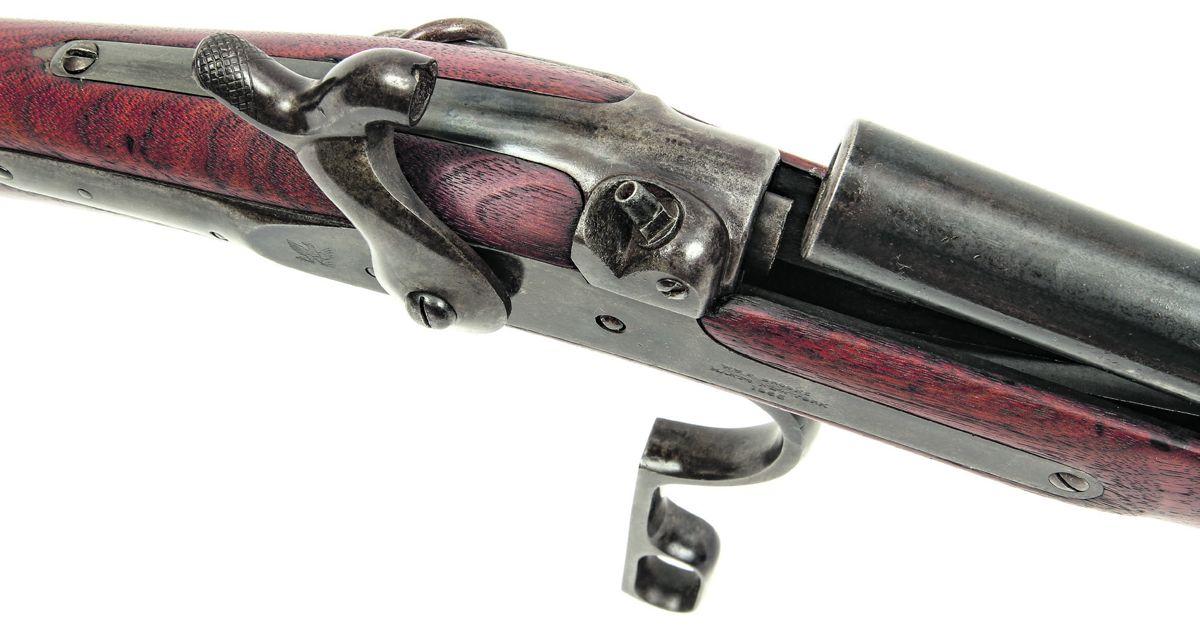
patent repeating, revolving, percussion rifle having ever been produced. Gibbs’ patent that applied to his Civil War carbine was #14057, issued on Jan. 8, 1856. The patent was for a single shot, percussion, breech loading arm. At that time, Gibbs listed his residence as New York City. It appears that Gibbs may have produced a few single shot pistols using the same patented breech design, but these are so scarce that Flayderman’s Guide to Antique American Arms does not asses a value for them. Gibbs’ design was not particularly revolutionary, in the greater sense of “invention,” but was more of an “improvement” upon existing designs and was patented as such. The Gibbs system used a lever under the breech to push the barrel away from the breech face of the carbine and tilt it down for loading. The system is in fact very similar to the Gallager Carbine (patented in 1860), and the Gallager was likely heavily influenced by the existing Gibbs design. The Gibbs patent was probably influenced by Edward Maynard’s carbine (patented May 1851), where an under lever pushed the barrel away from the breech face and tilted it down for loading and unloading. The Maynard system relied upon a brass cartridge case to seal the rear of the barrel against the breech face to prevent the escape of gasses when the gun was fired. This meant that the brass case had to be manually extracted after each shot. Gibbs’ system used a small button shaped projection on the face of the breech to fill the rear of the barrel’s chamber and seal it against gas leaks. This allowed the use of combustible paper or linen cartridges, like those in the Sharps designs, and eliminated the need to extract spent cartridge cases. From a purely economic point of view, the ammunition was cheaper and easier to produce, as no metal case was required for the Gibbs cartridge. As
Overall obverse view of a Gibbs carbine.
(All photos by Tim Prince)
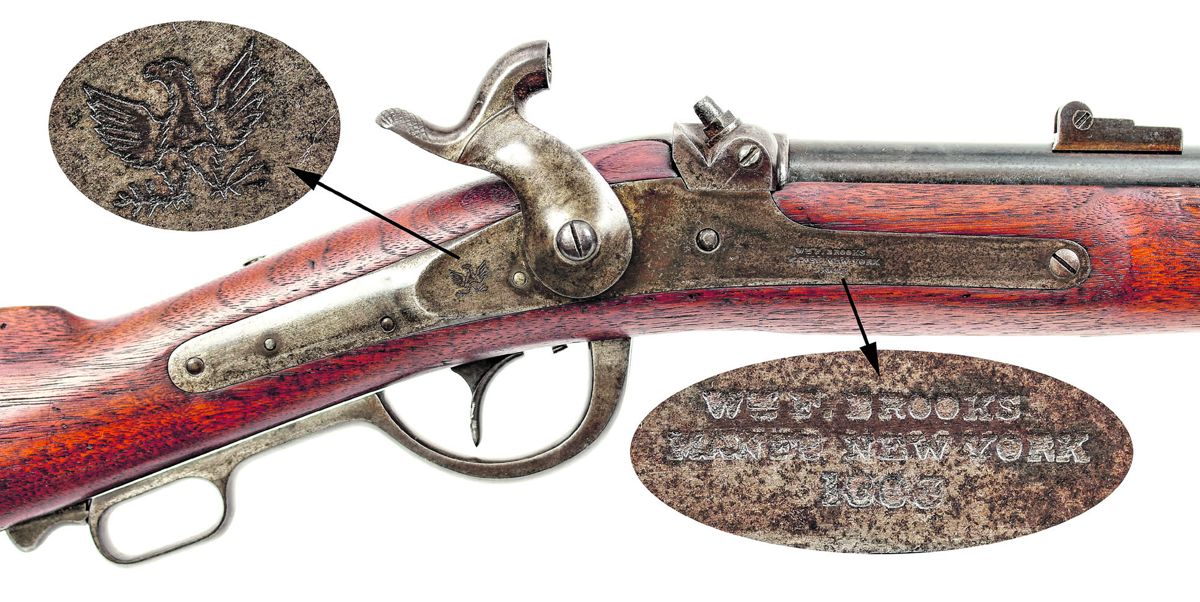
Close up of the Gibbs lock, showing the WM F Brooks lock marking and the somewhat comical Eagle behind the hammer.
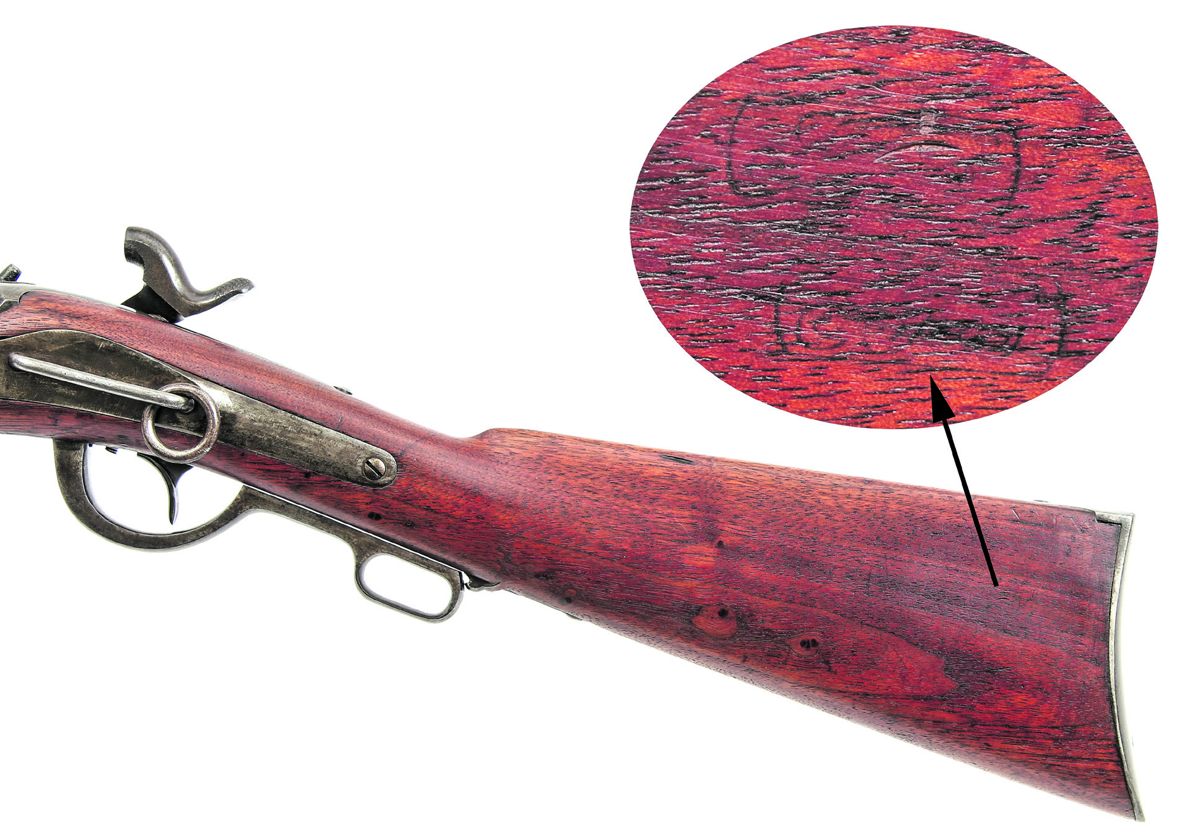
Gibbs described in his patent application: …my said invention also consists in combining with a sliding barrel made with the rear or breech end open, a fixed breech pin which fits the bore of the rear end of the barrel, in combination with an annular recess surrounding the said pin to receive the rounded edge of the rear end of the barrel, to prevent as much as possible the escape of gases and in case of any escape to deflect them toward the muzzle. Sometime during 1857, Gibbs managed to have approximately twenty sample carbines produced, most likely by W.W. Marston of New York. At least one of these carbines was tested by a U.S. Army Ordnance Board at West Point during 1858, and was considered to be a generally good design, but no orders were forthcoming. The carbine was a simple, single shot, percussion breechloader whose action was opened by lowering a lever that was an extension of the triggerguard. The lever resembles a miniaturized version of the classic Winchester lever, with a much smaller loop for the hand and an extension between the loop and triggerguard. The carbine had a .52 caliber, 22-inch round barrel and was 39 inches in overall length. The carbine’s barrel was blued, with a color casehardened lock and furniture, and mounted in a walnut stock. The standard markings on the production Gibbs carbines that were delivered included a three-line horizontal lock mark as well as a three-line breech marking. The very long, elongated lock plate was marked, forward of the hammer: WM F. BROOKS / MANFR NEW YORK / 1863. To the rear of the hammer, it was marked with an American Eagle, although it is a sort of scrawny, “chicken necked” eagle. The top of the breech was marked L.H. GIBBS / PAT’D / JANY 8, 1856. The buttplate tang was marked with the standard U.S. found on period U.S. military muskets. The inspection cartouches were stamped on the reverse of the stock, close to the butt, and not in the usual location on the reverse wrist. It appears that Samuel T. Bugbee inspected most of the Gibbs carbines that were completed and delivered, as the handful of extant examples with legible cartouches show his script STB stamp in the wood. A short sling bar and ring were mounted to the long, elongated side plate on the reverse that mirrored the lock plate’s contours. A single barrel band served double duty as a forend cap. The front sight was a brass blade mounted in a dovetailed iron base, but the rear sight was a standard U.S. rifle musket rear sight, with the leaves graduated to 100, 300, and
500 yards. While the wartime production carbines used the U.S. Pattern 1861 rear sight adopted during the summer of 1861, it is likely that the earlier test carbine used a U.S. Pattern 1858 rear sight. With the coming of the American Civil War, and the U.S. military’s desperate need to acquire breechloading small arms for the cavalry, Gibbs finally seemed poised for success. On Oct. 24, 1861, Thomas Fields, representing Strobell & Company of Washington, D.C., submitted a proposal to the U.S. Ordnance Department to deliver 10,000 Gibbs carbines at a rate of $28.00 each. The Ordnance Department subsequently recommended on Nov. 21, that the proposal be reduced to 5,000 guns, and issued a contract to Strobell & Company, to be returned in January 1862. Strobell & Company never returned the signed contract for this order, and it was subsequently cancelled. The Ordnance Department initiated a second contract with Strobell & Company on Dec. 13, 1861, for 10,000 Gibbs carbines; exactly the same proposal that Fields had put forth only weeks earlier! This contract, however, appears to have been either issued by accident or as a duplicate for yet another Gibbs carbine contract. In any case, the HoltOwen Commission that investigated U.S. military contracts, and all the problems that seemed to go along with them, cancelled both Strobell & Company orders. The first contract was annulled on the grounds that the original contract had never been signed and returned by Strobell as required, and it was argued that the second contract was really issued to another company! Interestingly, researchers have yet to determine who Strobell & Company or Fields were, and there is no evidence that either entity ever had anything to do with firearms production or manufacturing. It is most likely that they were simply arms speculators hoping to secure governments arms contracts, with the plan of having sub-contractors do the actual work. The Dec. 13, 1861, contract for 10,000 Gibbs carbines was apparently intended for William F. Brooks of New York City. Brooks was also the recipient of a contract for 10,000 U.S. M1861 Rifle Muskets, issued the same day as the Gibbs contract. Brooks was another speculator, who had no firearms manufacturing capability. While testifying before the Holt-Owen Commission, Brooks noted that he was a “brass and flue manufacturer.” He further noted that he intended to have W.W. Marston’s Phoenix Armory, the firm that made the twenty initial sample carbines, manufacture both the Gibbs carbines and the M1861 rifle muskets. Brooks was to have the first 1,000 guns under each contract delivered by April 12, 1862, and to continue deliveries at the rate of 1,000 per month until the contract was completed. By April 1862, no Gibbs carbines, or any rifle muskets, had yet been manufactured or delivered. The Holt-Owen Commissioners investigated the situation very quickly, and even sent Captain Silas Crispin of the U.S. Ordnance Department to inspect Marston’s manufacturing facility. Crispin’s report noted that Marston’s factory was capable of producing the Gibbs carbines, given the necessary time, tooling, and materials. He also noted that they had already sub-contracted for barrels and some small parts, had invested sufficiently in the required machinery to manufacture the necessary additional components, and assemble the guns. However, he noted that there appeared to be no progress at all in regard to manufacturing of the rifle muskets, and on April 18, 1862, that portion of the contract was voided. The commission did, however, agree to maintain the carbine contract. On June 21, 1862, the Gibbs carbine contract was reissued, making this the forth official contact for these guns, with the first delivery of 1,000 carbines to take place on Aug. 1, 1862. As with every previous contract for Gibbs carbines, the sellers were once again in default, and not a single gun was delivered under the contract. For whatever reason, Marston did not seem to have had the ability to get his operations under control and ready to manufacture the guns. On Dec. 1, 1862, the Mayor of New York City, George Opdyke, bought Marston’s Phoenix Armory and the Gibbs carbine contract and went to work filling it. As Opdyke wanted to avoid any appearance of impropriety, and because he was probably busy running the city, he placed the factory in the name of his son-in-law, G.W. Farlee. They hired new management including two new factory superintendents and a special foreman to supervise production of the Gibbs carbines. The man hired to directly oversee Gibbs carbine production was John W. Keene, a U.S. Ordnance Department sub-inspector at the time. Keene eventually would go on to work for Remington about a year later and would also invent the Remington-Keene bolt-action repeating rifle. Interestingly, it appears the Keene made his first trip to Ilion, N,Y., to investigate the possibilities of having Remington complete the Gibbs carbine contract, after the factory fire of July 1863 ended production; but we are getting a little ahead of the story. With new management and leadership, the bad luck that followed the Gibbs carbines from their first contract seemed to have been wiped away. After four different contracts and nearly two years of delays, the factory was able to deliver the first five hundred and fifty Gibbs carbines to the Ordnance Department on May 30, 1863. The next five hundred and two were delivered on June 24, 1863. By July 13, 1863, another five hundred were completed and ready for inspection at the factory, prior to delivery, and some six thousand more were in the process of being built or assembled. That same day, the “curse of the Gibbs” struck again, and this time ended the Gibbs story permanently. On July 13, 1863, the New York Draft Riots broke out in response to the newly established national conscription act. Rioters tore through the streets of New York looting, burning, attacking, and killing. Whether they attacked the former Phoenix Armory because they wanted weapons, because they knew it was owned by the Mayor, or just as a random act of destruction is unclear; but attack it they did. The rioters were initially driven off by New York City police stationed at the factory to protect it. The factory superintendents issued the thirty-four policemen Gibbs carbines. After the police shot and killed one of the rioters, the mob moved off. However, the situation in the city had become truly dangerous, and with only the police trying to control the rioters (the New York Militia had been sent to Pennsylvania due to Lee’s invasion of that state), the police stationed at the factory were sent to other parts of the city to help. Later that day rioters returned to the factory and burned it. In the process they destroyed five hundred completed carbines and the six thousand others being assembled. In the end, all the time, effort, and capital spent on the production of the Gibbs carbine resulted in only 1,052 being delivered to the U.S. government. Nearly all these guns were issued for use in the field; Gibbs carbines have been documented as being issued to the 13th and 16th New York Cavalry (who were issued 95 and 111 carbines respectively) and the 10th Missouri Cavalry (426), for a total confirmed issuance of 632. Others were likely issued as well, although the carbine was ill thought of in service, especially when compared to the Sharps and Spencer.
Tim Prince is a full-time dealer in fine & collectible military arms from the Colonial Period through WWII. He operates College Hill Arsenal, a web-based antique arms retail site. A long time collector & researcher, Tim has been a contributing author to two major book projects about Civil War era arms including The English Connection and a new book on southern retailer marked and Confederate used shotguns. Tim is also a featured Arms & Militaria appraiser on the PBS Series Antiques Roadshow.