
Private Alfred Rigby’s Diary Focuses on Cedar Creek
By Carl L. Sell, Jr. · Originally published March 2019 · pp. 12–13
Private Alfred Rigby’s Diary Focuses on Cedar Creek By Carl L. Sell, Jr. After a week at sea, with its usual sickness, and another spent marching and riding the rails, Private Alfred Abel Rigby and the Twenty-Fourth Iowa Infantry were in need of having their spirits lifted in early August 1864. The troops had arrived in Harper’s Ferry, W.V., after traveling by boat from Louisiana to Washington City, then by rail to Monocacy Junction in Md., and finally Harper’s Ferry, W.V. After settling in camp and enjoying the scenery, the TwentyFourth and a large number of other arrivals were introduced to General Phil Sheridan, commander of the newly formed Army of the Shenandoah. In his diary entry of August 9, Rigby wrote: “Altho a small man there seems to be a good deal of him. I have much confidence in him as a commander.” What’s more, General Ulysses Grant was in town, making plans with Sheridan to take control of the rich Shenandoah Valley from Confederate forces under General Jubal Early. The Confederates had arrived back in the Valley after a campaign that had reached the outskirts of Washington City.
Early’s foray had forced Grant to divert troops from the Army of the Potomac near Petersburg to meet the threat. As a result, Grant devised a plan to destroy Early’s army and deprive the Confederates of the provisions being provided by the fertile valley. He put Sheridan, his feisty cavalry leader, in charge of the new army to do it. That’s why Rigby’s regiment had been sent almost 2,000 miles by sea and rail to Harper’s Ferry. They had been part of the successful Vicksburg Campaign in 1863 and the Red River Campaign earlier in 1864 that gave the Federals control of the Mississippi River delta. Rigby enlisted with a group from the Mount Vernon, Iowa, near Des Moines. Born in Ohio, he was teaching school in Iowa at the time. After a ride down the Mississippi River from Muscatine, Iowa, the regiment eventually reached the Vicksburg area. By the time the call came from the east, the Twenty-Fourth had been involved in bloody battles at Champions Hill in Mississippi and Mansfield, La. The Twenty-Fourth sailed from Louisiana at sunrise on July 23,
1864, aboard The Star of the South and were escorted by a school of porpoises, according to Rigby’s diary. It didn’t take long for sea sickness to set in. At three p.m. on July 25, the ship passed Key West and set a course in the Atlantic Ocean up the east coast. The winds picked up that night and sea sickness got worse. After arriving at Fort Monroe, the Twenty-Fourth was ordered into Chesapeake Bay and up the Potomac River to Washington City. Along the way, Rigby mentioned passing George Washington’s tomb at Mount Vernon, although he admitted he couldn’t see it because of the trees. From Washington City, the regiment traveled by rail to Baltimore and subsequently on to Harper’s Ferry. Grant and Sheridan settled on a plan to defeat Early, first by heading toward Winchester with a two-pronged attack along the Charlestown Road and the Berryville-Winchester Turnpike. The Twenty-Fourth marched within the shadow of the western slope of the Blue Ridge to a spot between the mountains and Berryville. It was along the same route Early had taken when he crossed the Blue Ridge at Snickers’ Gap after threatening the capital. The attack began at 2 a.m. on September 18, just past Opequon Creek in what is known as the “Berryville Canyon” because of the steep slopes. Meanwhile, other Union troops attacked along the Valley Pike. The strategy resulted in a hurried Confederate retreat from Winchester. The Twenty-Fourth went into camp on Sept. 19; the next morning they moved south toward Fisher’s Hill, where the enemy was strongly entrenched. Sheridan’s forces broke through Early’s defenses at Fisher’s Hill, forcing the Rebels to retreat toward Staunton. The Union army set up camp near Cedar Creek and Sheridan went off to confer with Union leaders in Washington. Early on the foggy morning of October 19, the Twenty-Fourth was sent on a reconnaissance patrol that ran into an all-out Rebel attack. Rigby’s Battle of Cedar Creek Oct. 19, 1864 diary entry reads: As I have never given a description of our forces I will give it in order to better understand the difficulties we labored under. Our works were diagonally across the valley along the banks of the creek. The 6th and 8th Corps occupying the flanks and the 19th the center. The picket firing during the night created but little suspicion as it was nothing unusual. At 4 Ocl the pickets were deployed in the line with special instructions to be vigilant. At five Ocl the enemy made a feint on the 6th Corps while the main force was being massed on the left flank of the 8th. In order to accomplish this, Gen. Early had occupied the whole night in marching his forces along the base of the mountain single file. Then crawled upon their hands & knees as close to the picket lines as possible without exciting suspicion. At day dawn they marched upon the 8th Corps surprising the camp driving their half formed lines back upon the 19th. This was so sudden and unexpected that no time was given for extending our lines. After a short but stubborn resistance we were obligated to fall back in confusion upon the 6th Corps. In this struggle we suffered our greatest loss. The enemy was checked by the 6th Corps sufficiently to teach them caution in their further movements. Our corps was reformed on the hights two miles to our right. Here we could see the enemy plundering our camp. At this time it seemed the intention of our commanders to retreat. Gen. Wright had been wounded early in the morning leaving us without a commander in chief and many of our bivouac officers had already fallen. Our ranks were fearfully thinned and the list of stragglers going to the rear was still greater. Our prospects looked gloomy indeed, and fighting seemed out of the question except for existence. At 11 Ocl three lines of battle were being formed, the columns already on the retreat recalled and new vigor seemed to be infused in the ranks. Gen. Sheridan had arrived, and to use his own language, said “this work must be stopped. We must camp on our old grounds tonight.” Stockades of rails were hastily thrown up ready for the onset of the advancing foe. It was impetuous but met fearful recoil at the hands of our brave men. The well- directed volleys poured into their ranks checked them, silencing their hideous yells, and drove them panic stricken to a more respectful distance. After being driven from their strong positions actually retreating then reorganizing a dispirited army and driving an exultant foe from the field, with less than half of his army, in consternation, merits for Gen Sheridan a name among the military heroes of the age. So sure was the enemy of success that many of the women from Strausburg followed the army for the purpose of pillaging. Our wounded were subject to all manner of insults from those fiends. Ambulances were fired into while passing through Middletown. The secessionist of Winchester were very exultant until news of Early’s defeat reached them which caused quite a reaction in public sentiment. I had been sent on picket the night before. At four A.M. our suspicions were aroused. When the firing commenced we were satisfied that the enemy was pressing the 8th Corps. The enemy did not advance upon our flank until after they had gained the first work on our flank. We kept up a rousing skirmish, crossed the creek and formed on the bluff between our works and the creek. They made no further demonstrations but stood on the opposite hills and cheered Jeff Davis and Dixie. We did not retreat further until the balls began to come in our flank. I shall never forget the scene which greeted my eyes upon reaching the breastworks. Our lines were broken, and wagons and men were hurrying to the rear in one promiscuous mass while the enemy’s shot and shell was scattering death & destruction in every direction. I found Major Myers with a squad of the 4th Brigade. We reached the regiment in time to reform. My heart was overflowing with gratitude to God for his preserving care in my behalf and so many of my comrades. Our greetings were truly cordial. We know not how strong are our attachments until so fearfully tested. Col. Wright* soon came to us and kept his command all day though suffering from his wound. Martin did not come to us until noon which relieved my mind of a load of uneasiness in his behalf. I volunteered with others to go out as sharpshooters and remained as such a portion of the afternoon. Our brigade made one brilliant charge driving the enemy from a stone fence and capturing many prisoners. Surely God has been merciful to me today. I believe that prayer does avail at the throne of Grace. May I never loose [sic] this confidence is my daily prayer. A silence, ominous, portentious, and forbidding reigned along the lines until four Oclock. It was our turn to take the offensive. The scene which followed was awfully sublime; steadily we drove the enemy amid the screaming of shells, the rattling of musketry and the yells of the combatants. Gen. Sheridan rode along the lines on his white charger speaking words of encouragement to the faint and by his presence enabled all to dare & brave all for the victory. Before our old works were gained the enemy were in full retreat which was turned to a rout by our invincible cavalry. At sunset we stacked arms on our respective parade grounds. The cheers which rent the air testified of the joy of the warworn veterans who survived. Our wounded were gathered up and cared for and refreshments taken, the first time since the night before, and a part of our force pushed on to Strausburg, our brigade taking the advance. On the way we met a Rebel team and a number of pieces of artillery driven by their original drivers, with a “yank” sitting
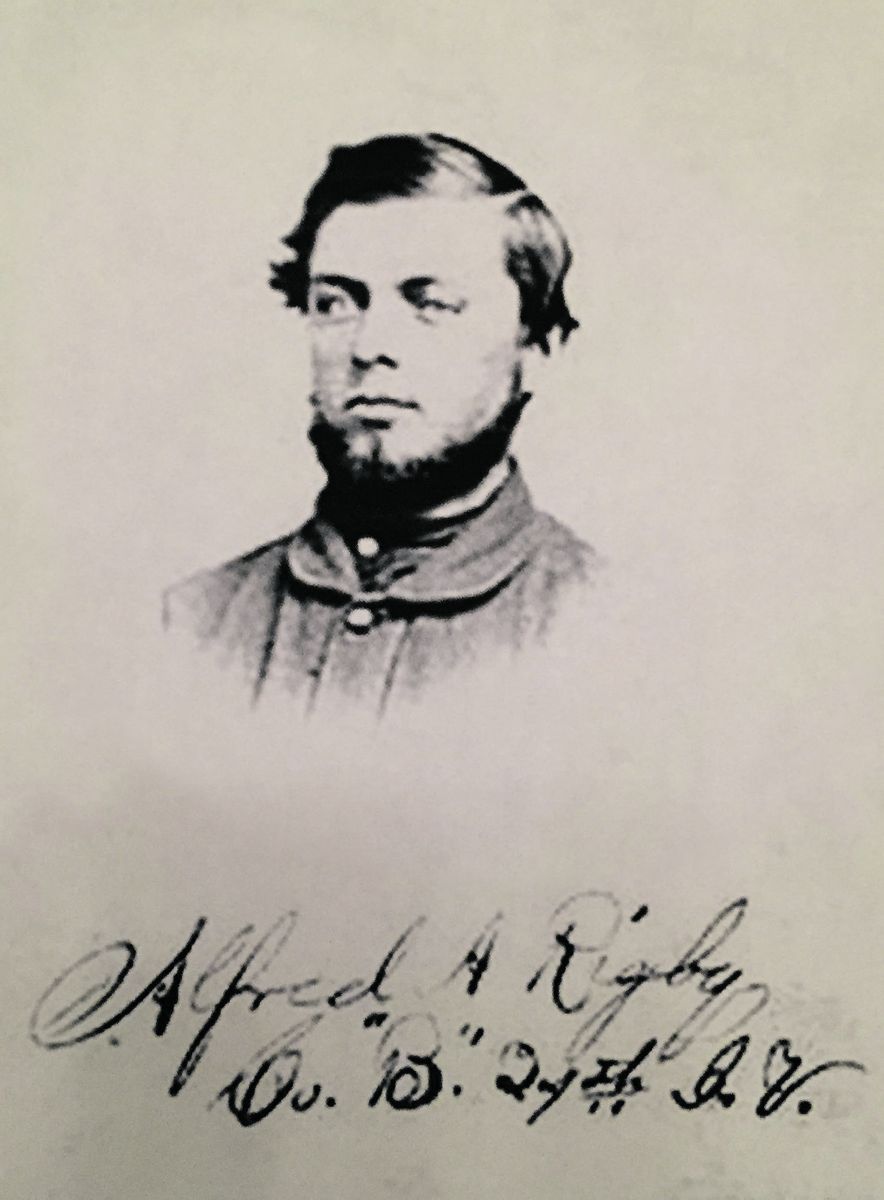
Alfred A. Rigby, Co. B, 24th Iowa Infantry. Cornell College and later became a Methodist minister as part of the Upper Iowa Conference. During the war, Rigby organized prayer groups among the troops and faithfully attended local churches, often in Confederate territory. He married Carrie Nancy Gerard and fathered two sons, Archie Edward and Alfred Gerard. Rigby died on July 8, 1872, age 31 from tuberculosis contracted during the war. His wife remarried in 1881 and lived until 1934. *Lieutenant Colonel Ed Wright of the Twenty-Fourth, not to be confused with Major General Horatio Wright, the VI Corps commander. **Sergent Martin F. Rigby was one of Alfred Rigby’s three cousins in Company B. Captain William T. Rigby, who had been promoted on Aug. 6, 1863, also was at Cedar Creek. Nineteenyear-old Jesse W. Rigby had been taken captive in Louisiana on April 8, 1864, and missed the trip to the Shenandoah Valley. All survived the war. Alfred was promoted to Sixth Corporal on July 1, 1865, just before the TwentyFourth disbanded. Note: This article is the result of a chance meeting between Civil War historian Carl Sell and Dee Hallett at the Bluemont Fair at Snickers Gap in the Blue Ridge Mountains of Virginia during the fall of 2018. Sell had a table selling his books and gave a talk about Civil War history in the area that day. Sell’s great grandfather, a private in the Thirty-Eighth Virginia Infantry, passed through Snickers Gap in June 1863 on the way to Gettysburg. Hallett, who lives nearby, said her husband, Kirk, had a great-great grandfather who fought with the TwentyFourth Iowa Infantry Regiment in the Shenandoah Valley in the fall of 1864. What’s more, she said, the family had a daily diary kept by Private Alfred Abel Rigby that reported on his unit’s travels during the war. Dee and Kirk subsequently provided a copy of the diary section that focused on Rigby’s experiences on the trip from Louisiana to Virginia and Cedar Creek. It was Kirk’s grandmother, Stella Rigby Hallett, who copied and typed the hand-written diary. The manuscript is part of the Manuscript Archives and Rare Book Library at Emory University in Atlanta, Ga. Archie E. Rigby, Kirk’s great grandfather, was only two years old when his father, Alfred, died in 1872. Archie’s daughter, Stella, married Reveley Allinson Hallett. They had a son named Edward Reveley Hallett, Kirk’s father. Contact Carl Sell at [email protected] for additional information regarding this story or his books about his ancestors, Jeb Stuart, and Snickers Gap.