
The Graphic War
Lee and his Generals
By Salvatore Cilella · Originally published March 2019 · p. 22
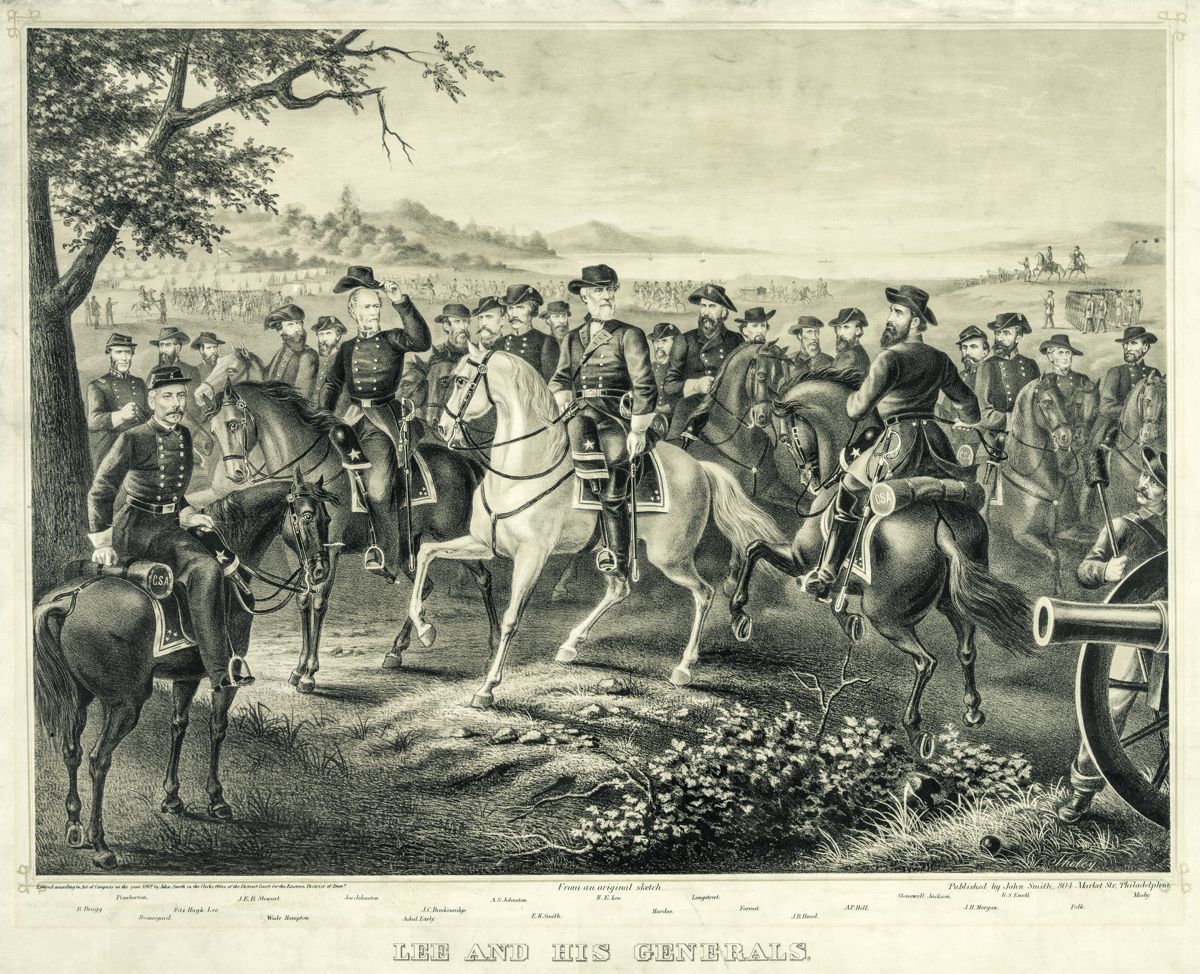
Lee and his Generals This occasional column highlights prints from the Civil War. It discusses their meaning and most importantly, what the print maker or artist was trying to achieve. After the war, (and not during), several lithographers, artists, and publishers began memorializing the old south and the Lost Cause. The most popular figure to receive their attention was Robert E. Lee. Following close behind were Jefferson Davis and Stonewall Jackson. Copying previous groupings of commanders, particularly Union commanders, artists composed fictitious group meetings showing many Confederate commanders who were still favorably viewed by potential buyers. The myth of the Lost Cause became a new marketing endeavor for the economically struggling south, and after all, the new prints were relatively cheap by art standards. Lee and His Generals was the creation of the Tholey brothers, Charles and Augustus. Unlike most lithographers of the 19th century, they were native born; their grandfather had migrated from Alsace-Lorraine to Philadelphia in 1848 during the revolutions in Europe that year. They worked in lithography with well-known artists/printers such as the Duvals, who specialized in military subjects. During the war, the Tholeys produced prints of Grant and his staff, Lincoln’s funeral in Philadelphia, the Battle of Antietam; and of course, Lee and his Generals.1 The Tholeys may have been adequate artists, but they were short on historical accuracy and details. Lee, of course, is the central figure on a white horse that bears little resemblance to Traveler who was gray. The most prominent generals of the Confederacy surround Lee in “a clever composite of portraits based on photographs…all on improbable bodies and horses.” The meeting never took place but that, and the obvious miscues, did not seem to matter to the Lost Cause market. The print was lithographed by Joseph Hoover and published by John Calvin Smith, both of Philadelphia, in 1867.2 Hoover specialized in chromolithographs and his business flourished from 1856 well into the 20th century before folding in 1985.3 The Tholeys gave prominence to P. G. T. Beauregard shown in the far-left corner. Between Beauregard and Lee is Joseph E.
Johnston; between Johnston and Lee is Albert Sidney Johnston, dead since Shiloh. Over Lee’s left shoulder are Longstreet and then Stonewall Jackson. Lesser known lights occupy the mid and background, sharing space with neat rows of white tents and drilling soldiers. A cannon completes the scene in the lower right corner. It’s remarkable that a northern lithographic firm, a creature of the victorious side, would celebrate the vanquished (and rebellious) in such a heroic and robust manner. Looking at this print with 21st century eyes and void of any contextual references, makes one question who won and who lost the war. Conventional scholarship places the blame of the myth of the Lost Cause on various southern constituencies—the Klan, the United Daughters of the Confederacy (UDC), Jubal Early, and Confederate veterans. They may have all played a role furthering the narrative; but there are countless examples of northern printers, artists, and publishers offering heroic prints such as this who contributed mightily to the myth.4 How ironic.
Harry Peters, America on Stone, New York, Arno Press, 1976 reprint, 383. Mark Neely, Harold Holzer and Gabor S. Boritt, The Confederate Image: Prints of the Lost Cause. Chapel Hill: University of North Carolina Press, 1987, introduction, caption, Plate 12. Jay T. Last, The Color Explosion: Nineteenth Century American Lithography, Santa Ana, California: Hillcrest Press, 2005, 196. See Caroline E. Janney, Remembering the Civil War: Reunion and the Limits of Reconciliation, Chapel Hill: University of North Carolina Press, 2013.
Salvatore Cilella is retired after 43 years in the museum field. His last position was President and CEO of the Atlanta History Center. He is the author and editor of several articles and books including Upton’s Regulars: A History of the 121st New York Volunteers in the Civil War (U. Press Kansas, 2009) and The Correspondence of General Emory Upton, 1856–1881 (U. Tennessee Press, 2017).