
Through The Lens
It Was My Fight
By Stephanie Hagiwara · Originally published March 2019 · pp. 14–15
It Was My Fight “Yanks, if you know what is best for you, you had better make a blue streak toward sunset.” – C.S. Capt., 26th N.C. On Aug. 21, 1864, U.S. Gen. Ulysses S. Grant ordered Gen. Winfield Scott Hancock’s 8,500 man II Corps south of Petersburg, Va., to destroy the tracks near Ream’s Station. In what became known as the “Siege of Petersburg,” Grant planned on capturing Richmond by severing the Confederate capital’s supply lines. As part of that effort, Hancock’s men had fought at the Second Battle of Deep Bottom, Va., on Aug. 13–20, marched all night back to Petersburg and now were marching towards Reams Station. They became known as “Hancock’s Cavalry” as they stopped marching only when the staff officers got fresh horses. “Move down the railroad
… and do all in your power to punish the enemy,” ordered Gen. Robert E. Lee. Lee knew he wouldn’t be able to regain control of the entire the Weldon railroad that connected Richmond to the outside world via Wilmington, N.C., but he wasn’t going to allow further destruction without a fight. Gen. Wade Hampton’s cavalry and generals Henry Heth, William Mahone, and Cadmus Wilcox, of A.P. Hill’s 3rd Corps were ordered to stop Hancock. Wilcox was a popular career military officer. He had participated as a groomsman at the weddings of future generals George B. McClellan and Grant. He served in the Mexican-American War, as executive officer under Lee at West Point, and spent a year in Europe studying warfare tactics. Wilcox wrote “Rifles and Rifle Practice”, the standard text at West Point. He predicted that
George Weller Juno 11311 S. Indian River Dr. • Fort Pierce, Florida 34982 770-329-4985 • [email protected] improvement in range and accuracy would extend the field of battle, changing warfare. Wilcox advised, “to shelter troops from the enemy’s fire as long as possible without being too far distant, and to hold them well in hand, will probably be the best rule to observe.” The deciding factor for Wilcox to join the Confederacy wasn’t loyalty to his home state but his inability to face fighting his Tennessee relatives. A couple of days destroying railroad track was a nice change of pace for Hancock’s men. On the evening of the Aug. 24, Hancock received a dispatch advising that between eight and ten thousand Confederates were approaching. On the morning of Aug. 25, Gen. David Gregg’s cavalry drove in the Confederate pickets without a counter response. Consequently, Gen. John Gibbon’s division was directed to continue tearing up the tracks. Gen. Nelson Miles, in his first day as a division commander, ordered his men to strengthen the elliptical shaped line of breastworks Federal troops had built in June. Their valiant efforts were unable to overcome the work’s inherent design flaws. At 2 p.m. Wilcox’s infantry attacked while Wade Hampton’s cavalry swooped in to push back Gregg’s cavalry. Gibbon’s division stepped in to block the cavalry sweeping around the Federal line before falling back to Reams Station. Heth’s and Mahone’s infantry joined the fray. Snipers in the trees killed 134 artillery horses, immobilizing the Federal batteries. C.S. Col. William Pegram’s eight guns began an intense short range barrage about 5 p.m. “When the guns fell silent, most of the Northerners emerged from their rifle pits unscathed, but the intense bombardment had demoralized many of the raw recruits recently inducted into the Second Corps. The replacements must have been further shaken as a double assault column raced from the woods toward Miles’s division, emitting their eerie yell.” Still the Federals held off the
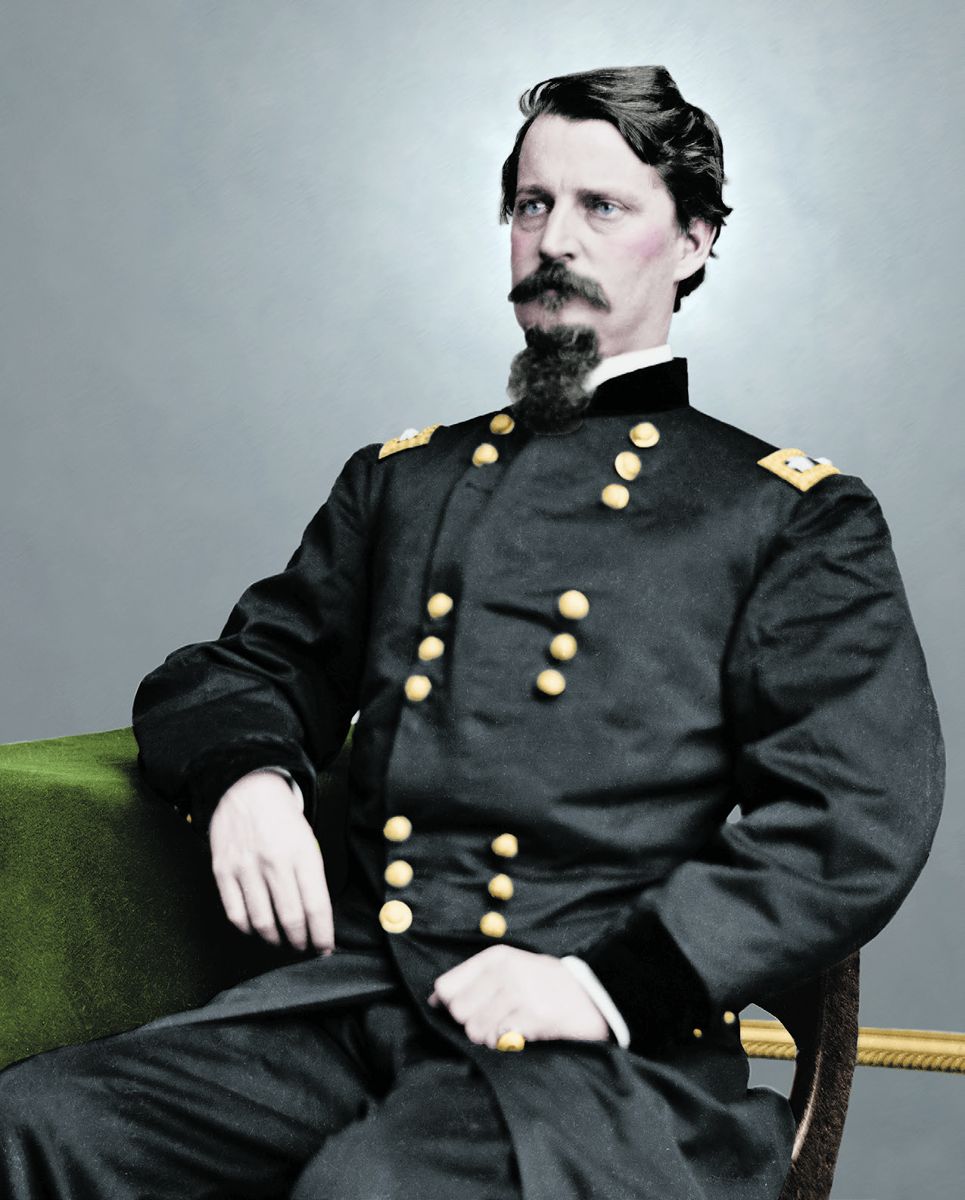
Maj. Gen. Winfield S. Hancock, “Hancock the Superb”; Colorization © 2010 civilwarincolor.com courtesy civilwarincolor. com/cwn. (Library of Congress) onslaught. Heth and the color bearer of the 26th N.C. climbed the breastworks, each holding the staff, waving the flag, the general cheering on his men. Farther down, a lone captain of the 26th N.C. breached the works warning the Yankees to run. Having enough, the bluecoats ran. Miles was stunned. On the verge of victory, his position was collapsing. He ordered other troops into the breach. “Instead of following orders, these troops panicked and either ran to the rear or dropped to the ground where they had been standing.” The 4th Brigade moved in while the 12th N.Y. Artillery fired upon the approaching enemy. Their horses dead or wounded, Union gunners abandoned their artillery as the
Rebels reached the guns. Worse, the Confederates turned one gun to fire on the fleeing Yankees. Miles spotted the 61st N.Y., his old regiment, standing up to the enemy. His used the regiment as an anchor as he “directed it to advance with a cheer. It swept the enemy from a major portion of the north face of the work, recapturing three guns of the Twelfth New York Battery, and driving the enemy into the railroad cut.” Hancock, ignoring his personal safety rode all over the field rallying his men. “Hancock had his bridle-rein cut by a bullet,” wrote a soldier, “but was continuing galloping along the front urging the stragglers to resume their places in the lines and do their duty.” Suddenly his horse dropped under him. Hancock left the animal for dead. “We can beat them yet,” he yelled. “Don’t leave me, for God’s sake!” During the fight, Hancock placed a hand on his staff officer’s shoulder saying, “Colonel, I do not care to die, but I pray God I may never leave the field.” Gregg’s dismounted cavalry saved part of Gibbon’s division. The rest either ran as fast as they could from the field or surrendered to the Confederates. The rallied Federals were not enough for a counter-attack. Hancock gave the order to pull out. Between nightfall and the heavy rain, the Confederates did not follow. They had captured nine guns, 12 flags, over 3,000 muskets, and 2,150 prisoners.
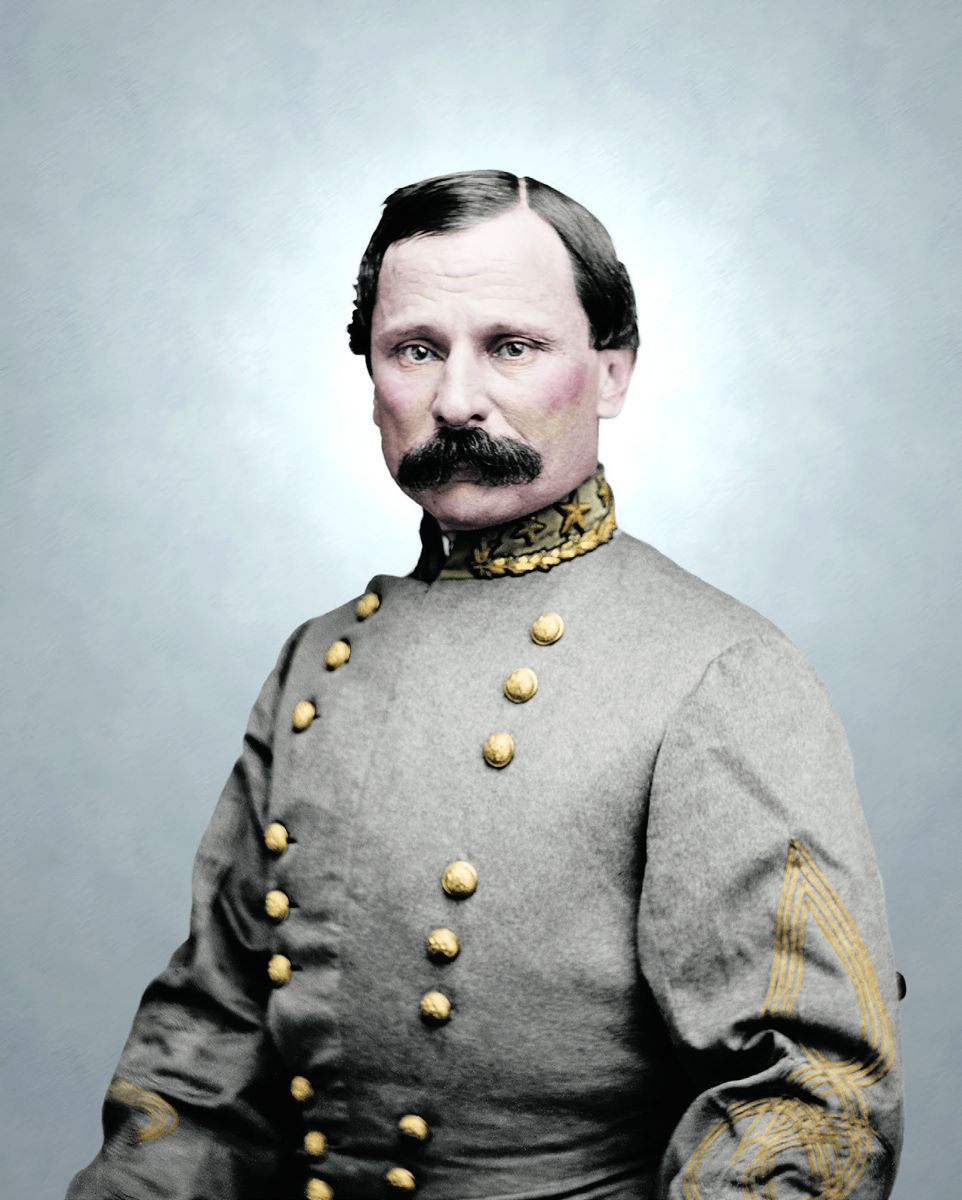
In the dispatch to Richmond, the Confederate victory was credited to Heth’s and Gen. James H. Lane divisions under Gen. James Connor. Wilcox and his division were not mentioned at all. As a professional soldier, stuck in the trenches around Petersburgh, credit earned was a needed morale booster. Wilcox would write, “It was my fight. … I gave the orders, … had my horse killed, one of my aides had his killed, two couriers had theirs killed & my Adjutant General wounded. My brigadiers all said it was a strange dispatch.”
Walker, Francis Amasa, General Hancock; Great Commanders Patterson, Gerard, From Blue to Gray: The Life of Confederate General Cadmus M. Wilcox DeMontravel, Peter R., A Hero to His Fighting Men: Nelson A. Miles, 1839–1925 Dauchy, George K., The Battle of Reams’s Station; Military Essays and Recollections, Military Order of the Loyal Legion of the United States. Commandery of the State of Illinois Vol 3
Stephanie Hagiwara is the editor for Civil War in Color.com and Civil War in 3D.com. She also writes a column for History in Full Color. com that covers stories of photographs of historical interest from the 1850’s to the present. Her articles can be found on Facebook, Tumblr and Pinterest.