
Emerging Civil War
Emerging Civil War — March 2019
Originally published March 2019 · pp. 34–35
From the Editor One of the things I love most about public libraries is that they’re usually a far cry from the stereotypical temples of silence that we all think of. Yes, you can find people tucked away in quiet corners, reading, studying and researching. Sometimes, dim lighting adds to the sense of quietude and seclusion, but just as often, rooms are awash in bright florescent white. This is only fitting. Libraries themselves are beacons. They serve as repositories of all our accumulated knowledge. In an age where we’re so easily distracted by soundbites and clickbait, and where we confuse opinions with wisdom, libraries represent steadiness and deliberateness. But libraries are so much more than that, too. I recently spoke at a branch of the Central Rappahannock Regional Library, and on my way in, I was delighted to see the window in the entryway plastered with notices about upcoming events: book groups, a quilting guild, “books with wine,” a stamping club, a writers group, “paws for reading,” mahjong players, and even a senior exercise class. It represented a vibrant array of activities for all segments of the community. Good libraries always sit at the heart of their communities that way. As a community, Civil War buffs love their books and pride themselves on their own libraries. But how might you or your Civil War Round Table, book club, or historical society work with your local library to help promote Civil War education? How might you help the library develop and promote its Civil War holdings? Just as the library sits at the heart of a community, how might you help ensure that Civil War history has a seat there, too? — Chris Mackowski Editor-in-Chief
Library window plastered with notices.
Edward Alexander is teaming with author Doug Ashton on a William Barksdale biography, hopefully a late-summer release with Savas Beatie. Chris Kolakowski recently had an article appear in the inaugural issue (Fall 2018) of the Air Force Journal of Indo-Pacific Affairs. The article is titled “A Short History of US Involvement in the Indo-Pacific.” It can be accessed here: h t t p s : / / w w w. a i r u n i v e r s i t y. a f . e d u / J I PA / D i s p l a y / A r t i c l e / 1 6 7 6 6 11 / volume-01-issue-1-fall-2018/ Chris Mackowski has an article, “Saving Spotsylvania,” in the inaugural issue of Central Virginia Battlefield Trust’s magazine, On the Front Line. You can read the magazine here: https:// indd.adobe.com/view/604a944dba03-4b04-8d5a-f9483b6ca4d2. Dave Powell’s annual March Seminar in the Woods at the Chickamauga Battlefield is coming up March 8 and 9. This year Dave and NPS Historian Jim Ogden will focus on “the crucial operations in McLemore Cove, leading up to the battle of Chickamauga.” Room is still available on the tour. More details, including ticket info, are available at Chickamauga Blog:
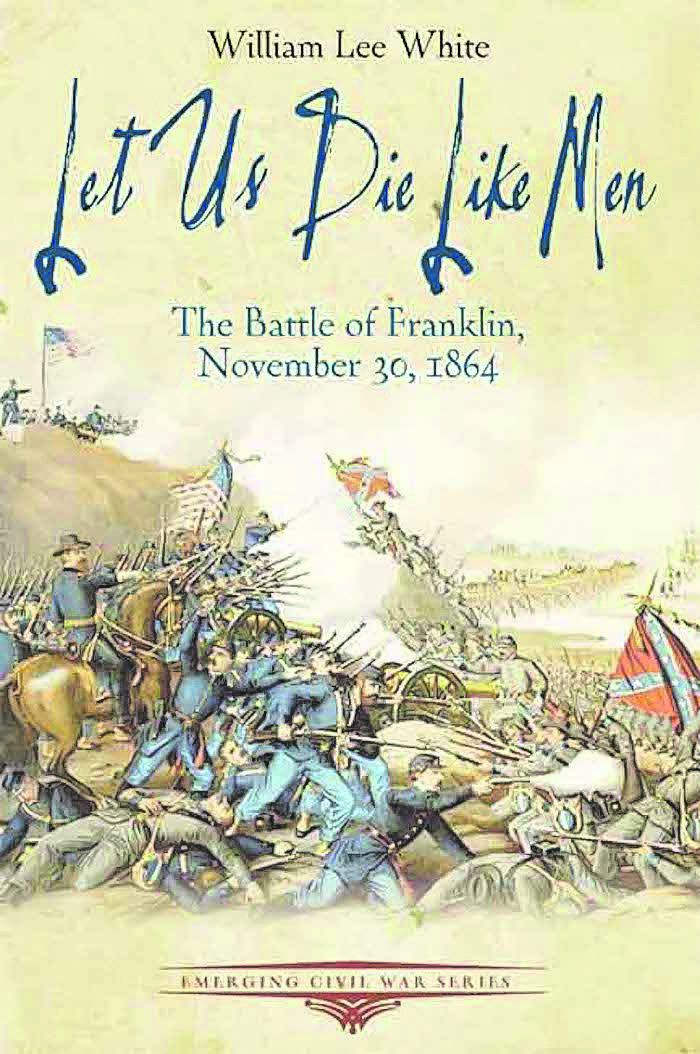
ECW Bookshelf William Lee White’s long-awaited ECWS book on the battle of Franklin is now hitting bookshelves. Let Us Die Like Men: The Battle of Franklin takes its title from a comment made prior to the battle by Confederate Major General Patrick Cleburne. White, author of the ECWS book Bushwhacking on a Grand Scale: The Battle of Chickamauga, says his book on Franklin is the result of a lifelong fascination with the battle, which he has studied astutely for decades. Aside from new maps by Hal Jespersen, the book features appendices on the captured flags of Franklin, artillery, preservation, and Franklin in memory. Let Us Die Like Men is published by Savas Beatie and marks the 28th book in the Emerging Civil War Series.
10 Questions … with ECW’s James Brookes James Brookes is Emerging Civil War’s one-man bureau in England. James, who is finishing his degree in American Studies at Great Britain’s University of Nottingham, has a particular fascination with Civil War portrait photography. You can read his full bio here: https://emergingcivilwar.com/author-biographies/authors/james-brookes/.
ECW News & Notes www.emergingcivilwar.com
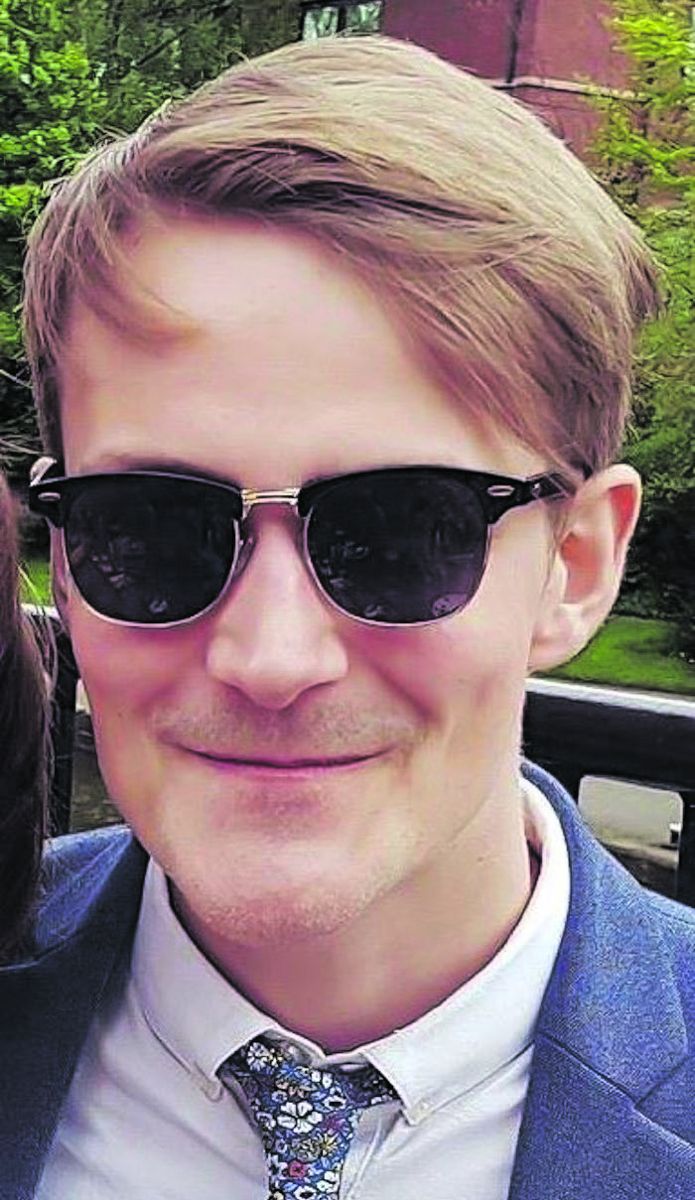
James Brookes As ECW’s “Foreign Bureau,” what does the American Civil War look like from your side of the Pond? Distant, but its reverberations are still felt across the Atlantic. Statues of Abraham Lincoln stand in Westminster, Manchester, and Edinburgh. In the North West, where I grew up, it’s more noticeable. The “Cotton Famine Road,” the result of a project intended to alleviate the effects of the cotton shortages, cuts through the countryside. In Liverpool, the former U.S. consulate stands a few minutes’ walk from the unofficial embassy of the Confederacy. A Union veteran lies in my hometown cemetery.
The war is often internalized to the U.S., which is logical, but we must remember that the conflict occurred in an era of global change: abolition had already been embraced by most nations, but conservatism faced off against egalitarian movements, monarchism rivaled democratic projects, and republican ideals espoused by the U.S. weren’t as exceptionally American as one might think. I recall once hearing the Civil War described as “a universal conflict, fought on an American stage,” and I think that’s a thought-provoking way to consider it. How did you get interested in the war in the first place? Despite what I’ve just said, my entry into the Civil War wasn’t tied to any of these UK-based Civil War touchstones. I was landed with giving a presentation on the war’s impact on the U.S. government in a politics class in high school, and that was my first “serious” engagement with the war. I had applied for American studies programs at university, but I’d been more interested in the colonial period and the early republic. But that small glimpse into the war set something off. I picked up McPherson’s The Battle Cry of Freedom shortly after that presentation, found myself absorbed by his references to the experiences of common soldiers, and within a year or so, if I wasn’t reenacting the War; I was surrounded by a small library devoted to it. Your area of expertise focuses on Civil War-era portrait photography. What do you find so fascinating about those photos? Portrait photographs were potent vessels of personal identity during the Civil War. Much like letters, they were imbued with the hopes and anxieties of ordinary Americans, but they never seem to receive the same attention from scholars. I’ve taken wet-plate photographs and have been the subject of them. From engaging in that process you gain a real appreciation of the planning and labour that went into producing a portrait photograph in the 1860s. It was a ritual. They were a means for Americans to affirm and immortalize their selves when their identities were so in flux, and were so threatened by the specters of death and disability. Not only that, but they had very practical functions. For soldiers, they were used as tokens of home, as mediators of distance, and as surrogates for loved ones they wanted near.
relate to field photography? I think the differences between the two mediums are most fascinating, though they can bleed into one another in some respects. On the one hand, field photography can have a significant anonymizing element to it, unless we’re talking about pictures of historic notables. But throngs of African American refugees, hosts of Union soldiers, crowds of civilians, or heaps of Confederate dead are susceptible to be viewed as masses, rather than as individuals. This is because of the documentary nature of field photography: we know we are viewing a major event when we see so many participants and onlookers. Conversely, in studio photography, you’re usually only confronted with one figure. They are the subject and the focus of the picture, and you have to reckon with their individualism. These soldiers made a conscious decision to have their portraits made: it was proof of their commitment to the cause they fought for, and they fixed themselves into the war’s visual archive. It’s incredible that we have such a diverse grassroots archive to parallel the mainstream record. What are you working on at the moment? I’m working towards completing my PhD. I’ve spent three years working on it at my home institution, the University of Nottingham, and now I’m currently based at the Smithsonian American Art Museum as a research fellow. My project essentially seeks to provide a comprehensive examination of soldiers’ creation and employment of war imagery: graphic arts, paintings, prints, portrait photographs, etc. I look at the ways in which soldiers made use of popular visual imagery, but also their own depictions of the war. From there, I’m examining the extent to which they associated with the heroic traditions of representing warfare. Most do, but some distance themselves in very interesting ways. I mostly focus on Union soldiers, owing to the greater number of archival materials related to them. It’s proved to be a little too ambitious, considering how much great material I’ve pulled up, but I’m really enjoying it. Lightning Round (short answers): Most overrated person of the Civil War? Joshua Lawrence Chamberlain. I admire him greatly, don’t get me wrong: his service record is incredible and he was a true wordsmith. But his post-war writings and political career shone a bright light on his contributions, which were then illuminated further by The Killer Angels and the movie Gettysburg. He’s come to eclipse so many other personalities in the popular understanding of the war. Favorite Trans-Mississippi site? I’ve not travelled west of the Mississippi, yet. I’ve always wanted to visit the Arabia Steamboat Museum in Kansas City, though it’s not strictly a Civil War site (the Arabia sank in 1856). It’s a mammoth time capsule of American material culture from the mid-nineteenth century. Favorite Regiment? The 57th Massachusetts Veteran Volunteers. Formed in 1864, they left camp with over 900 men to fight the Overland Campaign. By August, 47 remained. Their endurance was mind-blowing, and Warren Wilkinson tells their story poignantly in Mother, May You Never See the Sights That I Have Seen. What one Civil War book do you consider to be essential? Drew G. Faust’s This Republic of Suffering. It’s difficult to pick up any Civil War book without being reminded of the war’s enormous toll, but Faust’s book forces you to confront it on a very intimate level. Death’s heightened presence, proximity, and immediacy made it almost inescapable. We should always bear that in mind whenever we engage with the war. What’s one Civil-War related question no one has ever asked you that you wished they would? It’s difficult to pick out one question. My current work forms my greatest interest in the war so I’m fortunate to get asked plenty of questions about what I’m most passionate about. In general, I’d like to see people asking more about the war’s social and cultural history: it allows individuals to approach the war on a grassroots and personal level, which I think is key in generating interesting in accessible ways.
ECW Podcast Dan Welch joins Chris Mackowski as a regular co-host of the Emerging Civil War podcast. Chris spends time chatting with Dan about his Civil War origins, his publications, and his dual life as historian, musician, and educator. Dan is co-author of the Emerging Civil War Series book The Last Road North: A Guide to the Gettysburg Campaign. In January, ECW ran a series on the blog called “Primary Sources:
The Words They Wrote.” In our second podcast of the month, Chris Mackowski and Kris White talked about the use of primary sources in research and writing – a “must-hear” for anyone interested in learning more about how historians work behind the scenes. Plus, Chris and Kris talk about some of their personal favorite primary sources.
Emerging Revolutionary War News Emerging Revolutionary War historians were out and about as December turned to January. Historian Mark Maloy, author of Victory or Death, was at the annual reenactment of the battle of Trenton. He made a stop at the Old Barracks Museum and is pictured with the last copy of his book in the bookstore.
Mark Maloy ERW Historian Bert Dunkerly was one of the event organizers for the commemoration of the January 5, 1781, raid on Richmond, Va., by Benedict Arnold. Although the National Park Service portion of the event was canceled due to the government shutdown, the rest of the day unfolded as scheduled: speakers at St. James Church, where Patrick Henry famously gave his “Give Me Liberty or Give Me Death” speech, van tours of the raid, and drills conducted by reenactors. Approximately 40 people attended and came from as far as New England and the Carolinas. Dunkerly and other Richmond Revolutionary War era historians are looking to conduct similar events and programs in the future, so stay tuned to Emerging Revolutionary War for those updates.