
USS Keystone State in the Civil War
By Joan Wenner, J.D. · Originally published June 2019 · pp. 20–21
USS Keystone State in the Civil War By Joan Wenner, J.D. “Everything is Ours Now” …Union soldier to North Carolinian who pleaded to save her Family Bible Toward the end of the Civil War, Sherman marched from Atlanta to Savannah, through Lee’s beloved South from Columbia, S.C., and on to Fayetteville, N.C., to Averasboro, Bentonville, and finally, Bennett’s Place near Durham Station, where the surrender of General Joseph E. Johnston’s troops virtually signaled the end of the war. The efforts of Federal forces to defeat the South began when old warhorse and General-in-Chief Winfield Scott and young Major
Watercolor by Erik Heyl, 1949, painted for use in his book Early American Steamers, Volume I. This steamer served as USS Keystone State in 1861–65. After the Civil War she returned to civilian use as SS San Francisco. Courtesy of Erik Heyl. (U.S. Naval History and Heritage Command photo # NH 63857)
General George McClellan jostled for mastery of the Army to begin the process of ‘constricting the windpipe’ of the South, as had been sketched out in Scott’s now familiar Anaconda Plan which, like a colling snake, sought to blockade all ports in secessionist states to restrict the flow of military supplies. Historians agree that both sides understood the importance of controlling the ports, inlets, and coastal waters of the ‘Rebel’ states and, in fact, just a week after the bombardment of Fort Sumter in April 1861, Scott’s plan was implemented. Jefferson Davis felt he couldn’t strip the southern coast to reinforce Johnston and Beauregard based on what had happened at Hatteras Inlet, N.C., during early
August 1861, as it was just the beginning. The Federals would ultimately control a good third of North Carolina and a sizable part of the Confederate seacoast, hamper the blockade runners, and eventually command ‘the back door’ to Norfolk. A Southern newspaperman at Raleigh asked dolefully, What does the entrance of the Yankees into our waters amount to? It amounts to this: The whole of the eastern part of the State is now exposed to the ravages of the merciless vandals. New Berne, Plymouth, Edenton, Hertford, Elizabeth City, are all now exposed, besides the whole of the adjacent country… . our state is now plunged into a great deal of trouble. A ‘great deal of trouble’ was an accurate description. When the Union flotilla took Forts Hatteras and Clark at Hatteras Inlet, from then on the Union held the main entrance to Pamlico Sound, closing it to Southern use and allowing Union resupply for bases it would shortly establish. The Federals soon reached the point of applying an “unendurable pressure.” Greatly aiding the Union effort was the USS Keystone State, a Union warship that provided valuable service against blockade runners from 1861 until war’s end in 1865. During almost four years, the USS Keystone State played its part from the beginning of hostilities to the end, enforcing the Federal blockade of the eastern seaboard. This is her story and the theater of war in which she operated. Keystone State was a 1,364-ton side wheel wooden steamer built at Philadelphia in 1853 and employed in passenger and cargo service. In 1861 she was acquired by the U.S. Navy and commissioned the USS Keystone State. Following extensive service in the Civil War, the Federal government sold her in September 1865. Soon thereafter, renamed as the San Francisco, the vessel began a second civilian career that lasted until 1879.
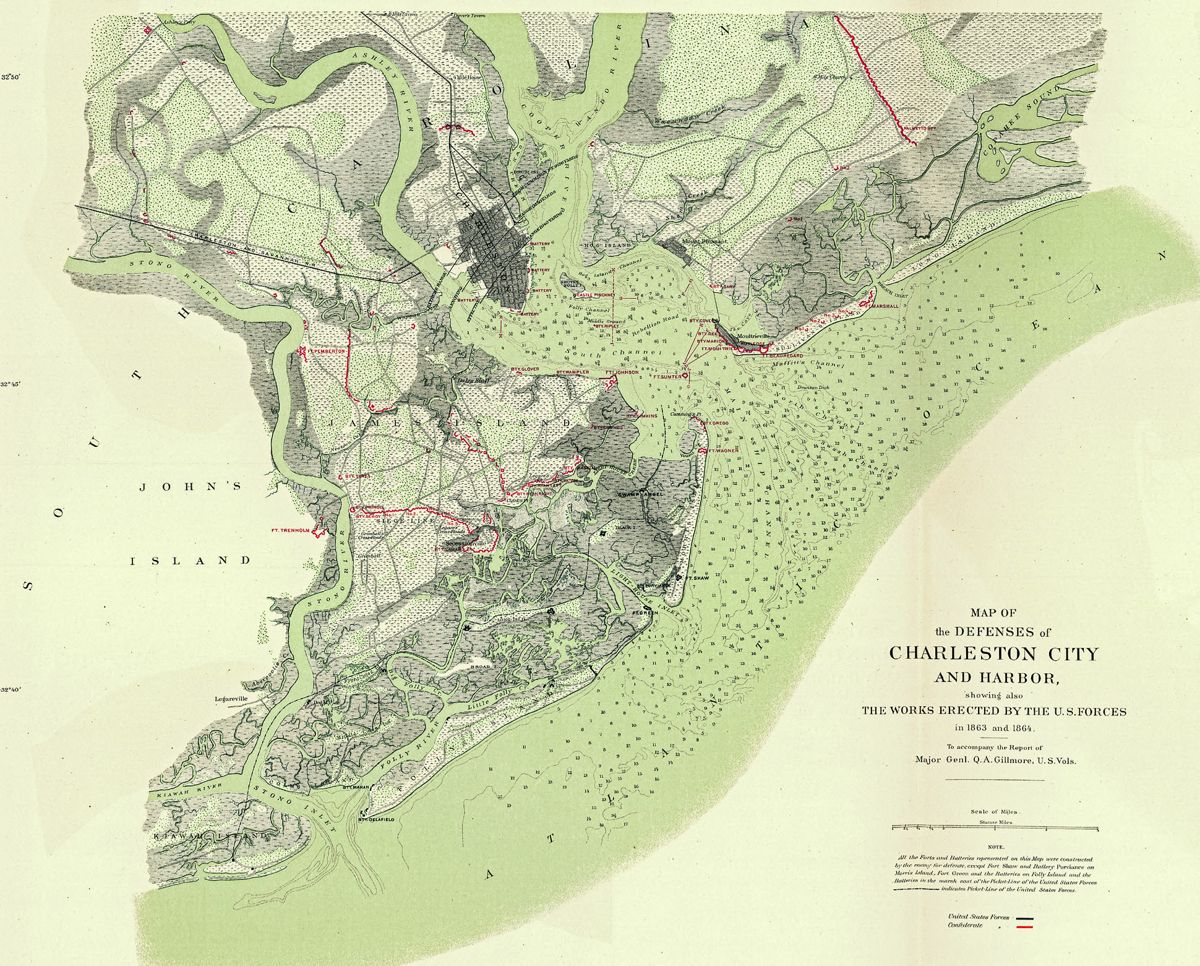
The Ironclads and the Keystone State at Charleston After two years the war returned to the city where it had begun. General Beauregard was now back in South Carolina, in Charleston, where he had drawn a famous “circle of fire” around Fort Sumter, taken the post after a spectacular bombardment, and for a little while Southern spirits were high with much hope and waving of palmetto flags. But it was now a time to be more practical with the Confederacy’s limited resources; Fort Sumter was Beauregard’s to defend, and the war had a new grimness. The Charleston Courier reported on
July 4, 1862, that a painted board was found near a rebel battery with the inscription: “Six miles from Charleston 16th June, 1862. Five minutes to hell.” The Federals had assembled a whole fleet of ugly and menacing warships to use in destroying the fort, the city, “and to kill secession in the place where secession began,” reported the Northern press. Rear Admiral Samuel F. Du Pont had nine new ironclads, seven monitors, with one listed as a low-hulled ‘experimental ironclad’ differently arranged than the regular monitor class ships. This was the USS Keokuk, mounting two 11-inch guns in fixed citadels bow and stern. It was clear to Beauregard), that the Yankees were “tuning up for an attack on Charleston.” It was September 1862 and he was right; Du Pont was ordered to capture Charleston though no exact date was set. Beauregard began improving defenses that were badly sited, incomplete, and poorly armed. New guns went into forts and batteries, floating mines were planted in ship channels at the harbor entrance, buoys were anchored so that gunners at Forts Sumter and Moultrie would know precise ranges. By the winter of 1862, all was ready as Admiral Samuel Francis Du Pont would soon learn. On Jan. 30, 1863, a Federal gunboat nosing around the Stono River, a dozen miles south of the entrance to Charleston, was fired upon and badly damaged by Confederate batteries and hastily surrendered. The next day two lightly armored dim grayblue Confederate rams slipped out past Fort Sumter in the early dawn taking Federal blockaders by surprise. The sortie Beauregard ordered sent the CSS Chicora and the CSS Palmetto State out to target Union ships. This mission occurred on the night of January 30-31, and “became one of the most successful conducted by the Confederate Navy. Its repercussions, the only practical effect of the affair, reverberated for months to come.” The two Confederate warships overpowered the Keystone State and the Mercedita, “forcing their Captains to strike their flags.” One report said it began with the two ironclads moving out of Charleston Harbor in what was a major attempt to break the Union blockade. It was said that thousands of soldiers watched silently shoreside as the two ships, their lights out and their crews at general quarters, slipped over the sandbar at 4:30 a.m. on Jan. 31. The vessels were not sighted by the blockading warships until they attacked. The Mercedita was first struck by the Palmetto State’s ram which tore a hole into her side while its bow gun fired a shell that exploded in the engine room, bursting a boiler which left her adrift. When the crew, finding themselves alone as other Federal ships scattered, made temporary repairs, the Mercedita simply left the area returning when repairs were completed. Meanwhile the Chicora attacked the Keystone State, the wooden merchant steamer ship turned ‘gunboat,’ and hit her setting her afire. The Confederate ironclad was basically impervious to the Keystone State’s four smoothbore guns. As the one-sided fight continued, the Confederate shells created havoc aboard the Keystone State, disabling her engines, and causing many casualties. The recorded history of the clash said the captain considered surrender and lowered her flag, but another account said she was able to limp away from the action with about twenty of her crew dead and as many wounded. With much confusion prevailing, the Keystone State, along with the Mercedita, hoisted their flags again and managed to get away. For a brief time the two rams controlled the sea channel. In short order the blockaders were back on station; the two ironclads, not seaworthy enough to pursue them into offshore waters, returned to Charleston Harbor. It was a victory, however brief, but a credit to the Union ships’ crews for returning the battered vessels to duty quickly. Nonetheless, Du Pont’s superiors were outraged and ordered him to attack Charleston with all the ironclads he could gather. These orders would become a major factor in the next Confederate attempt to break the blockade. It seemed to Du Pont that too much reliance was being placed on the monitors by Washington, but he obeyed orders to send all his wooden cruisers, including the Keystone State, to Savannah or the Gulf to open the Mississippi, leaving two monitors at Charleston. The sluggish and cantankerous ironclads would prove Du Pont right. Confederate batteries were waiting for them. Confederate-held Fort Sumter put up a roaring fight and the following day Du Pont, in consultation with his captains, decided that Charleston could not be taken by the navy alone. The monitors might be almost unsinkable but were complicated pieces of machinery. That conclusion would finally cost him his command. In James McPherson’s 2012 book, War On The Waters, he notes that Lincoln, while praising the Union armies, stated: Nor must Uncle Sam’s webfleet be forgotten. At all the watery margins they have been present. Not only on the deep sea, the broad bay, and the rapid river, but also up the narrow muddy bayou and wherever the ground was a little damp, they have been, and made their tracks.
The main events were the ever-tightening blockade, the fall of New Orleans, and the naval assistance in the campaigns that led to the fall of Vicksburg and Port Hudson and the opening of the Mississippi. Ships like the
USS Keystone State provided support to Union war operations in the field, through ship-to-shore fire, supply convoys, and landing parties, and while on the water they pursued rebel raiders. The Confederate Navy could never hope to match the Union’s numbers, armament, steam power, and technological advancements. Joan Wenner, J.D. has contributed for many years to the Civil War News and The Artilleryman among other history publications and has a law degree. Comments are welcomed at [email protected]