
The Unfinished Fight
Snuff
By Craig L. Barry · Originally published June 2019 · pp. 10–11
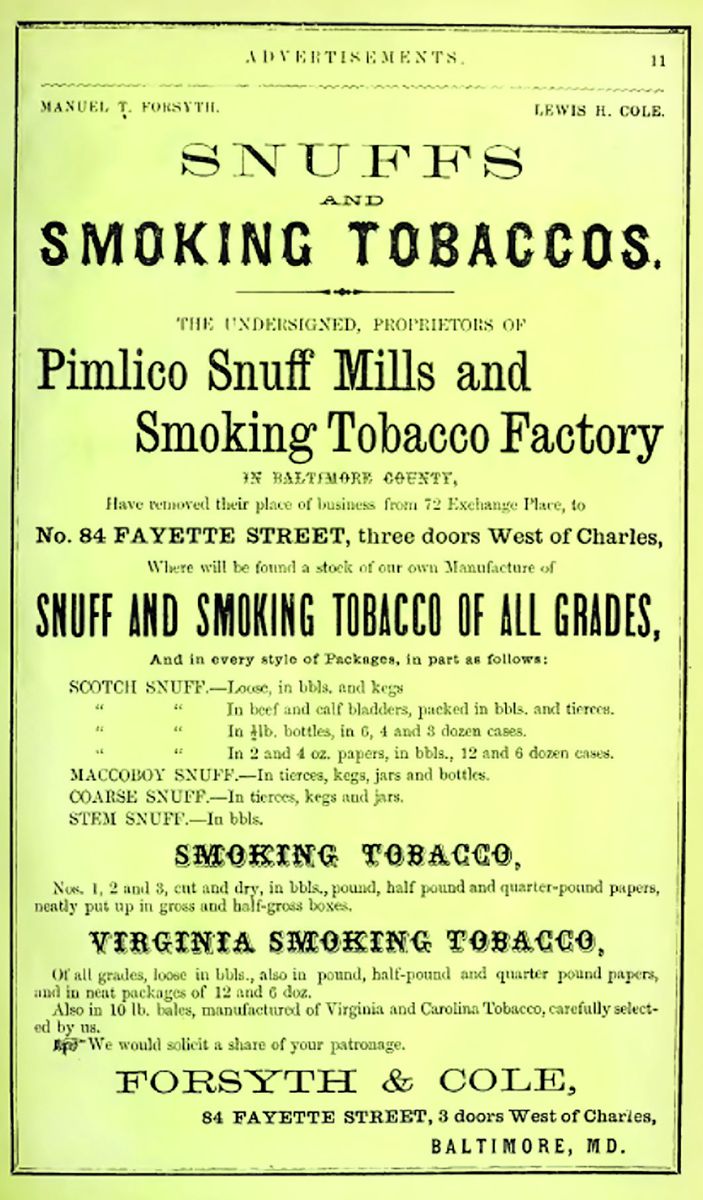
Snuff “Most of the Southern women chew tobacco or ‘dip snuff’ as they call it.”– Thomas P. Nanzig, From Shiloh to Surrender with the 18th Wisconsin The differing ways of consuming tobacco have often mirrored larger cultural trends. One of the more curious aspects of 19th century material culture was widespread use of tobacco by women, particularly in the South. It was not just that the genteel women from below Messrs. Mason and Dixon’s boundary line used tobacco more often than the women from the North, but also the curious methods employed by them to enjoy it. To start with, the Southern states had the climate and soil tobacco requires and, soon after colonization, tobacco was a chief money crop exported to Europe. The earliest uses were, of course smoking, mostly in clay pipes or else chewing, both of which pre-dated American colonization. After the colonial era in America (1776), the use of ground or pulverized tobacco called “snuff” became popular among the European elite. Snuff was considered by many in America to be an aristocratic luxury for “dandies” and somewhat effeminate. American men in general overwhelmingly preferred their tobacco in other forms. For American women, though…it was another story, they preferred snuff and to a lesser degree, cigarettes which were just coming into vogue. On the home front, while entertaining guests after dinner, men might relax with a good cigar while the women would retire to the parlor and dip snuff together.
It was said you could tell a great deal about a lady from her snuff box, apparently the more ornate the better. In the mid-19th century much more than today, social behaviors followed strictly along the lines of gender roles. The prevailing attitude that snuff (like cigarettes) was “not manly,” combined with the pleasant effects of nicotine seem to be the main factors by which Southern women came to partake in it. Snuff can be primarily used two ways; first it can be insufflated or sniffed. When fine powdery snuff is insufflated, it often causes the user to sneeze repeatedly. This was of course, not ladylike. In addition, some women claimed that “sniffing” gave them headaches. Instead coarser, moist snuff was “dipped” or used orally placed between the cheek and gum with a stick tooth brush to dip it out of the can. A period account describes the process:
The usual mode is, to procure a straight wooden toothbrush— one made of the bark of the hickory-nut tree preferred—chew one end of the brush until it becomes soft and pliant, then dab back into the mouth again with the fine particles of snuff adhering; then proceed to mop the gums and teeth adroitly, to suck, and chew, and spit to your heart’s content.”
As noted above, using snuff resulted in the need to expectorate a stream of brown saliva on a fairly regular basis. For those not normally exposed to the sight of women spitting tobacco juice, it took some getting used to. Some women used snuff only in private or when not among men in a social setting, others simply did not care. In the Diary of Caroline Seabury (1854–1863,) she noted,
…after dinner the men were smoking and drinking and the women were dipping snuff. I was asked to join in, but responded that I did not take tobacco (in any form) and they stared at me incredulously. Mrs. Seabury was a native of Massachusetts who relocated to
Columbia, Mississippi, to teach school there, which probably explains it. Charles Willis, an Illinois gentleman traveling in the South noted the following about an attractive young lady on the train from Atlanta to Dalton, Ga., in a letter to his sister:
I noticed that she was constantly spitting some dark colored fluid from her mouth. I thought she had a toothache, and had perhaps something in her mouth to cure it. I looked on the floor and there was a great puddle at her feet, by George it was tobacco juice…I ‘wilted.’ A soldier sitting near me remarked, ‘she is mighty good looking but awful on dipping tobacco’… The practice of tobacco use among women also varied by region and population density in the South, with pipe smoking and chewing (the socalled Virginia habit) more commonly encountered among the less affluent living in rural communities. A Northerner traveling in the South just after the Civil War noted of the class and gender habits of tobacco use that:
…seven-tenths of all persons above the age of twelve years, both male and female, used tobacco in some form. Women could be seen at the doors of their cabins in their bare feet, in their dirty one-piece cotton garments, their chairs tipped back, smoking pipes made of corn cobs into which were fitted reed stems or goose quills. Boys of eight or nine years of age and half-grown girls smoked. Women and (older) girls “dipped” in their houses, on their porches, in the public parlors of hotels and in the streets. The description of Southern women smoking corncob pipes on cabin porches is particularly vivid and tells of their social standing. Women of higher social standing would be very unlikely to enjoy tobacco in the manner described above, and much more inclined to “dip” snuff in private. Apparently women who did enjoy snuff were somewhat protective of the habit or at least defensive about male disapproval of it. The following, which appears to be written by a man (perhaps on behalf of his wife) appeared as an anonymous letter to the editor in an 1862 Houston, Texas, newspaper.
Two letters of your “Local” have within the past few weeks appeared in your paper ridiculing and execrating the habit of “dipping snuff.” I do not pretend to excuse or defend a practice which is of no earthly benefit to the ladies who indulge in it, although it is said that it preserves and purifies the teeth. But I should desire to know what caused the virtuous indignation of “High Private” or “Local” to vent itself of a sudden on “snuff dipping.” “Local” can see the motes in the ladies’ eye, whilst he is not aware of the beams in those of the gentlemen. Before preaching to the ladies, Mr. Local, you ought to reform the gentlemen first; but chewing tobacco is a necessity of life, whilst “dipping snuff” is a nasty, filthy habit. You are aware, Mr. Editor, that smokers find solace and comfort whilst smoking, and ladies ease their mind in the same manner by dipping snuff; it is very hard not to allow them one bad habit, whilst we gentlemen have so many…I, therefore, would suggest that all the ladies who wish to indulge in “snuff dipping” be permitted to do so peaceably and without any interference from the male population, and I am backed up by the opinion of a married friend of mine, who says the only time his wife doesn’t quarrel with him, is when she has got her tooth-brush between her teeth. As far as “bad habits,” snuff usage by women was largely superseded by cigarette smoking by the turn of the 20th century. However, there are still a few people living, especially those with rural Southern backgrounds who may recall “Granny” sitting on her front porch with a tin of snuff and a stick in her mouth spitting brown saliva into a Mason jar. Tobacco related diseases may not have been recognized as such, or may have not been as common as today. There are some possible reasons for this; the mid-19th century smoker was not inhaling chemically treated, nicotine enhanced, and genetically modified tobacco grown in polonine enhanced soil and the wrapper was free from burn rate modifiers. Whatever the case, the broader question remains, “Would it have made a difference?” Craig L. Barry was born in Charlottesville, Va. He holds his BA and Masters degrees from the University of North Carolina (Charlotte). Craig served The Watchdog Civil War Quarterly as Associate Editor and Editor from 2003–2017. The Watchdog published books and columns on 19th-century material and donated all funds from publications to battlefield preservation. He is the author of several books including The Civil War Musket: A Handbook for Historical Accuracy
(2006, 2011), The Unfinished Fight: Essays on Confederate Material Culture Vol. I and II (2012, 2013) and three books (soon to be four) in the Suppliers to the Confederacy series on English Arms & Accoutrements, Quartermaster stores and other European imports.