
The Graphic War
George Washington and the Impending Crisis
By Salvatore Cilella · Originally published June 2019 · p. 22
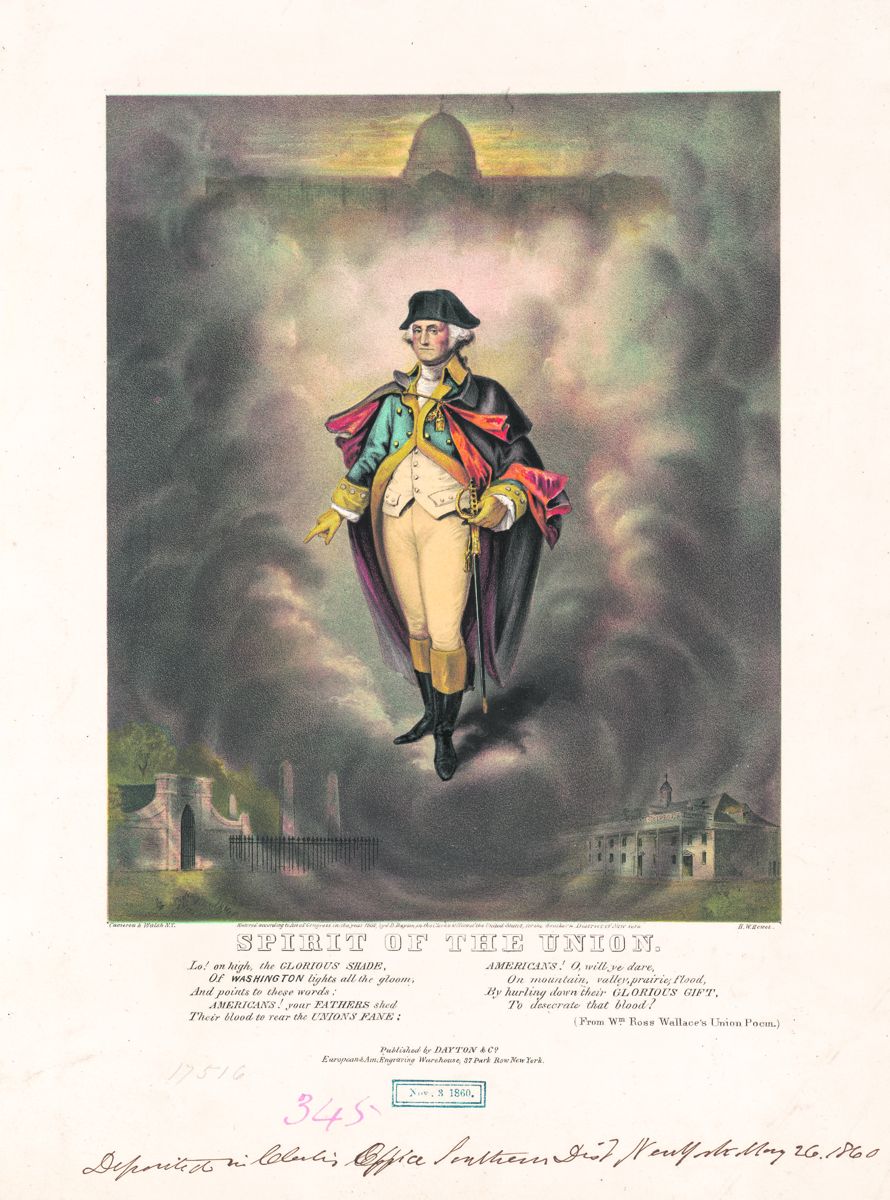
This column highlights prints from the Civil War, discusses their meaning, and most importantly, details what the print maker or artist was trying to achieve. If the United States had a secular saint, it was George Washington. As the country hurtled toward conflict midnineteenth century, voices on both sides counseled against rash action. In doing so, they invoked the image of the father of our country. Both sides eventually felt that not only was God on their side, George Washington was as well. After all, he was a native son of Virginia and the hero of the revolution. Before the war began, Currier and Ives began publishing patriotic prints reminding Americans of our glorious past before, during, and the years after the revolution. The flag and George Washington became abiding symbols of unity, harmony and reason in the increasing hostile atmosphere.1 The tradition of displaying American heroes in print on American walls began immediately after independence. A Russian visitor in 1811 remarked: “Every American considers it his sacred duty to have a likeness of Washington in his home, just as we have images of God’s saints. Washington’s portrait is the finest and sometimes the sole decoration of American homes.”2 By 1860, the meaning of the revolution and the symbol of George Washington became divergent as sectionalism reared its ugly head. Proud Southerners saw their cause as following the spirit of revolution embraced by the father of our country while Northerners saw the birth of the country as a unified entity, blessed by God, and destined for greatness. Both positions became rigid as both sides entrenched. Northern publishers were quick to recognize the potential of bringing visual impact to their readers and subscribers. Currier and Ives was no exception. An employee of Currier’s, John Cameron, free lanced with another lithographer, John Walsh. Cameron, according to Currier scholar, Harry Peters, “deserves much of the credit for the N. Currier and Currier & Ives horses, comics and caricatures.” He was a “brilliant lithographer, a hunchback” and an alcoholic. On his own, and with other collaborators, he produced religious, nostalgic, and a portfolio of views of California before the war.3 In 1860, he published with Walsh a print entitled “Spirit of the Union.” If ever there was any doubt that Washington, had been sanctified, the production of prints showing his apotheosis erased it. Apotheosis, from the Greek meaning to “deify,” became a popular motif for Washington and later Lincoln, showing the two heroes united in heaven. In Cameron’s work he shows a military Washington with sword in hand in a heavenly cloud. Above is the Federal capital, in the lower right corner is Mount Vernon, and the left corner, Washington’s tomb. In the title margin, Cameron quoted lines form a poem by William Ross Wallace, entitled “Union Poem.” “Lo! On high, the Glorious Shade/ of Washington lights all the gloom/ and points to these words: Americans! Your fathers shed their bloods to rear the Union’s Fame.” “Americans! O will ye dare/ on mountain, valley, prairie, flood, / by hurling down their Glorious gift/to desecrate that blood?” It was an obvious play to the better angels of all Americans to resolve their differences peacefully and not through war. It was an appeal to both sides to remember the founding fathers and the sacrifices they made eighty years previously to form a unified country. It was obviously not enough. Sixteen years later, Currier and Ives re-issued the “Spirit of the Union” under its own company name as the country celebrated its Centennial and tenuous “re-union.” 1.
Endnotes:
Bryan F. Le Beau. Currier & Ives: America Imagined. Washington: Smithsonian Institution Press, 2001, 336.
There are numerous works on Washington and his symbolism in American material culture. See Margaret Brown Klapthor and Howard A. Morrison, G. Washington: A Figure Upon the Stage. Washington: Smithsonian Institution Press, 1982; Patricia A. Anderson, Promoted to Glory: The Apotheosis of George Washington. Northampton: Smith College Museum of Art, 1980; Wendy Wick, George Washington: An American Icon, The Eighteenth-Century Graphic Portraits. Washington: The Smithsonian Institution, 1982; Barbara J. Mitnick, ed., George Washington: American Symbol. New York: Hudson Hills Press, 1999. Harold Holzer, Mark E. Neely, Jr. The Union Image: Popular Prints of the Civil War North, Chapel Hill: The University of North Carolina Press, 2000, 26. Harry Peters. America On Stone:
Titled “Spirit of the Union.”
The Other Printmakers to the American People. New York: Doubleday & Co., 1931, 130. See Noble E. Cunningham, Jr., Popular Images of the Presidency from Washington to Lincoln. Columbia, Mo., University of Missouri Press, 1991.
Salvatore Cilella is retired after 43 years in the museum field. His last position was President and CEO of the Atlanta History Center. He is the author of several articles and books. His most recent books are Upton’s Regulars: A History of the 121st New York Volunteers in the Civil War (U. Press Kansas, 2009) and The Correspondence of General Emory Upton, 1856–1881 (U. Tennessee Press, 2017) edited. He is currently editing Till Death do us Part, The Letters of Emory and Emily Upton, 1868–1870 to be published next year by the University of Oklahoma Press.