
Book Reviews
Book Reviews — June 2019
Originally published June 2019 · pp. 38–44
Civil War News book reviews provide our readers with timely analysis of the latest and most significant Civil War research and scholarship. Contact Stephen Davis, Civil War News Book Review Editor. Email: [email protected].
Train Collisions, Drowning, Shipwrecks and More Inglorious Passages: Noncombat Deaths in the American Civil War. By Brian Steel Wills. Notes, bibliography, index. 416 pages. University Press of Kansas. kansaspress. ku.edu. $34.95 hardback. Reviewed by Bruce Stewart
The American Civil War may very well be regarded as the most tragic time in our nation’s history. The loss of life was devastating, as well over 700,000 men and women perished in little more than four years. No region of the country was spared. Historians have taken great care to give an accurate account of the casualties which took place on the field of battle. Lost to the casual reader and often overlooked by the serious scholar was the loss of life from other causes—which carried off two-thirds of the officers and five-sixths of the men in the ranks. Women on the home front were suddenly thrust into a life fraught with danger, and some would suffer the consequences as well. In Inglorious Passages: Noncombat Deaths in the American Civil War, Brian Steel Wills has brought to light the unexpected. Obviously, disease could appear at any time and ravage anyone in its path. Far too often even rudimentary treatments lay decades in the future. But in many cases, Americans met their end in an unforeseen circumstance. Simple accidents were joined by friendly fire, drowning and train collisions. Industrial explosions, naval disasters and disciplinary executions only added to the rolls. Physically, men could see their foe; medically they could not. Even suicide appeared with unsettling frequency. The sheer volume of sick and dying overwhelmed medical care givers and hospitals struggling to handle the influx of patients. Modern pharmaceuticals were non-existent and the concepts of proper hygiene had yet to be discovered. As the war dragged on the sights and sounds of the suffering seemed to have no end. Combining copious research among previously unpublished letters and diaries, Dr. Wills has explored not only the complications of daily routine in camp, but also the experiences of Civil War soldiers, using a wide variety of well-documented cases of noncombat death. Death from contact with the enemy was so much easier to understand. Albert Marshall, a Union soldier serving in the Trans-Mississippi, explained noncombat death this way: “such a serious loss of life in such a manner is far sadder than to see our comrades fall in battle.” Well written and concise, Wills’ Inglorious Passages is a very thorough revelation of new evidence and will be much appreciated by the entire Civil War community. Bruce H. Stewart, Jr., is a past president of the Atlanta Civil War Round Table and author of Invisible Hero: Patrick R. Cleburne (Mercer University Press, 2009).
Northern Home Front Dissent during the Civil War
Contested Loyalty: Debates Over Patriotism in the Civil War North. Edited by Robert M. Sandow. Illustrations, notes, bibliography, index, 328 pp., Fordham Univ. Press, www.fordhampress.com, $65 hardcover. Reviewed by Paul Taylor
Most of the Civil War’s 150-plus-year historiography has focused on the battles, leaders and politics that shaped the fouryear conflict between the Union and the Confederacy. The general impression, therefore, left upon many casual readers throughout the decades and newer students was that both North and South were fully united behind their respective causes. Scholars of the conflict know that nothing could be further from the truth. Both North and South struggled with dissent from almost day-one, as many of each region’s civilians held significantly differing perspectives on what constituted proper patriotism and loyalty. As the war dragged on, both regions were threatened at times with their own violent, internal civil war. In Contested Loyalty: Debates over Patriotism in the Civil War North, editor Robert Sandow has gathered ten new essays from today’s leading scholars. Collectively these ten historians examine distinctly different northern individuals and groups, and how their backgrounds shaped the way in which they defined patriotism and loyalty. In general, these competing definitions of loyalty and patriotism centered on the Lincoln administration’s rationales for fighting the war, its alleged transgressions against civilian
Constitutional liberties, workers’ rights, and whether or not—and how—to utilize free northern blacks in the war effort. Sandow highlights in his Introduction that for many Americans, loyalty was not nationalism. Instead, one’s loyalty was often manifested primarily toward family, community, region or even ethnicity. To counteract such localized perspectives, social elites and men of means established Union League clubs in both major cities and small towns to dictate what they believed were “proper” nationalistic displays of patriotism and “unconditional loyalty.” In addition, these essays show how social class differences, religious affiliation, ethnicity, political beliefs, and gender all created their own fault lines as to how one defined loyalty. In numerous instances, these differences were so contentious that they led to homefront violence. This exceptional volume stretches out far more broadly than the traditional anti-war examination of the Copperheads and/or Democratic Party dissent. Sandow and his authors contend that there were multiple and competing layers of northern loyalties during the Civil War, all of which were heartily contested in speeches, newspaper editorials, sermons, and public letters. That public debate on how one was to properly define and display loyalty is the central thesis of this book. The ten essays begin with analyses of national and state politics. Melinda Lawson examines what the burgeoning American nationalism truly meant. Matthew Warshauer looks at the Connecticut “Peace Democrats” and their narrow interpretations of Constitutional law, followed by Jonathan White’s study of the war victim compensation debates in the Pennsylvania state legislature.
Julie Mujic and Kanisorn Wongsrichanalai follow with two chapters that focus on elite college-educated men and how their station in life shaped their views of loyalty and honor. In a fascinating essay by Mujic, we are offered an in-depth look at competing loyalties through the personal letters of a college-educated Republican abolitionist and his staunch, anti-war Democratic fiancé. Sean Scott explores religious conscience and public loyalty through the case of an apolitical Protestant minister who adhered to a strict separation between church and state and the consequences thereof. Loyalty viewpoints of working-class men and women toiling within war-related industries are then examined by Judith Giesberg and Timothy Orr. The final essays by Ryan Keating and Thaddeus Romansky examine concepts of patriotism and loyalty through the lens of ethnicity and race. Keating discusses Irish-American communities in Wisconsin and Connecticut followed by Romansky’s study of African Americans who served in the Union Army. As historian Gary W. Gallagher points out in his Foreword, these insightful essays illustrate to us just how tenuous the Union cause was at various stages during the rebellion. Moreover, they offer ample food for thought as to how we, the people, may come to grips with wartime concepts of “loyalty” and “patriotism” within our modern era. Paul Taylor is author of seven books pertaining to the Civil War era. His newest book is “The Most Complete Political Machine Ever Known”: The North’s Union Leagues in the American Civil War, published by Kent State Univ. Press.
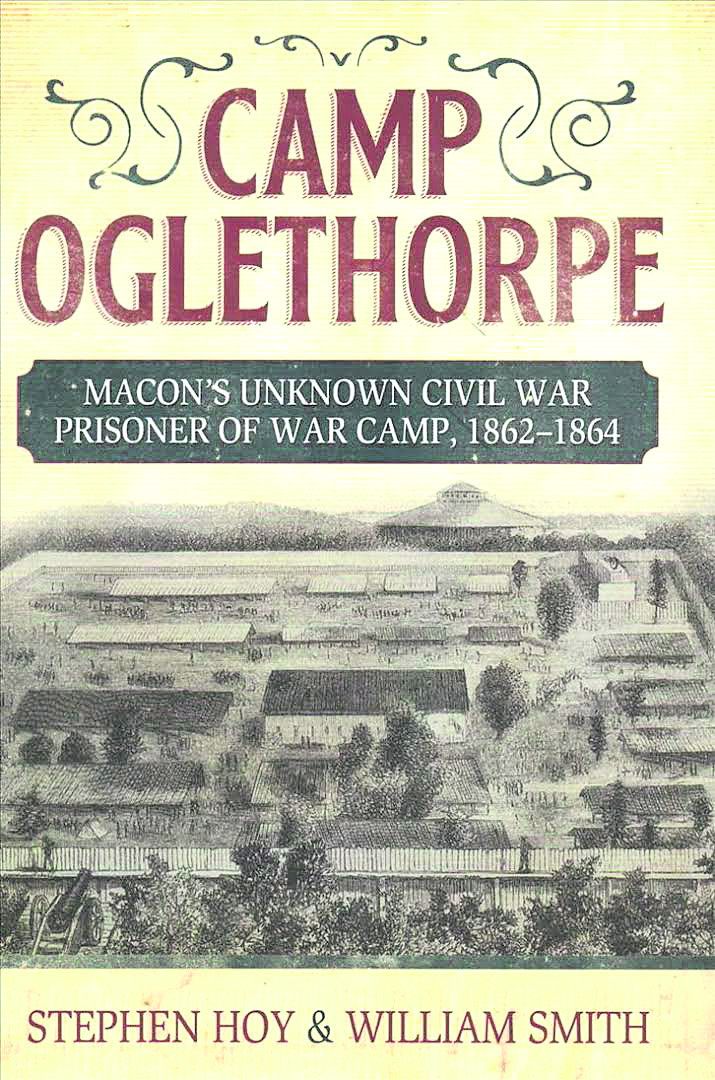
A Prison for Federal Officers Camp Oglethorpe: Macon’s Unknown Civil War Prisoner of War Camp, 1862–1864. By Stephen Hoy and William Smith. Maps, photos, footnotes, index, bibliography, illustrations, prisoner list, 260 pp., 2019. Mercer University Press, www.mupress.org. $35 hardback. Reviewed by Gould Hagler
Camp Oglethorpe may not be unknown, exactly, but it certainly is not well-known, even to Civil War enthusiasts. Relying on prisoner accounts, newspaper reports, government documents and numerous secondary sources related to Civil War prisons and other aspects of the war, Hoy and Smith have provided a solid account of this Confederate prison in Macon, Ga. Camp Oglethorpe, an officers’ prison for most of its history, is not as notorious as, for example, Camp Sumter and Elmira, but like every other POW camp it was an unpleasant place to be, a place where men were underfed and poorly sheltered, a place where all inmates suffered and where many died. Before the war this patch of land in the central Georgia city was used for militia training and agricultural fairs. When war came the site became an army training ground and a staging facility for Georgia companies leaving home to join the fight. Later the prisoners came. Located at the junction of two railroads in the Confederacy’s interior, Macon was a logical place to keep prisoners taken in battle. The authorities hastily constructed a fence to enclose some three acres of the fairground just in time for the arrival of the first prisoners; 838 officers and men marched through the gate on May 4, 1862. Camp Oglethorpe tells much the same story that a history of any Civil War prison camp would tell. Floods of captives overwhelmed the system improvised to accommodate them. From the perspective of the authorities, the questions were how to feed them, house them, guard them? How to treat the many sick and wounded in their midst? And what to do when the breakdown of the exchange system exacerbated the already insoluble problems? And from the prisoners’ perspective, how to survive on the scanty rations, how to stay dry and warm, how to fight the tedium of captivity? And, of course, how to escape? Hoy and Williams’ book covers more than the prison itself. The reader learns about two cavalry raids, Stoneman’s in the summer of 1864 and Wilson’s the following spring. In addition to his primary mission of wrecking the railroads south of Atlanta, Stoneman tasked himself with freeing the prisoners in Macon and Andersonville. Instead, he and many of his men found themselves captured and penned with the men they hoped to liberate. The chapter on Wilson’s Raid tells of the more successful expedition that ended in Macon as the war reached its conclusion. No one would deny that prisoner-of-war camps were places of immense suffering. However, in their final chapter the authors advise that prisoner accounts should not be accepted uncritically. “Stories were often exaggerated,” they warn, “and facts embellished.” They quote a Michigan cavalryman held at Camp Sumter, who read several accounts written by his comrades and wrote that he was “surprised at the free-lance recklessness of description.” According to this final chapter, some 670,000 men were captured in the war. Of these, 400,000 spent at least some time in prisons, and 56,000 of these died. Camp Oglethorpe tells the story of one of these prisons, one of the 150 such places where Americans were held in captivity by their former—and future— fellow citizens. Gould Hagler is a retired lobbyist living in Dunwoody, Ga. He is a past president of the Civil War Round Table of Atlanta and the author of Georgia’s Confederate Monuments: In Honor of a Fallen Nation, published in 2014. Hagler speaks frequently on this topic and others related to different aspects of the Civil War and has been a regular contributor to CWN since 2016. He can be reached at [email protected].
Slave Refugee Camps Get Much Needed Scholarly Attention Embattled Freedom: Journeys through the Civil War’s Slave Refugee Camps. By Amy Murrell Taylor. Images, maps, notes, bibliography, index, 368 pp, 2018. University of North Carolina Press, www.uncpress.org. $34.95 hardcover. Reviewed by Tim Talbott
While seemingly almost every aspect of the Civil War era has received a fair share of scholarly examination, one significant yet largely ignored facet is finally getting much deserved attention. Until recently, outside of a handful of books and articles, a true gulf in scholarship existed on the experiences of those in the war’s slave refugee camps. Jim Downs helped with his book, Sick from Freedom: African American Illness and Suffering during the Civil War and Reconstruction (Oxford, 2012), which explores a specific thread of the camps. Chandra Manning helped fill this void too with her recently published Troubled Refuge: Struggling for Freedom in the Civil War (Knopf, 2016), which examines how the war’s fugitive slaves reworked emancipation as a Union war aim, and then challenged the idea of who was to be considered a citizen in the war’s aftermath. Now, with Amy Murrell Taylor’s new contribution to this growing body of study, Embattled Freedom: Journeys through the Civil War’s Slave Refugee Camps, even more light is finding its way to this underexposed historical topic. Referred to during the conflict as “contraband camps,” these often fluid and makeshift settlements popped up in almost every area where the Union military showed its might and held its ground for any length of time. Found in almost every seceded and border state by war’s end, the 300 or so refugee camps could be places of unbridled hope at some points, yet deadly discouraging and dangerous places at other times. What largely separates Embattled Freedom from previous studies is that in it Taylor provides a more complete groundseye view into the everyday happenings of the slave refugee camps. As one would expect, the experiences varied greatly among the estimated 500,000 men, women, and children who fled slavery and who found varying degrees of freedom during the four years of the Civil War. Refugees encountered a diversity of problems, opportunities, dangers and dilemmas, depending on where they were from, and thus where their refugee camp materialized; when they arrived; what they were able to bring with them, both materially and in skills; whom they encountered and those peoples’ attitudes toward African Americans; and what they were tasked to do for service with the United States military, Taylor insightfully tackles many of these refugee camp issues by viewing them through the lens of three individual case studies. These three examples not only help the reader better understand the experiences of particular refugees, but also helps show how perhaps the refugee camps may have differed due to geographical location, and most importantly gives us their experiences from their own perspectives. Taylor skillfully weaves the book’s eight chapters around the personal stories of Edward and Emma Whitehurst, wouldbe shopkeepers in southeast Virginia; Eliza Bogan, an army laundress in Helena, Arkansas; and Gabriel Burdett, an aspiring minister at Camp Nelson, Kentucky. The eight chapters of the book discuss the myriads of concerns experienced by refugee men, women and children. In “Securing Work,” the author explains through the Whitehursts’ story that the challenges faced in transitioning from a forced labor system to a monetary wage labor system, especially during time of war, was not always smooth. In “Finding Shelter,” we discover that locations allocated for refugees were the ones least desired by the military, and that finding relatively permanent shelter was a constant struggle for refugees. “Confronting Removal” examines the common occurrence of putting distance between soldiers and refugee communities, often due to perceived negative racial influences. “Facing Combat” shows the many ways that refugees contributed to slavery’s demise, both inside the Union military and out. “Battling Hunger” and “Clothing Bodies” also spell out other practical, yet life-threatening challenges faced by refugees, while finding ways of “Keeping Faith” and “Grappling with Loss,” although perhaps less tangible, were in many cases just as important for refugee survival. With Embattled Freedom: Journeys through the Civil War’s Refugee Camps, Taylor gives us the book that many of us have been waiting for. Its particular approach to the subject matter, thorough research, and keen writing ensures that it will maintain a place in Civil War history for years to come as a source of better understanding the slave refugee camp experience. Tim Talbott is the Director of Education, Interpretation, Visitor Services, and Collections at Pamplin Historical Park and the National Museum of the Civil War Soldier in Petersburg, Va. He is currently researching the various combination of elements that led to emancipation.
D. Solid shot heated in a furnace to set fires among wooden targets. E. A place of refuge from artillery fire. F. A road surface constructed of small tree trunks, laid down in muddy or swampy areas. G. An inferior wool that fell apart soon after issue, used in early Union uniforms. H. Soldiers incapacitated by wounds or sickness but still on duty. I. An elevated area on the outskirts of Fredericksburg, Va. J. A nickname for newspaper correspondents who traveled with an army. Answers found on page 42. Steve Davis is the Civil War News Book Review Editor. He can be contacted by email at: [email protected].
A First-hand Account of the Daily Life of Soldiers in the Army of Northern Virginia
A South Carolina Upcountry Saga: The Civil War Letters of Barham Bobo Foster and his Family 1860–1863. Edited by A. Gibert Kennedy. Maps, photos, notes, index, 360 pages, 2019. University of South Carolina Press, www.sc.edu/uscpress. $49.95 hardbound. Reviewed by Tom Elmore
The Foster family first arrived in upstate South Carolina in the 1790s. By the 1820s the family owned a successful (and still-standing) inn and tavern in what is now Spartanburg (John C. Calhoun was a frequent guest) as well as a plantation in Cross Anchor, S.C. Barham Bobo Foster was born in the tavern in 1817. Twenty years later he was married and had settled down on a plantation near Glenn Springs, S.C. He served in the state militia, the South Carolina state legislature and was a county treasurer. The letters start with the South Carolina Secession Convention in Charleston in December 1860 and are written primarily by Foster, who served as a lieutenant colonel in the Confederate Army, and by his sons Capt. Lewis Perrin Foster and Corporal James “Tony” Anthony Foster. They are arranged chronologically. In the earliest letters we see the sons training in Charleston and Columbia. As was typical of letters written in this very early stage of the war, they are full of bravado and optimism. Upon his arrival in Virginia, Lewis wrote, “I have never seen such soldiers than I have of the confederate army. Most of them volunteers for 2 years or the war. They seem resolute and determined to do or die. They never seem to doubt their success and I don’t think such men can be whipped at all.” Interestingly, Lewis makes note of a female drill officer from a Zouave regiment. But as the war goes on, things did not go as well as the men expected. Perhaps no other topic takes up more of the letters than the subject of disease. The writers and/or the men in their units contracted just about every illness one could imagine: the measles, mumps, typhoid, diphtheria, dysentery, etc., which took the lives of many of their comrades in arms. Also, price gouging was a common occurrence, both at home and in camp, while requests for clothes and swords were frequent. Food was a constant problem as well. Anyone looking for new insight into any of the major figures of the war will be disappointed, though Gen. P.G.T. Beauregard’s name is constantly misspelled as “Boureguard.” The letters to home end on December 10, 1862, prior to the battle of Fredericksburg. Lt. Col. B. B. Foster resigned his commission in late Januaryearly February 1862 for medical reasons. Tony was killed in action at the battle of Maryland Heights on September 13, 1862, while Capt. Lewis Foster was killed in action at Fredericksburg. The last letters from Lewis read like they were written by a different person from the one who boasted about the Confederate army a year and a half earlier; the grim realities and uncertainties of war had set in. On the whole, this collection of letters gives a fascinating and interesting look into the Army of Northern Virginia in the war’s early years from the eyes of men living in camp. Anyone interested in life in the Confederate army should read this book. Tom Elmore’s family has lived in South Carolina’s upstate for over two centuries, and it is very likely that some of his ancestors knew some of the people mentioned in this book. Currently Elmore is studying the lives of Irish and Scottish immigrants living in his home town of Columbia during the antebellum period.
Book with Three Stories About One Place Palmito Ranch: From Civil War Battlefield to National Historic Landmark. By Jody Edward Ginn and William Alexander McWhorter. Maps, photos, index, bibliography, endnotes, 116 pp., 2018. Texas A & M University Press, www.tamupress.com. $26 flexbound. Reviewed by William Bozic
If asked, many Civil War buffs would say the last battle was fought at Appomattox Courthouse, but the final battle of the epic struggle was fought on May 12 -13, 1865 on and around a hill overlooking a strategic bend in the Rio Grande River. In eight chapters authors Jody Edward Ginn and William Alexander McWhorter tell the stories of the battles and preservation efforts at this site, as well as settle on the proper name of “Palmito Ranch” for the location which has been known as Palmito Hill, Palmetto Ranch and Palmetto Hill.
In 2001 Philip Thomas Tucker published The Final Fury: Palmito Ranch, The Last Battle of the Civil War. Tucker’s work was the first book to deal exclusively with this subject, but according to the authors, Tucker’s groundbreaking work fell short from its lack of support for some assertions with primary evidence. In 2002 Jeffrey William Hunt authored The Last Battle of the Civil War, which was exhaustively researched and documented, and probably would have been the last word on the topic, except that Hunt did not have access to the John S. “Rip” Ford papers held at the Haley Memorial Library in Midland, Texas. Jody Edward Ginn and William Alexander McWhorter researched the Ford papers and discovered that another, previously unknown battle had been fought at the site on September 6-12, 1864. This important and intriguing battle involved Union troops aided by Mexican artillery under command of Juan N. Cortina firing across the Rio Grande. The Confederates won the battle and captured some of Cortina’s Mexican troops. According to the authors, there are documents in the Ford papers to show that Juan Cortina’s soldiers were sent to a POW camp near Houston, Texas. Ginn and McWhorter aptly state the shortcomings in their narrative at the end of the chapter: “while far more research is necessary to fully understand this battle and the forces that fought there, the work to date demonstrates the forgotten battlefield’s significance and how it adds to the nation’s understanding of the Civil War through its military, multicultural, and international aspects.” This reviewer also felt a map showing the approximate positions and units during the battle would have been a big help. The May 12-13, 1865 battle involved the 62nd U.S. Colored Troops, 34th Indiana Volunteer Infantry and 2nd Texas Cavalry (US) vs. John Ford’s troops, predominantly consisting of Giddings’ and Carter’s battalions of Texas Confederate Cavalry, which included “Tejanos, American Indians, Anglos, Portuguese, Irish, Germans, Africans, and Danes” of military age. Ginn and McWhorter debunk many of the myths of the battle. They specifically address Colonel Barrett’s leadership of the 34th Indiana, Confederate flanking movements, the steadfast coverage of the Federal retreat by the 62nd U.S.C.T. They take particular notice of the Texans’ zeal and bravado in fighting for a cause that by then they knew was lost. Pvt. Ferdinand Gerring of Carter’s Texas Cavalry Battalion (who was mortally wounded) and Pvt. John J. Williams of the 34th Indiana are denoted as the final Confederate and Union casualties of the war. The third aspect of this book is the battle after the battle to save the battleground, involving a number of government agencies, private landowners and various Texas state agencies. McWhorter and Ginn were integral parts of this process due to their association with Texas state agencies. They give amazing insight into the details of what it took to have this long neglected and vandalized battlefield, which still retains its physical integrity, to be both preserved and interpreted. Those interested in battlefield preservation will find a great case study, complete with twists, turns and unexpected events, which could serve as a guide for future projects. There are plenty of color photos in this section, as well as pictures of some of the historical markers and their locations from the past to the present, so readers who may not be able to travel to this remote location can get an impression of what it is like. William Bozic is currently a seasonal employee of the National Park Service assigned to Minute Man National Historical Park. He is in the final stage of researching for his book Indianola Incidents: The Union Occupation of Indianola Texas 1863-4. William and his wife Julissa are the parents of four children and owners of one Labrador/ Husky with a severe case of ADHD.
Joseph and Sandy Holt: Intersecting Lives Slaves, Slaveholders and a Kentucky Community’s Struggle Toward Freedom. By Elizabeth D. Leonard. Notes, bibliography, index, 178 pp. 2019. University Press of Kentucky, kentuckypress.com. $50 cloth. Reviewed by Wayne L. Wolf
Holt’s Bottom, Breckenridge County, Kentucky produced both Joseph Holt, Abraham Lincoln’s Adjutant General, and Sandy Holt, one of the Holt family slaves. Using the lives of these two men, Elizabeth Leonard attempts to use Holt’s Bottom as a microcosm for viewing Joseph Holt’s transformation from an aristocratic slaveholder in Kentucky’s elite class to an ardent abolitionist—a proponent of the Union and full citizenship and equality for Black Americans. Sandy Holt is the runaway slave of the Holt family who joins the 118th U.S.C.T. and fights as a private for his freedom throughout the war. Joseph Holt’s ardent attachment to the Union and his evolving hatred for secessionists and slavery propel him into a high profile and influential role as an opponent of both slavery and white supremacy. While this position ingratiated him to Abraham Lincoln and Radical Republicans in Congress, it alienated him from his family, his roots and even his early views on slavery. Sandy Holt’s story is characterized as a representative struggle for freedom for all blacks. His military service included the battle of Dutch Gap, Va. as well as various assignments guarding railroads and fortifications while battling disease and squalid living conditions. After the Civil War, Joseph
Holt remained Adjutant General until his retirement in 1875. He then continued as an advocate for full citizenship rights for Black Americans and their protection from discrimination. He employed several of his former slaves and even purchased homes for them. Conversely, Sandy Holt, after his discharge in February 1866, returned to Breckenridge County, resumed farm labor, married and started a family. In 1885 he began applying for a disability pension due to war-related illnesses. The pension was finally granted in 1896, three weeks after his death. Sandy’s widow, Sarah, was left indigent and survived on a widow’s pension until her death three decades later. Elizabeth Leonard uses the story of these two men to focus on the different paths their lives took before, during and after the war. The essence of the book’s message is thus how white America needed to adjust to a new world of black equality and how tension between these two communities intersected and needed to be resolved. While thoroughly researched, this book fails to fulfill its aim of explaining how Kentucky struggled to reconcile these differences. Short biographical snippets of other members of the 118th U.S.C.T. never go beyond family data to address the complexities of reconciliation. For a more thorough understanding of the aftermath of the war on Kentucky, two books are highly recommended: Anne E. Marshall’s Creating a Confederate Kentucky (2010) and Marion B. Lucas’ A History of Blacks in Kentucky: From Slavery to Segregation (2003). Additionally, Leonard flirts with fictional writing when she hypothesizes what the characters thought, meant and felt without any historical evidence to support her conclusions. Leonard’s book is a welldocumented look into the two intersecting lives of Joseph and Sandy Holt, but at a cost of $50 it would be justified only for those specializing in regional history.
Wayne L. Wolf is Professor Emeritus at South Suburban College in Illinois and the author of numerous books and articles on the Civil War. He currently is seeking previously unpublished letters and diaries that tell the story of the common soldier.
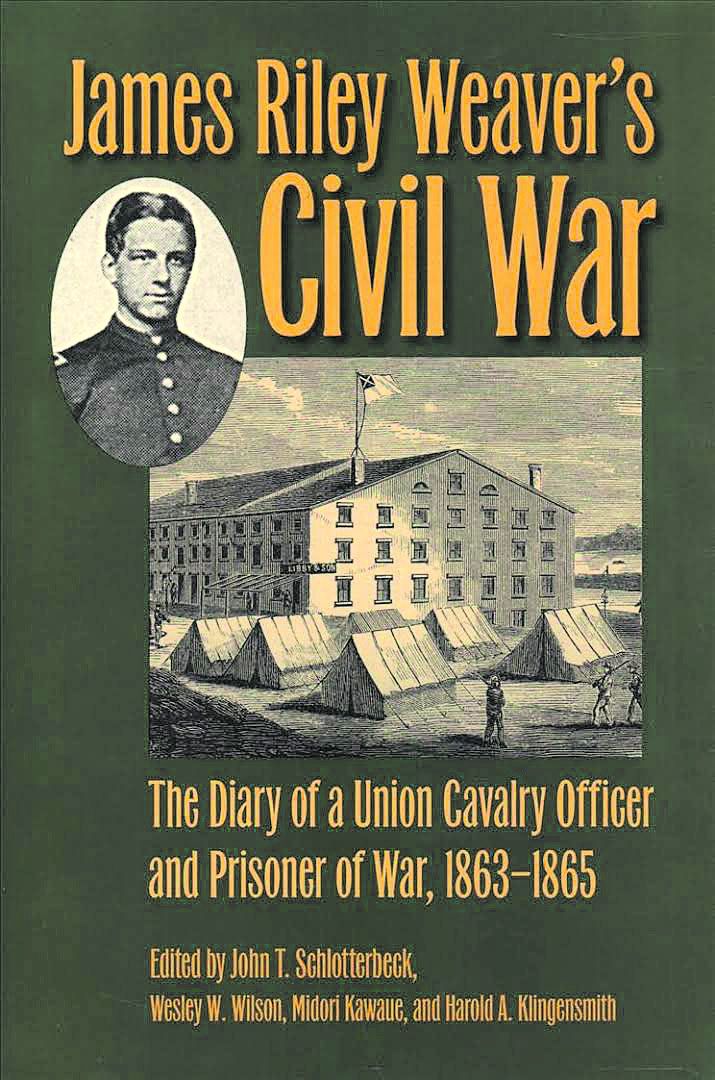
A Fascinating First-hand Account of Pure Hell James Riley Weaver’s Civil War: The Diary of a Union Cavalry Officer and Prisoner of War, 1863–1865. Edited by John T. Schlotterbeck, Wesley W. Wilson, Midori Kawaue and Harold A. Klingensmith. One appendix, notes, select bibliography, index, biographical chronology, 352pp., 2019. Kent State University Press, www.kentstateuniversitypress.com. $49.95 cloth. Reviewed by David Marshall
James Weaver, son of a Pennsylvania farmer, fervent Methodist and educator, enlisted as a private in the 18th Pennsylvania Cavalry in October 1862 on his twenty-first birthday. This brave man was quickly promoted to sergeant major, second lieutenant and first lieutenant. Every evening from June 1, 1863 to April 1, 1865, Weaver wrote an account of his day in his leather diary, with observations on activities, people, and the state of his health and mind. He thus provides 666 days of diary entries that document the life of a Union officer during the conflict, in which he was held in seven Confederate officers’ prisons, including Libby Prison in Richmond. Captured on October 11, 1863 at Brandy Station, Weaver was sent to Libby. While officers received better treatment than privates, they also suffered the psychological and physical consequences of lengthy confinement.
Publishers: Send your book(s) for review to: CWN Book Review Editor Stephen Davis 3670 Falling Leaf Lane, Cumming, GA 30041-2087
In his accurate and detailed journal, the well-educated soldier tells the story with poignant vignettes of anguish and death. Weaver records war news, exchange rumors, civilian visitors, escape plots, comments on prison guards, mock elections and social pleasures. Libby Prison, however, was but the initial and the lengthiest (October 1863-May 1864) of Weaver’s seventeen months as a POW. This time included Danville, Virginia (May 1864); Macon, Georgia (MayJuly 1864); Charleston, South Carolina (July-October 1864); and Columbia, South Carolina (October 1864-March 14, 1865; released from Camp Asylum). He offers detailed explanations of the landscape of incarceration at each location. He tells fascinating stories of new prisoners and recaptured escapees. Even brief moments looking at the free countryside through windows of railroad cars revealed a little of the outside world which helped Weaver to survive. His diary ends with his conditional release in March 1865, his repatriation and measured transition from soldier to civilian. A fascinating first-hand account of pure hell, James Riley Weaver’s Civil War tells how one man survived it. It is moving, informative, detailed and vivid. A real plus is the book’s twenty-seven illustrations Additionally, readers will gain from reading the appendix: Weaver’s “A Phi Psi’s Christmas in Libby.” There are many books on the horrors of the Confederate prisons, but James Weaver’s diary stands out for its graphic detail of what he suffered. This intense, eloquent account based on Weaver’s prison diary is pricey, but a must-read for students of the subject. David Marshall has been a high school American history teacher in the Miami-Dade school district for the past thirty-two years. He is president of the Miami Civil War Roundtable Book Club.
The Iron Horse: Lincoln’s Long-time Friend New York and the Lincoln Specials. By Joseph D. Collea. Illustrations, maps, appendices, chapter notes, bibliography,index, 295 pp., 2018. McFarland, www.mcfarlandpub.com. $39.95 softcover. Reviewed by Richard J. Blumberg
After completing his term in Congress, Abraham Lincoln returned to his Illinois law firm. Tired of being a junior partner without much hope of career advancement, Lincoln asked his partner William Herndon to join him in private practice. In the early 1850s, Lincoln focused on railroad case law. During the middle to the end of the 1850s, Lincoln was regarded as one of Illinois’ premier railroad attorneys. In addition to case law, railroads played a significant role throughout Lincoln’s life. He traveled by rail from Springfield, Ill. to Washington to assume the presidency. After the first battle of Manassas, Lincoln accurately assessed railroads as a strategic tactical and logistical tool of warfare that would directly affect the conduct of the Civil War. Ultimately, the railroad would transport him back home for burial. Collea’s work is unique. It documents two special train rides that Lincoln took through the state of New York. Although this work has a very narrow focus, it achieves its goal of comparing and contrasting two presidential rail trips. The first trip, a 1,631-mile, 83stop journey from Springfield to Washington, enabled Lincoln to accept the presidency. It was filled with joy, anticipation and exhilaration. Collea provides background information on logistical issues and crowd responses at the various towns where the train stopped. The second trip was the funeral train taking Lincoln back to Springfield from Washington. It was full of sadness and mourning, as the great leader was being escorted to his final resting place. Details about both trips were gleaned from a variety of newspaper accounts, diaries, memoirs and other primary sources. Collea’s use of illustrations and maps is very effective. He provides his readers with an inside view of what it was like to be a passenger on these trains, or the local citizens awaiting the train’s arrival at the various stations. Railroad enthusiasts will enjoy the detailed narratives about railroad operations, logistics and security issues. The Empire State is an interesting choice to focus on since New York made significant contributions to the Civil War in both men and materiel. Additionally, the state was a hotbed for abolitionist activities and the location of several terminal points of the Underground Railroad. This reviewer is not aware of any other work similar to this one, and Collea’s extensive research makes this work compelling. Richard Blumberg, of Spring Tex., is entering his eighteenth year as a book reviewer for Civil War News. His current research focuses on the contributions of music during the Civil War.
“Hidden evidence, a look inside” Civil War Artillery Projectiles – The Half Shell Book. By Jack W. Melton Jr. Full color photographs, glossary, bibliography, selected patents, index, 392 pp., 2018. Historical Publications LLC. www. ArtillerymanMagazine.com. $89.95 hardbound. Reviewed by Peter A. Frandsen
What immediately strikes the reader opening this fabulous book is the graphics on virtually any page. The illustrations are large, sharp, clear, detailed and most importantly, highly informative. At the same time they are almost works of art and are the best yet in any artillery book. What is amazing is that the majority of the photographic illustrations consist of artillery projectiles expertly cut in half showing the working contents of the mean part of the artillery weapons system, a subject one might have presumed to be somewhat boring. Not so, and certainly not so after reading this book. The projectile is the real working part of artillery. To the uninformed viewer, from the outside most Civil War-era projectiles look pretty much the same—stained brownish-black balls or pointed cylinders with maybe a fuse opening, a joint line, and some other odd bits and markings. Cleanly bisected, one can see how complicated these projectiles were, thus providing real insight into not only how artillery works, but the materials, design and manufacturing science of mid-19th century America. It shows the amazing variety of products and ingenuity of American (and some European) inventors to increase the efficiency of an artillery system designed to control the battlefield with firepower. The focus here is on what is inside the projectile, especially the all-important payload. This information clearly validates the book’s promotional tag line that is no puffery: “hidden evidence, a look inside.” Usually, each projectile gets a page with one or more illustrations and text; however, the more important projectiles receive several pages with multiple illustrations, lengthier text, and a copy of the original patent filed with the government as appropriate. The late Cleveland “Corky” Huey of South Carolina cut most of the projectiles over a twentyyear span. He used a band saw and very, very carefully cut the projectiles in half, sanded, and then coated the exposed surfaces to protect them. His machine shop work was also a work of art as shown by photographs. As author Col. John F. Biemeck (Ret.) warned repeatedly in his massive multi-volume Encyclopedia of Black Powder Projectiles, dissecting or playing with loaded projectiles is extremely dangerous and should be undertaken with only the greatest caution. Many people are deservedly credited with advancing the study of these projectiles, but Jack Melton has brought it all together. There are a total of 850 modern and historical photographs, drawings, radiographs and original patents. The author, and his indefatigable wife Peggy, took the photographs with studio-quality results. Reproduction is of high quality. The photographs, with their captions and tags, impart abundant information about the projectiles; the accompanying text adds more. The primary source material for this book is its subject: the actual shot, shell, fuses and associated implements. Second, copies of the original patents are used to enhance and explain the projectiles. Third, published accounts including manuals, official reports and histories of the designers, manufacturers and end-users add further detail. Finally, some battle histories and secondary sources round out the story. All of this is reflected in the extensive footnoting and bibliography. Full disclosure must be made by this reviewer, who assessed the book’s extensive bibliography prior to publication. Jack W. Melton Jr., author of The Half Shell Book, publishes Civil War News and The Artilleryman magazine. The author modestly entered the artillery projectile writing business with Melton & Pawl’s Guide to Civil War Artillery Projectiles (1996) by Jack W. Melton Jr. & Lawrence E. Pawl, along with their earlier Introduction to Field Artillery Ordnance, 1861–1865 (1994). This new work clearly surpasses the earlier ones in both detail and weight of material. This large-sized and weighty (literally) work is printed on glossy paper, further insuring high-fidelity reproduction of photos and artwork. The Half Shell Book is essential to anyone interested in Civil War-era artillery or armament engineering. It raises the bar for serious illustrated military reference works. Peter A. Frandsen, of Silver Spring, MD, writes the regular column “The Artillery Bookshelf” for The Artilleryman Magazine.