
Critic's Corner
Allen Tate’s Stonewall Jackson: The Good Soldier (1928)
By Stephen Davis · Originally published June 2019 · p. 40
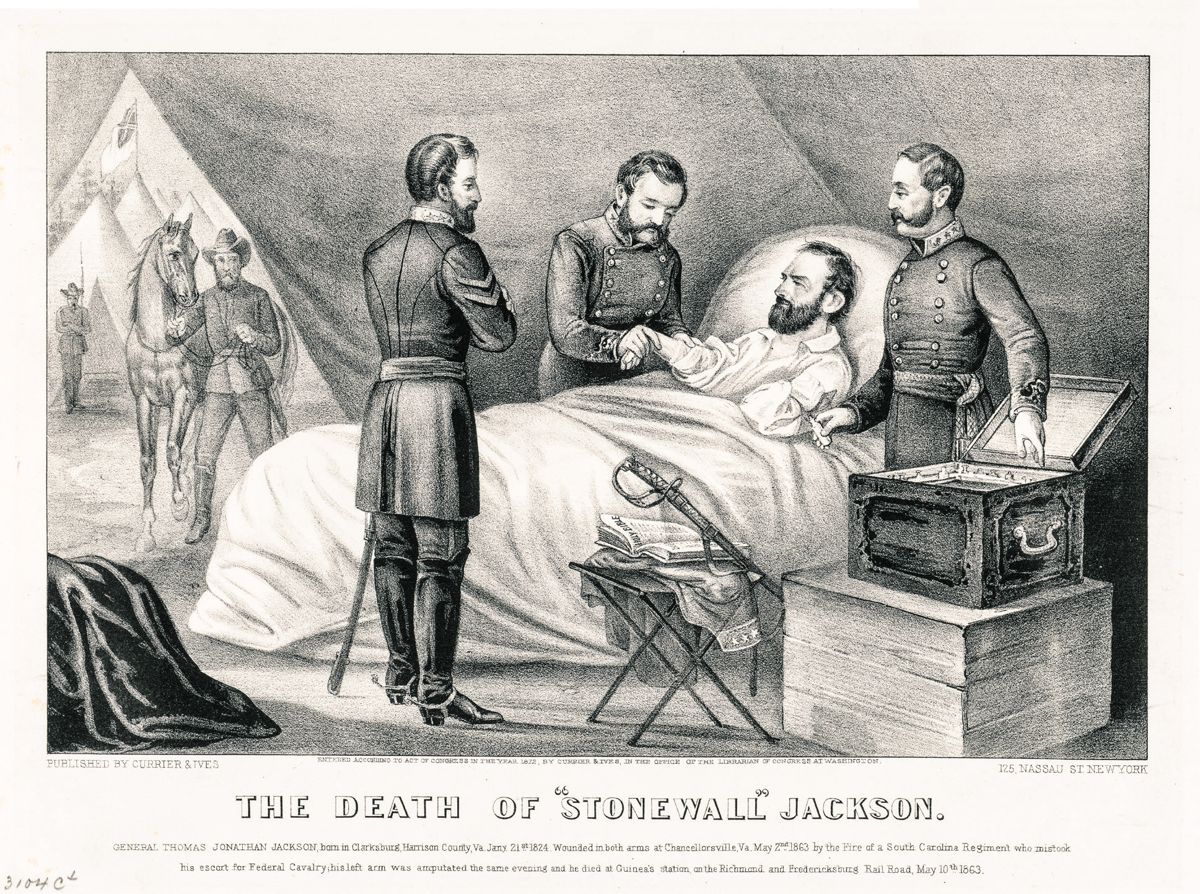
Most readers wishing to bone up on Confederate Lt. Gen. Thomas J. Jackson, or check on a specific fact about his life, will probably turn first to James I. Robertson, Jr., Stonewall Jackson (1997). From the last generation is to be remembered Frank E. Vandiver’s Mighty Stonewall (1957). Both Robertson and Vandiver rank as professional historians. In another tier are the good works by Burke Davis, They Called Him Stonewall (1954), and Lenoir Chambers, Stonewall Jackson (2 volumes, 1959). Chambers was editor of the Norfolk Virginian-Pilot. Also a gifted writer, Davis was author of biographies of Lee and Stuart as well as other famous American soldiers. Lost in the shuffle, perhaps also in memory, is Allen Tate’s Stonewall Jackson: The Good Soldier (1928). Through the years Tate’s work has remained one of my favorites for several reasons. But first about Tate. Born in Kentucky in 1899, he entered Vanderbilt in 1918, taking freshman writing from John Crowe Ransom. By the time of his graduation he was already a professional poet, editor, critic, and founder (with Ransom and Donald Davidson) of The Fugitive magazine. In 1930 the “Fugitive group”— Ransom, Tate, Davidson, and Robert Penn Warren, along with other Southern writers—published I’ll Take My Stand: The South and the Agrarian Tradition. The controversial work collected a dozen essays defending various aspects of Southern life and culture, but generally advocating the superiority of an agrarian society’s lifestyle over the industrial, urban culture of the North. They seized upon the Old South as metaphor in their critique of modern society, at least as they perceived it in 1930’s America. Which brings us to Stonewall Jackson. Tate intended his book to be both biographical narrative and cultural commentary, purposes that make it a bit complicated. In tracing Jackson’s prewar life and his record as a Confederate general, the author is always looking toward Chancellorsville, Jackson’s greatest battle and historic Southern victory. The very site of the engagement, the Wilderness, allows Tate to use the destruction of forests to symbolize the rape of the land that would ensue after the Civil War. While the thick woods aided Jackson’s troops by concealing their march, Federals were busy chopping trees down for their fortifications. As he got his men into position for their attack, Jackson listened to the sound of axes. “The chopping continued. General Hill rejoined Jackson’s party,” Tate writes. “There was no talk; only the steady chopping in the distance.” Tate similarly turns to the industrialism and scientism in which he criticized Northerners for having placed too much confidence. Bitterness turns to humor as the author describes Hooker’s elaborate aerial reconnaissance and telegraph systems: “As the sun rose on the morning of May 1st a dense fog around Fredericksburg hid the Confederate movements from Sedgwick’s aeronauts; the telegraph broke down.” Then there is Stonewall himself. Tate sees the famed Confederate chieftain’s violent determination to kill the enemy as the kind of resolution Southerners would have to adopt in opposing the materialism and industrialism of the modern North. Jackson’s strong religious faith also serves the author; Stonewall was “the good soldier,” as he put it in his subtitle. Tate quotes the general before a battle as predicting victory “by the vigorous use of the bayonet, and the blessing of divine Providence.” Jackson was the embodiment of “active faith,” a concept Tate adopted to reflect the kind of religion he maintained that Southerners should practice. When Tate asserted that “the South would not have been defeated had she possessed a sufficient faith in her own kind of God,” as he wrote in an essay, “Religion and the Old South,” he was thinking of Stonewall’s God. Active faith meant unswerving confidence and unbridled courage—“mystical optimism,” as Tate put it. The author tells of the moment at Chancellorsville when word reached Jackson that a Federal sortie had cut the Confederate army in two: “Jackson gave the calamity as much attention as he would have given the news that a war-canoe full of South Sea Islanders was setting out to capture Richmond!” Even in death, Stonewall Jackson is Tate’s metaphoric hero. “Doctor, Anna tells me I am to die today. Is it so?” he asks Dr. McGuire. “Yes,” was the reply. “Very good, very good,” Stonewall says; “it is all right.” Jackson’s calm acceptance of his life’s end is a basic element of active faith. An aging Confederate says it best in Tate’s poem, “To the Lacedemonians,” when he observes, “there is no civilization without death….It is a privilege to be dead.” For Confederate soldiers, and for Jackson particularly, death in the heroic tradition is sublime—in striking contrast to moderners’ abhorrence and fear of their mortality. Reading Allen Tate’s Stonewall Jackson in these ways helps one consider the question of Tate’s life and career: how could a Southern intellectual become so enamored of the Confederate cause? In April 1927, Tate wrote his friend Donald Davidson that he had contracted with a New York publisher for his proposed work on Jackson. He closed his letter by writing, “Since I’m convinced that the South would have won had Jackson not been killed,
I’m doing a stirring partisan account of the Revolution. The Stars & Bars forever!” Davidson closed his letter of reply: “Yes, I’m all for you. We’ll whup the Yankees yet.” Stephen Davis’ article, “Simply Criminal,” on the battle of Pickett’s Mill, appears in the May 2019 issue of America’s Civil War. Civil War News of January 2019 also carried Steve’s article about an incident of that battle—how Union soldiers complained that all the bugling from Willich’s brigade alerted Confederates of their march to Pickett’s Mill. He and Bill Hendrick are working on a book on the Atlanta Daily intelligencer, leading wartime newspaper in the city.