
The Unfinished Fight
Haversack
By Craig L. Barry · Originally published July 2019 · pp. 4–5
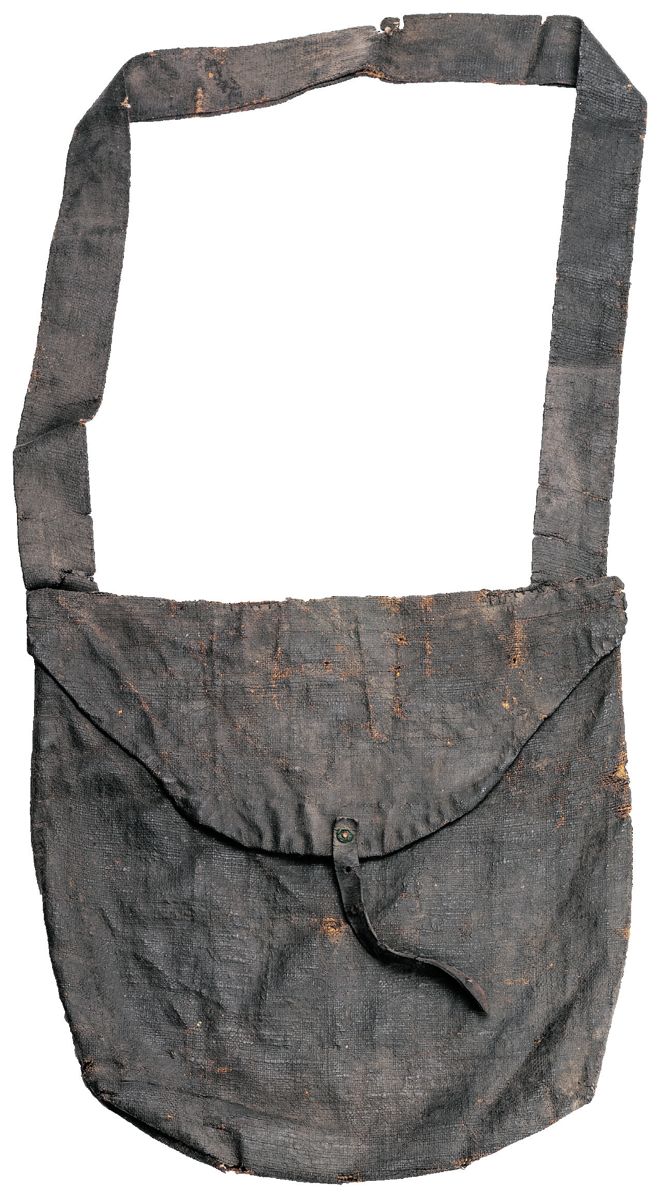
Haversack As soon as we had stacked arms, I left for the city to replenish my haversack, which had become rather flat…On entering town I passed by the abandoned Confederate Commissary department, and seeing a great abundance of food stuffs, I thought that I would go down into town for a while, and then on my way back would fill up my haversack. But when I returned, I found the building in flames and all the food which we could have put to good use was in ashes before daylight. – Civil War diary of Alexander Dowling, February 1865. Term: Haversack (Civil War) Definition: “Linen or canvas bag about one foot square, which was slung over the shoulder and used to carry a soldier’s rations when on the march.” (Dictionary of Civil War History: Wisconsin Historical Society) The haversack was a key piece of equipment for the Civil War soldier in the field. Without it there were very few options for the soldier to carry several days’ worth of rations, except in his stomach, which was sometimes done whether a haversack was available or not. The term haversack actually derives from the 18th century German word hafersach or “oat bag,” a canvas bag used by the Prussian cavalry troops to feed their horses. Perhaps by outward resemblance to the hafersach, the English etymology of the word evolved during the 19th century to indicate a single strap shoulder bag used by any branch of the military to carry marching rations. In America prior to 1851, haversacks with shoulder straps appear to have been made from plain white linen in a variety of sizes; there was a lack of standardization. It was not until May 1865 that the U.S. Quartermaster Manual addressed “official specifications” for the haversack which was too late to have any impact as far as what was used during the preceding years. After 1851 the haversack provided through the U.S. Quartermaster Department began to display the characteristics that would be common throughout the Civil War-era and on into the late 1870s. The first post-1851 change was that the haversacks were painted black and treated with linseed oil for water resistance. The dimensions still varied slightly, but the official size appears to have been between twelve inches square, or thirteen inches across by eleven inches deep. In any event, the haversack was not supposed to be longer than it was wide, although some no doubt were. There was a top flap secured with a leather strap and a japanned (painted) roller buckle. Inside the haversack was (a smaller) white cotton drill “rice bag,” officially called the pocket, held in place by three buttons. The rice bag was supposed to hold the actual field rations. It could be unbuttoned and removed for cleaning, a necessity due to the messy nature of the usual ration of greasy salted meat. The rest of the mess kit (plate, knife, fork) were to fit in the haversack around (but not inside) the rice bag. This includes the tin cup, if there was room for it inside. Tin cups were not automatically hung from the outside strap as they clanged around noisily when placed there and could get snagged. Soldiers make mention of this in their diaries. For example, a New Jersey soldier noted, “besides this (three days rations) I have in my haversack a plate, tin cup, knife and fork…” When soldiers make note of attaching the tin cup to the outside of the haversack, it frequently includes a mention of the din caused by its banging against the bayonet scabbard or canteen. Although much has been written about foraging for food to supplement the rations, an activity which may not always work out well as noted if the diary entry from the heading is to be believed; it is a simple fact that the vast majority of the sustenance a soldier consumed during his enlistment was furnished through the Commissary Department and carried in his haversack. One Union soldier noted that
…one shoulder and the hips support the ‘commissary department’—a haversack with its odorous mixture of salt pork, salt junk, sugar, tea, coffee, rice and leftover bits of yesterday’s dinner. This description brings up a good point. Used as intended, painted cloth haversacks would not last long, they wore out and were replaced on a regular basis through the Quartermaster Department much like clothing or shoes. Very few issued items were replaced on a fixed schedule; the replacement of the haversack was not automatic or at any particular interval. Replacements were ordered on the basis of individual need. Note the following from the diary of a soldier in late 1862: The men drew new clothing today just as fast as the quartermaster could receive the supply from the general quartermaster. We were pretty hard on our clothes in the Army…Nearly every man in the regiment is drawing a full suit, out and out. Some of the men will need new knapsacks, canteens and haversacks, while others are getting new shoes. I drew a pair of pants and a fatigue blouse (sack coat), a pair of drawers and a pair of socks. As time went on, U.S. Army Regulations even added procedures for returning a damaged haversack for repair or even for a return to stock if there was any excess supply. Note the following: SURPLUS AND DAMAGED STORES 3044. On arrival of recruits at their destination, the clothing-bags and haversacks which they turn in as unnecessary, unsuitable, or unserviceable, will be properly packed and turned over to the Quartermaster Department for transportation to Watervliet Arsenal.
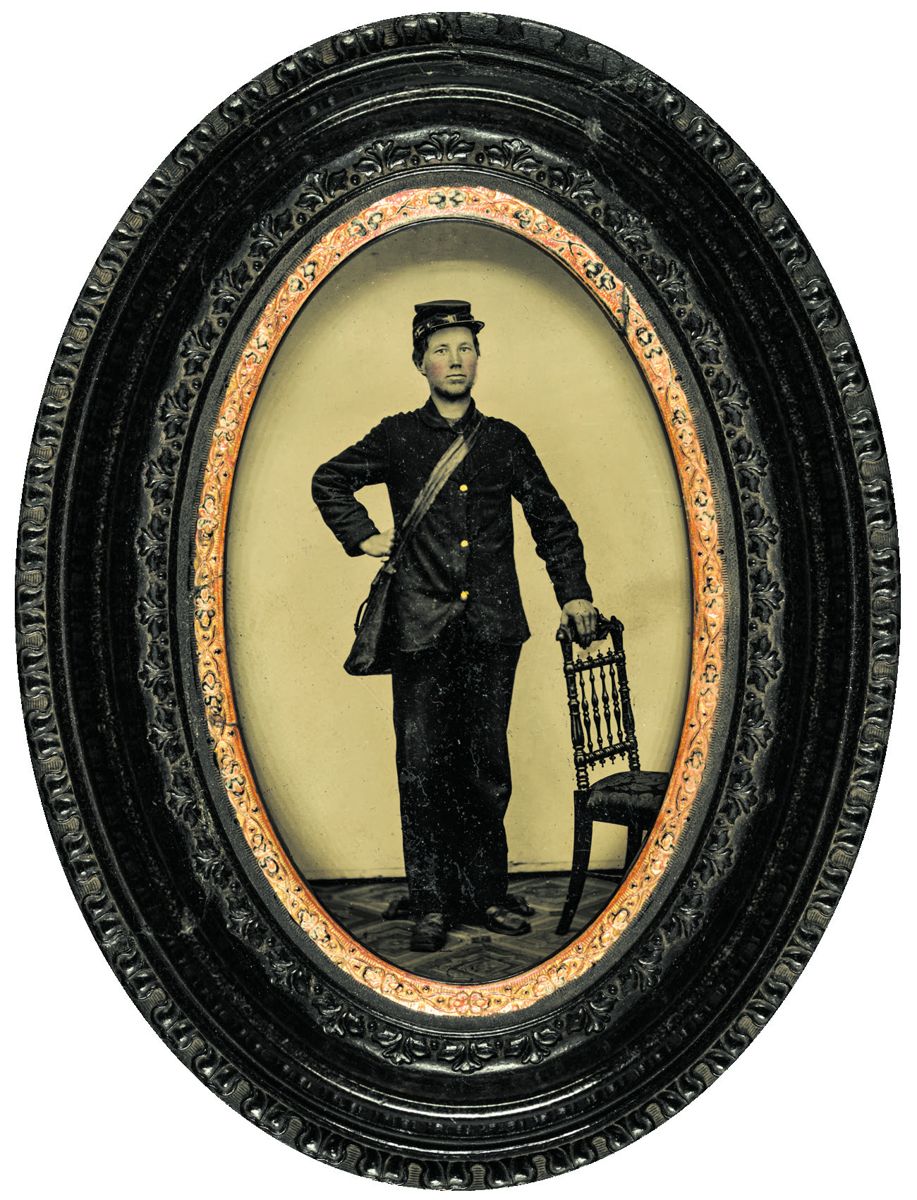
There are two accepted variations of the Regulation Federal Civil War-era haversack. Without making things overly complicated, the types are broadly defined as “Early War” and “Late War.” The two styles are almost indistinguishable except for the leather closing strap, or rather how the leather strap is attached to the outside of the bag. On “Early War” haversacks, the strap and the buckle are sewn to the outer surface of the haversack. On the “Late War” haversacks, the strap is reinforced with a copper rivet. The inside seams were flat felled, like the seams of an unlined Union sack coat. Sometimes the haversack appears to be sewn after the material was painted black and other times before. Sometimes main seams are machine sewn while others show evidence of being hand-sewn throughout. A variety of different contractors supplied haversacks to the various U.S. Arsenals over the course of the war. It is a safe estimate that millions were produced. The cost to the Quartermaster Department was about 56 cents each. The shoulder straps were between 42-48 inches long and were often shortened on the haversack. The average Civil War soldiers were as a rule smaller, but even allowing for a height/weight differential, the shortened straps suggest the bag was worn fairly high up on the soldier’s hip. This is for comfort, so it did not bounce off the thigh while on the march. As a final point, the cloth used on original haversacks is surprisingly thin compared to most reproductions which are produced from heavier (almost tent thickness) canvas. On some surviving haversacks the material used for the outside bag is only slightly thicker than the rice bag (about as thick as a cotton shirt), although the coating of black paint and linseed oil on the surface did reinforce it. Craig L. Barry was born in Charlottesville, Va. He holds his BA and Masters degrees from the University of North Carolina (Charlotte). Craig served The Watchdog Civil War Quarterly as Associate Editor and Editor from 2003–2017. The Watchdog published books and columns on 19th-century material and donated all funds from publications to battlefield preservation. He is the author of several books including The Civil War Musket: A Handbook for Historical Accuracy (2006, 2011), The Unfinished Fight: Essays on Confederate Material Culture Vol. I and II (2012, 2013) and three books (soon to be four) in the Suppliers to the Confederacy series on English Arms & Accoutrements, Quartermaster stores and other European imports.