
The Graphic War
The Bombardment and Capture of Fort Fisher, N.C. Jany. 15th 1865
By Salvatore Cilella · Originally published January 2019 · p. 22
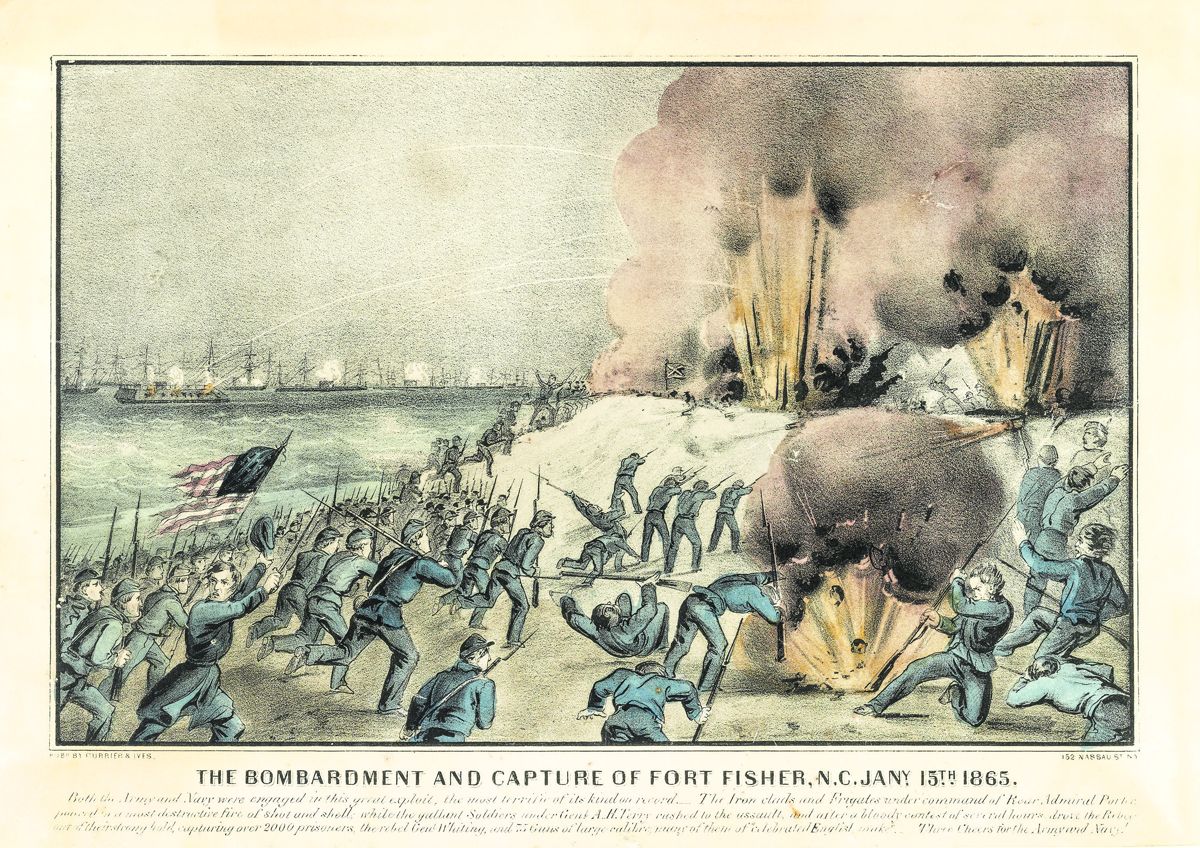
The Bombardment and Capture of Fort Fisher, N.C. Jany. 15th 1865 This occasional column highlights prints and printmakers from the Civil War discussing their meaning and most importantly, the print maker or artist’s goals. By the time the firm of Currier and Ives folded in 1907, it had produced more than 7000 separate lithographic renderings or titles. Beginning in the 1840’s, the firm covered every major American and some world events in picture form for an eager American market. Early prints depicted the Mexican war, westward expansion, news events, political figures, verdant farm and country scenes, city views, and of course, the great Rebellion.
Between 1861 and 1865, Currier and Ives produced countless portraits of war personalities, politicians, and battle scenes. The latter left much to be desired, artistically. Many of them were so crudely and quickly drawn and produced, they stand out today for their naivete and lack of draftsmanship that other prints notably possessed. Nearly all were based on news from the front. Additionally, so many of the battle scenes were indistinguishable and if it were not for the depth and length of the caption, one battle looked much like another. Despite their unreal, dreamlike quality, Civil War battle prints were a “great subject” for Currier.
According to one authority, the company produced fifty-three small folio battle scenes or more than one per month during the war. Adding seven large folios brings the total to 60—twice the number of steamboat scenes in the previous 30 years. To that sum must be added the numerous military portraits and “military genre scenes.”1 During the war, “Currier and Ives Civil War prints became increasingly patriotic,” aiming at the “Northern, proUnion market. Most battle prints were of Union victories and were so labeled with little concern for the facts,” according to author Brian Le Beau.2 Our featured print this month fits Le Beau’s description. The war was good to
Currier and Ives. Unlike most battle depictions, the small folio illustrating the bombardment and capture of Fort Fisher, N.C., Jan. 15, 1865, was slightly more recognizable in that both land and naval forces were identified. According to the caption, “Both the Army and Navy were engaged in this great exploit, the most terrific of its kind on record. The Iron clads and Frigates under command of Rear Admiral Porter poured in a most destructive fire of shot and shell; while the gallant Soldiers under Genl. A.H. Terry rushed to the assault, and after a bloody contest of several hours, drove the Rebels out of their strong hold, capturing over 2000 prisoners, the rebel Genl. Whiting, and 75 Guns of large calibre; many of them of “celebrated English make.” Three cheers for the Army and Navy!” The first attempt to take the fort in December failed. The fort was the gate way to Wilmington, and known as the “Gibraltar of the South,” with heavy naval traffic through its port. On Christmas Eve, 60 Federal ships attacked the defending force of 500 Confederates and were repulsed. The defeated Union armada returned to Hampton Roads. In the first month if the new year, General of the Army, Ulysses Grant tasked Major General Alfred Terry and Rear Admiral David Porter and their combined forces of 18,000 to attack once more the last major, Confederate coastal stronghold. The garrison was commanded by Major General Robert Hoke. What the Currier print failed to mention was the engagement of a division of US Colored Troops under Brigadier General Charles Paine and a second division under Brigadier General Adelbert Ames. Between the navy’s heavy guns and the assault by Paine and Ames, Hoke’s men surrendered late that day. The last Confederate port of any significance was closed. Ames went on to become a reconstruction governor of Mississippi; Paine was a New England Blue Blood, a descendant of a signer of the Declaration of Independence, and after the war made a fortune in railroads. Hoke went on to enjoy a career as a businessman, dabbling in insurance and gold mining. Admiral David Dixon Porter remained in the navy but was largely involved with writing unremarkable histories and fiction, all now, long forgotten. And the prints? In the 1930’s a group of collector/dealer/ scholars set out to choose the 50 best Curriers. It appears the battle prints were not considered. Currier and lithographic scholar, Harry Peters who wrote extensively on Currier, barely mentioned them. Ironically, the best Civil War battle prints were produced in the thirty years after the war by other lithographers. Endnotes: 1.
Harold Holzer, Mark E. Neely, Jr. The Union Image: Popular Prints of the Civil War North. Chapel Hill: The University of North Carolina Press, 2000, 199. Bryan F. Le Beau. Currier & Ives: America Imagined. Washington: Smithsonian Institution Press, 2001, 77.
Salvatore Cilella is retired after 43 years in the museum field. His last position was President and CEO of the Atlanta History Center. He is the author of several articles and books. His most recent books are Upton’s Regulars: A History of the 121st New York Volunteers in the Civil War (U. Press Kansas, 2009) and The Correspondence of General Emory Upton, 1856–1881 (U. Tennessee Press, 2017) edited.