
Critic's Corner
Grant and Twain: The Story of a Friendship that Changed America (conclusion)
By Stephen Davis · Originally published January 2019 · pp. 38–39
Grant and Twain: The Story of a Friendship that Changed America (New York, 2005).
Grant and Twain: The Story of a Friendship that Changed America (conclusion) Book Review Editor’s note: in our last month’s column, General Grant had been enticed by the Century Company of New York to publish his memoirs. Mark Twain then asked the general for his own company to publish the book. Meanwhile, Grant’s throat cancer was worsening, even as he worked hours on end, every day writing his recollections. We pick up the story here, in the fall of 1884, based upon Mark Perry’s
Twain finally finished Huckleberry Finn in 1883, after nine years of off-and-on again writing. Disappointed with the American Publishing Company of Hartford, Twain decided to have Charley Webster publish his new book. Twain gave Webster his manuscript, “with strict instructions,” as Perry writes, “that the book could be issued only after a large number of copies had actually been sold.” Thus Twain was talking with Grant about the general’s memoirs when he was working hard to get his own book published. After Twain left Grant’s New York City home on Nov. 20, Grant discussed the offer with Fred, Julia and Adam Badeau. He then wrote to a friend, George Childs, asking him to come to New York and assess the competing book offers. Childs soon decided that Twain had extended the better deal. “His condition now stable,” Perry explains, Grant was again able to write. He was at this point, in early Dec. 1884, about to finish drafting the first part of his memoirs. Finally, after Twain offered a 20 percent royalty on book sales (well above Century’s ten percent offer), Grant declared, “Give the book to Twain.” Clemens enthusiastically predicted that the general’s royalties could eventually amount to $420,000. To give Grant and his family some money in the meantime, Twain set aside $10,000 as an advance—“a highly unusual practice at the time,” Perry notes. The Century Company’s leaders accepted Grant’s decision without rancor, understanding that in the publishing business, as in every business, it was all about the money. Throughout late 1884, Grant tried to keep the actual state of his health from the press, even from his friends. When Cump Sherman paid a call to Grant’s home just before Christmas, he was more dismayed by signs of Grant’s financial distress than by evidence of his illness. In January ’85, Grant’s health showed slight improvement. “He now rose early each morning,” according to Perry, “wrapped himself in his shawl, and focused on writing his memoirs.” Dr. Douglas came to conclude that the general had resolved to tough it out—determined to finish writing his book before he died. Still, by the end of February 1885, the general had not signed a contract with the Webster Company. On Feb. 26, as he relates in Mark Twain’s Notebook, Twain visited the Grant home; “I was astonished to see how thin and weak he was.” In Mark Perry’s words, “Twain was disturbed by Grant’s wan appearance. The general looked exhausted and spoke with difficulty and barely above a whisper.” At the end of his visit, Twain was taken aside by Fred, the general’s son, who said that doctors believed that Grant had only a few weeks to live; “Twain was shocked.” Yet Fred assured him that his father was working hard daily. By this time, the first planned volume of the memoirs was complete (taking Grant’s story from childhood through the Mexican War to Vicksburg), and the second was underway. Twain, writes Perry, was such a “Grant-intoxicated man” that he had no doubt of his friend’s ability to finish the project. “Over the next months, as Grant faded, recovered, nearly slipped away, and then finally rallied, Twain never lost faith that his friend would win his last battle.” Grant’s determination stemmed in good measure from the awareness that he was writing a book whose sales would provide financially
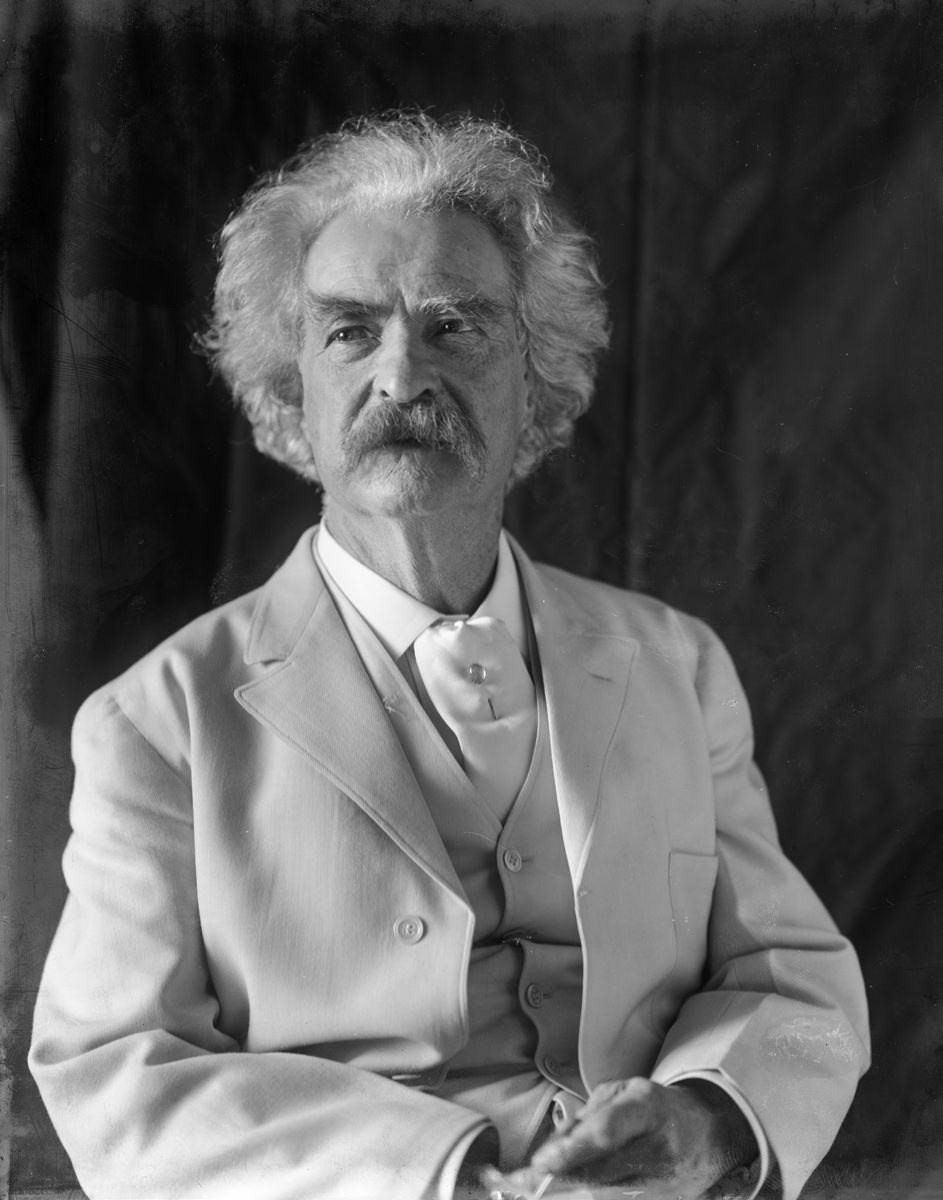
Samuel Clemens, also known as Mark Twain. Photograph published in 1906. Frances Benjamin Johnston, 1864-1952, photographer. (Library of Congress) for Julia and his family. In the process he felt strengthened, even envisioning the final appearance of the published memoirs: two volumes, each of about 450 printed pages. (In the set that I own, published in 1885 and 1886, Volume One has 584 pages; Two, with an index, is 647 pages long.) Clemens aided Grant’s work in several ways. He instructed the Webster Company to finalize its contract and have it delivered to the Grant residence on 66th Street, where Grant finally signed it on February 27. Twain also supported the general’s decision to hire a stenographer, Noble Dawson, to take down Grant’s dictation and read it back to him. At the same time, Twain was planning the marketing campaign for the memoirs. He was short of cash, so he took out a loan of $200,000 to cover the printing of Grant’s book. He also increased his subscription canvassers’ commissions to incentivize their activity. Eventually these sales agents, traveling door to door selling the book, would include a large number of Union veterans, who saw the work as one of homage to a great Northern war leader. “Twain was everywhere at once,” as Perry puts it, “insisting that he oversee every part of the operation, from reading the galleys to ordering the paper to ensuring that the book was properly printed, marketed, advertised, and sold.” But there was a very big issue that Sam Clemens could not manage: his friend’s health. In early January 1885, New York papers began reporting that Grant was ill, though they did not know the specifics. So many people in the city were now aware of the general’s malady that the Times came out with an electrifying headline on its front page on March 1: “GRANT IS DYING.” Within a day, reporters bunched outside the Grant home, craning to peer into windows. Some irreverently termed their vigil a “death watch.” Reporters from across the country soon arrived. Then there were the casual onlookers and curiosity seekers. Soon the N.Y.P.D. had to post constables outside the house to contain the crowd. Actually, however, Grant’s doctors believed that the general’s writing not only diverted his attention from pain but was, as Dr. Douglas told Julia, possibly enabling him to live longer. Julia disagreed, arguing that the work was weakening her husband and should be suspended. Grant settled the issue by telling everyone that he wanted to continue working. Former comrades made appointments to come by and pay respects; Grant entertained them as his health and work schedule allowed. Even the sons of Robert E. Lee and Albert Sidney Johnston visited. Grant proved genuinely happy when he received a visit from John Logan, a Union division commander at Vicksburg;
Grant read him the section of his book on the campaign. Things improved financially for the Grants as well. Grant had resigned from the army to run for president in 1868. His friends lobbied Congress to reinstate him at that rank. When both houses voted to do so on March 4, 1885, the lieutenant general began earning an annual salary of $13,500. Julia was also assured an annual $5,000 retirement. The reinstatement was an immense relief to Grant, who had been ruined by the collapse of Grant and Ward. He turned anew to his daily dictation with Dawson. “Grant’s room, facing the street, was beginning to resemble a good-size Civil War library,” Perry observes. The general’s desk was piled high with notes, orders, memos, maps, and books—as well as the list Grant made each late afternoon of which parts of the book should be completed the next morning. Grant sat in a large chair near the desk in his by now regular attire of bulging shirt, scarf, and knitted cap. Nearby was Dawson, writing what the general dictated, often waiting in pauses while Grant either rested his throat, retrieved a map, memo, or paper, or called to Badeau or Fred to clear up some point, add a date, check a spelling, or offer advice on a certain topographical feature. Dawson would often help Grant by reading back what he had dictated, and Grant would correct and shape his words depending on what he heard. Often he would think for long moments, trying to remember a particular event, a face, or just how a battle had proceeded. At the end of each day he collected what Dawson had written and edited it before reading to Julia. Only then would the stack of paper be given to Badeau and Fred for their suggestions. The stenographer proved a key to the general’s productivity. Dawson noticed that Grant dictated flowingly and without effort. He spoke so cogently that the written product rarely had to be changed. By late March Grant had put the finishing touches on his Vicksburg article for “Battles and Leaders.” When Grant finished his fourth article for Century, covering the Wilderness Campaign, he was able to fold all four narratives into this memoir. (The general would not see his work in print; “Shiloh” appeared as “Battles and Leaders” in the magazine’s Sept. 1885 issue, “Chattanooga” in Oct. 1885, and “Wilderness” in Sept. 1886). A series of violent coughing spells on March 31 caused many to believe that Grant would not live long, but his condition improved and he returned to work on April 12. From notes he continued to dictate; on good days Dawson took down enough text to fill two dozen printed pages. Fred and Adam edited the text each evening, putting events in chronological order if the general had reminisced randomly. Twain held back, reserving for himself an editing purely for grammar. Yet he was quite pleased with what he was seeing. At one point he enthusiastically compared
Grant’s narrative to Julius Caesar’s famous commentaries. “I was able to say in all sincerity that the same high merits distinguished both books,” he wrote in his autobiography: “clarity of statement, directness, simplicity, unpretentiousness, manifest truthfulness, fairness and justice toward friend and foe alike, soldierly candor and frankness, and soldierly avoidance of flowery speech.” But the clock was ticking. Grant celebrated his sixty-third birthday on April 27, 1885, by working as he did every day. By now he was covering events from the Wilderness to Appomattox. Twain quietly concluded that if the general were to die now, Fred could finish the narrative. In the middle of May, “Grant’s neck was now swollen,” Perry writes, “and he could barely speak. The cancer had spread into the back of his throat and into his jaw. It was literally eating him alive.” But the pain had an upside: it was keeping Grant up at night. Sitting in his chair, fitfully dozing, he would write while the household slept, though his penmanship was now weak and wavering. On June 8, Grant told Twain that he had finished the second volume, at least in rough draft. Clemens quickly arranged for his printing presses to swing into action, applying all the money he had into the effort to get the general’s book out. With summer approaching, doctors suggested that Grant get out of the New York City (Library of Congress)
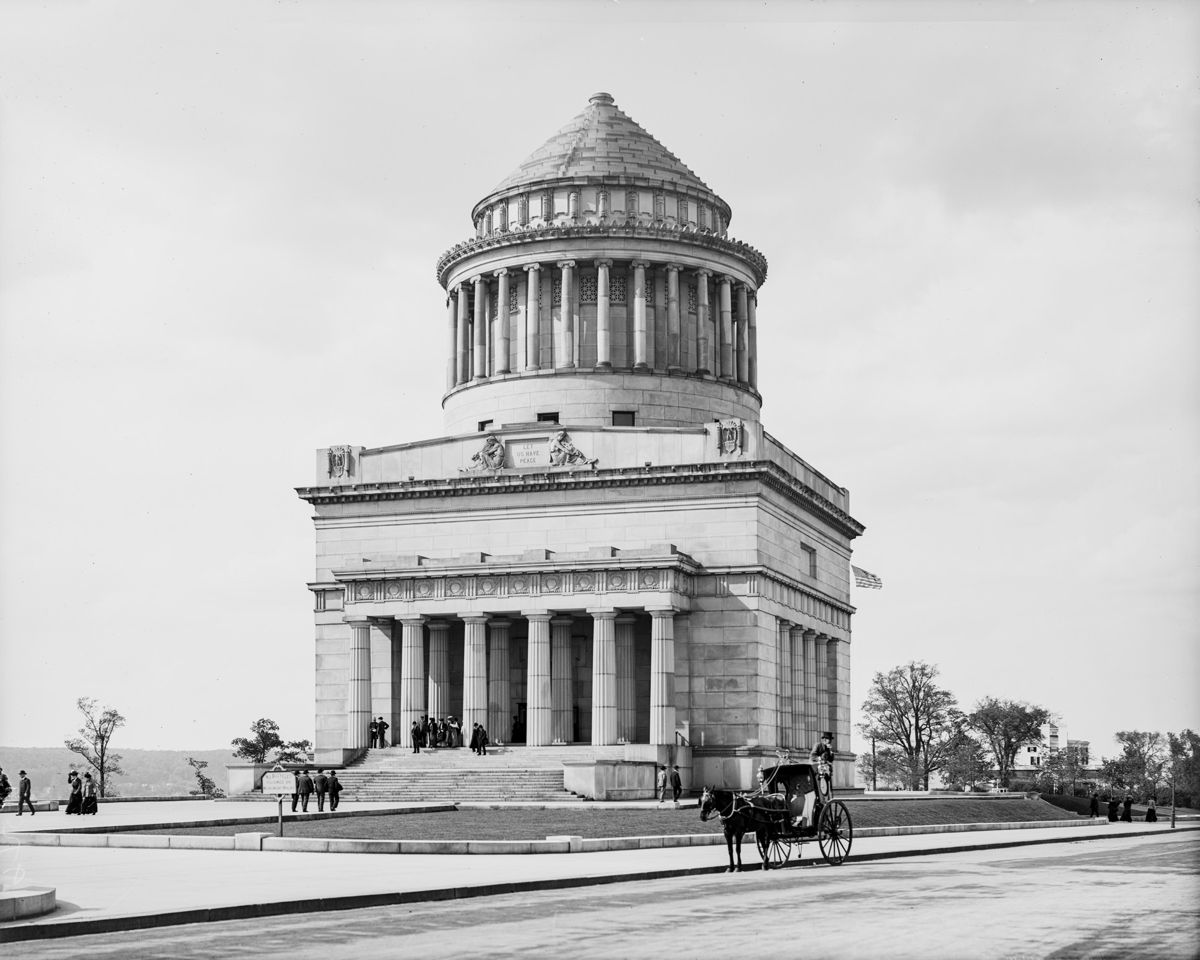
heat for a cooler retreat upstate. He settled on a cottage in Mt. McGregor, a dozen miles from Saratoga. The general and his family left on June 16. By now, as Perry explains, “Grant could barely talk and spent most of his time communicating by writing short notes….Because he could not swallow, Douglas knew, he was literally starving to death.” “Grant was forced to subsist on tea and soft fruit,” even as he persisted in the work of dictating and editing. The general could feel the end was coming. On June 17, he managed to compose a letter to Douglas: “Dr., With a decrease of daily food, I have fallen off in weight and strength very rapidly for the last two weeks. There cannot be hope of getting far beyond this period.” That same day he wrote his son Fred as to his desired place of burial. He and Julia had bought a burial lot in St. Louis as well as in Galena, he wrote, but “I am also much attached to New York.” He left the final decision to Fred, asking only that “a place shall be reserved for your mother.” Twain grew impatient when the general insisted on adding little touches to his second volume draft. On June 21, he spent hours sitting on his porch at Mt. McGregor working. A few days later he and Dawson completely revised the chapter on Lee’s surrender. Still, the general was “sinking fast,” as his stenographer later recalled. Physicians were administering cocaine to ease Grant’s throat pain. Grant asked Twain on the 27th to come to Mt. McGregor. Clemens was there the next day. “If I could have two weeks of strength I could improve it very much,” he jotted about his manuscript. Twain left without it, disappointed. “Each day brought new coughing fits, which usually ended only when Grant, choking on his own blood, was able to vomit and clear his breathing passages,” as Perry painfully puts it. “I’m ready now to go at any time,” the general sadly wrote a friend. On the afternoon of July 19, as Grant was seated, bundled in his chair, he put down his pencil and looked at Dawson. He smiled a bit, looked back down at his paper, and then handed it to his transcriber. The book was finished, he said. Three days later, at 8:08 a.m. on July 23, Grant breathed his last. Twain’s publishing company brought out Volume One of Personal Memoirs of U.S. Grant on Dec. 10, 1885. Two and a half months later, Clemens gave Julia a check for $200,000—the largest royalty payment in American history at that time. In all, the general’s widow would receive almost a half-million dollars. Twain made a lot of money as well; the Webster Company published Volume Two in 1886. Before the Preface of Volume One is a handwritten statement: These volumes are dedicated to the American soldier and sailor. U.S. Grant New York City May 23d. 1885. That Grant would write such a dedication—he could have dedicated his work to the Union soldier and sailor—demonstrates his magnanimity, and his respect for the American fighting man. That Federals and Confederates were somehow alike was demonstrated in an anecdote that Grant remembered, and included in his memoir. After arriving at Chattanooga, Grant made a personal inspection of his picket lines, accompanied only by a bugler. I rode from our right around to our left. When I came to the camp of the picket guard of our side, I heard the call, “Turn out the guard for the commanding general.” I replied, “Never mind the guard,” and they were dismissed and went back to their tents. Just back of these, and about equally distant from the creek, were the guards of the Confederate pickets. The sentinel on their post called out in like manner, “Turn out the guard for the commanding general,” and, I believe, added, “General Grant.” Their line in a moment front-faced to the north, facing me, and gave a salute, which I returned. In the closing pages of his memoir Grant offers the prediction that “we are on the eve of a new era, when there is to be great harmony between the Federal and Confederate.” “I cannot stay to be a living witness to the correctness of this prophecy,” he added sadly, “but I feel it within me that it is to be so.” “Let us have peace,” he concluded. And, after a heroic struggle to compose and complete his monumental memoir, peace it was that Grant had finally earned. • •
• • •
Additional sources
Ron Chernow, Grant (New York, 2017). Paul Kahan, The Presidency of Ulysses S. Grant (Yardley PA, 2018). Chris Mackowski, Grant’s Last Battle (2015) Mark Twain’s Notebook (New York, 1935). Personal Memoirs of U.S. Grant, 2 vols. (New York, 1885, 1886).