
Through The Lens
Fathers and Sons
By Stephanie Hagiwara · Originally published January 2019 · pp. 14–15
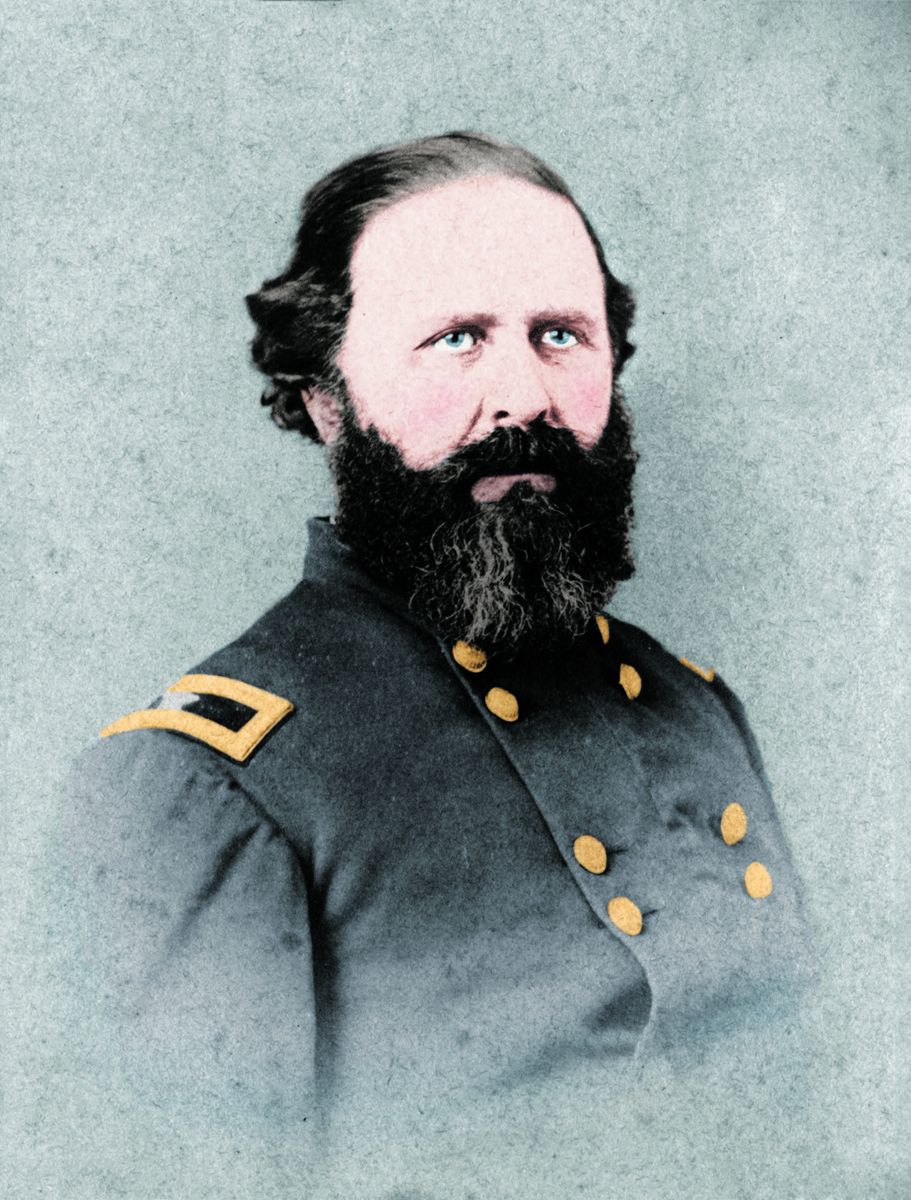
Fathers and Sons “My son is a rebel! – I defend him not!” – U.S. Senator John J. Crittenden Both the North and South wanted Kentucky on their side. Situated between three slave holding and three free states, Kentucky was a major producer of wheat and livestock. On Jan. 19, 1862, two inexperienced armies clashed at the Battle of Mill Springs, Ky. The Confederates were led by Gen. Felix Zollicoffer, a former Tennessee journalist and U.S. Congressman. Zollicoffer was appointed Brig. Gen. for his political not military experience. Zollicoffer’s superior officer was Brig. Gen. George Bibb Crittenden, Cmdr. of the District of East Tenn. As the son of U.S. Senator John J. Crittenden he had been promoted to Brig. Gen. to attract possible recruits. Zollicoffer selected Mill Springs as his winter quarters for its high riverbank bluffs on the Cumberland River, ample water, and timber. The camp was in a horseshoe bend of the river, surrounded on three sides by water, with a 1,200-foot line of earthworks spanning the fourth. Crittenden, a career military officer, was appalled at the site. It was a trap not a fort. The location violated the military maxim to never fight with your back to a river. Having been captured in a similar situation during the Mexican War, Crittenden was not willing to repeat the experience. Furthermore, the river was unfordable; the pontoon bridge and several boats had been washed away in a recent storm. Zollicoffer’s fleet consisted of a small paddle-steamer, the Noble Ellis, and two wooden flat-boats. It would be impossible to convey the men, 12 cannon, horses, wagons, and supplies away in a timely manner. The Confederates were aware that Federal Gen. George Thomas was assembling 5,000 men nearby. Since the Southerners lacked supplies to withstand a siege; it was agreed to execute another military maxim, “strike your enemy while he is divided and defeat him piecemeal.” They would use the weather to their advantage because the continuing freezing rain would flood Fishing Creek making it possible to surprise the Federals ten miles north at Logan’s Crossing. Crittenden ordered that, to identify each other from their foe, the Confederate password would be “Kentucky.” At midnight on Jan. 18, his 5,000 men left Beech Grove. The march in the cold, driving rain and mud as deep as 12 inches took six hours. Zollicoffer led the cavalry in the front. At daylight, pickets of the U.S. 1st Ky. fired at the Rebel cavalry before falling back to the 10th Ind. Brig. Comdr. Col. Mahlon D.
Manson, 10th Ind. Inf. ordered the alarm sounded. New to command, instead of sending a messenger, Manson personally went to alert Thomas several miles away. Along the way, he warned Col. Speed Fry, 4th Ky, at the camps of the 2nd Minn. and the 9th Ohio. During Manson’s report, Thomas interrupted, “Damn you, sir, go back to your command and fight it.” As he returned, Manson alerted artillery batteries. Meanwhile the 10th Ind. Inf. was on their own. They retreated up a narrow ridge. The Confederate 19th Tenn. Inf. advanced in a fog and the shooting became “almost constant.” Zollicoffer, with the Nineteenth, could only see muzzle flashes and was unsure of the size of the enemy’s force. The 4th Ky. Inf. rushed to bolster the 10th Ind. and experienced the same withering fire. It was Federal Enfield riffles against Southern flintlocks. During the battle, the 15th Miss. believed the 20th Tenn. was to their front. To determine the facts, Col. Edward Walthall, yelled, “Whose troops are those?” The reply was “Kentucky.” He repeated the inquiry with the same response. The Fifteenth unfurled their flag and the Yankee Kentuckians riddled it with bullets. Walthall returned exclaiming, “Now I think you know who they are”. Confederate Zollicoffer, spotting a regiment that he thought was the 15th Miss., rode forward to direct its placement; at the same time, Union Fry had ridden out to get a better view of the field. Through the haze he could see another officer riding towards him on a white horse. He was wearing “a white rubber coat and a blue army cap.” Fry approached Zollicoffer with “our horses’ heads coming very near together… so closely that our knees touched.” Zollicoffer said, “We must not shoot our own men.” Fry responded, “Of course not. I would not shoot our own men intentionally.” Zollicoffer pointed towards the 19th Tenn. and said, “Those are our men.” Fry rode in that direction to look and noticed a staff officer emerging from behind a tree. The officer fired at Fry yelling, “It’s the enemy, general!” Multiple Federals fired at Zollicoffer. Fry would later say, “I raised my pistol and fired. His horse turned and he fell.” Before the battle, Zollicoffer had shaven his beard to make himself less identifiable. Alas, it may have been his extreme nearsightedness that prevented Zollicoffer from identifying his enemy’s attire. The fury of the battle continued.
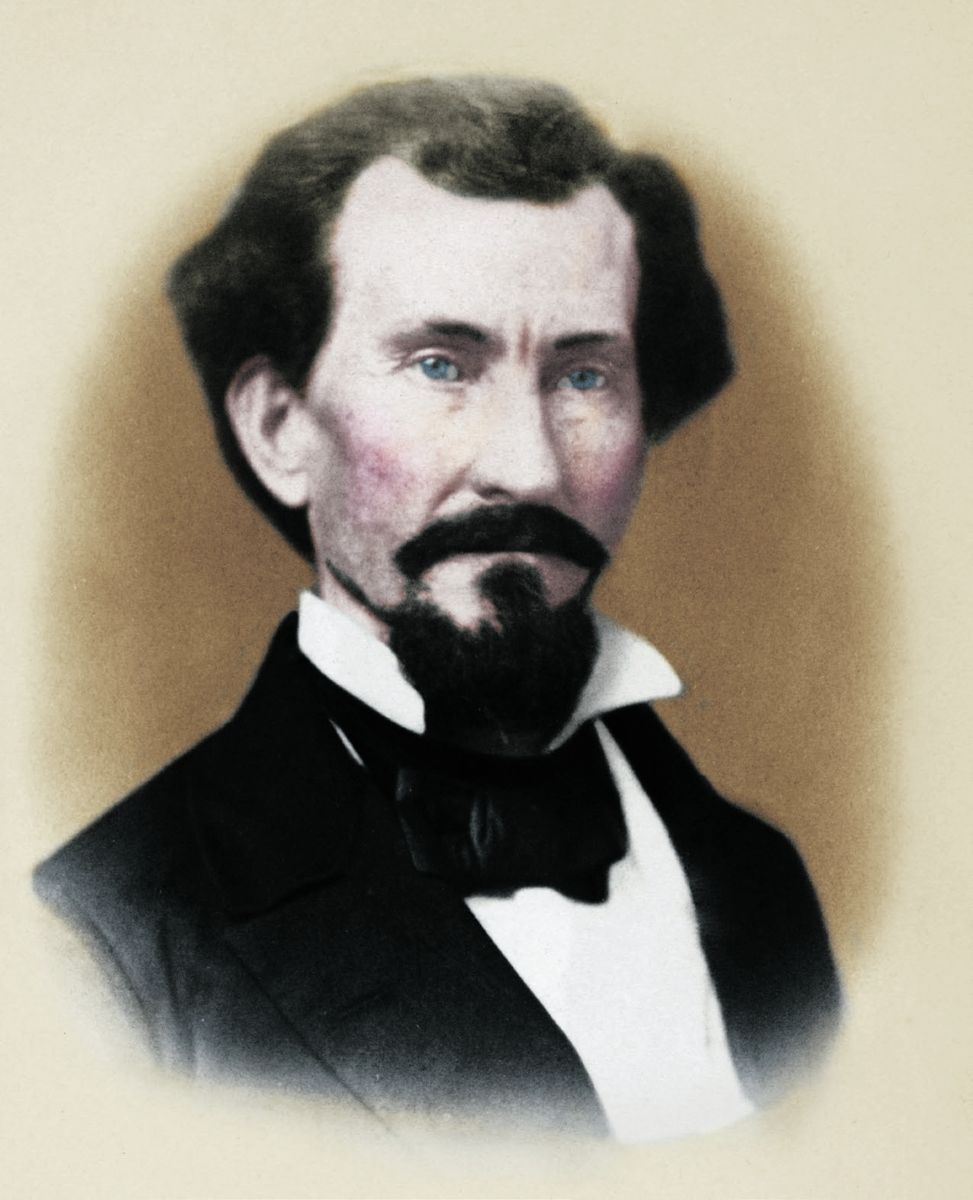
The thickness of the underbrush prevented charges. “We were so close to the enemy that we bayoneted them through the fence. The Mississippians were armed with great knives which they intended using on us, but our bayonets outreached their knives,” claimed a 10th Ind. soldier. Crittenden sent in Gen. William H. Carroll, whose brigade was in reserve. As the smoke and fog obscured the enemy, he placed his men on each side of the road, using it as a landmark before advancing into open space. Immediately, the men hit the ground due to lack of cover. The dampness prevented the flintlocks from firing. Some men abandoned their weapons and the field. When Thomas and his artillery arrived “… the enemy opened a most determined and galling fire, which was returned by our troops in the same spirit.” The 9 Ohio took a position behind a fence on the west side of the road before pushing forward. “If it gets too hot for you, shut your eyes my boys – Forward!” yelled the Ninth’s Maj. Gustave Kammerling. Having positioned themselves on the east side, the 2nd Minn. advanced in tandem with the Ninth. Both sides fired furiously through the fence. Being overwhelmed, the Confederates fled leaving Lt. Bailie Peyton Jr., 20th Tenn. on the field. He walked towards the Federals. Instead of surrendering, he fired his pistol; the Federals immediately shot him through the left eye killing him. The son of a former U.S. Congressman and Unionist, he died carrying his father’s sword, a gift from the citizens of New Orleans during the Mexican War. The North celebrated their victory without giving Thomas much credit. Both Fry and Manson were promoted to brig. gen. in March 1862. Fry and his father became estranged. The elder Fry believed high-ranking officers should honor a code of chivalry that forbade shooting each other, especially in the back. More importantly, the Battle of Mill Springs was the beginning of a chain of battles that won Kentucky for the Union. Sources: • Sanders, Stuart W.; The Battle of Mill Springs Kentucky • American Battlefield Trust; The Battle of Mill Springs Stephanie Hagiwara is the editor for Civil War in Color.com and Civil War in 3D.com. She also writes a column for History in Full Color. com that covers stories of photographs of historical interest from the 1850’s to the present. Her articles can be found on Facebook, Tumblr and Pinterest.