
“…dead, dead, dead.”
By Thomas P. Lowry · Originally published January 2019 · p. 17
“…dead, dead, dead.” By Thomas P. Lowry When this author was an Air Force doctor, he received many patients from all over the world by “Air Evac.” This miracle of modern medical transport is in sharp contrast with the 1863 journey of convicted murderer Homobono Carrabajol, from the mountains of southern Colorado to Washington, D.C., by wagon, horseback, steamer, and railroad while in chains. Who was Carrabajol and why was he ordered to be “… hanged by the neck until he is dead, dead, dead?” Why was one “dead” insufficient? Carrabajol was born in old Mexico, spoke no English, and
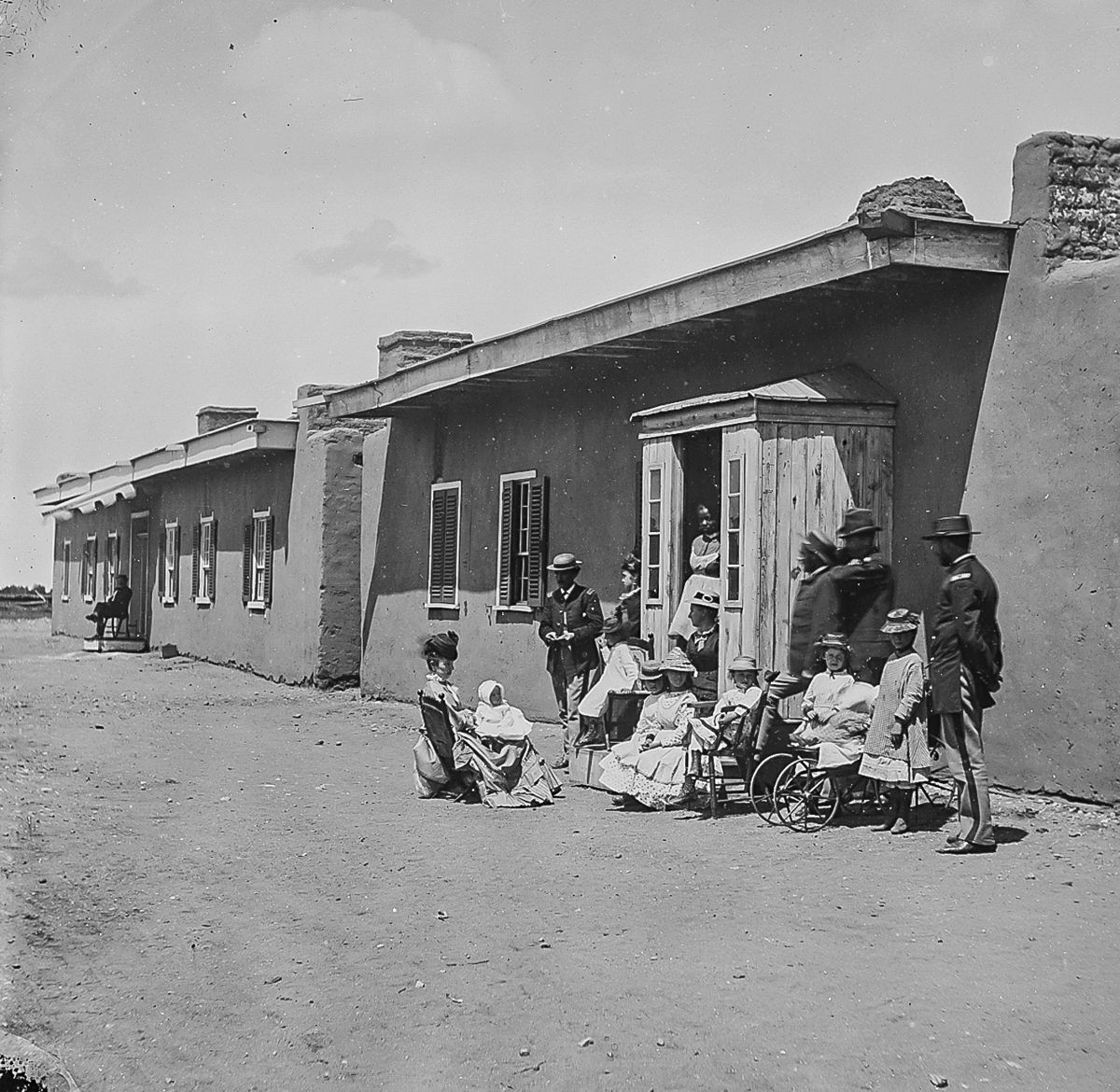
Fort Garland.
during 1861 he enlisted, age 22, in the 1st New Mexico Infantry at Fort Craig, in the Godforsaken desert of south-west New Mexico. His regiment was soon consolidated with others, and he served mainly in Co. D, 1st New Mexico Cavalry, where he was assigned to routine patrol and escort assignments. In January 1863, under Lieut. John Lewis, a company of forty men was sent to Fort Garland on “detached service.” This fort, in the verdant San Luis Valley of southern Colorado Territory, was established to keep the white settlers and the Muache band of Ute Indians from murdering each other.
Carrabajol’s role in history began the night of May 20, 1863. He and comrade Francisco Lujan left the fort in search of whiskey. It was not hard to find. The little creek beds outside the fort boundaries had many Mexican whiskey peddlers. Both men got drunk. Very drunk. And much in disagreement over who owed money to whom. Back at the fort, Lujan struck Carrabajol with a stick. The corporal of the guard, thinking it unwise to put both men together in the guardhouse, where their quarrel would continue, put Lujan to bed, and locked up Carrabajol. The next morning, he was released, but he wasn’t done yet. Lujan was asleep in his bunk. His comrade tiptoed up close, placed the barrel of his cavalry revolver against the back of Lujan’s head and pulled the trigger. The ball exited above Lujan’s left eye, with a spray of brain tissue. The other men asleep in the same room “… didn’t hear a thing,” but the First Sergeant did. He disarmed the shooter, who readily confessed, and put him in “double irons, hand and foot.” The other soldiers wanted to lynch him on the spot but were prevented from doing so. The court-martial was convened at Fort Garland June 6, 1863. There were no defense witnesses. Carrabajol submitted a written statement (through an interpreter) in which he admitted to the evil of his act and stated that if the court would show mercy, he would enlist for an additional five years and would send all his pay to Lujan’s widow, “until such time as she may take another husband.” The court then sentenced him “to be hanged by the neck until he is dead, dead, dead.” In the original manuscript, the final three words are underlined. A blizzard of memos, involving the District of Colorado and the Department of the Missouri, then commenced. There were a half dozen examinations by surgeons and even a board of surgeons; all pronounced him to be “crazy,” or “insane,” or “of unsound mind.” Meanwhile, the wheels of justice ground on. A communication from Major General Dodge, dated April 5, 1865, ordered that on April 14, 1865, at 2 p.m. Carrabajol would be executed at Denver City. “Should there be no gallows erected at this place for existing persons sentenced to be hung, you will erect a temporary one at some suitable place in the suburbs of Denver. You will make all the necessary arrangements for the interment of the body, previous to the hour of execution, such as providing the coffin, digging the grave, etc.” The suggested burial spot was one established by the city of Denver for executed criminals. The tale is not yet over. A surgeon Hamilton, of the 1st Colorado Cavalry, submitted one more report, certifying Carrabajol’s insanity. This was followed May 3, 1865, by an order from Major General Barnes, setting up a board of surgeons charged with determining his sanity and; “If found beyond a doubt to be crazy, send him to the Insane Asylum at Washington, D.C. [St. Elizabeth’s], under escort.” Two full years had passed since his crime. It is the journey, not the crime, which now becomes of interest. Carrabajol’s route, though not detailed in the record, was most likely northeast out of the San Luis Valley, along Sangre de
Cristo Creek, crossing Sangre de Cristo Pass, and then descending along an eastern branch of the Arkansas River to Old Colorado City, now Colorado Springs. From there it ran along the north fork of the South Platte River to Denver. The first railroad did not reach Kansas City, Mo., until 1887, so the Denver to Kansas City route was most likely by wagon (still in hand and ankle chains?) along a branch of the Republican River. From Kansas City onward travel was a mixture of steamboat and railroad. Our story ends, T. S. Eliot-like, “…not with a bang but with a whimper.” Homobono Carrabajol was admitted to St. Elizabeth’s in late September 1865 and released five months later as “cured.” Many St. Elizabeth’s records are lost, so the secret of his amazing cure is unknown. The New Mexico census records of 1870 and 1880 show no sign of him. In brief, Carrabajol mysteriously disappeared into the fabled “mists of history.” Information based on original court-martial and service records in the National Archives. NB With thanks to The Rev. Dr. A.H. Ledoux for a thorough search of the New Mexico census records. Thomas Lowry graduated from Stanford Medical School in 1957 and has published two dozen Civil War history books and dozens of Civil War articles.