
“A Want of Vigilance” – The Battle of Bristoe Station, Oct. 14, 1863
By Joe Bordonaro · Originally published January 2019 · p. 20
“A Want of Vigilance” – The Battle of Bristoe Station, Oct. 14, 1863 By Joe Bordonaro Following the bloodiest battle of the Civil War—Gettysburg— General Lee’s Army of Northern Virginia and General Meade’s Army of the Potomac did not engage in battle for over three months. This was hardly surprising, given the number of casualties that both armies suffered at Gettysburg. What is surprising, given that Gettysburg is rightly viewed as a major Union victory, is the fact that in October 1863, it was General Lee who initiated action against General Meade, and not vice versa. The aggressiveness of Lee and the extreme caution of Meade was the reason for this state of affairs. When you realize that the Army of Northern Virginia had sent its largest corps west to help the Army of Tennessee prevent an invasion of Georgia it is even more remarkable that General Lee took the offensive. As General Lee’s army moved toward contact with the Army of the Potomac, Gen. Meade ordered a withdrawal from his position in central Virginia and headed toward Centreville, a fortified location on the main railroad supply line of the Army of the Potomac. He was probably thinking back to 1862, when Union General Pope was roughly handled by the Army of Northern Virginia in this same area, culminating in the Second Battle of Manassas during August 1862; he was probably determined that, unlike Pope, he would not be hit with a flank attack and lose a third battle of Manassas. In any case, the Army of the Potomac was spread out on the roads heading north and the Army of Northern Virginia’s Third Corps commander, General A. P. Hill, thought he saw an opportunity to fall upon the rearmost corps in the rear of the Union column. Hurriedly calling for an attack, General Hill neglected to conduct any reconnaissance of his own. With Confederate cavalry, under General J.E.B. Stuart, licking its wounds after an encounter with the Federal II Corps, Hill was committing his corps to battle without knowing whether his target, the Union V Corps, was actually the rear of its army’s line of march. In fact, it wasn’t. As Hill’s lead regiments headed down toward a bridge crossing Broad Run to close with the enemy, they were ambushed by elements of Warren’s II Corps. Having fortuitously arrived on the scene while screened by a railroad embankment from Confederate view, the Federal troops created havoc in their opponent’s ranks. Repulsed, and suffering over twice as many casualties as the Yankees, General Hill’s forces were reinforced with the appearance of General Ewell’s Second Corps and claimed a victory, although it certainly was of the pyrrhic variety. General Lee was not pleased; Confederate President Jefferson Davis was even less so, writing that the heavy casualties were caused by a “want of vigilance” on the part of Hill. On the weekend of Oct. 13-14, 2018, Civil War reenactors gathered at the preserved portion of the Bristoe Station battlefield, in Prince William County, Va. The mission of the reenactors was to help Bristoe Station Battlefield Heritage Park draw the public to help commemorate the 155th anniversary of the battle. This mission was successful as the park enjoyed a large number of visitors over the course of the weekend. Although surrounded by new development, in 2004, Centex Homes, Civil War Trust, and Prince William County had collaborated to preserve 130 acres of the Bristoe Station Battlefield. More information on the park can be found at http://www.pwcgov.org/government/dept/publicworks/hp/Pages/BristoeStation-Battlefield.aspx More information on the battle can be found in A Want of Vigilance: The Bristoe Station Campaign, October 9–19, 1863 (Emerging Civil War Series) by Bill Backus and Robert Orrison. Joe Bordonaro is a USAF veteran (1973–1977), Glassboro State College graduate (1980), Catholic school teacher (St. Joseph’s ProCathedral, 1983–1988), and retired public school teacher (Mullica Township School, 1988–2009). He has been involved with Civil War reenacting/living history since 1999. Joe began submit-ting articles to the Civil War News in 2005 and has been covering events for the News on a regular basis since 2016. Joe lives in Mount Laurel, NJ, and has been married to his wife Karen for 29 years. If you wish to contact Joe, you may send an email to [email protected].
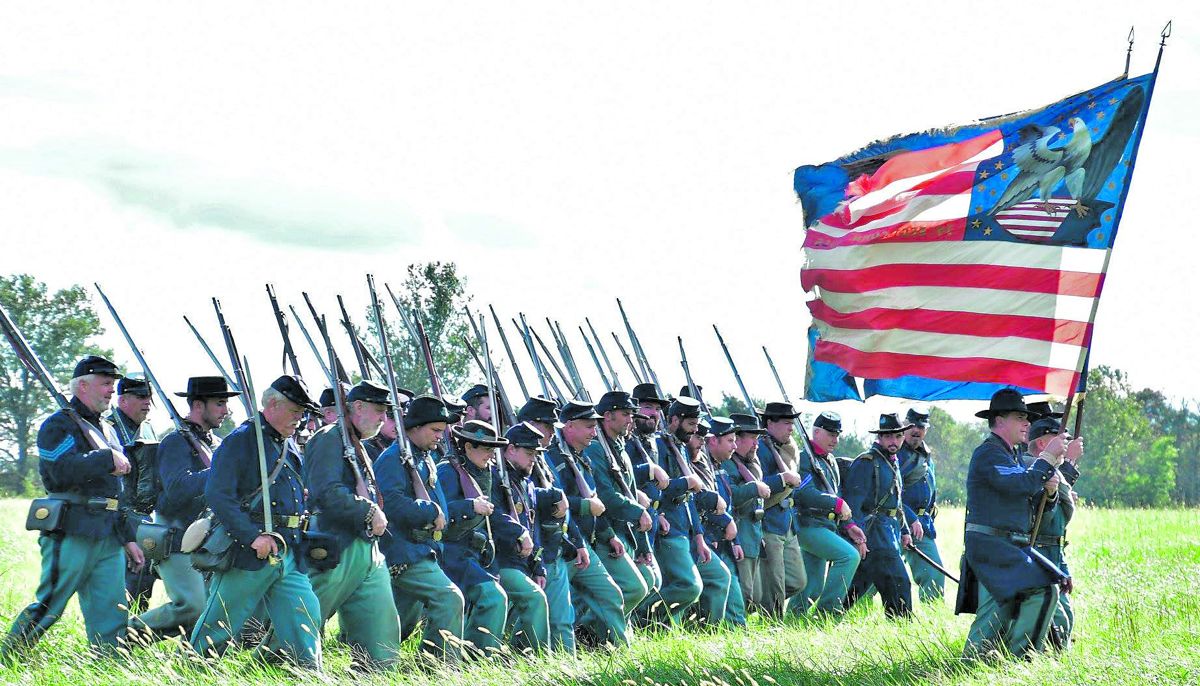
Federal infantry advancing.
(Kelly Boynton)
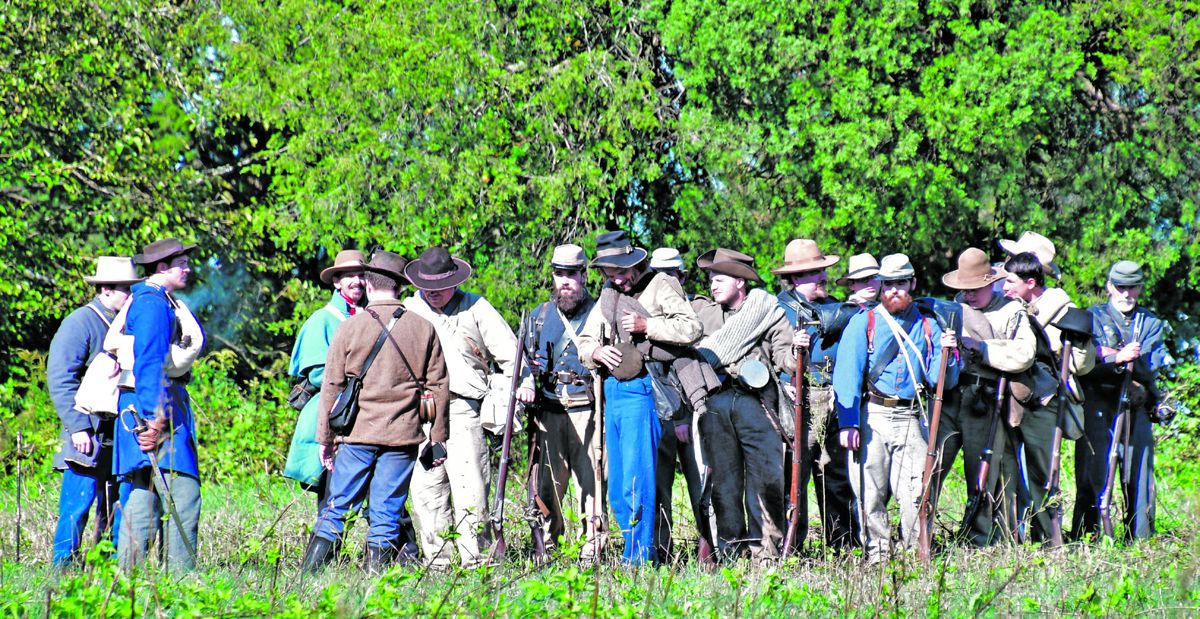
8th Florida falling in.
(Kelly Boynton)
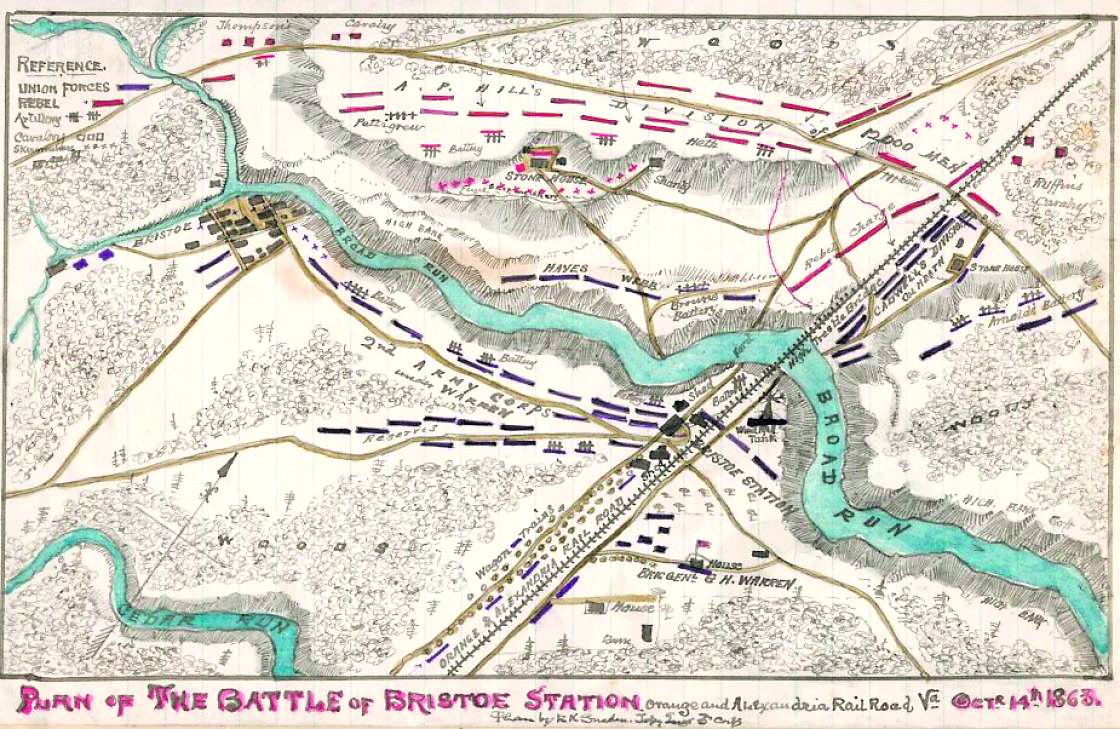
Plan of the Battle of Bristoe Station, Orange and Alexandria Railroad, Va., Octr. 14th 1863. Shows the area of Fairfax County, Va., which was the site of the Battle of Bristoe Station. The map is oriented with Cedar Run to the south, Bristoe to the west and indicates the route of the Orange and Alexandria Railroad. Also indicated are A.P. Hill’s Corps, Army of Northern Virginia, engaging the Union’s II Corps during its withdrawal toward Centreville, Va. (Artist Robert Knox Sneden, 1832–1918, Library of Congress)