
The Graphic War
Winter Quarters 1862–1863
By Salvatore Cilella · Originally published February 2019 · p. 22
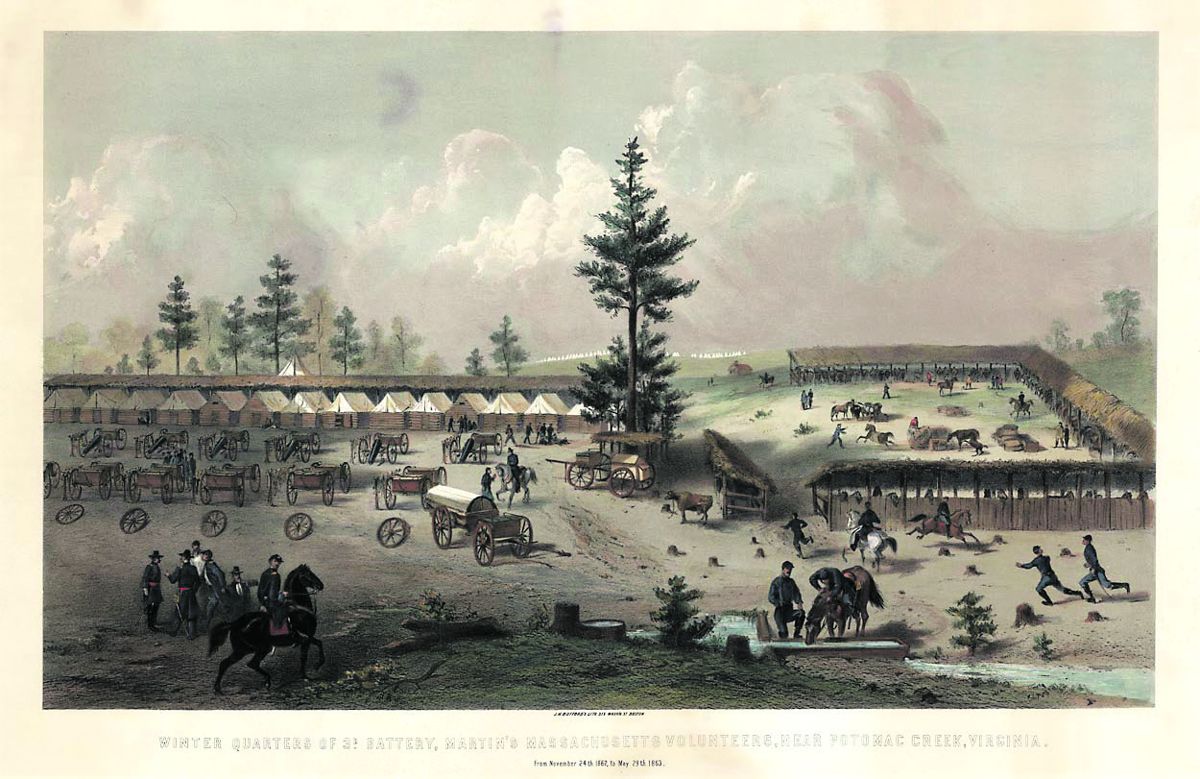
Winter Quarters 1862–1863 This occasional column highlights prints and printmakers from the Civil War. It discusses their meaning and most importantly, the goals of the print maker or artist. Salvatore Cilella
The Civil War was seasonal. In essence, the weather dictated military action. Most important action occurred between spring and late autumn. By late fall both armies usually withdrew to a comfortable, stable, and secure location. Although this lithograph portrays Battery 3 of Martin’s Massachusetts Volunteers from Nov. 1862 to May 1863 near Potomac Creek, the Battle of Fredericksburg occurred but a few miles south in mid-December. According to The Union Army, the Third Battery, Massachusetts Light Artillery, was recruited in the summer of 1861, by Dexter H. Follett, from among the friends of Senator Henry Wilson, colonel of the 22nd Mass. Infantry. It was mustered into the U.S. service Oct. 5, 1861, and left for Washington on Oct. 8, in company with the 22nd. It passed the winter of 1861–62 in and around Washington and took part in the advance of the Army of the Potomac into Virginia in the spring of 1862. One-half of the battery was engaged April 5 in front of Yorktown, and again at Hanover Court House, May 27. It was held in reserve at Mechanicsville, but took part at Gaines’ Mill and Malvern Hill, July 1. Accompanying the V Corps, it reached Fredericksburg the day after the battle, took part in the “Mud March” in Jan. 1863, and was in position, but not actively engaged at Chancellorsville. The unit was not again in action until Gettysburg. During the remainder of 1863 it was in no serious engagement.
The battery went into its second winter quarters at Bealeton Station, Va., remaining there from Dec. 1863, to May 1, 1864, when it joined the V Corps at Culpeper, and fought with it in the Wilderness, being one of the few batteries engaged. On May 8 it went into position at Laurel Hill, where it remained for five days, frequently in action. It was engaged at the North Anna River, and Shady Grove Church, Va., from May 30 to June 3. It sustained no loss at Cold Harbor, and moved on to Petersburg on June 18, being almost continuously in action until Aug. 13, 1864. It accompanied the 2nd Division, V Corps, in the expedition against the Weldon Railroad, and on Aug. 23, 1864, relieved the 11th Battery near Globe Tavern, remaining there until its term of service expired. At the end of that month, the reenlisted men and recruits were transferred to the 5th Mass. Battery, and the remainder of the command, 3 officers and 86 men reached Boston, Sept. 9. They mustered out on Sept. 16. The battery carried on its rolls 11 officers and 250 enlisted men.
Its loss during service was 1 officer, 11 men killed or died of wounds, and 11 men by accident or disease.1 From its history, the unit did not fare as badly as other artillery batteries and enjoyed two relatively mild winter quarters. The print by the famed Boston lithographic firm of J. B. Bufford featured here is magnificent in composition in comparison to other artists/lithographers. Its idyllic setting belies the sometimes-harsher elements of winter. It is extremely well executed and is reminiscent of earlier 19th century, New England, folk art paintings. It is very much unlike the hurried production of other publishers of battle scenes like Currier and Ives. The groupings of men and officers are well balanced and seem to be choreographed. The scene in the right, lower corner, with men and animals cavorting contrasts with the serious council of war going on in the left-hand lower corner. Those vignettes contrast with the rigid and orderly rows of cannon, caissons, and timber-tent capped soldier’s quarters. At the top right is another vignette showing stables and men attending to horses. Each section could be a separate painting. John H. Bufford enjoyed a long career as a lithographer. From 1835 to after 1871 he operated from Boston and New York. He was in New York during the war where he collaborated with many famous artists and lithographers like Nathaniel Currier. He gave Winslow Homer his start. Bufford tackled every conceivable topic—city views, whaling, sailing, and temperance to name a few. Among his other well-executed Civil War prints, subjects revolved around camp scenes and battlefields. His view of the camp of the 37th Massachusetts at Brandy Station depicts an almost carefree life of games including baseball. Another, more serious work featured the Army of the Potomac en route to the James River during the Seven Days battles in 1862, which he published the following year. One of his most ambitious prints was of the Gettysburg Battlefield in collaboration with John Bachelder.2 As lithographic historian Harry Peters pointed out “because [Bufford’s] volume was so great, and the prints so various” any selection of one over another would be “largely by chance.”3 His Civil War output was mostly concerned with naval engagements, which makes this particular print so different and unusual. Endnotes: 1. The Union Army. Madison Wisconsin: Federal Pub-lishing Company, 1908, I, 221 2. The American Civil War: A Centennial Exhibition. Washington, Library of Congress, 1961, 9, 14, 18, 20, 34. 3. Harry Peters. America On Stone: The Other Printmakers to the American People. New York: Doubleday & Co., 1931, 119. Salvatore Cilella is retired after 43 years in the museum field. His last position was President and CEO of the Atlanta History Center. He is the author and editor of several articles and books including Upton’s Regulars: A History of the 121st New York Volunteers in the Civil War (U. Press Kansas, 2009) and The Correspondence of General Emory Upton, 1856–1881 (U. Tennessee Press, 2017).