
UNC Trustees Told to Create New Plan for “Silent Sam”
By Stephen Davis · Originally published February 2019 · pp. 1–2
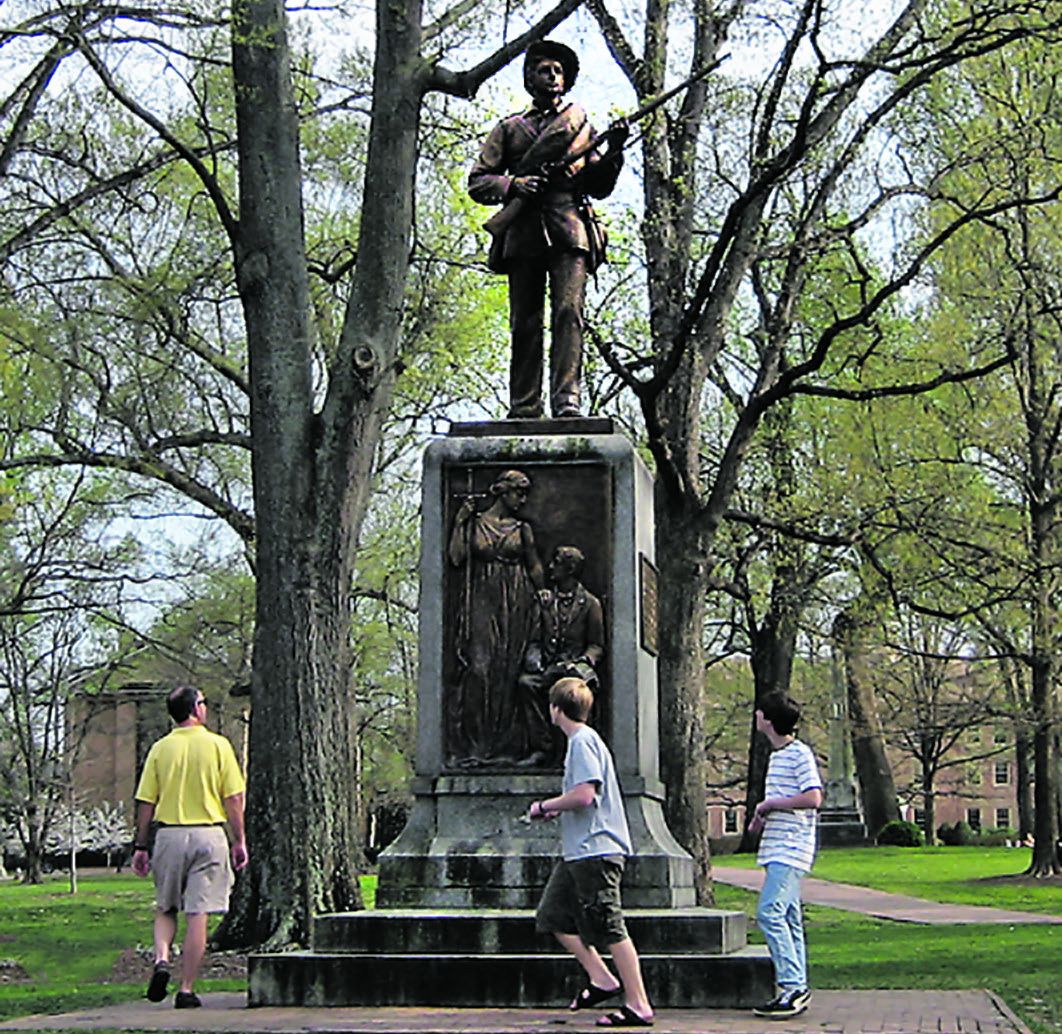
Special to Civil War News
On December 14, the University of North Carolina System Board of Governors rejected a proposal from University trustees at Chapel Hill to move the Confederate soldier’s monument on campus to a more secluded site, inside a building on the school’s southern fringes. The Board of Governors cited cost as a chief reason in rejecting the university’s proposal to move the bronze soldier, nicknamed “Silent Sam.” The cost of moving and reinstating the statue was estimated at $5.3 million. The UNC trustees were directed to come up with a new plan for Silent Sam by mid-March 2019. The issue was brought about by a protest rally at the statue, sited on McCorkle Place at the university’s entrance, last August. Protesters pulled Silent Sam down from its pedestal. University authorities then removed the bronze statue to a secure location, but left the pedestal and inscription plaques in place. A week later, the University System Board of Governors called on UNC Chancellor Carol Folt to develop a long-term plan for the statuary. In public statements, Folt made it clear that trustees did not want Silent Sam on campus, but a 2015 state law prohibits moving historical monuments from public places except to new sites of similar prominence and visibility. The Chapel Hill trustees’ proposal to move the statue, from a prominent walkway at the center of the university, to the south campus and a new building housing relics from the university’s history, clearly did not meet that criterion. The statue that stirred the rumpus on the campus actually originated more than a century earlier. In 1907 the North Carolina Chapter of the United Daughters of the Confederacy resolved to raise a monument at the University of North Carolina memorializing students who fought for the South in the Civil War. It was said that forty percent of the male student body volunteered for service, a record not equaled by any other Southern college. The university approved the UDC’s request in 1908. Fundraising for the monument came from UNC alums, the Daughters, and the university itself. When it was dedicated on June 2, 1913, “in memory of all University students, living and dead, who served in the Confederacy,” not only did North Carolina governor Locke Craig address the thousand or so onlookers, but so did University president Francis Venable. In his remarks the governor extolled the bravery of the young men who took up arms. “Nearly all the boys who left this institution to follow the flag of the Confederacy were killed or wounded in battle,” he declared; “the statue is a monument to their chivalry and devotion.” The bronze itself presents a young, uniformed Confederate soldier, walking with musket as if into battle. The brim of his hat is jauntily folded to its right; a blanket roll is tied over his shoulder. Below the statue on the pedestal is a metal plaque showing a frieze: a robed female warrior, holding a sword, lays her hand on a seated lad who is reading a book. The message is clear: she is calling the student to war. Given the substantial support for Silent Sam from UNC and its alums a century ago, I find peculiar the written statement released by Chancellor Folt: “We are the only university in this state that has anything closely resembling this statue….No university today would even consider placing such an artifact on their campuses….Put here more than one hundred years ago, our community is carrying the burden of an artifact, given to us by a previous generation in a different time.” I view in the chancellor’s statement a strained effort to forge a presentist disconnect from what was a genuine historical connection in 1908–13 between the university, its alumni, and the Confederate monument. Silent Sam did not stand in a void. Of ninety monuments
“Unveiling of the Confederate Monument, June 2, 1913” in Orange County, North Carolina Postcard Collection (P052), North Carolina Collection Photographic Archives, Wilson Library, UNC-Chapel Hill. A postcard photograph of the unveiling of the Confederate Monument Silent Sam at the University of North Carolina on June 2, 1913. The postcard was sent by “Drew”, on the very day of the unveiling, to Mrs. M.F. Patterson in Winston-Salem, N.C., and says: “My dear Mother, This is a photo of the unveiling of our new monument to those who left the Univ. to enlist in the army in 1861. The parade yesterday was a fine one, & Mary & the other looked very picturesque in your dresses. We’ll take good care of them & thank you for them. All well. Love to all. Affectionately, Drew.”
erected in North Carolina from the end of the war throughout the Centennial, Ralph Widener counts more than half, fifty, as dedicated during the first two decades of the last century, 1900–1919 (Ralph W. Widener Jr., Confederate Monuments: Enduring Symbols of the South and the War Between the States, 1982). The “silent” part has different stories. The North Carolina Division UDC hired a Massachusetts-based sculptor, John A. Wilson, to make its Chapel Hill statue. Wilson had already created a statue of a Maine soldier killed in the war; the sculptor did not include a cartridge box. When contracted by the North Carolina ladies, Wilson repeated the scene: the Confederate held his rifle, but he carried no cartridge box. Hence the “silent” soldier who never fired his weapon. Despite its silence (the campus newspaper, the Daily Tar Heel, began calling it “Silent Sam” in 1954), the statuary started provoking protests in the 1960s. In 1965, the Tar Heel published a letter complaining that the sculpted Confederate soldier was a racist symbol. In April 1968 it was vandalized with paint after the assassination of Dr. King. The university Black Student Movement began holding protests at the statue. Silent Sam was spray painted again in July 2015. Three months later, addressing students on University Day, Chancellor Folt was interrupted by shouts of
“Tear it down!” Then came the Charlottesville riots of Aug. 11-12, 2017, which thrust that city’s monuments to Confederate heroes into the national spotlight. On August 14, the Confederate statue in Durham, N.C., home of Duke University, was torn down by an angry crowd. A week later, UNC officials warned North Carolina governor Roy Cooper that the same thing could happen at Chapel Hill. “It is only a matter of time,” the statement read, “before an attempt is made to pull down Silent Sam in much the same manner we saw in Durham.” Campus police began guarding the monument, even forming a barrier around it when protesters talked of tearing it down. But the protection could not prevent the inevitable. On Aug. 20, 2018, protesters pulled Silent Sam down from its pedestal. Several days later, the North Carolina Division of the Sons of Confederate Veterans placed flowers around the base that had held the soldier’s statue. In recent years, a group calling itself “the Real Silent Sam Coalition” had begun to hold protests at the statue. The Coalition posted this notice at the site:
“The Real Silent Sam” September 1, 2011
The Confederate Monument at Chapel Hill was erected in 1913 during a white supremacist movement in which similar statues were built throughout the South. This memorial to Confederate soldiers who left the university perpetuates an incomplete and inaccurate history—one that intentionally neglects the vast number of North Carolinians who opposed secession and the Confederacy. The original supporters of the movement, both town and university leaders, were motivated by racism and were colluders in a statewide campaign to establish white dominance. This statement from the Real Silent Sam Coalition goes a long way toward explaining why there developed such local antipathy to the Confederate soldier’s monument on the university campus.