
New York State Militia/Hiram Roosa’s Collection
By Leon Reed · Originally published February 2019 · pp. 4–7
New York State Militia/Hiram Roosa’s Collection By Leon Reed So, when did the Civil War “start?” Well, when I taught U.S. History, the Virginia Standard of Learning stated the first shots were fired at Fort Sumter, S.C., on April 12, 1861. The SOL also mentioned that the first “significant armed combat” happened at First Manassas, on July 21, 1861. I doubt any state standard mentions the event that arguably marked the beginning of the fighting and the moment the country recognized we were stepping into something big. This event came almost half-way between the “first shots” and the “first battle” and is today almost forgotten. Thanks to the early involvement of the New York State Militia and the interest of a key NYSM official in souvenirs, a fresh reminder of this event is available.
NYSM Mobilizes Of all the northern states, New York was the one that took military affairs most seriously in the years preceding the Civil War. The New York State Military Association, parent organization for state militia units, was also politically active. Early in the secession crisis, NYSM approved resolutions denouncing secession, calling on Federal authorities to defend Federal arsenals and other property in Southern states, and specifically endorsing plans for defense of Fort Sumter. No state had a more effective militia organization. Unlike most Northern states, many NY militia units had at least partially full rosters, some training, and had been issued some equipment in peacetime. As a result, New York militia regiments were among the first units organized, equipped, and dispatched to Washington, D.C., at the start of the crisis. At least eleven NYSM regiments responded to Lincoln’s April 15, 1861, call for 75,000 volunteers, leaving New York for Washington between April 19 and May 7, to serve for three months.1 Four additional New York State
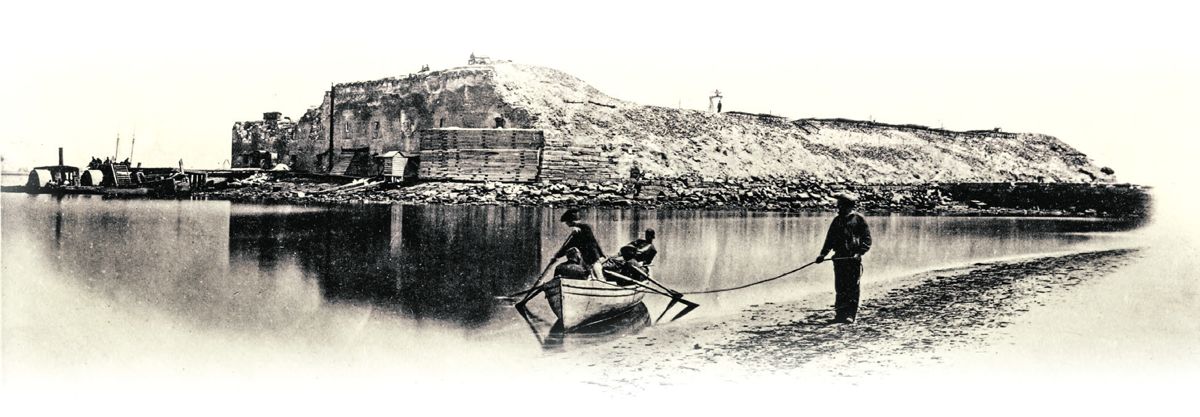
Militia regiments volunteered for three years’ service.2 On May 23-24, 1861, NYSM regiments played a leading part in the first offensive operation of the war, the move across the Potomac River to occupy Alexandria and Arlington.
Roosa and His Collection The corresponding secretary of the Military Association was Hiram Roosa. As the corresponding secretary of one of the most prominent pro-Union organizations, he had a wide acquaintance with politicians and military officers. During the first year of the war, Roosa was also an avid collector of Civil War souvenirs. An album he kept has passed down through Roosa’s descendants. It sat unseen in a bag for at least 50 years before resurfacing recently. The scrapbook contains some of his correspondence (with, among others, Maj. Robert Anderson, commandant of the U.S. garrison at Fort Sumter, and Horatio Seymour, a prominent New York state politician), a superb collection of several hundred envelopes with printed cartoons and sayings on them, and several keepsakes of early war incidents.
The Death of Col. Elmer Ellsworth, first Union officer to die in the Civil War Elmer Ellsworth worked in Abraham Lincoln’s law office and accompanied him to Washington for his inauguration. Some years before the war, Ellsworth introduced the Zouave concept in the United States. His first unit, the Chicago-based United States Zouave Cadets, put on precision drills and exhibitions in the United States.3 His first unit, the Chicago-based United States Zouave Cadets, toured 20 cities before the war, including West Point and Washington, D.C. When the war broke out, he formed and was the first commander of the First New York Fire Zouaves (11th New York
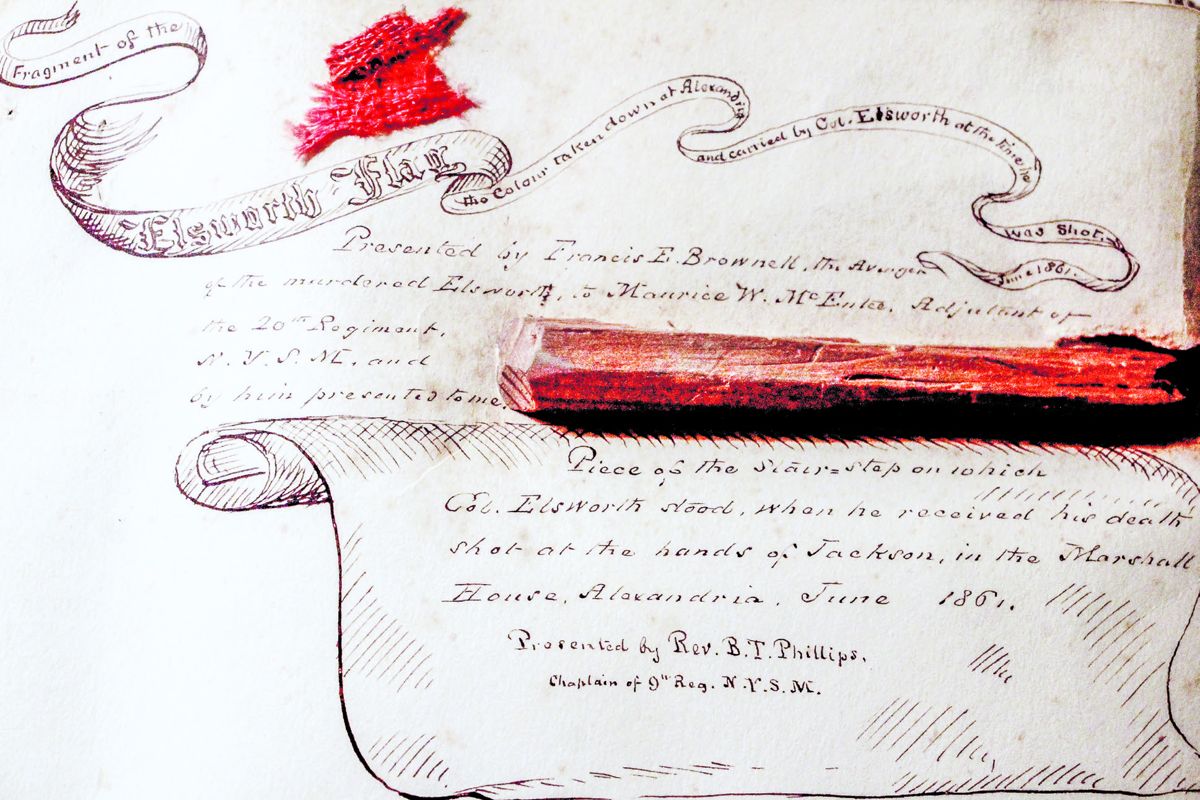
Volunteers), one of the early regiments to arrive in Washington during Lincoln’s initial crisis. On May 24, 1861, the day after Virginia voted in a referendum to ratify the articles of secession approved earlier by the legislature, Ellsworth’s regiment took part in the first offensive operation of the war. The New York Times listed nine NYSM units (including “Ellsworth’s Zouaves”) as making up about two-thirds of the Union force that crossed the Potomac River to occupy Arlington County and Alexandria. While the 69th New York (later a stalwart component of the Irish Brigade) led a column of troops across the Long Bridge (near today’s 14th Street Bridge) into Virginia, Ellsworth and his Zouaves took a steamer down the Potomac to the Alexandria city dock. Most Confederate troops had fled and the occupation of the city was relatively smooth. An 8- by 14-foot Confederate flag flying from the roof of the Marshall House, an Alexandria hotel, had been an irritating presence to those across the river for several weeks. Ellsworth led a squad to get it. Ellsworth was accompanied by only four soldiers as he approached the Marshall House. There was no resistance and he easily reached the hotel’s roof and took down the flag. According to one account, as Ellsworth and his escort descended to the ground floor, “Ellsworth just happened to meet the one person he didn’t want to meet,” innkeeper James Jackson. Jackson was a strong defender of secession and also was reportedly a violent man. Jackson accosted Ellsworth and fired a shotgun at him. Jackson’s shotgun blast killed Ellsworth instantly; Jackson in turn was gunned down by Cpl. Francis Brownell, one of Ellsworth’s party. Ellsworth became the first Union officer killed during the war. The reaction to Ellsworth’s death was instantaneous. The New York Times reported that night that his regiment was camped on a steamer in the river
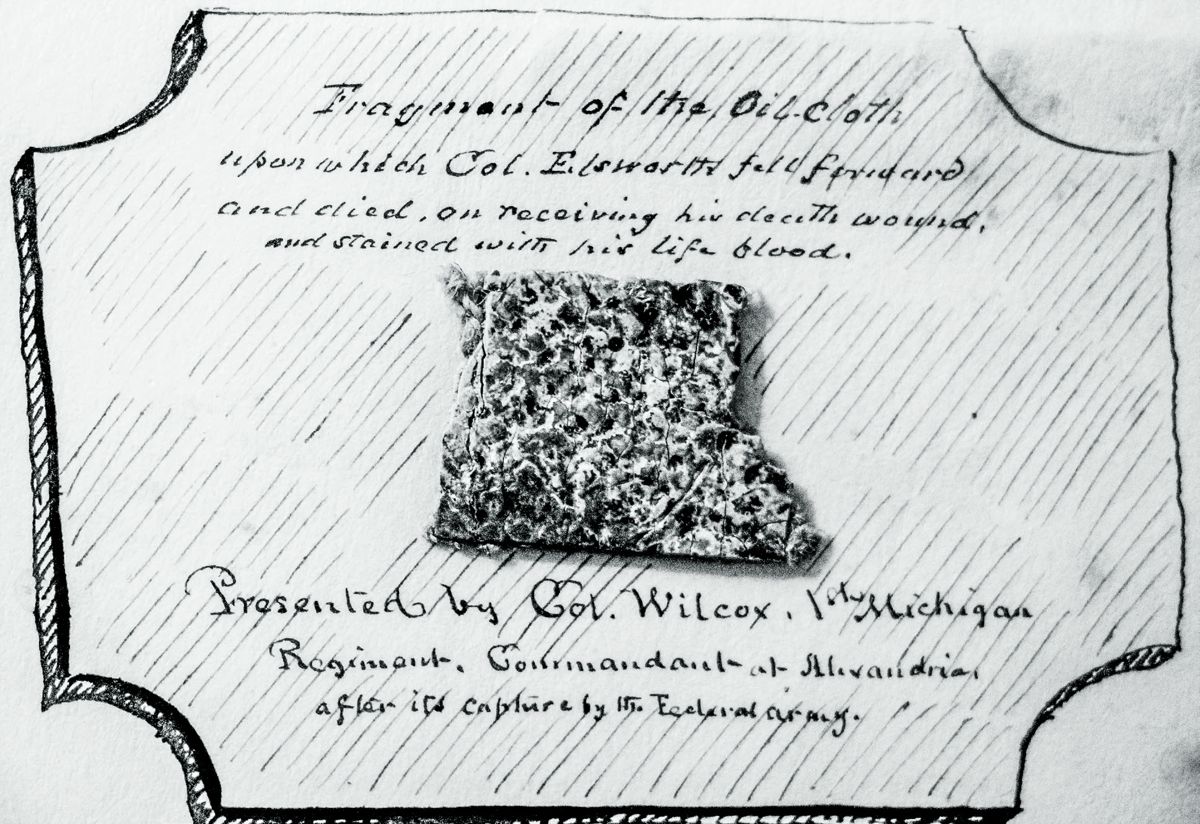
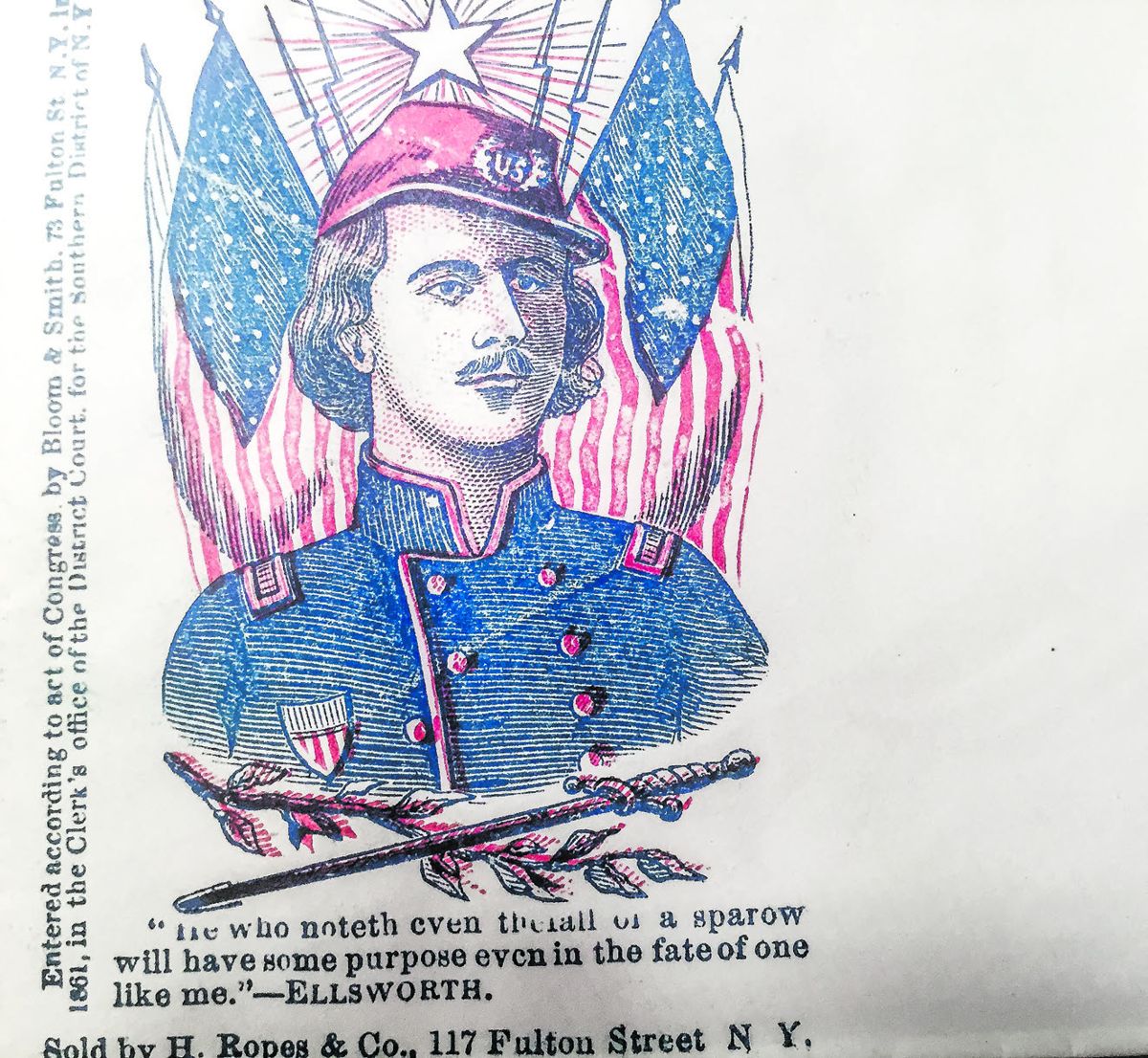
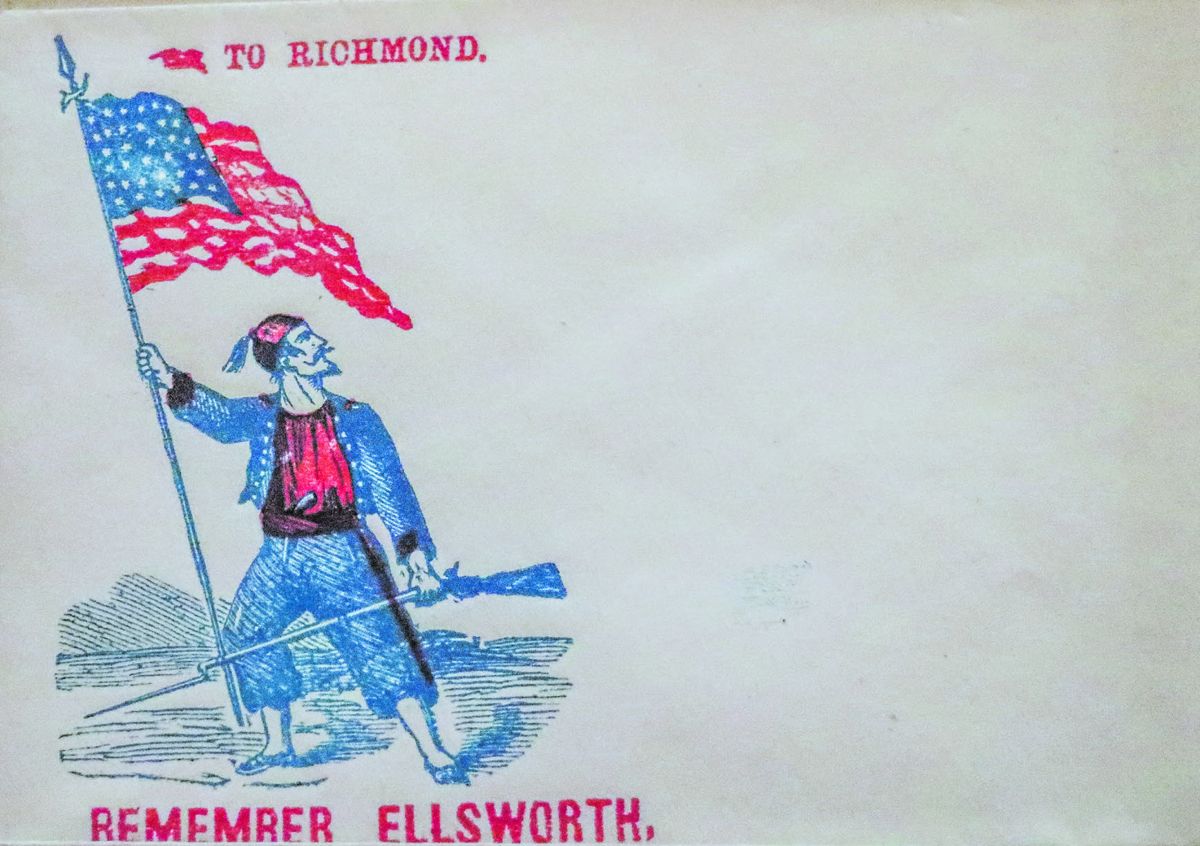
“to prevent them from avenging the death of Ellsworth.” The city was reported to be quiet. “The citizens are in great fear.” The New York Tribune and other papers published accounts of the incident and news traveled fast. In death, the friend of Lincoln and “martyred hero” reached celebrity status. His body lay in state at the White House and then was taken to New York City, where thousands lined up to view Ellsworth’s cortege.4 Early in the war, before the number of heroes began to mount, “Remember Ellsworth!” became a rallying cry and his name and face and descriptions of his heroics appeared on stationery, envelopes, and other ephemera. The 44th New York Volunteer Infantry Regiment, which was forming at the time, took the nickname “Ellsworth’s Avengers.” The incident galvanized the south as well. Not only Jackson’s martyrdom but the broader events of the day became rallying cries. The entire Federal troop movement into northern Virginia was condemned as an illegal invasion and occupation. The day’s events did much to convince doubters that war was inevitable.
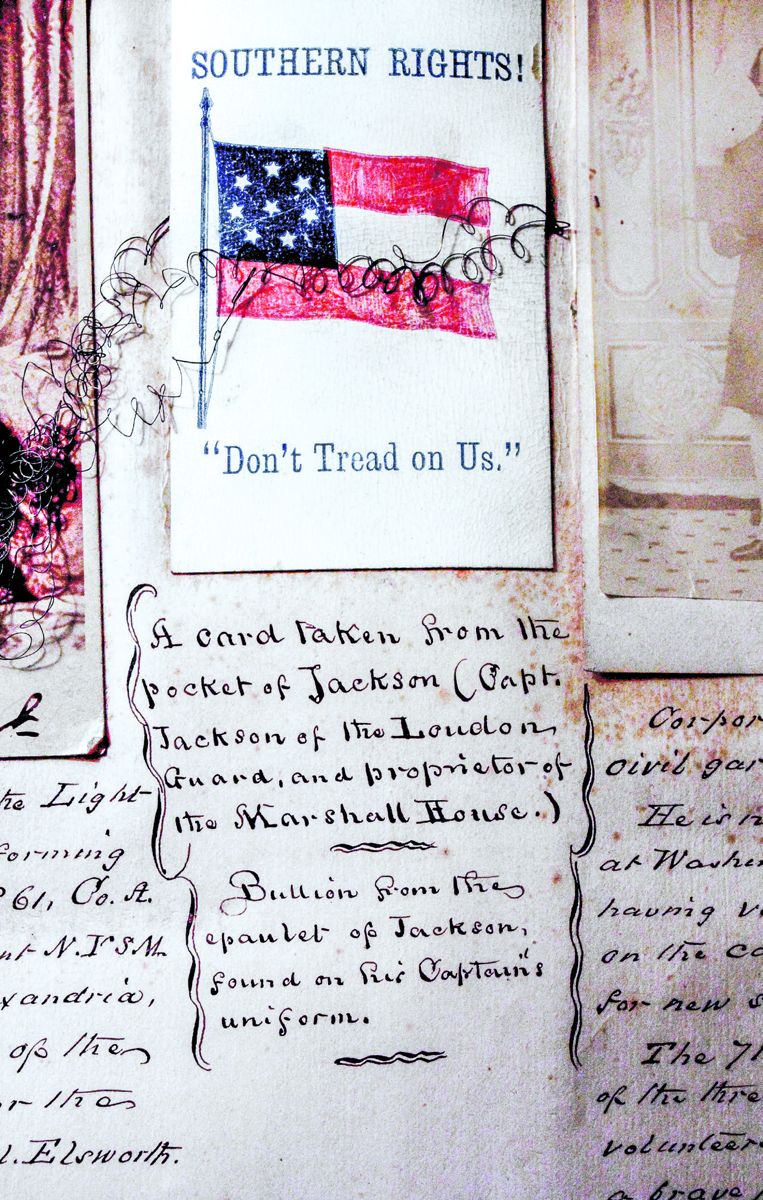
Writing in 1864, New York Times editor Horace Greeley commented on the significance of this small event. “Jackson’s deed, which, at the North, was shudderingly regarded as assassination, at the South was exulted over as an exhibition of patriotic heroism; and a subscription was at once set on foot for the benefit of his family. The incident was widely regarded by many as indicative of the terrible earnestness of the contest upon which the American people were now entering.” The newly-discovered souvenir in Roosa’s collection contains a brief handwritten account of Ellsworth’s death; items identified as a fragment of the stair Ellsworth was standing on, presented to the adjutant of the 20th NYSM by Cpl. Brownell; a “Southern Rights, Don’t Tread on Us” card removed from Jackson’s pocket; a fragment of the oil cloth that Ellsworth was laid on; and an envelope commemorating Ellsworth. After the action in Alexandria, Ellsworth’s regiment was heavily engaged at First Manassas, was involved in the Seven Days campaign in the spring of 1862, and was then sent back to New York City to muster out.
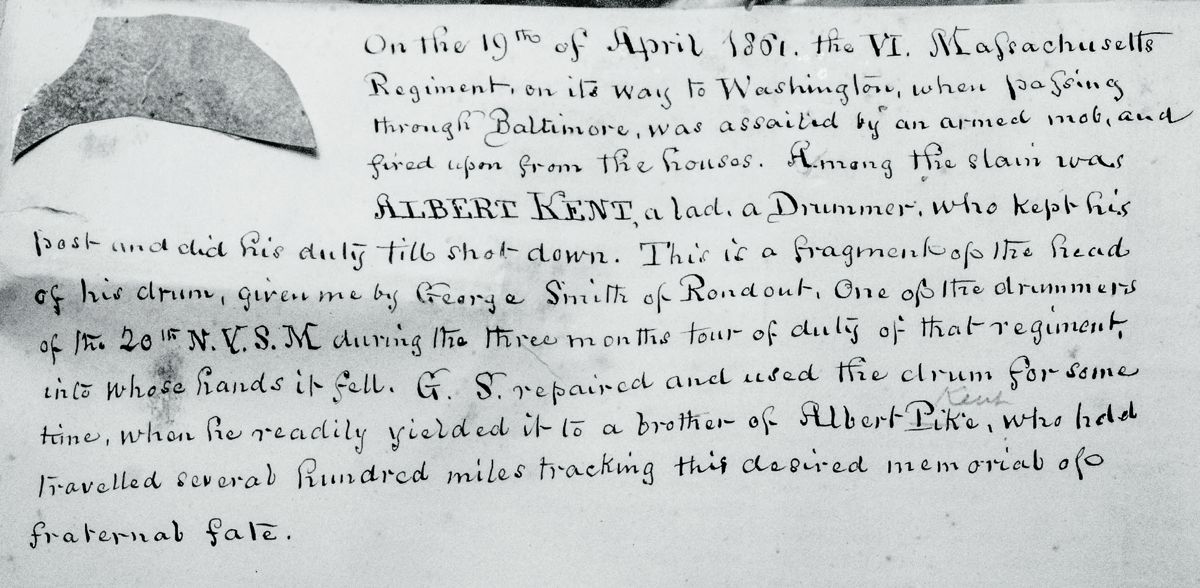
Fight Through Baltimore: Albert Kent, drummer Roosa’s second interesting souvenir concerned another event with national significance that happened a month earlier than the Federal advance into Virginia. It concerned Albert Kent, a drummer boy with the 6th Massachusetts Infantry. Kent was killed April 19, 1861, during the Pratt St. riots in Baltimore. The riots happened when the 6th Massachusetts, one of the first regiments to reinforce the national capital, marched through downtown Baltimore.5 Due to the lack of through rail links, passengers for Washington were forced to transfer 10 blocks from the President St. station to the Camden station. The 6th Massachusetts arrived in Baltimore only six days after the surrender of Fort Sumter and pro-secession feeling ran extremely high. Members of the “Copperhead” (anti-war Democrat) and pro-Confederate factions blocked efforts to pull the rail cars from station to station and surrounded a group of soldiers walking through town.6 Shots were exchanged and at least 4 soldiers and 12 civilians died before the mayor dispatched police who quelled the riot and escorted the soldiers on to the Camden train station. The Federal government reacted swiftly to the riots and the threat of secession in Maryland. In the aftermath, a new route to Washington from the north was established via Annapolis, allowing Federal reinforcements to bypass Baltimore. The 8th Massachusetts and 7th New York occupied Annapolis; the New York regiment then moved to Washington, breaking the siege and ensuring the survival of the nation’s capital.
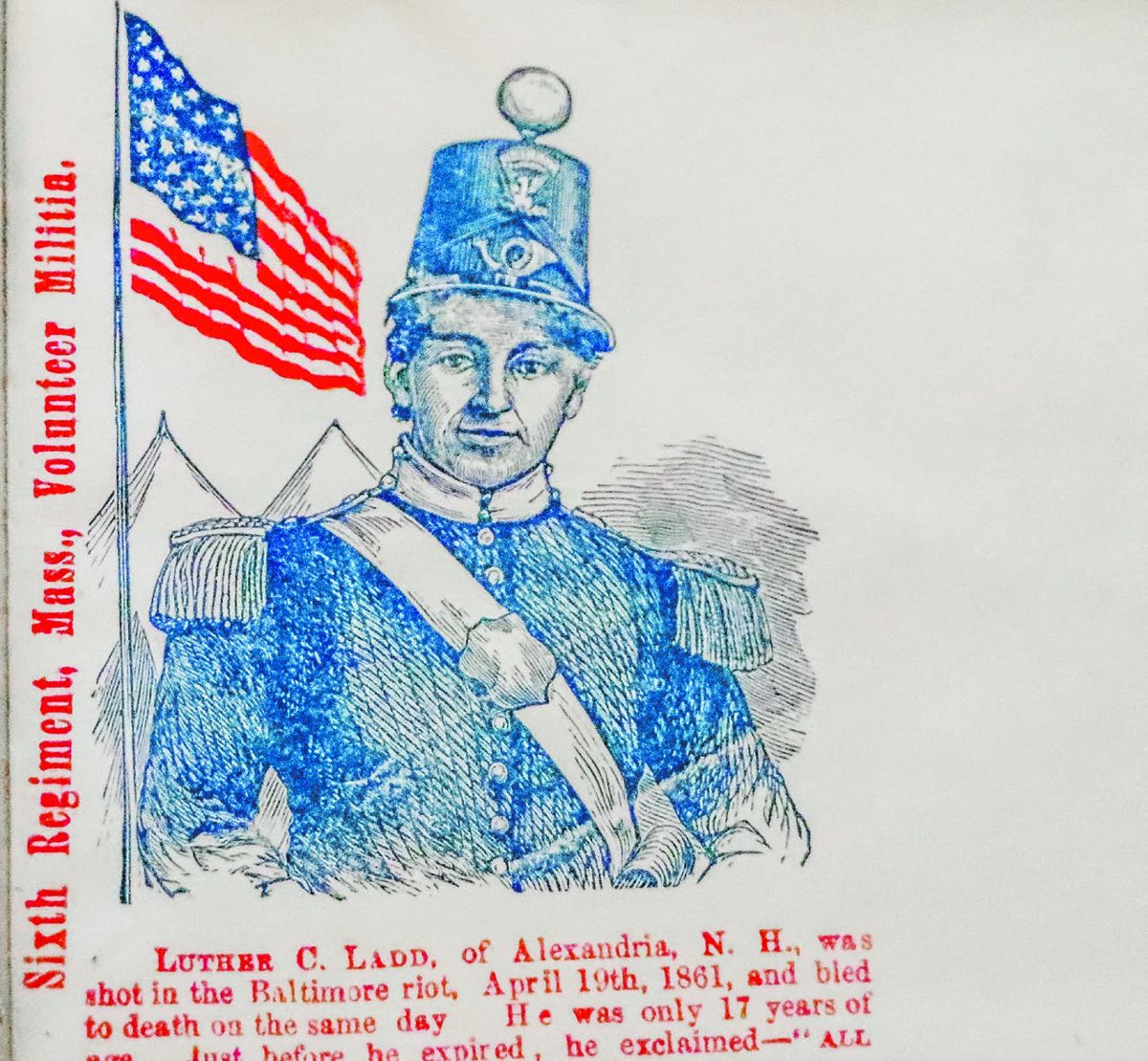
Baltimore was occupied by Federal troops and President Lincoln declared martial law, arresting most of the political leadership and imprisoning them without charges, later ignoring a Supreme Court ruling that his declaration was unconstitutional. When the legislature met in September to consider secession, Lincoln had a third of the legislators arrested, ending discussion of secession in this critical state. The riots were one of the first violent events involving U.S. troops to occur during the secession crisis. The souvenir contains a brief account of Kent’s death and a fragment of his drum, given to Roosa by a drummer from the 20th New York State Militia. The Roosa collection also contains an envelope honoring another 6th Massachusetts soldier shot during the march through Baltimore.
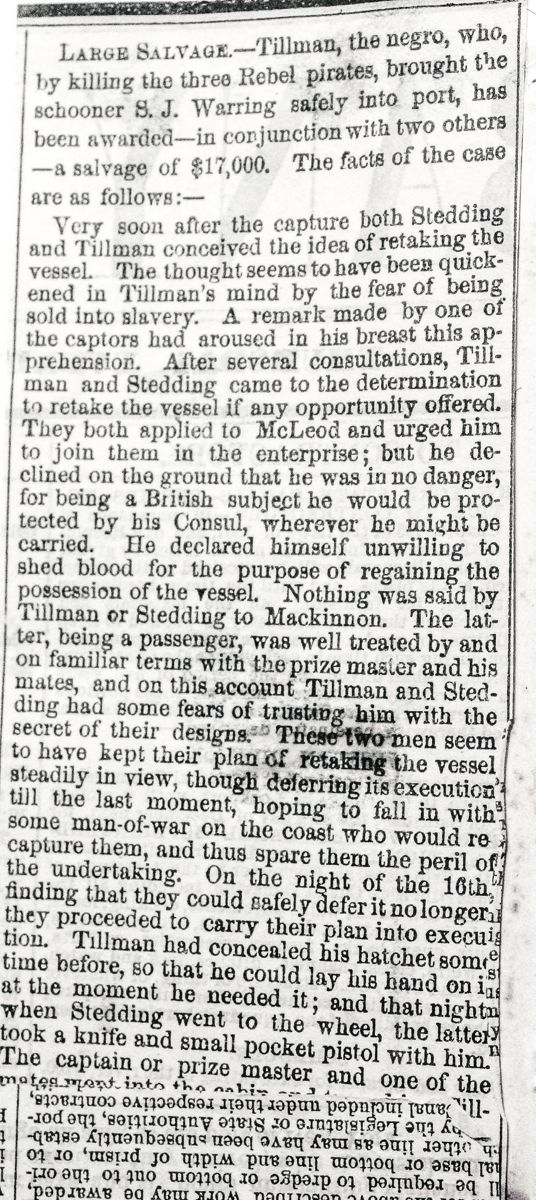
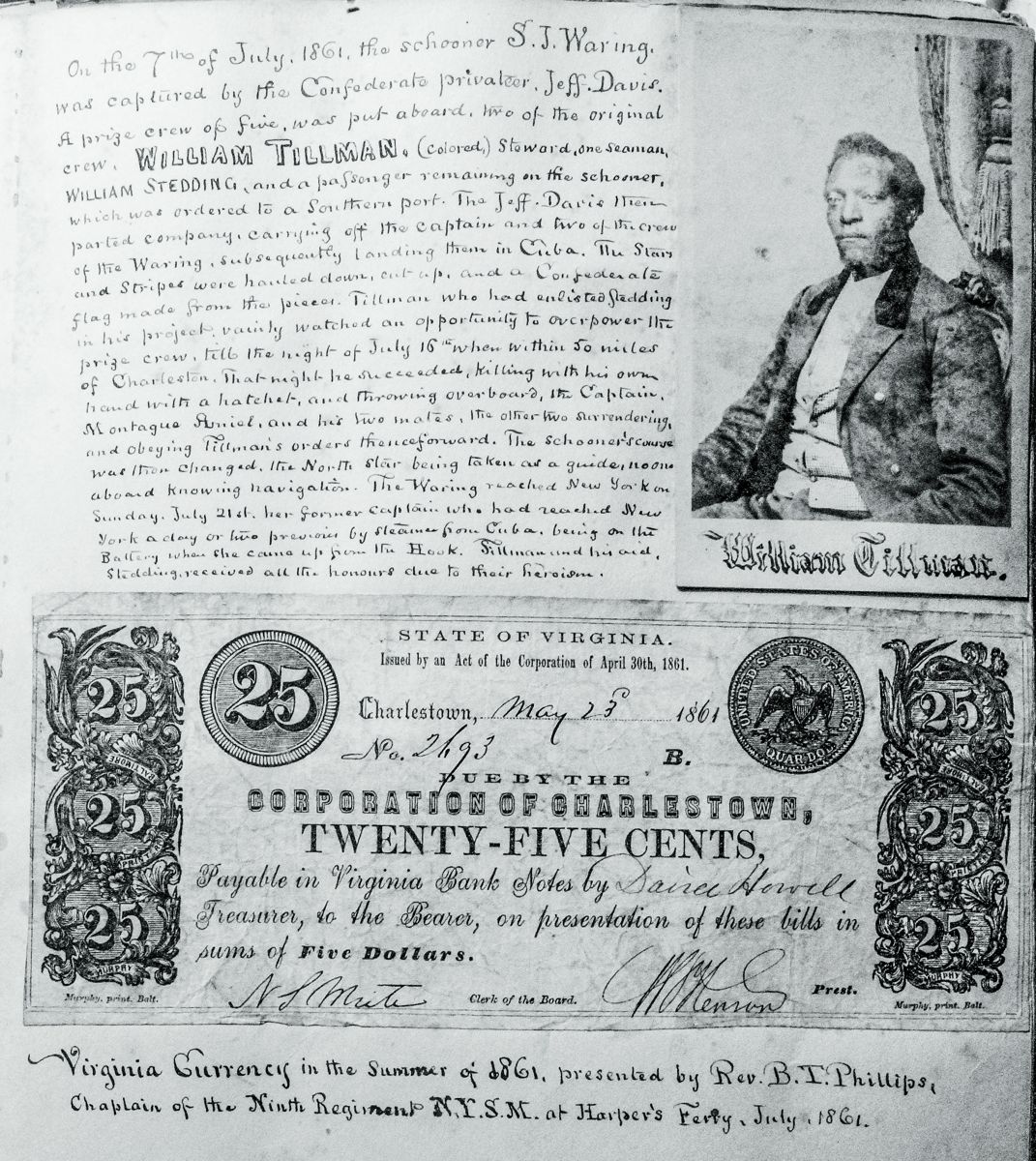
William Tillman Saves the S.J. Waring The third event celebrated in Roosa’s collection didn’t have the national implications of the Ellsworth killing or Pratt St. Riots, but it provided an important morale boost for the Union public at a time good news was desperately needed. William Tillman was a black steward on the S.J. Waring, a northern merchant schooner headed toward Montevideo. On July 9, 1861, the ship was seized by Confederates from the privateer Jefferson Davis. The Confederates dropped most of the white crewmen off in Cuba to await a ship back to New York and then headed for port in South Carolina with Tillman, a prize crew, and a few of the Waring’s original crew. The privateers told Tillman that he was Confederate property and he knew his ultimate
Fragment of Albert Kent’s drum.
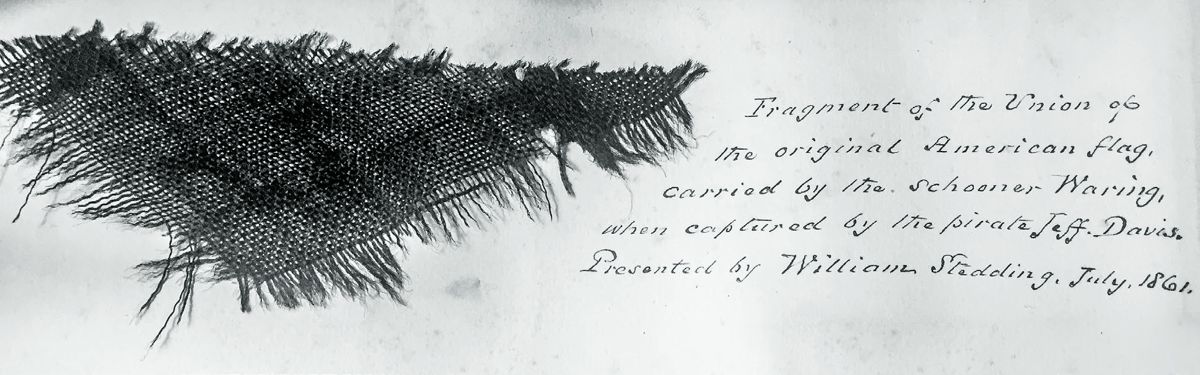
destination was enslavement on a southern plantation. To their ultimate regret, the privateers continued to allow Tillman to have the run of the ship, believing him incapable of hatching or carrying out a plot. While en route, Tillman and one of the original crew members overpowered and killed the privateer’s leaders, locked the other Confederates below deck, and, assisted by the original crew members, sailed the ship toward New York. When additional crew was needed he brought the Confederates up on the deck and promised to shoot them if they disobeyed in any way. With his makeshift crew, Tillman arrived in New York, beating the captain and other crewmen who had been left in Cuba. The souvenir in Roosa’s collection includes a handwritten account of Tillman’s story, a photo of Tillman, a newspaper article describing the adventure, and a fragment of the flag that flew over the Waring. A country just recovering from the shocking loss at First Manassas earlier the same day hailed this maritime triumph. Tillman received $6,000 in prize money for recovery of the
“Waring” and enjoyed a brief period of celebrity. Black writer William Wells Brown wrote in 1867 that “the New York Tribune said of this event ‘To this colored man was the nation indebted for the first vindication of its honor on the sea.’ Another public journal spoke of that achievement alone as an offset to the defeat of the Federal arms at Bull Run. Unstinted praise from all parties, even those who are usually awkward in any other vernacular than derision of the colored man, has been awarded to this colored man.” Tillman even got the equivalent of a reality show: “At Barnum’s Museum he was the center of attractive gaze to daily increasing thousands.” Roosa’s scrapbook is in excellent condition and provides a fascinating glimpse of early Civil War activity. The scrapbook contains a few dozen letters, most concerned with the routine business of the Military Association, a few more souvenirs of early Civil War events, and more than 100 illustrated envelopes. Some celebrate early Union victories (“McClellan, Liberator of West Virginia”) and leaders (most notably President Lincoln and General Winfield Scott) while others heaped scorn on Jefferson Davis or other Confederate leaders. I am grateful to Hiram Roosa for assembling this Civil War history and to my cousins, Mary Reed and James Reed, for taking such good care of this collection for a combined 80+ years.
1st Fire Zouaves, 5th, 6th, 7th, 8th, 12th, 13th, 20th, 25th, 28th, and 71st New York State Militia. Although these were initially three month regiments, many of them re-enlisted upon the expiration of their term or formed the nucleus of a new New York volunteer regiment. These were the 2nd state militia (later the 82nd New York Volunteers), 9th (83rd), 14th (84th), and 69th (later a component of the Irish Brigade). Much of this information is abstracted from https://dmna.ny.gov/historic/reghist/civil/infantry/20thInfNYSM/20thInfNYSMMain.htm. Timothy Marr, “The American Zouave: Mania and Mystique,” Military Images, Autumn 2016, p. 22. “Very Important News: the War for the Union Commenced in Earnest,” New York Times, May 25, 1861, p. 1, “Exciting News: the War Commenced,” Baltimore Sun, May 25, 1861, p. 1, and Greeley, Horace,
The American Conflict. Vol. 1 (Hartford, OD Case, 1864). https://www.nps.gov/articles/the-pratt-street-riot.htm The secession crisis was very much a current event at the time. The first seven states seceded between December 1860 and February 1861 following the election of Lincoln. The scrap at Fort Sumter not only triggered the reinforcement of Washington but also brought renewed discussion of secession to the eight slave states that had remained with the Union. Virginia seceded two days before the Baltimore riots, and discussions were underway in Arkansas (seceded May 6, 1861), North Carolina (seceded May 20, 1861), Tennessee (seceded June 8, 1861), Maryland, Missouri, and Kentucky. (Delaware had earlier rejected secession and was never considered a threat to secede.)
Endnotes:
Leon Reed is a former congressional aide, defense consultant, and U.S. History teacher. He lives in Gettysburg and writes military history books.