
Book Reviews
Book Reviews — February 2019
Originally published February 2019 · pp. 36–42
Civil War News book reviews provide our readers with timely analysis of the latest and most significant Civil War research and scholarship. Contact Stephen Davis, Civil War News Book Review Editor. Email: [email protected].
Rising in Flames: Sherman’s March and the Fight for a New Nation. By J. D. Dickey. Maps, photos, notes, bibliography, index, 413 pp., 2018. Pegasus Books, www.pegasusbooks.com. $29.95 hardcover. Reviewed by Stephen Davis
J. D. Dickey, a writer who lives in the Pacific Northwest, is author of Empire of Mud, a history of Washington, D.C. in the 1800s. In Rising in Flames he offers a colorful narrative of Sherman’s Georgia and Carolina Campaigns of 1864–65. It’s an interesting take on these important events, as I saw in Dickey’s book elements of history, biography and fiction. Through his publisher, I e-asked the author if he saw his work as a blend of these three. He answered, “although there are certain novelistic and biographical elements to the book, I intended Rising in Flames as a work of narrative nonfiction—a history of selected participants in Sherman’s march and people who supported them on the home front.” Dickey thus follows Sherman’s campaigns not as a traditional historian would, but through the experiences of eight characters: Sherman, Gens. Jefferson Davis and John Logan, Capt. Charles Wills (103rd Illinois), the Rev. John Hight (chaplain of the 58th Indiana), “Mother” Mary Bickerdyke, Mary Livermore (publisher of a religious newspaper in Chicago), and John McCline, an 11-year-old escaped slave. I asked Mr. Dickey how he chose his characters. He answered, “I chose these characters because each represented something intrinsic to what Sherman’s campaign was about….Each was fascinating in his or her own right (especially such an amazing person as Mother Bickerdyke).” But because he chooses to view events through Northern characters, he essentially omits the Confederate side of the story. With its focus on individuals,
History, with a Touch of Fiction
I found Rising to read rather as impressionistic history (although the author’s research is extensive, judging from his notes and bibliography). And as a novel will, the narrative is not sustained and linear; we jump from Fort Donelson to Chickamauga in four pages. I read his treatment of the Atlanta Campaign with greatest interest. When Dickey writes that at Kennesaw Mountain “Logan bellowed at his men to follow him into a blizzard of gunfire and minie balls,” I suppose he can be forgiven for a bit of novelistic hyperbole (as XV Corps commander, Logan’s place was properly in the rear, as shown in Thure DeThulstrup’s famous painting of 1887). Similarly, referring to the Northern bombardment of Atlanta, July 20–August 25, he writes, “anywhere from 100 to 150 civilians had died in the shelling, though no one could be sure since many bodies were vaporized or severed into countless pieces by the blasts.” I found this particularly odd, as Dickey cites my article in Atlanta History from back in 1999, when I estimated only twenty civilian lives lost to Sherman’s shells. Rising in Flames follows Sherman through Georgia and the Carolinas to the end of the war in its colorful, interesting fashion. But, as you can infer from these few instances, when I want the facts on the Atlanta Campaign and the march to the sea, I’ll turn to Castel’s Decision in the West and to Trudeau’s Southern Storm.
Hawkeyes Go To War Iowa and the Civil War, Volume I: Free Child of the Missouri Compromise. By Kenneth L. Lyftogt. Maps, photos, notes, index, 416 pp., 2018. Camp Pope, www.camppope.com, $40 hardback. Reviewed by Jeff Patrick
Recounting a state’s participation in the Civil War is a daunting challenge. This is particularly true in the case of Iowa, for the Hawkeye State contributed much to the Union war effort, and reminders of the state’s Civil War heritage can be found in many communities and on many battlefields. Author Kenneth Lyftogt has not only accepted the challenge, but is planning to produce a three-volume study detailing Iowa’s role in the war—the first comprehensive history of the subject to appear in more than a century. This first volume begins with an examination of Iowa politics and abolitionism in the 1850s, and concludes with the 1862 Battle of Shiloh. Lyftogt argues that although the state’s residents leaned toward the Democratic Party in the years immediately following statehood in 1846, the new Republican Party soon posed a significant challenge to Iowa Democrats, and by the late 1850s Republicans were firmly entrenched in state offices. In the 1860 election, 69 of the state’s 97 counties went for Abraham Lincoln. Abolitionist John Brown found support in the state, and Iowan Barclay Coppoc served with Brown at Harpers Ferry. With the start of the war in 1861, the citizens of Iowa and Governor Samuel Jordan Kirkwood enthusiastically responded to President Lincoln’s call for troops. Iowans played an important role in some of the war’s early fighting, particularly the 1861 battles of Athens, Wilson’s Creek and Belmont, Missouri. In early 1862 Iowa infantry, cavalry and artillery units helped secure southwest Missouri and greatly aided fellow Iowan Samuel R. Curtis’s victory at Pea Ridge, Ark. Iowa regiments gained glory east of the Mississippi River as well. The state’s soldiers assisted Ulysses S. Grant in the capture of Fort Donelson, Tennessee, in February 1862. On the first day of the battle of Shiloh on April 6, 1862, several Iowa units fought bravely in the legendary Hornet’s Nest and elsewhere on the field, and according to one estimate, nearly a quarter of the casualties suffered by Grant’s army that day were Iowans. Lyftogt’s prose is a delight to read, with interesting details and a refreshing lack of jargon that would put off readers unfamiliar with Civil War history. He avoids digressions and minutiae that would slow the pace of the narrative. Although not intended to be an exhaustive study of all aspects of the state’s history during the Civil War period, Lyftogt’s excellent overview of Iowa’s role in the first year of the war is required reading not only for Hawkeyes, but also for anyone wanting to learn more about the war in the Western and Trans-Mississippi Theaters. This reviewer looks forward to the other volumes in the series as Lyftogt follows the Iowans to Corinth, Vicksburg, Chattanooga, Atlanta and beyond. Jeff Patrick is the museum curator at Wilson’s Creek National Battlefield in Republic, Missouri. He is currently working on a history of the 2nd Kansas Colored Infantry (83rd U.S.C.T.)
The Role of Media in the Civil War
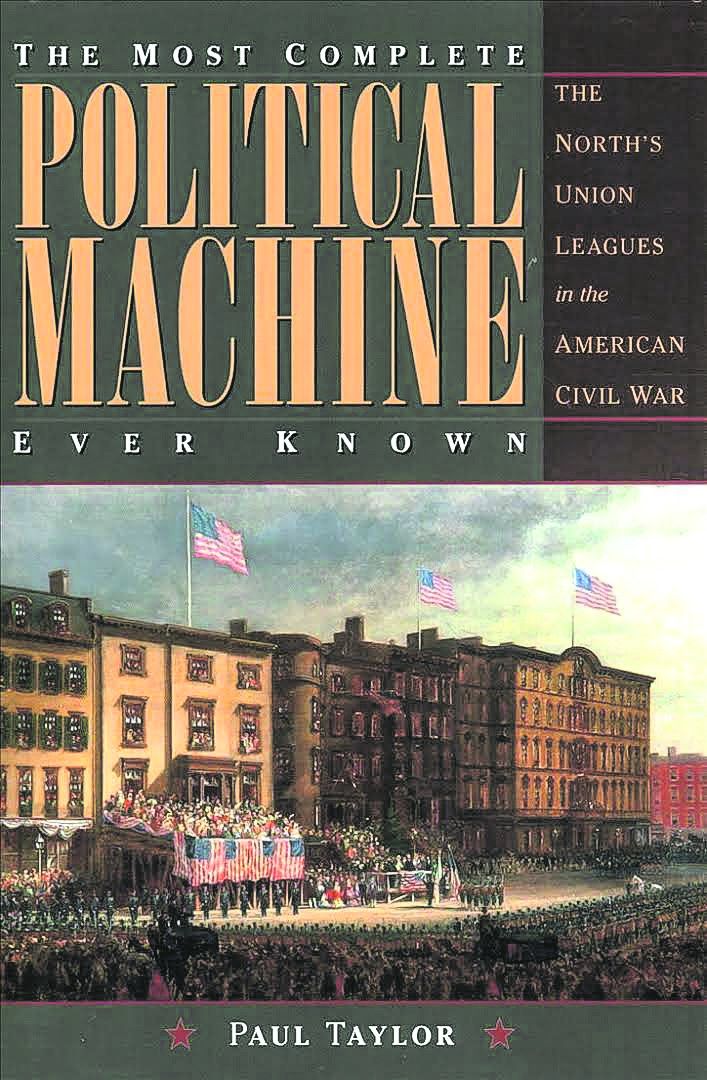
The Most Complete Political Machine Ever Known: The North’s Union Leagues in the American Civil War. By Paul Taylor. Illustrations, index, notes, bibliography, 322pp., 2018. Kent State University Press, www.kentstateuniversitypress.com. $45 hardcover. Reviewed by Wayne L. Wolf
The North’s initial enthusiasm for crushing the secessionists waned by the summer of 1862. Repeated Federal battlefield losses fueled an antiwar sentiment at home. What was deemed necessary was an organization to shape pro-Union public opinion. This gave rise to the creation of various Union Leagues, which became the most powerful propaganda tools for the Lincoln administration to attack Copperhead sentiment and shape antiwar positions as treasonous. Begun as a series of secret societies, by the end of 1863 onefourth of adult Republican males were members of an organized pro-Union loyalty group. From this time until Lincoln’s reelection in November 1864, the Union Leagues distributed millions of pamphlets, wrote thousands of newspaper editorials, and gave countless public speeches equating patriotism with the policies of the Lincoln administration. Loyal opposition by Democrats became treason and justified the questionable
Constitutional silencing of antiwar protestors. The efforts of the Union Leagues were responsible for reversing the malaise in the North, rallying reluctant enlistees and creating a voting bloc that ultimately saw Republican dominance for decades to come. They likewise successfully mitigated resentment towards the Emancipation Proclamation, the suspension of habeas corpus, and the Enrollment Act of 1863. They shaped public opinion to accept these means as justified to win the war and save the Union. In today’s political climate, the central question of “Do the means justify the ends?” is still hotly debated. During the Civil War the Union Leagues answered this question in the affirmative. The perceived threat from the Knights of the Golden Circle, the Sons of Liberty, and the Order of American Knights energized the Union Leagues into the most effective political action committee the country has ever experienced. In the end, their victory transformed the United States from a plural to a singular noun, began the process toward AfricanAmerican equality, and preserved the original Union. Paul Taylor has produced a thoroughly researched tome that finally removes the Union Leagues from an historical footnote to an essential tool in winning the minds and hearts of Northerners to save the Union. His work is essential for an understanding of not only its role in the Civil War and Reconstruction, but how the media today can shape public opinion. It is highly recommended for historians and political scientists as well. Dr. Wayne L. Wolf of suburban Chicago is Professor Emeritus at South Suburban College in Illinois and Past President of the LincolnDavis Civil War Roundtable. He is the author of numerous Civil War books and articles and is currently researching previously unpublished soldiers’ letters to increase our understanding of the common soldier.
Under the Crescent Moon with the XI Corps in the Civil War – Volume 2: From Gettysburg to Victory, 1863– 1865. By James S. Pula. Photos, maps, footnotes, appendices, bibliography, index, 369 pp., 2018. Savas Beatie, www.savasbeatie.com. $34.95 hardcover. Reviewed by Robert L. Durham
This book is the second and final volume of James S. Pula’s history of the Union XI Corps. I reviewed Volume 1 and found it to be an exceptional, well-written book. This volume lives up to its predecessor’s terrific standards. The first book ends with the battle of Chancellorsville, where the Federal right flank was attacked and surprised by overwhelming numbers of General Stonewall Jackson’s force, and only collapsed after putting up a noble fight. The rest of the army did not see it that way, and blamed the XI Corps for the loss of the battle. This second volume picks up where the first leaves off and provides the XI Corps’ experiences in the battle of Gettysburg. There, on the first day of the battle, they are again attacked by superior numbers (General Richard S. Ewell’s Corps). The ground they held had few natural defenses and, to top it off, one of their divisions moved forward, against orders, leaving both flanks in the air. Pula’s description of the XI Corps defense of the area north of Gettysburg is one of the most exciting I have read. He excels at describing the battle action; one almost feels he is there. Again, after a fearsome fight, the unlucky XI Corps is forced to retreat from the field. And again, even though the I Corps was also driven off the field, blame was placed on the XI Corps for losing the battle of July 1. On the second day, they were attacked at their post on East Cemetery Hill. They faced greater numbers again, but this time they slugged it out with the enemy until the Rebs were forced to retreat. It was a hard-fought battle and their actions won several commendations. One would think this would have redeemed them, but the balance of the army still thought they were not equals to the rest of the Army of the Potomac. After Gettysburg, they were separated from the Army of the Potomac and sent to Chattanooga to aid in lifting the siege of that city by the Confederate Army of Tennessee. Being in another army, in another section of the country, should have changed their luck. I advise obtaining this book to find out.
Redemption Under Fire
I recommend this book for anyone interested in the Civil War. The XI Corps served in both major theaters of the war and James Pula does a brilliant job of telling its story. His battle accounts are unparalleled. Robert L. Durham of Centerville, Ohio, has been a devoted history buff for many years and is finally getting a history degree online. Bob has written articles for publication in various historical magazines and internet blogs, as well as CWN. He is retired from almost 40 years of service with the Defense Logistics Agency, where one of his roles was to install communications systems for Foreign Military Sales countries. This gave him an opportunity to travel all over the world.
Two Charlestonians at War: The Civil War Odysseys of a Lowcountry Aristocrat and a Black Abolitionist. By Barbara L. Bellows. Maps, photos, notes, index, 344 pp., 2018. Louisiana State University Press, www.lsupress.org. $38 cloth. Reviewed by Kelly Mielke
What can a free black abolitionist and an aristocratic slaveholder have in common? A shared love of their mutual hometown of Charleston, according to Barbara Bellows’ dual biography of Joseph Barquet and Thomas Pinckney. Born a mile apart in the very city in which the war began over the diverging ideologies that Barquet and Pinckney represented, their lives intersected only once and briefly in the midst of war. In 1864, Barquet, a sergeant in the 54th Massachusetts and a guard at the prison on Coffin (now Folly) Island, met an imprisoned Captain Thomas Pinckney of the 4th South Carolina Cavalry. It is Pinckney’s telling of this single encounter in his unpublished memoirs that inspired Bellows to uncover their lives. She explores how their mutual affection for the Charleston of their childhoods bridged for a few moments the insurmountable gulf between them. Barquet, a free biracial man of European ancestry whose father came to Charleston via Santo Domingo, lived most of his adult life in the North, became an abolitionist, and eventually a sergeant in the 54th Massachusetts. Pinckney represents a way of life in many ways opposite that of
Five for Freedom: The African American Soldiers in John Brown’s Army. By Eugene L. Meyer. Notes, bibliography, index. 282 pp., 2018. Chicago Review Press, www.chicagoreviewpress.com. $26.99 hardcover. Reviewed by Tracy J. Revels
Everyone remembers John Brown, the fiery abolitionist whose plan to incite a slave rebellion came to a bloody end at Harpers Ferry. Brown’s trial, and his willingness to sacrifice his life for his cause, inspired some Americans just as it horrified others. Lost in this famous story are the five African Americans who accompanied Brown in his quixotic quest. Journalist Eugene L. Meyer brings them back into the picture in Five for Freedom, a highly readable volume that considers the diverse motivations and undeniable courage of these men, restoring them to their rightful place in history. Brown’s small but stalwart band of revolutionaries consisted of nineteen men, among them three of Brown’s sons and several veterans of the violence in “Bleeding Kansas.” Five black men committed themselves as well. They were a diverse lot. Dangerfield Newby had been freed from slavery, but was in a relationship with a slave woman, the mother of his children. Despite a lifetime of toil, he was unable to buy the freedom of his family. John Anthony Copeland and Lewis Sheridan Leary were free men of color and residents of Oberlin, Ohio, where they had participated in the dramatic rescue of a fugitive slave. Osborne Perry Anderson, another free person of color, was active in aiding runaways in Chatham, Canada. Newby, Copeland, Leary, and Anderson were all of mixed racial heritage. In contrast, Shields Green was a fugitive slave from
A Hometown Meeting in Times of War
Untold Stories, Unknown Heroes
Barquet’s. Pinckney remained a lifelong Southerner, enlisted in what became the 4th South Carolina Cavalry, and believed in a paternalistic view of the institution of slavery. This biography provides a microhistory of the factors that developed identity and motivation, providing insight into the diversity of experience for Southerners before, during and after the Civil War. Bellows’ work builds upon two Civil Rights-era books, Who Speaks for the Negro and Who Speaks for the South, that consider the diversity of racial experiences and the importance of both races to Southern culture. Indeed, Barquet’s life illustrates the diversity of black experience in both the South and the North. The reader sees a shift in how Barquet identified himself based upon his geographical location and the racial dynamics present therein, which explains how Barquet transitioned from a slaveholding family in the South to life as an abolitionist in the North. Even as Barquet pursued his new cause, his background and education meant that others sometimes perceived him as an outsider, including his comrades in the 54th Massachusetts. Pinckney’s largely unsuccessful experience throughout the war, during which he never obtained the honor he sought through service but which in fact ended ingloriously, did not hinder him from becoming a stout advocate of the Lost Cause in his later years. In many ways, Pinckney’s and Barquet’s lives create a back-and-forth dialogue that brings the nation from the foundations of the Civil War through Reconstruction. It is then that the irony of Barquet’s life becomes apparent: had he chosen to remain in his home state of South Carolina, he perhaps could have pursued the political opportunities that Illinois denied him in the decades following the war. While Pinckney committed himself to living in the new post-Civil War South in which he found himself, he eventually moved to the epicenter of the Lost Cause—Virginia—and became immersed in the literature. Bellows’ acknowledgment of this has the unfortunate effect of undermining the basis of her dual biography—that friendly meeting of equals on Coffin Island in 1864. Given Pinckney’s devotion to the Lost Cause, his description of the meeting, while still remarkable, becomes suspect. That the book does not consider this is a looming flaw. In addition to this flaw in argument, Bellows sometimes runs into the risk that befalls many biographers and speculates on inner thoughts or feelings with no real evidence, especially Barquet’s perception of the meeting on Coffin Island, for which there is no record. However, despite these issues, the book is overall a very enjoyable read. Readers may not come away impressed with any real significance of their meeting, but the book’s value lies in providing concrete examples of how identities and ideologies played out in the lives of two vastly different men. Kelly Mielke resides in Charleston, S.C. Her Civil War interests reside chiefly in social, cultural and political aspects of the Confederacy, especially the use of print culture in the formation of Confederate identity. She has written reviews for several historical publications.
Charleston, South Carolina, who had lived for a time at the home of Frederick Douglass. Each man brought a different level of education and experience to the plot, and each carried personal motivations—for rescue, for revenge, for sacrifice—to the cause. By the time the raid came to its sanguinary conclusion, two of these men were dead, two were captured (and later executed), and one escaped. Meyer brings a journalist’s flair and sensibility to this project. The story of each participant is woven with Meyer’s personal journey of research. Readers discover not only these five men, but the worlds they lived in and the places their descendants inhabit. Meyer explores how their stories were forgotten and how they were, in essence, consumed by the long shadow of John Brown. Meyer includes another story as well, that of Haywood Shepherd, a free black man who had the great misfortune to be caught in the crossfire of the Brown raid. A baggage handler and porter at the Harpers Ferry railroad station, Shepherd most likely was killed by one of the raiders when he either raised an alarm or simply walked into their path. Like the raiders, he left behind a family who mourned him. Meyer takes the stories of these men beyond their deaths, into the period of remembrance and commemoration after the Civil War. The lone survivor struggled to have his voice heard, publishing an account of the raid in 1861, but dying a pauper in 1872. Founded in Harpers Ferry after the war, Storer College, West Virginia’s first institution of higher learning for African Americans, helped to keep the legacy of the five raiders alive for almost a century, but the college’s financial collapse in the early 1960s extinguished another light of remembrance. Ironically, Shepherd was erroneously portrayed as a
“faithful slave” and became a hero to “Lost Cause” partisans, who erected a monument to him at Harpers Ferry. In an era filled with controversy over monuments and memorials, Meyer’s thoughtful and well-written book, aimed at a general audience, will help students of the war dive deeper into the story of the raid and its repercussions. By including the details of the raiders’ descendants, Meyers demonstrates that the story of John Brown’s revolutionaries is not an isolated incident, but part of the connective tissue of the American experience. Tracy J. Revels is Professor of History at Wofford College in Spartanburg, S.C.
The Union Envisioned as White Christian America
Our Country: Northern Evangelicals and the Union during the Civil War Era. By Grant R. Brodrecht. Notes, index, 278 pp., 2018. Fordham University Press, www.fordhampress.com. $40 paperback.
Reviewed by Sean A. Scott
The phrase “Christian America” likely engenders associations with the culture wars and religious right of the 1980s. However, as historian Grant Brodrecht demonstrates, during the Civil War and Reconstruction most evangelical Northerners championed Republican policies and affirmed their belief that the Union must be preserved at all costs in order to sustain and further their goal of a Christian nation. Brodrecht approaches his topic through the sermons and writings of preachers. Well-known figures such as George Cheever, Gilbert Haven, Henry Boardman and George Peck dominate the account with lesser ministerial lights filling in the gaps. While it can be argued that clerical commentary reflects the predominant views of the laity as much as shepherds shape the opinions of their flocks, Brodrecht gives careful attention to gradations of Republican support among more politically conservative, moderate and radical clergy, especially regarding their stances against slavery and for racial equality. For example, Haven consistently worked to obliterate all distinctions based on caste, but during Reconstruction many evangelicals forgot about or neglected freedmen and instead turned their rhetoric and energies into unifying the nation around a white Christian culture. The book’s focus on presidential politics—at times Lincoln, Johnson and Grant all fit the bill of providential instruments chosen to carry out the evangelical agenda—similarly bends the narrative toward a history of elites. Although evangelicals typically favored Republicans, Brodrecht’s account would benefit from acknowledging evangelical backing of Democrats. He categorizes Boardman as representative of “the moderate to conservative portion of the Republican spectrum,” but in September 1864 the Presbyterian cleric congratulated George McClellan on his nomination for president and expressed hope that God would allow him to win election. Three months later Boardman’s letter of consolation underscored that the general’s defeat was a national tragedy. Including evangelical Democrats most certainly would modify yet enrich the analysis. The thesis that Northern evangelicals cloaked the Union in sacred garb fits nicely with Gary Gallagher’s assertion that unionism remained a constant motivation for Northerners and was never eclipsed ideologically by emancipation (The Union War, 2011). By tracing how evangelical pastors equated the Union with Christian America in their sermons, letters, and editorials, Brodrecht essentially offers theme and variation on works ranging from James Moorhead’s analysis of clergymen who saw the United States as essential to furthering millennial conditions (American Apocalypse, 1978), to my own work that highlighted how the Northern laity’s patriotism politicized the church (A Visitation of God, 2011). Nuances aside, these studies all underscore how evangelicals of the Civil War era viewed the American nation as indispensible to God’s working out his providential designs in the world. Perhaps Brodrecht’s greatest contribution lies in enlarging the story to include Reconstruction, a period characterized by historical neglect of evangelicals. His point that evangelicals contributed to its failure rings true in the sense that many denominational leaders prioritized white unity over black inclusion. However, the American Missionary Association and various denominational freedmen’s aid societies, which are largely absent from these pages, continued to work in educating and evangelizing
African Americans long after mainstream popular opinion embraced a reconciliationist rather than emancipationist memory of the war. Highlighting national politics and those preachers who sought audiences with presidents—with expectations that they would carry out evangelical policies—raises questions about how, why and when men and women on the front lines in the South gave up the fight. To be sure, evangelicals, Northerners, Southerners—practically any generalized category of people —either failed to live up to the nation’s lofty founding ideals or actively undermined African American equality as citizens. Yet without the efforts of numerous Northern evangelicals during the war and Reconstruction, freedmen and women would have been substantially worse off. With over eighty pages of notes that highlight Brodrecht’s masterful command of the secondary literature, Our Country makes a welcome contribution to the growing literature on religion during the Civil War era. A specialist in Civil War era religion, Sean A. Scott teaches U.S. History at the Indiana Academy in Muncie. He recently completed a research fellowship at the Methodist Archives at Drew University.
September Mourn: The Dunker Church of Antietam Battlefield. By Alann D. Schmidt and Terry W. Barkley. Maps, photos, footnotes, appendix, index, bibliography, 156 pp., 2018. Savas Beatie, www.savasbeatie.com. $19.95 hardcover.
Reviewed by John Michael Priest
Anyone familiar with the Maryland Campaign and the battle of Antietam has seen or heard about the whitewashed brick building on the west side of the Hagerstown Pike just north of the Visitor Center. Built by pacifist Anabaptists, known as the German Baptist Brethren, it stands as a monument to peace on what became one of the United States’ bloodiest fields. September Mourn is an excellent history of the remarkable individuals who built and restored this iconic structure. But it is much more. Besides serving as a thorough description of the Brethren and their various sects, the book succinctly describes the German influence in the settlement of western Maryland. This book filled in many of the gaps in my own knowledge of Sharpsburg and Washington County, Maryland. I discovered that individuals, whom I had been told were Brethren, were not; that the majority of the Germans in the area were Reformed or Lutheran; that the Brethren allowed other churches to conduct funerals from the church; and that the African American who returned the Bible to the church in the early 1900’s was one of the Brethen. I had never known that the Brethren were integrated at that time. They genuinely practiced their belief that all men were equal in the sight of God. While the book has a chapter devoted to the church’s role during the battle, in its last part it details the seemingly insurmountable struggle to rebuild and preserve the building for future generations. That was a separate battle and is the part of the story I had known so very little about. Had it not been for dedicated individuals like Paige and Betty Otto, the Washington County Historical Society, dedicated National Park Service historians such as Superintendent Harry Doust, and countless others, the church foundation would still be all that remained of the building. I cannot say enough about how the hard working staff at Antietam are constantly maintaining and improving the battlefield. I am honored to serve as a guide there. That love and devotion resonate throughout Schmidt’s and Barkley’s very important contribution to the Brethren, the Dunker Church and the battlefield. Among his other works Mike Priest, of Clear Spring, Md., is the author of Antietam: The Soldiers’ Battle (1989).
Excellent History of the Remarkable Individuals Who Built and Restored This Iconic Structure
An Underwhelming Argument Creation of a National Cemetery General Grant and the Rewriting of History: How the Destruction of General William S. Rosecrans Influenced Our Understanding of the Civil War. By Frank P. Varney. Images, maps, 312 pp., 2018. Savas Beatie, www.savasbeatie.com. $19.95 paperback. Reviewed by Louie P. Gallo
Frank Varney’s book General Grant and the Rewriting of History is an attempt to critically examine how the most influential military leader during the American Civil War, Ulysses S. Grant, affected the contemporary reputation of a lesser known general, William S. Rosecrans. Varney also explores how Grant’s characterization relegated Rosecrans to the ash heap of history. Varney’s approach is much different from most of the recent books on Grant. Instead of focusing on the development of Grant as a general or politician, General Grant and the Rewriting of History concentrates on Grant’s character, and tries to make the argument that he was a manipulative, deceitful and self-aggrandizing person. Varney poses thought-provoking questions about Grant’s motives as a leader. He presents arguments that challenge the accepted view of Grant and the validity of his personal memoirs. In each chapter, Varney lays out the basic negative interpretations of Rosecrans’ record, arguing that Grant’s incorrect assessments of Rosecrans fueled those interpretations. Varney attempts to show how Rosecrans has been treated unfairly by historians because of Grant’s assertions. Perhaps the most interesting claim that Varney makes is that Grant intentionally falsified the historical record in order to hurt Rosecrans’ reputation and to bolster his own. Although Varney raises interesting questions, he fails to provide convincing answers. On the surface, his explanations for Rosecrans’ demise appear to be sound, but when they are checked against the record, it becomes evident that Varney tends to misquote Grant, and he takes evidence out of context to reinforce his argument. Just one example is his handling of the battle of Corinth. He argues that Grant intentionally manipulated the historical record with shifting statements about Rosecrans’ conduct during the battle. Varney cites the supposed inconsistencies found within Grant’s original report on the battle and what he later wrote in his personal memoirs. Varney claims that Grant was only “mildly critical” of Rosecrans in his battle report. He includes a portion of Grant’s report to prove this claim, but an examination of the report in The Papers of Ulysses S.
Grant and The Official Records of the War of the Rebellion reveals that Varney omits a significant portion of the quote without noting it in his book. The part he leaves out drastically affects his argument because it includes Grant’s statement that he had given clear orders that Rosecrans did not follow. In the next paragraph, Varney continues to quote Grant in an attempt to show that Grant praised Rosecrans after the battle, but he fails to alert the reader to the nature of the document (he also provides an incorrect citation in this section), which is important because he is quoting from a fairly typical general order by a commanding general that praised every person involved in the victory. Finally, Varney quotes Grant’s memoirs, in which he was critical of Rosecrans’ actions, to show that Grant intentionally changed his views to disgrace Rosecrans. This argument is invalidated by Varney’s mischaracterization of Grant’s original assertions about Rosecrans’ conduct during the battle. The author’s failure to properly contextualize the varying documents used does not lend credibility to the overall argument and leaves his interpretations on shaky ground. This, in conjunction with numerous citation errors found throughout the book and an inability to show why Grant would be so vindictive in the first place, makes it difficult for Varney to mount a convincing argument. Although one may question Varney’s approach, he does raise an important point about how Rosecrans and his contribution to the war have faded. Even John Y. Simon, a pioneer in the documentary editing field and a renowned Grant historian, praised Varney for making this point (although Simon was apparently commenting on the dissertation the book is based on and not the final product). While Varney rightly brings attention to Rosecrans’ forgotten achievements, his reliance on questionable interpretations to explain the general’s faded fame provides an underwhelming argument. Louie P. Gallo is Publications Editor at the Ulysses S. Grant Presidential Library and Association, headquartered at Mississippi State University.
Where Valor Proudly Sleeps: A History of Fredericksburg National Cemetery, 1866–1933. By Donald C. Pfanz. Maps, photos, index, 253 pp., 2018, Southern Illinois University Press, www.siupress.com/engagingcw. $26.50 paperback. Reviewed by Phillip S. Greenwalt
On a hillside overlooking Fredericksburg, Va., resides a national cemetery with the same name. Interred within the walls are the graves of 15,257 Union soldiers, with fewer than 2,500 of those identified. Visitors pass through the gates of the cemetery and can stroll the rows of graves, glance at the various statues that dot the premises, and marvel at the sacrifice the American Civil War took, just in this small geographic area. Questions lingered however. How did the solders’ remains arrive at this bucolic hillside? How did this become the location of a national cemetery? Of the soldiers’ remains that are identified, who did the identification? Retired National Park Service historian Donald C. Pfanz has now dug into those questions and uncovered the answers. In the second volume of the Engaging Civil War Series, published by Southern Illinois Press in conjunction with “Emerging Civil War,” enthusiasts and readers now have the answers at their fingertips. This is truly the first in-depth account of the creation of Fredericksburg National Cemetery and fills that void for the avid student of the American Civil War. In a sweeping narrative, Pfanz provides a complete synopsis of the creation of the national cemetery, from the painstaking approaches by the early United States Army teams that scoured the battlefields of the region, to the more systematic approach that followed. Pfanz moves into the creation of the national cemetery and two chapters later provides background along with images of the development of buildings within the confines of the graveyard, including the Superintendent’s house, which is used by the national park today. An epilogue ties the cemetery with Fredericksburg and Spotysylvania National Military Park and how the park has grown over time yet. Fredericksburg National Cemetery does not just contain Union soldiers from the American Civil War, but includes burials of soldiers from later wars and their spouses, bringing the total population of burials within the walls to over 15,300. Pfanz captures these stories in their own chapter, entitled “Special Population,” truly showing the breadth and depth of his research into the creation of this final resting place on hallowed ground. The book is a very in-depth study of a very specific topic that may not appeal to the general masses of Civil War enthusiasts. Painstaking research into government publications and the archives of Fredericksburg and Spotsylvania National Military Park shows in the text. With a very brief overview of the engagements in the surrounding area that caused the casualties that would be interred at Fredericksburg, Pfanz’s history stays true to the subtitle, “A History of Fredericksburg National Cemetery, 1866–1933.” One of the special programs that the National Park Service holds for the national cemetery is the annual luminaria held on Memorial Day Weekend. Boy Scouts lay out 15,300 candles in the cemetery and at night the hillside sparkles with the flickering of the candle wicks. Park Rangers and volunteers tell the stories of some of the known that lay at rest in Fredericksburg National Cemetery. Now, thanks to Pfanz’s book, we know how these, and the thousands of unknowns came to a place “Where Valor Proudly Sleeps.” Phillip S. Greenwalt is a full-time contributor to “Emerging Civil War” and co-founder of “Emerging Revolutionary War.” He is the co-author of four books, three on the American Civil War and one on the American Revolutionary War. He is currently working on a publication about Valley Forge for the “Emerging Revolutionary War” series. Phillip currently resides in Florida where he is actively researching that state’s role in the Confederacy and the contributions of Florida soldiers.