
Critic's Corner
A Texan Writes Home
By Stephen Davis · Originally published February 2019 · p. 38
A Texan Writes Home Many of us are practicing scholars and writers, even if we’re “amateur” ones—strictly defined by the academicians as not earning our financial livelihood from our work (as college professors do). Nonetheless, we all share the joy of research—gaudium investigationis, as they used to say. One of my particular pleasures is to come upon a soldier’s letter that has not made its way into the literature. The experience is made sweeter when the archival repository holding that epistle is beyond one’s beaten path. I credit my friend Brad Butkovich, in his book The Battle of Pickett’s Mill (History Press, 2013), for putting me onto the letters held at the library of Pickett’s Mill State Historic Site. I drove out there recently, and Kelly Miller of the staff kindly provided me copy of the fourteen-page typescript of the missive written by Lt. Sebron G. Sneed, Jr. of the 6th/15th Texas Infantry (Consolidated) to his wife, “Fannie,” dated June 7, 1864. In his writing, he refers to a diary he kept during the campaign, so his recollections for Fannie strike me as particularly well informed. Sneed was the son of a wealthy farmer and slaveowner in Austin. Born at Fayetteville, Ark., in Sept. 1836, he attended college in Galveston and, after traveling to Rome in 1858, he studied for the priesthood. Sneed returned to Texas in 1860, and when war broke out he enlisted in Co. G, 6th Texas Infantry. The regiment became part of Brig. Gen. Hiram B. Granbury’s Brigade in Pat Cleburne’s famed division. “Seb” liked to write long letters. His to Fannie of June 7 is quite extensive. Here I draw from it that portion having to do with the battle of Pickett’s Mill, fought about 25 miles northwest of Atlanta on May 27. In the field near Marietta, Ga. June 7th, 1864 My darling Fannie: * * * * * * * On this morning of the 27th two batteries of Artillery occupied the front of us where the Calvary [sic] was and our Regiment was ordered to support them. We entrenched strongly. The enemy made no demonstrations against us at this point, but seemed to be attempting something further down towards our left. We lay quiet and lazy in our works. The cannoniers at their guns and our boys occasionally popping at a blue coat as he dodge about in the wood in front. About 5 P. M. our scouts reported a large force had gone further than we extended towards our Right and that they were massing troops at that point. Our Brigade was quietly put in motion as we moved about a mile further to the Right. Here we found a weak line of dismounted calvary [sic] who were a continuation of our main battle line. Our Brigade was not more than halted before the enemy opened a hot fire which rapidly approached us and increased in intensity
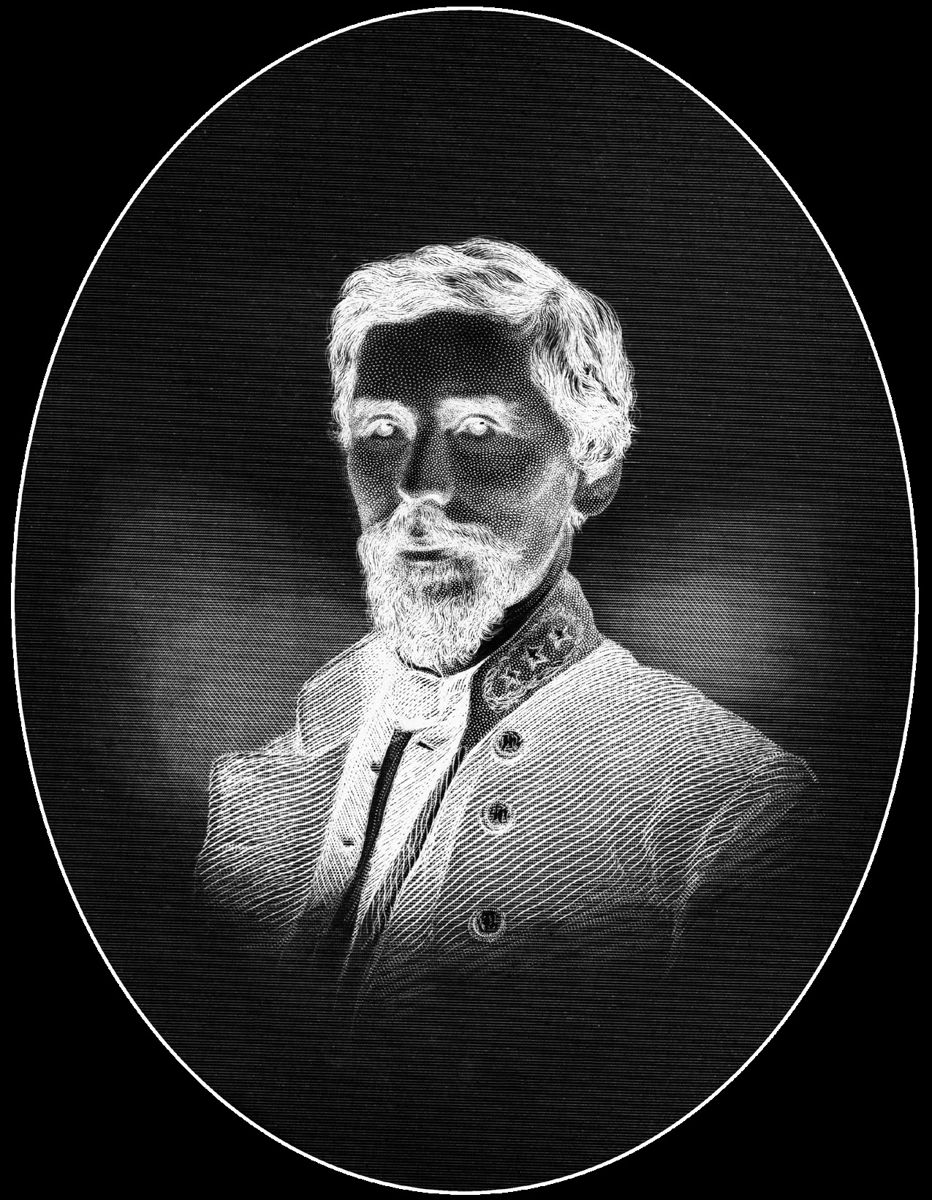
(Library of Congress)
Maj. General Patrick R. Cleburne. We came upon them suddenly and captured about 300 prisoners. They flew in utter confusion. We learned from the prisoners that we had been fighting the whole of Howard’s Corps and part of another and that they had four lines of battle against us which were all repulsed. They had silently taken position and had purposely kept quiet in our front lower down in order to conceil what they were about. They thought they would find only the Cavalry which they could easily drive from its position and thus flank our main line. But our Brigade arrived at the opportune moment to thwart their cunning strategy. The next morning we went over the ground and the light of day revealed what havoc our bullets had made in their ranks. Over four hundred lay dead in front of our works. Many of the chief officers of the army, Johnson and Hardee, and others said they never saw men piled thicker in all the battle fields they had seen. It was an awful sight. They lay crossed and thrown in every conceivable situation. Most of them were shot in the head. Could some of our women who have been insulted by the ruffian tools of the tyrant and despot, or some of the parents who have lost their idols in defense of their country, have seen the slaughter they would have thought it a retribution for the wrongs the demons have inflicted on us. It was a ghastly sight and I will not sicken you with its horrible details. Our loss was not heavy….
John R. Lundberg’s fine Granbury’s Texas Brigade (2012) informs us that Seb Sneed was wounded in the battle of Jonesboro. General Granbury mentions him in his after-action report: “First Lieut. Sebron G. Sneed, acting assistant adjutant-general, was severely wounded in the breast on the evening of the 1st instant while carrying an order in the most exposed portion of the field. His conspicuous daring won the admiration of the entire command” (OR, vol. 38, pt. 3, 745). Sebron recovered at a hospital in Barnesville, Ga., continued to serve as A.A.G. and, by the end of the war, had been promoted captain. He returned to Austin to become one of the city’s noted educators. He founded the Austin Normal Military School, was the first treasurer of the Austin School Board, and superintendent of the Travis County Public Schools. After Fannie died in 1867, Seb remarried to Alice Bacon, who sadly passed away in 1881 at the age of thirty. Sebron lived out his years as a bachelor; death came on Sept. 1, 1894. He is buried in Austin. Note: next month I’ll write about a cool letter I found at the Auburn University Libraries Special Collections and Archives. Steve Davis is the Book Review Editor for Civil War News. His article, “The ‘Criminal Blunder’ at Pickett’s Mill,” will appear in the May issue of America’s Civil War.