
The Graphic War
The Battle of Stones River or Murfreesboro December 31, 1862 – January 3, 1863
By Salvatore Cilella · Originally published December 2019 · pp. 22–23
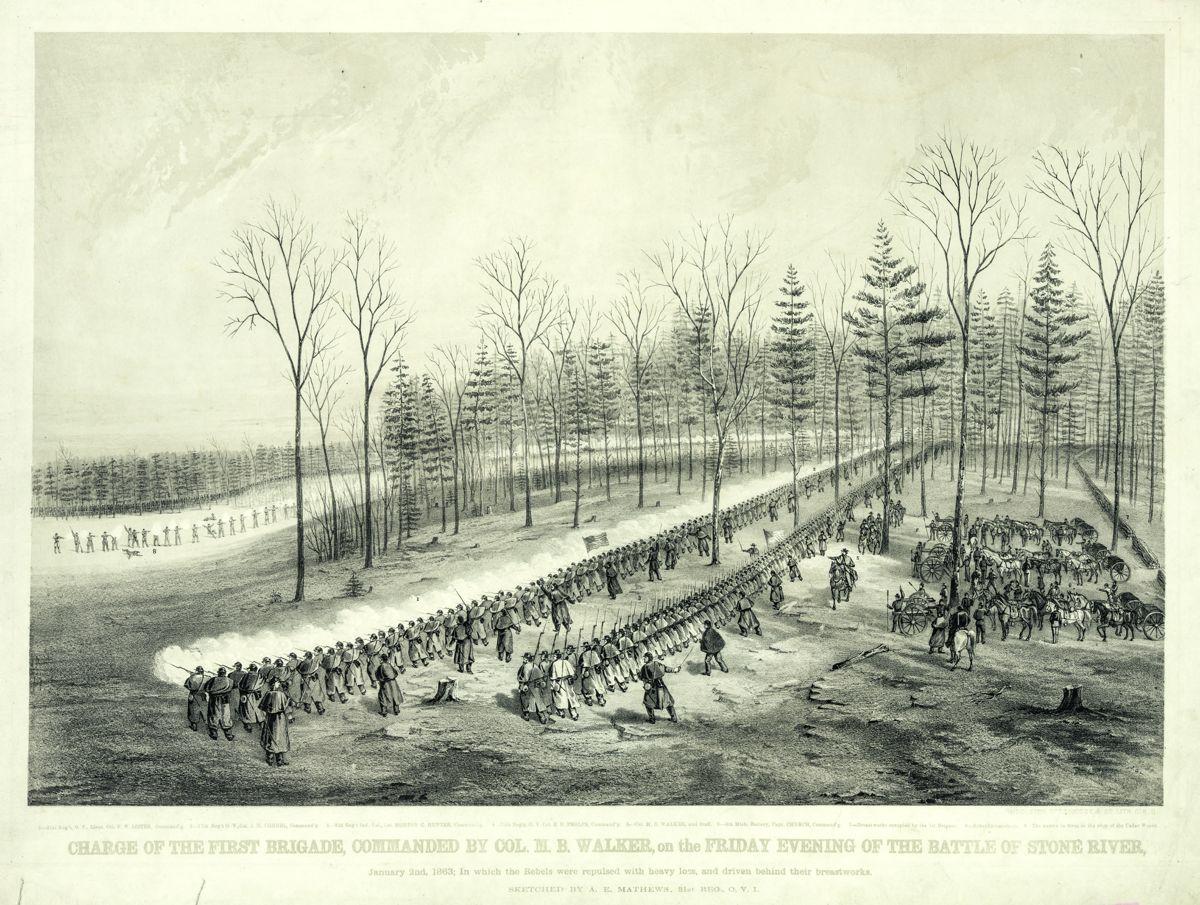
The Graphic War highlights prints and printmakers from the Civil War discussing their meaning and most importantly, the print maker or artist’s goals. Early in the Civil War, western lithographic firms maintained a high interest in the activities in the “Western Theater” just as their counterparts in New York,
Boston, and Philadelphia depicted the struggles in the east. The firm of Middleton, Strobridge and Co. of Cincinnati was no exception. The two principles had morphed from another business partnership; a common occurrence among lithographic firms in mid-nineteenth century. Between 1859 and 1864, the time the firm operated, it produced “a long series of small Civil War scenes… sketched by A. E. Mathews of the 31st Ohio volunteers.”1 Like most American artists of the 19th Century, Alfred Edward Mathews was an immigrant, in his case, from Bristol, England.
His family moved to Rochester, Ohio, in 1833. Before the war, Mathews worked as a teacher in Tuscaloosa County, Alabama. With conflict on the horizon, he avoided joining the Confederate Army by fleeing to East Texas. He quickly realized that his situation was no better there as Texas was also preparing to secede. Mathews headed for Missouri, mostly on foot, and was almost hanged in Arkadelphia, Arkansas. He managed to self-publish his journey in 1861.2 Making his way to Ohio, he enlisted in the 31st Ohio Infantry, September 5, 1861, at age 30. He joined Company E as a musician. On April 24, 1864, he transferred to Company I. During the war, he had been reduced to the ranks, for unknown reasons.3 Prior to the war, Mathews “had been a landscape” artist; his work was recognized by none other than Ulysses Grant who told Mathews that “his views” of Vicksburg were “among the most accurate and true to life I have ever seen. They reflect great credit upon you as a delineator of landscape views.”4 In Mathews’ rendition of the Charge of the First Brigade, all is unnaturally orderly and precise, unlike any battlefield reality. All fire in the first rank in unison; the second rank is equally disciplined in preparation for its role. According to historian James Brookes, “The officer leading the charge of the supporting regiment, pictured at center right with his word drawn above his head, is almost farcical.” Mathews places his own regiment on the left, but identifies his commanding officer as Lt. Col. Frederick William Lister and not Colonel Moses B. Walker, ostensibly leading the 31st.5 Major General Williams Rosecrans, commanding the Army of the Cumberland with 43,000 men faced General Braxton Bragg’s Army of
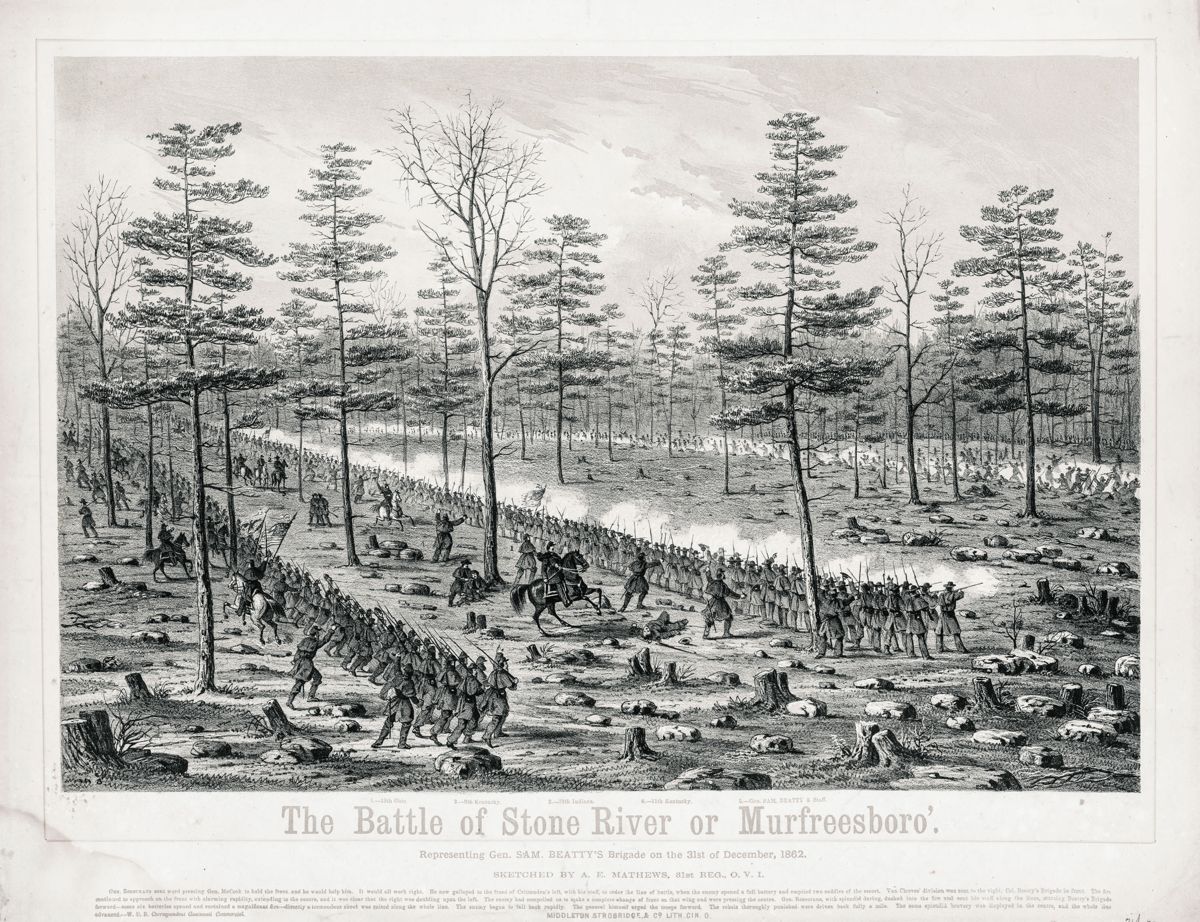
Tennessee with 35,000 at Stones River (or Murfreesboro). Mathew’s 31st Ohio Volunteers were in the center in the 3rd Division commanded by Major General George H. Thomas. The two armies clashed on December 31, 1862, near Murfreesboro on the Nashville Pike and rail line. For the next three days, January 1-3, the two armies, heavily depleted by the first day’s action, gradually pulled away from each other. The casualties were large, even in comparison to Shiloh and Antietam (nearly 13,000 for the Federal troops; nearly 12,000 for the Confederates). Mathew’s lithograph of the first day’s battle sanitized the tragic narrative, giving an inaccurate depiction of a horrific event. Additionally, the four-day duel was a tactical draw. Strategically, for the Union, Nashville was safe for the remainder of the war. The rebel threat to Kentucky and Middle Tennessee was blunted. Mathews survived the war, mustering out September 22, 1864. He traveled throughout the west publishing Pencil Sketches of Colorado (1866) and Pencil Sketches of Montana (1868). He lithographed his third book Gems of Rocky Mountain Scenery in 1869. Just before his death in 1874, Mathews produced sketches of Nebraska and California.6 He is buried in Larimer County, Colorado. The Denver Public Library maintains a large holding of his papers and drawings. Endnotes: 1. Harry Peters. America On Stone: The Other Printmakers to the American People. New York: Doubleday & Co., 1931, 284. 2. Civil War Database, www.civilwardata.com/active/ hdsquery.dll?SoldierHistory?U&614390. 3. Ulysses S. Grant, ‘Unidentified newspaper clipping in the Western History Department, Denver Public Library,’ Daily Miner’s Register (Central City, Colorado: December 1, 1865), p. 3 as cited in James Brookes “soldier-Artists and the Battle Experience (Part II), in Emerging Civil War, posted November 15, 2017
After 43 years in the museum field, Salvatore Cilella now spends his time writing and is the author of several articles and books. His last professional position was President and CEO of the Atlanta History Center. His most recent books are Upton’s Regulars: A History of the 121st New York Volunteers in the Civil War (U. Press Kansas, 2009) and The Correspondence of General Emory Upton, 1856–1881 (U. Tennessee Press, 2017) edited. His two-volume Correspondence of Major General Emory Upton, is the recipient of the 2017–2018 American Civil War Museum’s Founders Award for outstanding editing of primary source materials. He is currently editing a manuscript of Upton’s letters to his wife 1868–70, which the Oklahoma University Press will publish early 2020.