
The Battle of Arkansas Post: Target of Opportunity
By Robert Durham · Originally published December 2019 · pp. 30–31
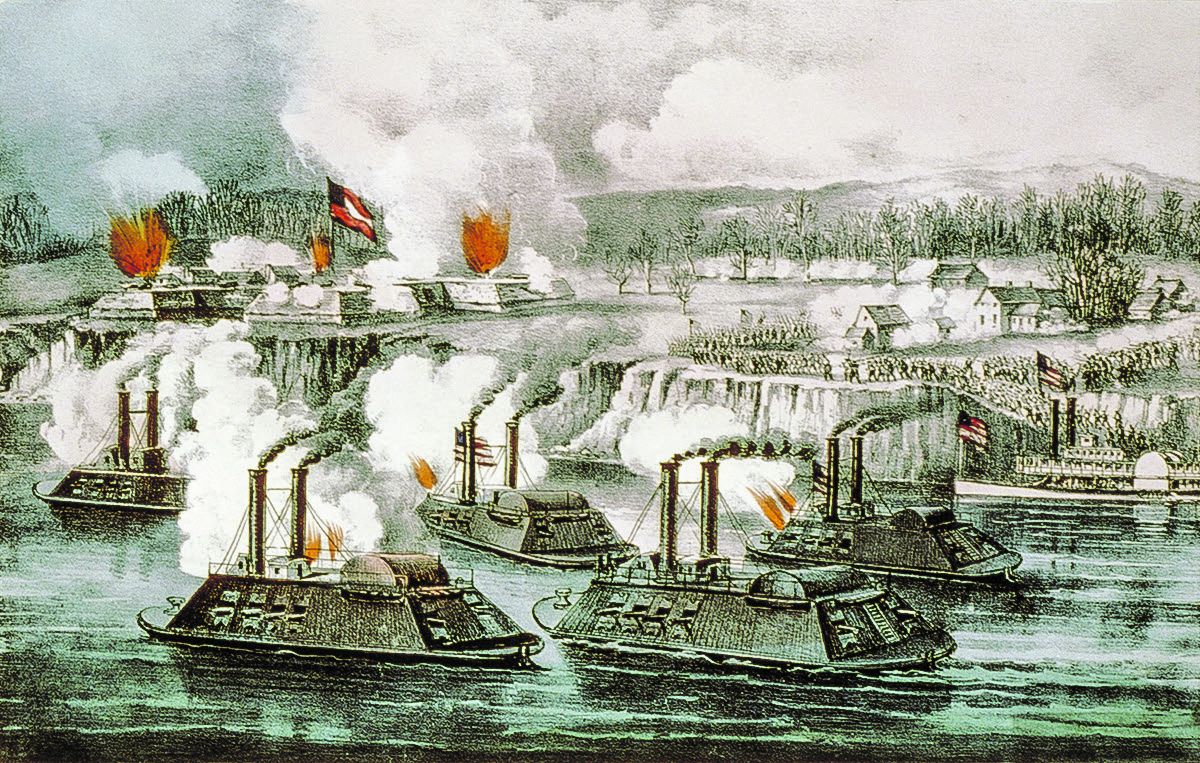
In 1861, the small town of Arkansas Post, also known as Post of Arkansas, would become an integral part of the Civil War defense of Arkansas. That same year, the Confederate Army and Navy built Fort Hindman near the town. The fort was located on the north (or left) side of the Arkansas River, where the river made a sharp horse-shoe bend. This made it a strategic site because it commanded the river in both directions. If the Federals captured Arkansas Post, they would have access to the Arkansas interior. Post of Arkansas was on a bluff, twenty feet above the water line.1 Fort Hindman was a square, earthen fort, with bastions on all four corners. The fort was 100 yards to a side, with an eighteen-foot parapet and a ditch, twelve to fifteen feet wide and eight feet deep. The fort had eleven or twelve guns mounted, including2 two heavy guns in oak log casemates and roofs reinforced with railroad iron.3 The Confederate engineers initiated the building of three lines of rifle pits: the first, from Fort Hindman west, stopped about 200 yards short of Post Bayou, where a swamp supposedly made the zone impassable; the second, east of Fort Hindman, ran northwest from the Arkansas River; and the third was further downstream where the river flowed north to
General Churchill (Confederate Veteran)
south. The Confederate troops, 4,900 men, and overall command of Arkansas Post were under General Thomas J. Churchill, a native Kentuckian who served with distinction in the 1st Kentucky Mounted Rifles in the Mexican War. Since 1848, he resided in Little Rock, Ark.4 On December 20, 1861, MajorGeneral William Tecumseh Sherman and Rear-Admiral David Dixon Porter sailed down the Mississippi to attack Vicksburg. For various reasons, the campaign failed; several attacks against Confederate earthworks on Chickasaw Bluffs were bloodily repulsed. On January 4, 1862, the troops re-boarded the transports and sailed to Milliken’s Bend, northwest of Vicksburg, between there and the Post of Arkansas. Major-General John Alexander McClernand met the fleet and, outranking Sherman, took over command.
General William T. Sherman Major-General Ulysses S. Grant, McClernand’s superior and commander of the Army of the Tennessee, was to reinforce Sherman in the attack on Vicksburg. Sherman waited in vain for Grant to show up, and McClernand brought word that Grant had abandoned his advance into Mississippi. His supply depot at Holly Springs had been destroyed and he was compelled to retreat to Memphis and would not be able to assist Sherman. In Grant’s absence, there was nothing to prevent McClernand from taking command of Sherman’s troops. McClernand and Sherman had 28,944 men and needed to find something to do with them. To make their decision a little easier, a transport ship, the Blue Wing, carrying dispatches and ammunition, was captured by some cavalry pickets out of Arkansas Post.5 The Mississippi River would never be safe while the Post of Arkansas could disrupt river traffic. Therefore, they decided to use their idle troops to reduce the site.6 Rather than sailing directly to the Arkansas River and tipping their hand, the fleet sailed to the White River, which they reached on January 8. White River ran parallel to the Arkansas and flowed into the Mississippi. The next day, they sailed up the White, then through a cut-off to the Arkansas. They sailed up the Arkansas to Notrib’s farm below Arkansas Post and disembarked.7 The Confederates manning the rifle pits, mainly dismounted Texas cavalrymen, were primarily armed with double-barreled shotguns and smoothbore muskets. Both weapons were loaded with buck and ball cartridges; three buckshot and an ounce ball in each cartridge. There were a few companies armed with Enfield rifled muskets that fired Minié balls.8 Sherman’s Corps led the advance along the Arkansas River levee. When they reached the Rebel rifle pits on January 10, they spread out in battle lines facing the Confederate position, Sherman on the right and Brigadier General George W. Morgan’s Corps on the left. Both sides posted heavy lines of skirmishers in front.
George W. Morgan (Library of Congress)
About 2 a.m., January 11, Confederates manning the outer rifle pits were outflanked by Union cavalry and fell back to their inner line of rifle pits, on the left of Fort Hindman.9 The Southern engineers had
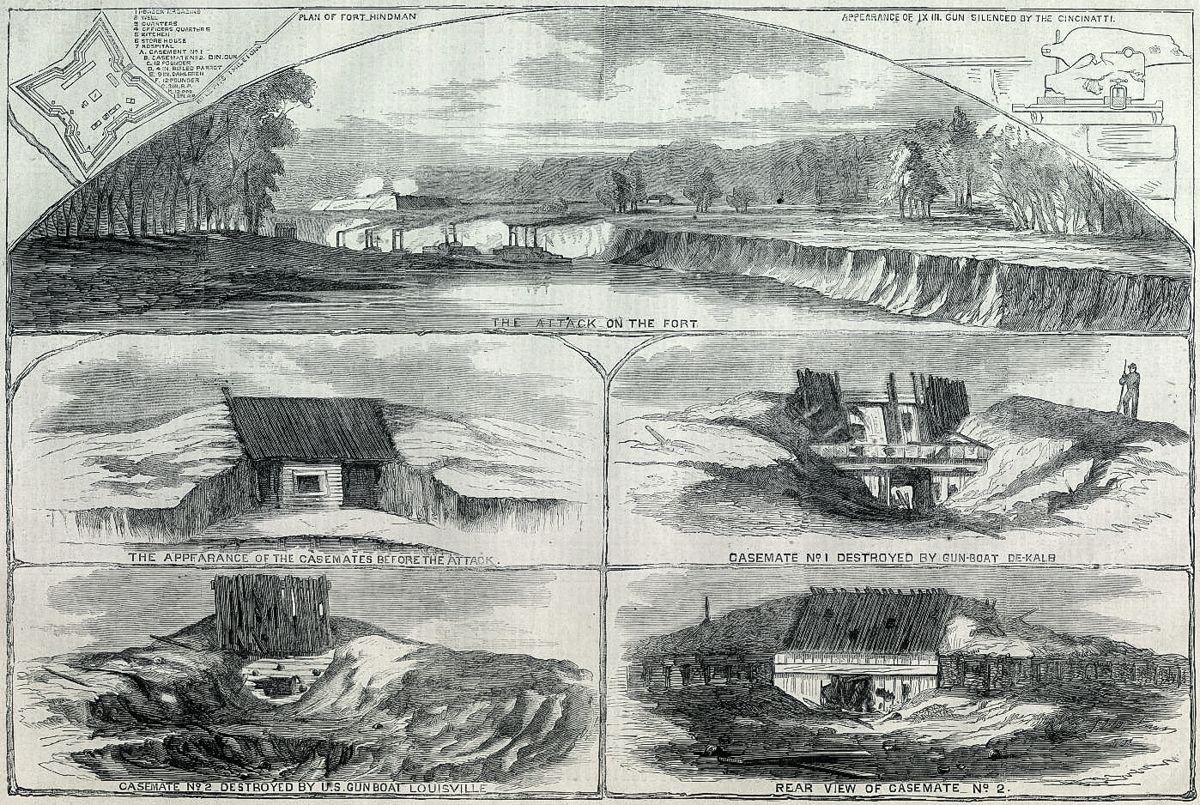
Arkansas Post battle engraving. assured General Churchill that the swamps on the left of the Rebel line made it “TOTALLY impassable for man or beast, but here comes the Yankees dashing and splashing straight through it, and as perfectly at home as an Alligator in Red river.”10 As the Rebels were forced back on their main line of works, they worked frantically to strengthen their trenches. The work was made extremely difficult because they lacked tools. The report of Colonel James Deshler stated: “We were very much delayed by the scarcity of intrenching tools; we were compelled to use pieces of board for shovels, &c.”11 At dawn, Union field guns opened fire and soon silenced the Confederate artillery. With almost all their artillery horses killed, the Confederates were unable to withdraw the guns. Colonel Lindsey opened an oblique fire on the Confederate rifle pits from across the river. General Morgan reported that “their fire was admirable; the enemy’s battle-flag was shot away and the trenches were filled with his dead.”12 After the fort’s guns seemed to be silenced, General Sherman ordered his men to attack. The troops all along the line began their advance. The Yankee lines moved forward at a double-quick time. The Confederate line opened with a volley of musketry and artillery that went over the Federal heads. However, the second volley was well-aimed and fell directly into the Union ranks. Colonel Wood ordered his men to lie down; he had some of his best marksmen crawl a little ahead and try to silence the defenders` artillery. They picked off the gunners and their horses. Federal fire on the Confederate rifle pits was so effective “that the Rebels did not dare to show their heads, and they just put their arms over and fired at random.”13
The 26th Iowa was in Thayer’s Iowa Brigade. They “crossed in double-quick time a narrow space of clear ground in their front and gained position in a belt of woods… Meeting with a terrible fire of musketry and artillery, these brave troops were checked.” Their national flag went down twice, and each time, it was raised again.14 Colonel Thomas K. Smith commanded the next brigade on the left that included the 55th Illinois. One of the 55th recalled “The entire front of the army in plain view of the rebels behind the works, was curtained with a cloud of skirmishers who … advanced against their fellow citizens … upon the other side. The ground gained from time to time under the hot fire was occupied by the skirmishers, when the main line advanced accordingly and lay down. This very well describes the character of the whole battle, … which consisted of a series of rushes.”15 To Sherman`s left was Morgan’s Corps. Brigadier General Stephen Gano Burbridge’s 1st Brigade of A. J. Smith’s Division, formed the right of Morgan’s line. The 83rd Ohio was one of Burbridge’s regiments. First-Sergeant Thomas B. Marshall, of the 83rd, said: “We moved forward and were ordered to lie down. We were now getting very close to the fort, and they began to hunt for us with their artillery. Balls came screeching through the woods, occasionally, the limbs falling in profusion.”16 “General Smith and his staff rode to and fro, pistols in hand, to reline the troops, … and Oh! how he swore! (For artistic, and effective profanity, General A. J. Smith had no superior, and, coming from him, it never sounded wicked. His every word hit the nail on the head, while all the air was blue.) We soon reformed and moved forward in good order, going to the edge of the slashing and to the top of the little rise. The fort was now in plain sight and the bullets were singing their songs as they flew both ways. We dropped to the ground, loaded and fired as fast as we could, or when we could see something to shoot at—all the time edging toward the fort.”17 Fort Hindman was still not under direct attack by infantry. General Peter J. Osterhaus formed up the 120th Ohio “in double column and ordered it to assault the east face of the fort, but added to the fosse there was a natural ravine which rendered it impossible.” They held their advanced position, “for an hour within pistol-shot of the parapet.” When the fort was surrendered, they entered the fort, accompanied by the 16th Indiana and the 83rd Ohio.18 The Yankees were not making any serious attack on Colonel Robert R. Garland’s line. When Deshler requested reinforcements, Garland sent alternate companies of the 24th and 25th Texas Cavalry (Dismounted), and two companies of the 6th Texas Infantry to reinforce Deshler. This greatly thinned Garland’s line of course, but he still repulsed three separate attempts on his position. About 4 p.m., Colonel Dunnington asked for reinforcements, and even though his works were greatly weakened, he ordered another two companies of the 6th Texas to enter the fort.19 Four Union guns across the river, opened on the rear of Garland’s Brigade. Captain Foster, of the 24th Texas Cavalry (Dismounted) described what happened next: “The first shot from it passed directly over [the] flag of our Regt. The next one cuts the flag staff in two. The next one comes still lower and goes in the ditch and kills two men, knocking one clear over the breastworks—outside— The next one goes nearly in the same place in that company, killing one man and cutting off both legs of his brother.” Distraught, the wounded brother put his pistol to his head and committed suicide.20 According to Colonel Garland, “The enemy’s gunboats and batteries had now complete command of our position, taking it on the right flank, front and rear, literally raking the entire position. It was at this particular crisis, about 4:30 o’clock P.M., that my attention was attracted by the cry of ‘Raise the white flag, by order of General Churchill; pass the order up the line.’ And on looking to the left, to my great astonishment, I saw a number of small white flags displayed.” All the evidence at the time indicated that the first white flag was raised by the 24th Texas Cavalry (Dismounted) and Colonel Garland would spend a good deal of fruitless time, after the battle, trying to have it investigated. Since the order passed up and down the line, “coupled with the name of the commanding officer, I was convinced … that the order must have originated from the proper source.” The troops in Garland’s Brigade ceased firing, and the Federals moved into their works.21 In Fort Hindman, they learned the fort had been surrendered when “a mounted officer galloped into the fort, and it was then discovered that white flags were flying over the breastworks near the center of the line… Someone started to lower the colors but a gallant old sailor … snatched up a musket and swore he would kill the man who attempted to pull down that flag… In a few minutes, however, … a shell struck the staff near the top, and the stars and bars … fluttered to the ground.”22 After the surrender, the defenders were rounded up and marched on board several transports. They thought they would be taken to Vicksburg and, from there, be properly exchanged. However, when they reached the Mississippi, the transports turned north instead of south. “Now what’s what—Vicksburg is down the river and we are going up the river.” The prisoners then knew they were on their way to northern prisoner of war camps. The second day out “it commences to snow—it is very cold no fires no clothes no blankets.” It took twenty days to reach St. Louis, whereupon they were split up and taken to various prison camps in the North. The casualties in the battle were high for the number of men engaged. The North suffered 1,061 casualties and the South 109 and an additional 4,791 men as prisoners. When the Union soldiers walked the battlefield the morning after the battle, they were amazed at the damage wrought by the heavy artillery. Major Miller of the 76th Ohio recounted: “In looking about the Rebel fortifications, we found that our fire had made sad havoc. The gun boats had badly crippled their fort and dismounted many of their heavy guns. The operations of the infantry seemed to be most effective in front of the 76th Regiment. Many Rebel dead lay strewn in the ditches, and around the battery that had delivered several deadly shots into our ranks, we found four or five dead horses and as many gunners, who were killed by our sharpshooters.”24 McClernand wanted to continue up the Arkansas River to attack Little Rock but Grant had a more important objective in mind: Vicksburg. It would be a long, grueling campaign but, eighteen months later, on July 4, 1863, Vicksburg would surrender.
Five days later, Port Hudson, La., which was besieged by Major General Nathaniel P. Banks, surrendered. Now, the Mississippi River could flow freely to the Gulf of Mexico. Endnotes: 1.
Committee of the Regiment, The Story of the Fifty-Fifty Regiment Illinois Volunteer Infantry in the Civil War (Clinton, W. J. Coulter, 1887): 198. Anonymous, “Capt. John W. Dunnington,” Confederate Veteran Volume 4, 1896: 84; Brown, Norman D., Editor, One of Cleburne’s Command: The Civil War Reminiscences and Diary of Capt. Samuel T. Foster, Granbury’s Texas Brigade, CSA (Austin, University of Texas Press, 1980): 7; Tenney, W. J., The Military and Naval History of the Rebellion in the United States with Biographical Sketches of Deceased Officers (Mechanicsburg, Stackpole Books, 2003): 336. Brown: 7. Anonymous, “Gen. Thomas J. Churchill,” Confederate Veteran Volume 15, 1907: 122. Brown: 11. Sherman, General William T., Memoirs of General William T. Sherman (New York, Da Capo Press, 1984): 295; Greene, Francis Vinton, The Mississippi (Edison, Castle Books, 2002): 83. Ibid. Collins, Lieut. R. M., Chapters from the Unwritten History of the War Between the States: The Incidents in the Life of a Confederate Soldier in Camp, on the March, in the Great Battles, and in Prison (Widener, Southern Heritage Press): 66; Brown: 13. 9. Snea: 452; OR: 780. 10. Heartsill: 92. 11. Garland, Colonel Robert R., “Arkansas Post: Its Fall, January 11, 1863,” Southern Historical Society Papers Volume 22 1894:11; OR: 791. 12. OR: 723. 13. Ibid.: 78. 14. Ingersoll: 531. 15. Committee of the Regiment, 55th Illinois: 201-202. 16. Marshall, First-Sergeant Thomas B., History of the Eighty-Third Ohio Volunteer Infantry: The Greyhound Regiment (Cincinnati, The Eighty-Third Ohio Volunteer Infantry Association, 1912): 55. 17. Ibid. 18. OR: 724. 19. Ibid.: 12. 20. Brown: 19-20. 21. Garland: 12-13. 22. Oliphant: 737-738. 23. Ibid.: 23-24 24. Bennett: 80. Robert L. Durham is a retiree from DLA, where he was a computer specialist installing communication systems for FMS countries. He is a longtime Civil War buff and has written numerous articles. He also is addicted to Old West and Napoleonic history.