Inspection, ARMS!
Remington’s “Old Model” 1861 Navy Revolver
By Tim Prince · Originally published December 2019 · pp. 24–25
In 1857, the firm of E. Remington & Sons introduced their first percussion revolver. Since the founding of the firm in 1816 by Eliphalet Remington, the company had concentrated on producing gun parts and then long arms. Their first products were gun barrels, then gun furniture, and then finally complete flintlock rifles were added to the Remington product line. In 1845, Remington acquired a contract for 5,000 U.S. Model 1841 “Mississippi” Rifles that had originally been granted to John Griffiths of Cincinnati, which he had defaulted on. The Ordnance Department was so pleased with the product delivered by Eliphalet’s company that he was granted two additional
M1841 rifles to the U.S. government over the course of a decade. Remington apparently saw the influx of government contract money as a steady stream of income that would allow him to expand his business, and he soon sought additional U.S. contracts. The same year as the Mississippi rifle contract, he acquired a contract to deliver 1,000 Jenks naval carbines, with the newly devised Maynard Patent tape priming lock. Remington purchased the necessary machinery from the Ames Company of Chicopee, Mass., who had delivered the first production variation of the carbines and rifles, and who no longer needed the equipment. However, it was clear that the technological evolution of firearms was heading toward repeating arms, and to that end the company began to pursue development of a percussion revolver. In 1856, with the addition of Remington’s three sons to the business, the firm officially became E. Remington & Sons. The following year, their first revolver was ready for sale, the Remington-Beals pocket revolver. This was the invention of Remington employee Fordyce Beals. Beals had been instrumental in the production of the Jenks carbine contract, and had actually been “acquired” from Ames, as had the machinery, as part of the negotiated arrangement between Remington and Ames. Beals’ design was a compact, single action, .31 caliber revolver that bore a resemblance to the “Walking Beam” revolver then in production by Whitney. This should come as no surprise as the Whitney revolver was based upon Beals’ 1854 patent which evaded
Colt’s protection of his pistol’s mechanism. In 1856, Beals patented the features that were salient to his new Remington revolver, and in 1858 he patented the cylinder pin and loading lever system that would define the profile of all large-frame Remington handguns for more than three decades. Beals’ 1858 patent (#21,478) was granted on September 14 and covered the winged cylinder arbor pin that secured the cylinder to the frame. The cylinder was retained by the loading lever located under the barrel and could be withdrawn from the frame only when the lever was lowered. Thus, began the evolution of the second most used U.S. marital revolver of the American Civil War. The first guns were produced in .36 caliber and production started to roll off the assembly line during late 1860 or early 1861. The .36 caliber “Navy” revolver was followed by a .44 caliber “Army” variant soon thereafter. By the time Beals-Navy revolver production ended in 1862, some 15,000 of the handguns had been produced, while only about 2,000 of the larger “Army” revolvers were manufactured, before the William Elliott “improved” Model 1861 pattern Remington revolvers (also known to collectors as the “Old Model”) superseded the Beals model. The Beals Navy Revolver was
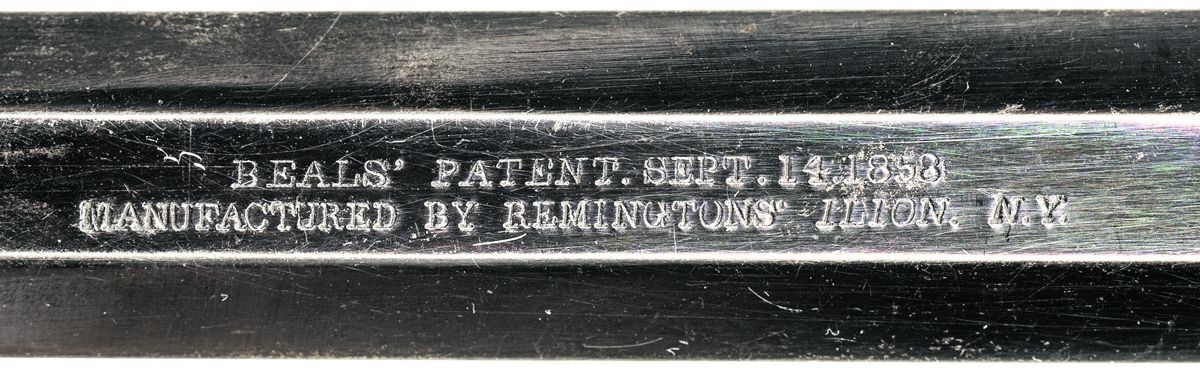
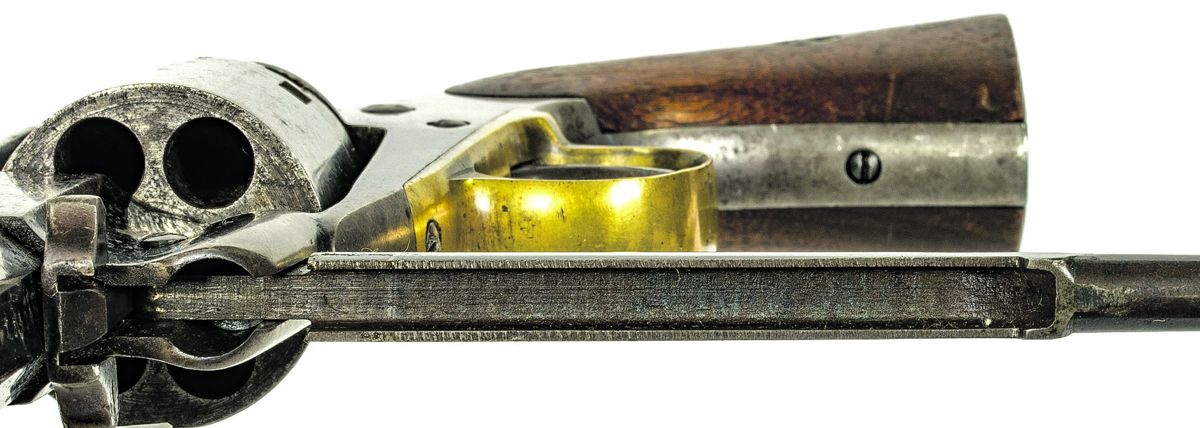
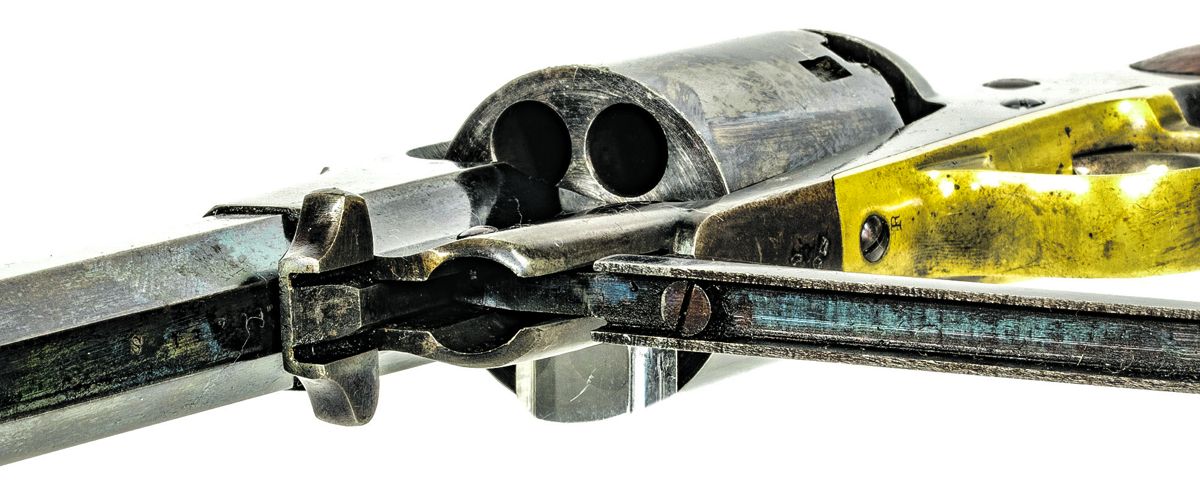
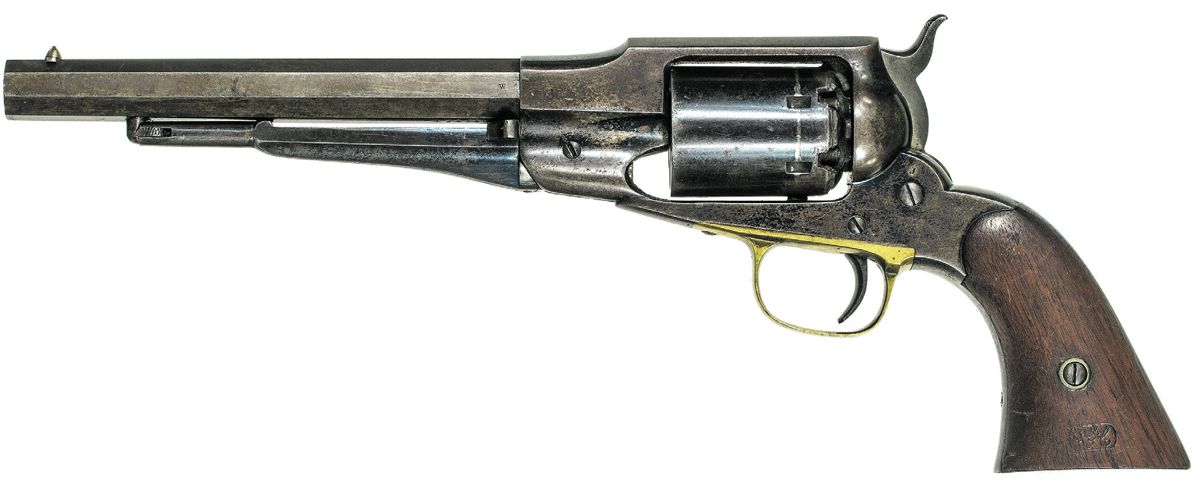
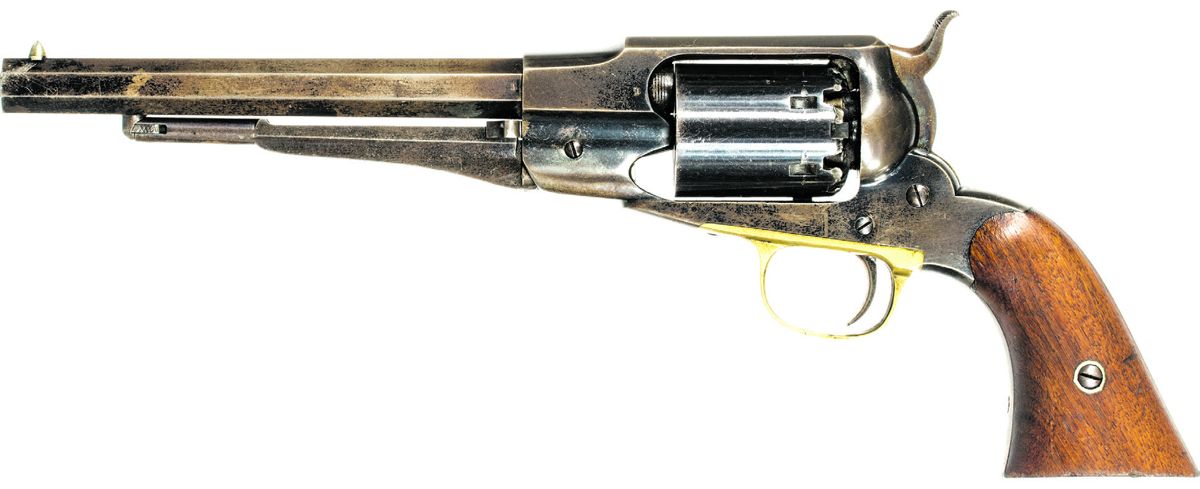
Remington’s first large frame, martial handgun to make it into production. The earlier Beals “Army,” a scaled-up version of the pocket model, was only produced as a prototype and it is believed that fewer than 10 were manufactured. The Beals Navy was a single action, 6-shot percussion revolver with a nominally 7 ½ inch octagonal barrel screwed into the solid frame. While most references list the barrel length as 7 ½ inches, some earlier examples measure closer to 7 3/8 inches. The guns were blued throughout, with brass trigger guards, and a color casehardened hammer. The gun had two-piece smooth walnut grips, secured by a screw that passed through German silver escutcheons. A cone shaped German silver front sight was dovetailed into the top of the barrel near the muzzle. The standard two-line barrel marking for the Beals revolvers read: BEALS’ PATENT SEPT. 14, 1858 / MANUFACTURED BY REMINGTONS’ ILION, NY. This barrel marking referenced Beals’ patent #21,478. There were a number of differences between the Beals model and the later production “Old Model” 1861 and “New Model” 1863 revolvers. The most obvious differences were the “high spur” hammer and the fact the frame concealed the barrel threads at the rear of the barrel. Shortly after the 1861 “Old Model” went into production, these features were eliminated. A relief cut in the frame revealing the threads at the barrel’s end was added to reduce the possibility of lock up due to fouling and a lower spur hammer was eventually adopted to reduce potential for breakage. The system of retaining the cylinder arbor pin via the loading lever evolved as well. While the Beals revolver required the lever to be lowered to withdraw the pin, the Model 1861 included a relief cut in the top of the lever that allowed the pin to be pulled forward with the lever in its upright and locked position. This was considered an improvement and the feature was patented by Remington employee William Elliott, who would be responsible for a number of successful Remington firearms designs. This “improvement” proved to be a failure in the field, as the arbor pin could slide forward in the relief cut during recoil. When this happened, the cylinder often moved slightly off axis at the rear and locked up, making the revolver useless. An eventual “fix” was developed for this potentially fatal flaw. A filister head screw was added to the inside of the loading lever that acted as a stop against the cylinder pin. This meant that the lever had to be lowered to remove the pin, essentially returning the design to the original Beals concept. The Beals models did not have safety notches on the rear of the cylinder that would allow the hammer to be safely dropped and locked between cylinder chambers. This feature was added to the Model 1861 and 1863 revolvers. Other minor evolutions occurred as well, including making the loading lever slightly larger and more robust. As the Beals was the first of the large frame martial Remington revolvers it underwent some changes and improvements during its production. The U.S. government had been relatively pleased with the original Beals Navy design and had obtained some 11,249 of the 15,000 Beals Navy revolvers produced. The purchases had been a combination of direct contract with Remington combined with open market purchases of some 7,250 revolvers that would not pass through a government inspection process. In June 1862, the Ordnance Department let a contract for 5,000 additional “Navy” caliber revolvers to Remington. The guns delivered under this contract appear to be a combination of late production Remington Beals Navy revolvers and the new Model 1861 “Old Model” or “Elliott” model revolvers. The serial numbering of the Model 1861 revolvers continued from the Beals Navy revolvers, with the numbers mixing somewhat randomly at the end of Beals production and the beginning of Model 1861 production. This can probably be attributed to using up older parts on hand, thus the existence of “transitional” Remington Navy revolvers. Between August and December 1862, a total of 5,001 .36 Remington “Navy” Revolvers were delivered under this contract. Due to reports of issues in the field with the new Elliott Model 1861 revolvers, modifications and improvements occurred during production of the “Old Model” Navy revolvers, that eventually morphed into the “New Model” or Model 1863 revolvers. No additional .36 caliber revolvers would be purchased from Remington by the Ordnance Department after the final December 1862 deliveries, but a huge number of the New Model 1863 Army revolvers were acquired between 1863 and 1865. Pictured here is a pair of Remington Elliott “Old Model” 1861 Navy Revolvers. Both have the standard two-line Model 1861 barrel marking that references the Elliott patent and reads PATENTED DEC. 17 1861 / MANUFACTURED BY
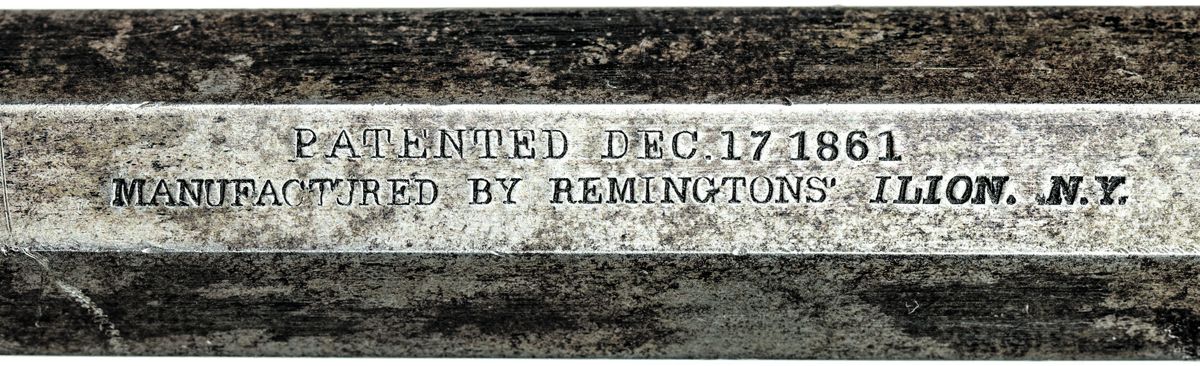
REMINGTONS’ ILION, NY. One gun is an earlier, “transitional,” Beals to Elliott model serial numbered 15,424. This gun retains the earlier Beals frame with concealed barrel threads and the Beals tall spur hammer and the Beals style cylinder without safety notches machined at its rear. However, it has the Elliott (or Model 1861) barrel markings and the Elliott patent cylinder arbor pin that can be withdrawn without lowering the loading lever. The other gun is a later production “Old Model” 1861 Navy, serial number 18,298. This gun has the cutaway frame that exposes the barrel threads, the safety notches at the rear of the cylinder and the added fillister head screw in the loading lever to prevent the cylinder arbor pin from moving inadvertently. During the process of converting from “Beals” to “Elliott” pattern guns, some features varied, with safety notches at the rear of the cylinder appearing intermittently until they were standard and the tall spur hammers remaining in use until they were used up. As only 5,000 transitional Beals-Elliott and Elliott pattern Remington Navy revolvers were purchased by the U.S. government during the early part of the American Civil War, they are fairly scarce on the collector market. Since the guns appear with variations and evolutions in their features, they can be a particularly interesting sub-set of martial Remington percussion revolvers to collect. Tim Prince is a full-time dealer in fine & collectible military arms from the Colonial Period through WWII. He operates College Hill Arsenal, a web-based antique arms retail site. A long time collector & researcher, Tim has been a contributing author to two major book projects about Civil War era arms including The English Connection and a new book on southern retailer marked and Confederate used shotguns. Tim is also a featured Arms & Militaria appraiser on the PBS Series Antiques Roadshow.