
Black Powder, White Smoke
Colonel Mann & European Matches
By Joe Bilby · Originally published December 2019 · pp. 10–11
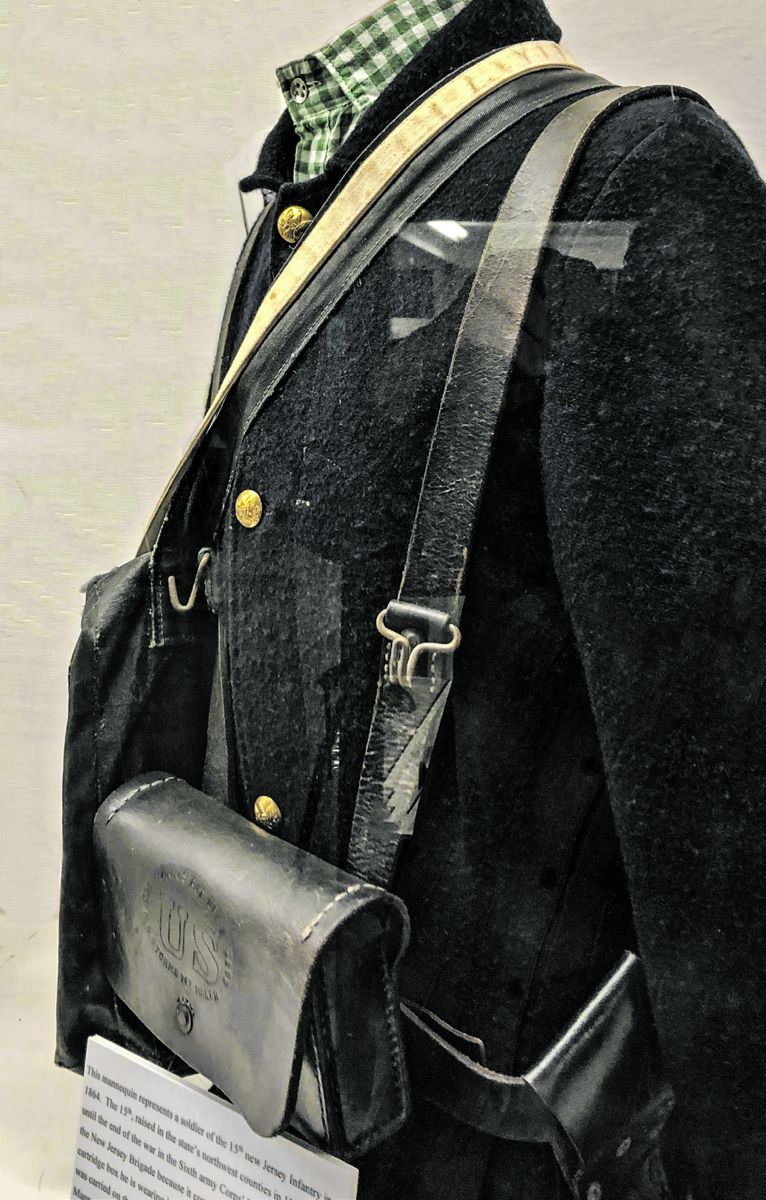
At the outbreak of the Civil War, William d’Alton Mann joined the 1st Michigan Cavalry, where his charisma won him election as a captain, even though he had no prior military experience. In 1862 Mann was promoted to colonel of the 7th Michigan Cavalry and commanded that regiment in Brigadier General George Custer’s Brigade at Gettysburg during the cavalry fight on the battle’s third day. In late 1863, Colonel Mann invented a set of equipment with a cartridge box carried in front, rather than on the soldier’s side, and connected to a backpack by a harness to balance weight and provide easier access to ammunition. Some Mann box designs held sixty rounds, twenty more than the standard forty round basic load. Soldiers almost always carried more than forty rounds, but the extra ammo was stored in a haversack, along with salt pork and hardtack, which did not contribute to durability. Mann presented examples of his invention to Ordnance and other officers, who were impressed. One responded that the equipment was “in many respects an improvement on the present accoutrements now used in service,” as it spread the weight of ammunition and knapsack over both shoulders which, the officer believed, “would be less fatiguing and injurious.” Mann equipment was issued to a few regiments in the spring of 1864 for trial in the field. The Fifteenth New Jersey
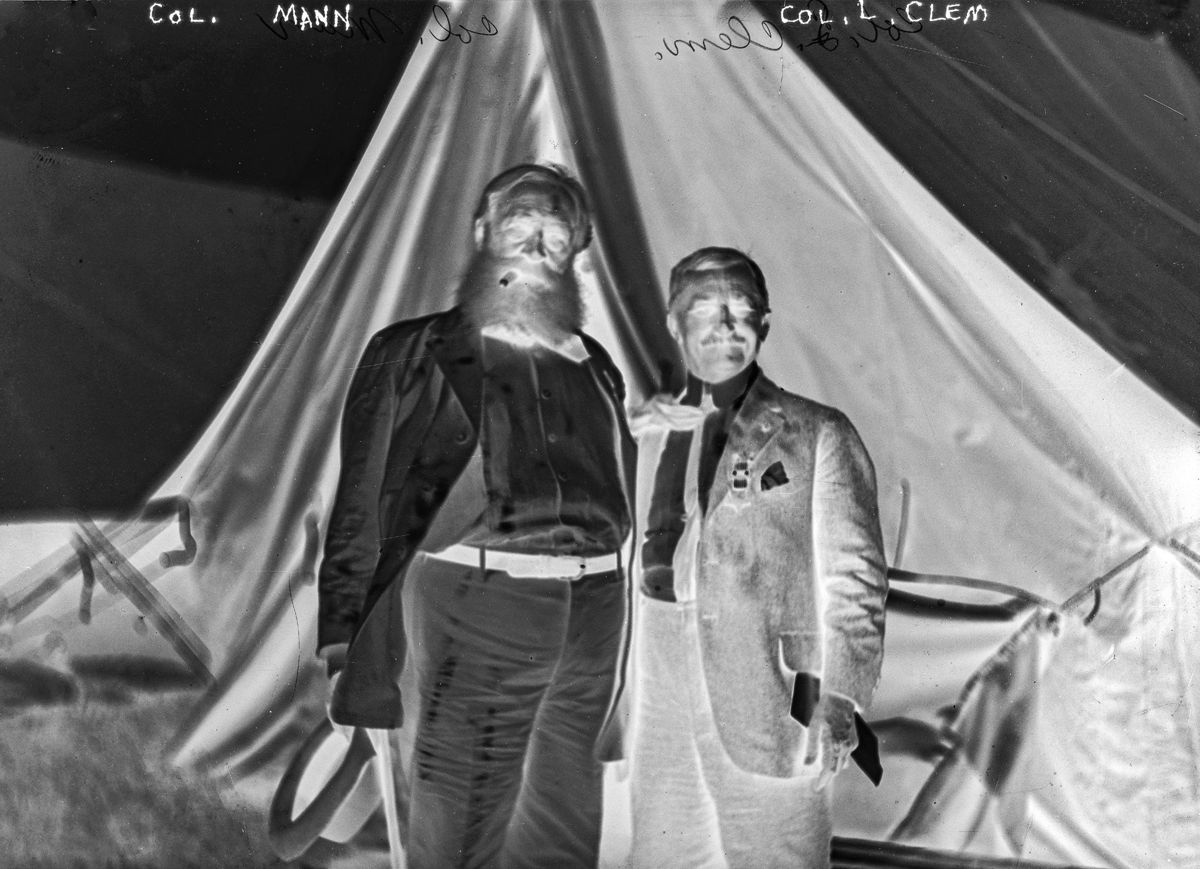
Infantry was one of the regiments selected. Unfortunately, only the cartridge boxes arrived at the Fifteenth’s camp in Virginia. The knapsacks were reportedly shipped by accident to New Orleans. After the war the Fifteenth’s chaplain recalled that he was able to identify his regiment’s dead at Spotsylvania by their Mann equipment. Over the winter of 1864–1865, the Fifteenth was reequipped with a second version of the Mann gear as was the 4th New Jersey Infantry, another regiment in their brigade. Praised though it was, Mann equipment never became the army’s standard. Following the war, Mann moved to Mobile, Ala., where he edited a newspaper, The Register, invented a new luxury railroad car, called the “Mann Boudoir Car,” that he later sold to the Pullman Company, and ran for Congress. Mann eventually moved to New York City, where in his cynical assessment of “New York Society,” a seemingly unchanging truth, was that it was “inhab- Reproduction Mann cartridge box on a mannequin dressed as ited by jackasses, libertines and a member of the Fifteenth New Jersey Infantry in 1864 at the parvenus.” To Mann, it was also a gold mine. He became editor and publisher of Town Topics, a pre-tabloid scandal sheet concentrating on the immoral behavior, real and suspected, of the elite “Four Hundred” of New York, a collection of “old wealth” families and “Robber Baron” parvenus. He earned a significant amount of money from essentially blackmailing the elite to bury their misdemeanors and bought a large home in Morristown, New Jersey. The photo shows Mann, never one to miss a publicity opportunity, at the 1913 Gettysburg reunion, along with John Clem, the legendary Civil War drummer boy.
The Italian company Pedersoli is the largest producer of reproduction traditional style muzzle loading military and civilian firearms; the company was the major sponsor of the 2019 European muzzle loading championships, that took place last summer at a range in the little Hungarian town of Salorsputza, near Budapest. Prominent European marksmen, including internationally known Hungarian black powder shooter and iconic YouTube shooting personality Balázs Neméth, organized the event, that saw a total of 273 participants from nineteen countries competing with rifles, handguns, and shotguns in stationary target and clay bird shooting over a five-day period. In a typical event, shooters had thirty minutes to load and fire thirteen rounds, with the best ten counted for score. The average of the top scores in all the matches was 98.5. The winner of the Vetterli fifty-meter offhand percussion rifle contest was German shooter Walter Massin, who achieved a maximum score of 100. Massin was a World Record Shooter in a previous match with a 150 out of 150 possible points that he shot with a Pedersoli rifle. Other medal winners included Finnish shooter Viertola Sakari, who took first place in the flintlock musket match with a Pedersoli Model 1777 musket and a score of 95, French shooter Mathieu Ducellier, who garnered gold in the Swiss rifle match and a score of 98. German Leonhard Brader took gold in the Minie rifle contest with a score of 97. Franz Lotspeic was overall winner in the clay bird events with a twelve-gauge Pedersoli/Gibbs shotgun and Franz Longspeich won first place with forty-three clay targets broken in the flintlock scattergun shoot. Spaniard Segura Badia Marcelo used a single shot Pedersoli Tatum & Egg pistol to win one of the handgun matches. Overall, there were nineteen separate competitions at the European championship matches over the five days, and the Pedersoli folks had reason to be proud, as shooters using their guns won fifteen gold, eight silver, and twelve bronze medals. At the end of the senior events, there was a junior muzzle loading competition, where young shooters under sixteen were able to try their hand and provide a vision of the future. Joseph G. Bilby received his BA and MA degrees in history from Seton Hall University and served as a lieutenant in the 1st Infantry Division in 1966–1967. He is Assistant Curator of the New Jersey National Guard and Militia Museum, a freelance writer and historical consultant and author or editor of 21 books and over 400 articles on N.J. and military history and firearms. He is also publications editor for the N.J. Civil War 150 Committee and edited the award winning New Jersey Goes to War. His latest book, New Jersey: A Military History, was published by Westholme Publishing in 2017. He has received an award for contributions to Monmouth County (N.J.) history and an Award of Merit from the N.J. Historical Commission for contributions to the state’s military history. He can be contacted by email at [email protected].