
The Unfinished Fight
Cherry Bounce
By Craig L. Barry · Originally published December 2019 · pp. 12–13
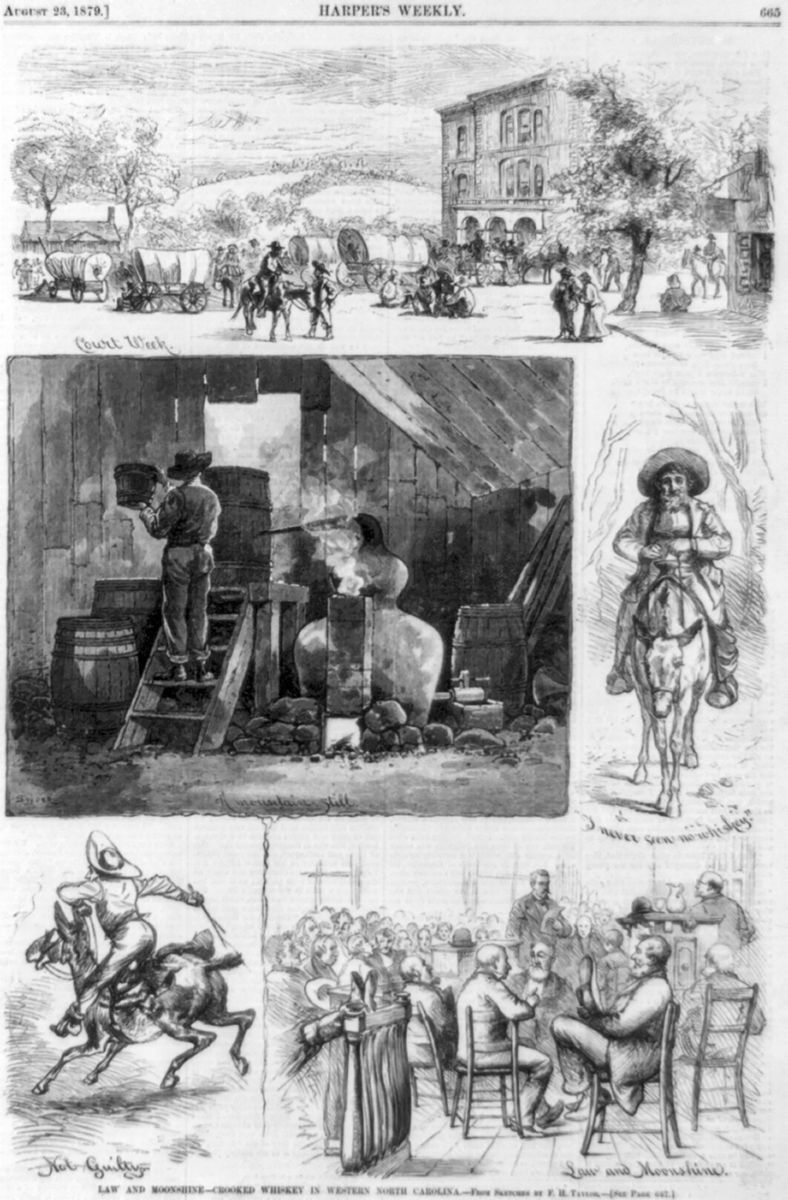
So as the Yankees say after every defeat, I retired in good order…Alas, I am a woman approaching forty, and the offering proved to be a bottle of cherry bounce. Nothing could have been more opportune and with a little ice &c, helped I am sure to save my life on that dreadful journey home. – Mary Chesnut’s Civil War Diary, September 2, 1861 When George Washington headed west across the Allegheny Mountains in September 1784, he carried a canteen full of one of his favorite libations, a mixture of cherries and brandy called “Cherry Bounce.” Martha Washington’s recipe is probably as good as any and appears below courtesy of the Mount Vernon Inn Restaurant:
Extract the juice of 20 pounds well ripened Morrello cherries. Add to this 10 quarts of old french brandy and sweeten it with white sugar to your taste. To 5 gallons of this mixture add one ounce of spice such as cinnamon, cloves and nutmegs of each an Equal quantity slightly bruis’d and a pint and half of cherry kernels that have been gently broken in a mortar. After the liquor has fermented let it stand close-stopped for a month or six weeks then bottle it, remembering to put a lump of Loaf Sugar into each bottle. Martha’s receipt: (recipe) for cherry bounce was found among her papers at Mount Vernon, but it was noted that it was not written in her handwriting, so who knows who actually came up with it? Whatever the case, she gets the credit for this particular version of the popular drink. While there were plenty of cherries to be found on the march, most soldiers lacked both the time and the necessary ingredients to produce the drink in camp. However, several soldiers made note of receiving bottles of cherry bounce in packages from home. In the Civil War Diary of Captain John Cheney, 1st Illinois Light Artillery Battery F, he noted in correspondence dated April 20, 1862, “I am as well off as most but if I had good brandy or cherry bounce, it would do me good and I would drink it.” He does not record if his wishes were granted or if his family eventually sent him any. In fact, probably the most famous producer of this drink both prior to and after the Civil War was a volunteer Confederate soldier and long-time moonshiner named Amos Owens of Cherry Mountain about 50 miles southeast of Asheville, N.C. Owens was known locally as the “Cherry Bounce King” well before the Civil War and his version of the drink consisted of homemade corn whiskey, cherries, and (either) sugar or sourwood honey from his farm. He enlisted as volunteer in the 16th North Carolina, Company D, on May 1, 1861, along with others from the same area. According to an article in the 1861 Shelby (N.C.) Star newspaper, the county was raising “a company of moonshiners and we present the name of Amos Owens for Lt Colonel.” According to the NC Archives there is no evidence that Owens ever achieved the rank of an officer during his enlistment despite the endorsement of the local newspaper. Herbert D. Lee was recorded as the captain of the 16th NC Infantry, Co. D while the biography of Amos Owens describes Owens during his term of enlistment as “a high private.” The 16th NC Infantry evolved from the former 6th NC Volunteers. The regiment was first organized in Raleigh. Its soldiers were from the counties of Jackson, Burke, Madison, Yancey, Rutherford, Buncombe,
Macon, Henderson, and Polk. Owens was himself from Rutherford County. They were sent to Virginia with about 1,200 men and the regiment was assigned first to General Gilham in July 1861, then General Wade Hampton and was later part of Dorsey Pender’s Brigade. Owens biography states he fought at First Manassas, but that can’t be correct because the earliest known battle involving the 16th North Carolina Infantry was at New Bern, N.C., in March 1862; the next was back in Virginia at Gaines Mill on June 27, 1862. However, Owens himself could not have participated in either battle because was discharged on January 17, 1862, while in camp at Wolf Run, Va., with “an incurable case of dropsy.” This was a general term for swelling in the extremities, but also included congestive heart failure. This much can be said, the physician noted that Owens was not expected to recover and he was sent home. Then as was often the case, after he returned home to his farm where he got decent food along with (no doubt) a good bit of the Cherry Bounce for which he was so well known, Owens “recovered completely in twelve months.” He already had a wife, two daughters, and a young son at home by that time and a fourth child was born June 19, 1863. It is worth noting that it is not unusual for biographies written many years post-bellum to be a little hazy on historical details involving battle specifics. Owens himself claims to have “several days of formal schooling” which is another way of saying he did not read or write. Hence, the biographer is going on memories of forty years earlier. What is reasonably clear is that Owens had an abbreviated first enlistment due to illness and was deemed unfit for future service. Amos Owens re-enlisted at Salisbury, N.C., with the 56th North Carolina under Captain Lawson Harrill, who previously served with him earlier in the 16th North Carolina. Private Owens was known for his marksmanship and “…It is related that he always fired after a careful aim, and as he took his smoking rifle from his shoulder, he would say: “And may the Lord have mercy on the soul of that blue-coat.” In fact, he often chided the bad aim of his comrades and he frequently criticized his comrades for shooting “up in the trees” when as (Private Owens put it), “the Yankees were just as close to the ground as they could git.” Owens was in Petersburg, Va., at the Battle of the Crater on July 30, 1864, and participated killing
U.S. troops there. Owens describes the killing of the trapped Union soldiers in the crater as “the most revolting sight ever witnessed in this lost and ruined world.” He was captured at the Battle of Dinwiddie Court House on March 31, 1865, and sent to the infamous prisoner of war camp at Point Lookout, Md. Here he suffered with the rest of the men what he termed “all the privations incidental to prison life,” but was paroled three months later and allowed to return home. On the rail trip home he was stricken with typhoid fever and once again the physicians pronounced that “he was bound to die.” According to his biography, Owens responded characteristically that was bound and determined to return home to distilling his cherry bounce. He purportedly said; “Doctor you say if I go I’ll be damned, and I say if I don’t go I’ll be damned.” A horse was brought around, and “…the audacious patient mounted him and rode home to the distillery, and then worked hard all night. From that time his recovery was rapid, and he was soon the picture of rugged health.” Post-bellum, The King of Cherry Bounce continued to produce his liquor illegally as a moonshiner and vowed to never pay a dime of revenue tax on any of it. This, of course, put him on a collision course with Federal Revenue agents. He was arrested several times, and it was said that local sympathies were very much in his favor as most of the jury were his customers and the government had difficulty in getting any convictions. One time he was brought to court and the judge ordered him to pay a fine. The story goes that Owens had previously arranged to have a wagon with forty gallons of his cherry bounce for sale right outside the courthouse; this raised the money for the fine and still made a profit. Finally, in his seventies, Amos Owens was sent to prison one final time for a short term and subsequently decided he was tired of it all. After that he gave up selling his famous cherry bounce liquor and started going to church at Walls Baptist Church. Owens accumulated a small fortune which he buried on the farm in baskets over the years, since he also distrusted banks. Amos Owens proved at least two Civil War physicians wrong and lived to be 85, if the dates on his tombstone in the church cemetery are to be trusted. Craig L. Barry was born in Charlottesville, Va. He holds his BA and Masters degrees from the University of North Carolina (Charlotte). Craig served The Watchdog Civil War Quarterly as Associate Editor and Editor from 2003–2017. The Watchdog published books and columns on 19th-century material and donated all funds from publications to battlefield preservation. He is the author of several books including The Civil War Musket: A Handbook for Historical Accuracy (2006, 2011), The Unfinished Fight: Essays on Confederate Material Culture Vol. I and II (2012, 2013) and three books (soon to be four) in the Suppliers to the Confederacy series on English Arms & Accoutrements, Quartermaster stores and other European imports.