Behind the Scenes at Shenandoah 1864
By Joseph Bordonaro · Originally published December 2019 · pp. 34–35
Most reenactors don’t think too much about how a reenactment is put together. They pay their registration and show up at the event site and expect water, sanitary facilities, firewood, and straw to be available and located in convenient spots. A quote from Dick Watters, who was heavily involved in the 2009-2015 cycle of 150th year commemorative reenactments headed by Chris Anders and his Rear Ranks Productions team, sums this attitude up: “When Mike Scheibe and I organized the last Cross Keys event I had to laugh when a friend who was helping on a work day before hand turned and said “you mean you decide where the porta-Johns go? Never thought about it, they are always just there.” This point is made, not to disparage reenactors, but to provide the rationale for the following article, which does not focus on a reenactment so much as the work that went into the production of it, in order to provide some recognition to those people who work tirelessly to provide their fellow reenactors with quality reenactments to attend. Rear Rank Productions is an all volunteer group of people who are dedicated to providing the public, and reenactors, with a “history-heavy” reenactment experience. Led by S. Chris Anders, the team includes Mike Lavis, Laurel Scott, Ted Brennan, Doug Dobbs, and Bill Watson. Rear Rank Productions have put on over 30 historical presentations since 1998. These presentations have included: Fire on the Mountain, 2001; Morton’s Ford, 2001; Burkittsville 1862, 2001; Drayton’s Brigade at 140th Antietam, 2002; War on the James, 2003; Loudoun Heights, 2003; To the Gates of Washington, 140th Monocacy Reenactment, 2004; Summer of 1862 - Jackson in the Valley, 2007; October (S. Chris Anders)
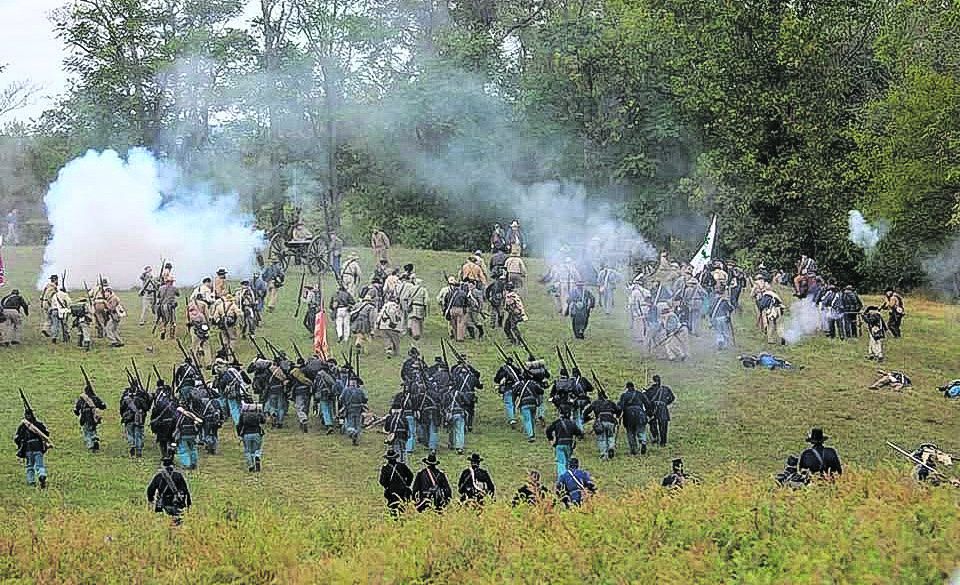
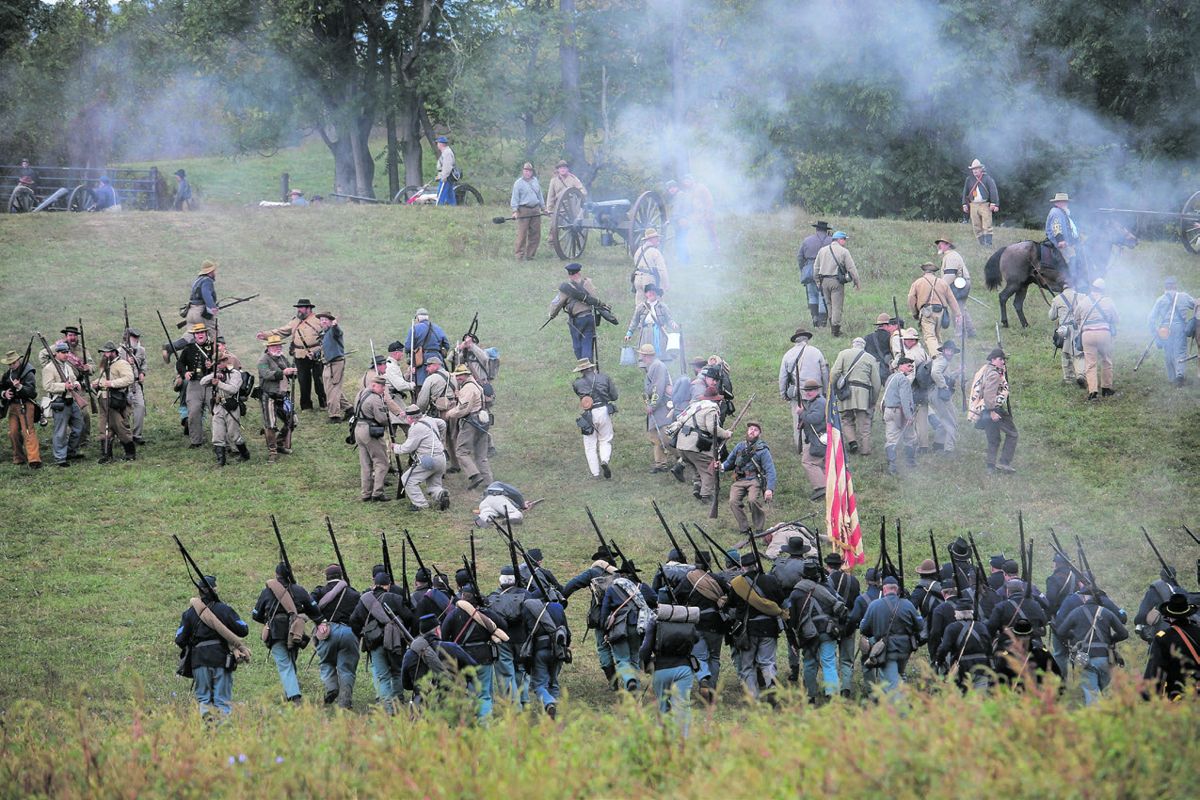
1862, 2007; At High Tide – 145th Gettysburg, 2008; Hope’s Campaign Tactical, 2009; Return to Manassas, 2nd Manassas, 2010; Along the Potomac – The 150th Anniversary of Ball’s Bluff, 2011; 150th McDowell, 2012; 150th Lee Takes Command – Seven Days Campaign, 2012; 150th Maryland Campaign – Maryland, My Maryland, 2012; 150th Campaign Before Richmond, 2014, 155th On to Richmond, Seven Days, 2017, Shenandoah 1864, 2019. To date, RRP has raised over $600,000 to support battlefield preservation and interpretation. This is certainly an impressive list of reenactments, and as those of us who have attended any of them can attest, they include many of the finest reenactments that have been presented during that time. The amount of money raised for battlefield preservation and interpretation is also impressive. The following information was provided by S. Chris Anders in response to a series of questions that I sent him: The goals of the reenactment were to provide the public with a historically correct view of the turbulent days in the Shenandoah Valley in the fall of 1864, while giving all participants a “magic window to the past,” and also generating preservation dollars to preserve our Civil War battlefields. As for the landowner, he wants RRP to come back and use his property again. We are looking at 2021 and possibly a Manassas event as the 160th anniversary cycle begins. Planning for the event began about 18 months prior to the event dates of October 4-6, 2019. Months were spent looking for a new event site; the land belonged to the current property owner of a farm in Anders’ hometown of Lovettsville, Va. The property owner has been working to turn his farm into a venue to host various events. Once a contract was negotiated and the rental fee set, off we went. The land always dictates the scenarios. You cannot just plop a scenario on a site. Rear Rank Productions knew that they wanted to do a Fall 1864 Valley Campaign event but were not sure which specific scenarios would be selected. After the land was secured, the team spent weeks looking over topo maps and the original sites to find a fit. Two battles were selected to reenact. On Saturday, the Third Battle of Winchester was depicted. On Sunday, the action at Fisher’s Hill was highlighted. There was also a tactical battle (non-scripted encounter between the opposing forces, not viewed by the public) on Saturday morning. After securing the land, providing plenty of safe water to drink is probably next in importance. Lining up the water supply entailed making a lot of phone calls and cobbling together different suppliers. The National Guard no longer supports such events, so all water on site was obtained through commercial vendorsthree in fact. Many water companies used to have smaller 2,000 gallon tankers, but not anymore. Now you have to obtain at least 4,500 gallon tanks, and multiple ones to provide water at various locations. It is not cheap. The health and safety of the participants and spectators was provided for by the presence of local volunteer EMS on site and RRP’s own internal security team. Also important for the health and safety of participants and spectators is the provision of portable toilets; some 52 were provided for the event and were kept clean throughout the weekend. The number of participants had to be capped, based on what the land could handle easily, and still provide for adequate space for the reenactors to maneuver. From what Anders’ has been told by the public, the Shenandoah Valley Battlefield Foundation, and the participants, the goals of Rear Rank Productions for the reenactment were met. About $ 5,000 was raised for the Shenandoah Valley Battlefield Foundation. Participant (total registration was about 1,340) and sutler fees covered all expenses except a small amount that RRP, LLC paid. Having put on many events, RRP always sets aside the fees the public pays to view the reenactment to go directly to preservation. They were very,
(Tiffany Umbaugh)
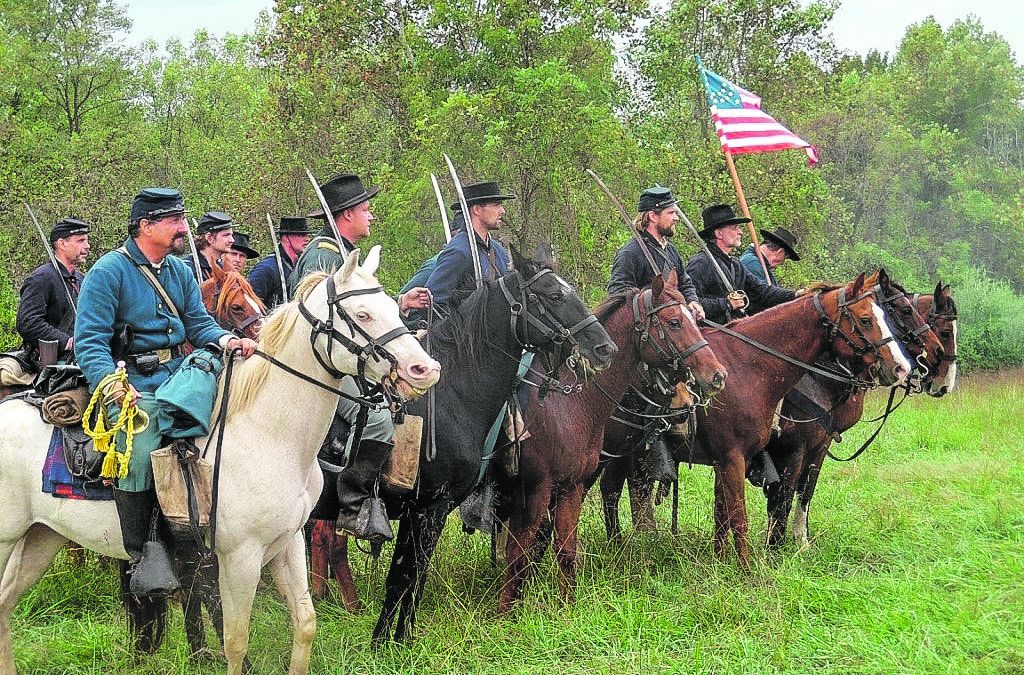
Shen 64. Federal cavalry preparing to advance.
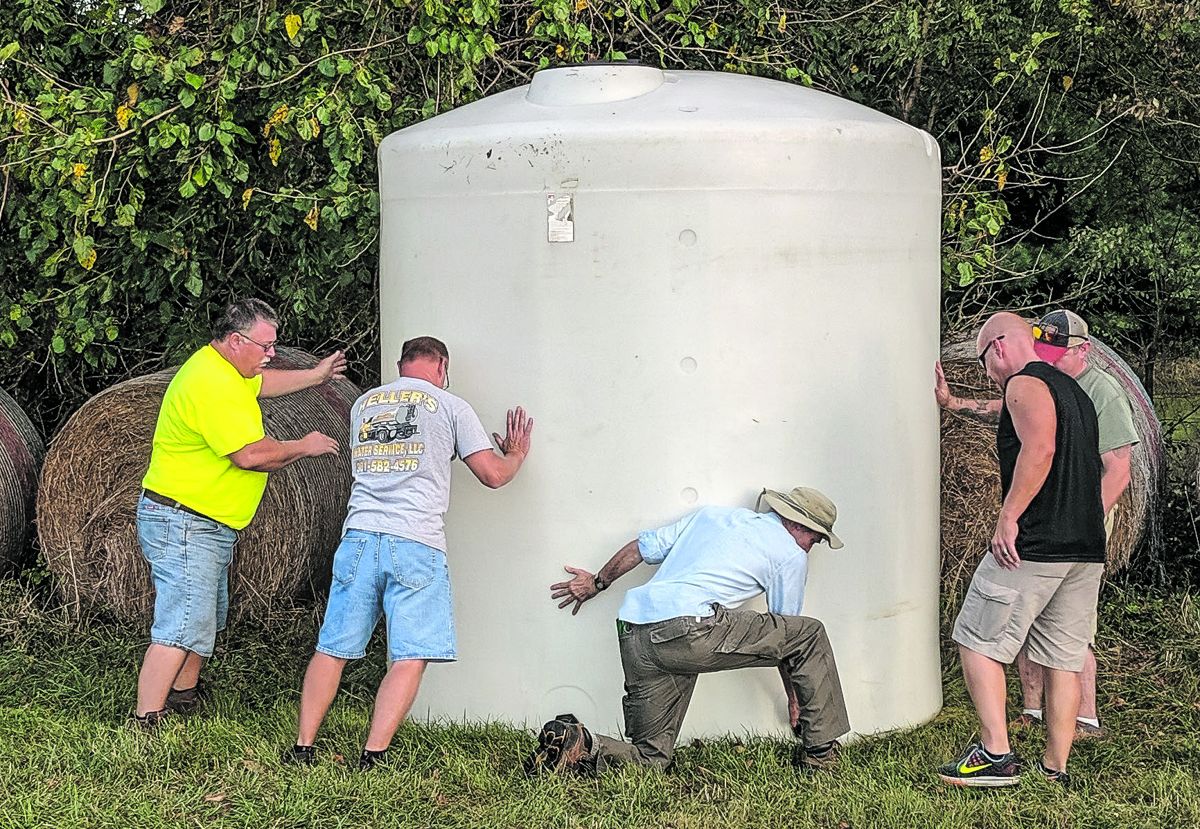
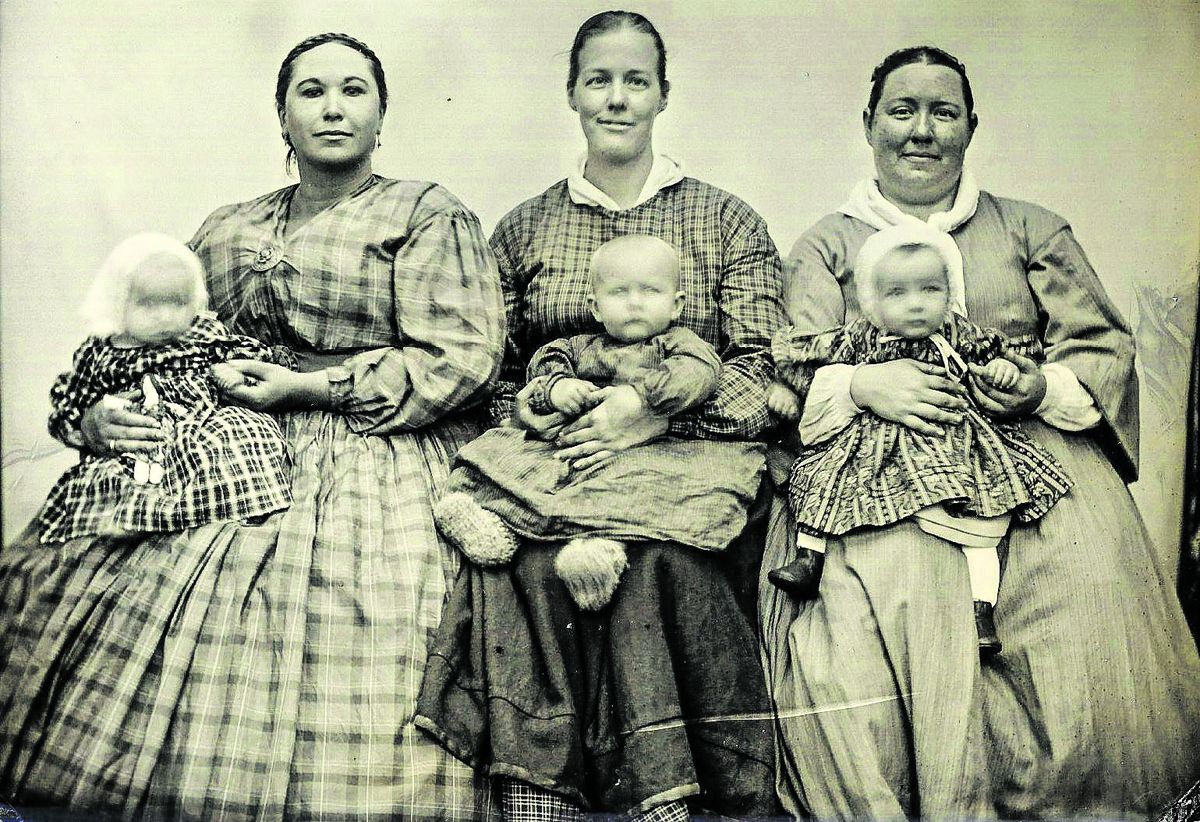
(Stevens D. Bunker) very close to breaking even on on an outdoor event that can be the event, and RRP considers that a bust if the heavens open or the a win. Having lost thousands on temps drop. It’s a tremendous Maryland My Maryland, RRP risk, which sometimes goes well considers a small loss a big win. and sometimes doesn’t. This Putting on RRP events is a labor event we were very blessed that of love. The hobby has been good things went very smoothly.” to the members of Rear Rank Other members of the RRP Productions for many years, and team also provided informathis is their way of paying it back. tion about their involvement They look forward to many more in the event. Laurel Scott was years of providing high quality the Civilian Coordinator at events. Shenndoah ‘64. At many events, Putting on a reenactment is a civilian participation is a bit of combination of hard work and an afterthought. A place to camp acceptance of financial risk. As is provided and that is about it. volunteer Doug Dobbs explains, RRP events make much more of “Chris (Anders) did the heavy an effort to integrate civilians in lifting, arranging for commod- an active role. The planning inities like wood to be delivered, volved in this was described by county permits to be signed, in- Laurel: “Our camp was not tersurance, etc. All are dependent ribly large, but even as civilians, the lay of the land dictated what we could and couldn’t do. The first task was figuring out how to set up our tents in a narrow hollow to allow for troop and cavalry movements through the center of “the town of Berryville.” We had two built-in scenarios with troops or cavalry coming through our town. It was nice to be able to give our civilians advance notice about these so we could plan for various types of reactions/interactions. We also discussed having a field hospital scenario, but I encouraged our civilians to do their own research and develop their own scenarios, ideally including military interaction. I provided basics about the history of the town, the battles, and the ground upon which we’d be working; our civilians took it from there. A highlight of the reenactor-generated scenarios was the visit from Federal sharpshooters who were foraging for food. Both foragers and townspeople enjoyed this immensely, and a few lessons in bargaining were learned. One of my greatest worries at “Shenandoah 1864” was also one of my greatest joys. When I realized we’d have three mothers and babies in camp, I sought to put them together so they could help each other. They set up a shared fly that worked well for all. Keeping the babies safe was my priority, since during one battle, the town was scheduled to be overrun by cavalry, and we’d have limited space within which to retreat. Loose horses are always a concern, and a pair of mules that were new to reenactments also had me worried. But after the walk-through, I located a good spot in the woods, and the retreat to safety proceeded without incident.” Volunteer staff member Doug Dobbs describes his special area of concern at the event: “My area of support began when the water tanks arrived. We sterilized them and plumbed them up for manifolds that could deliver a lot of water quickly if so needed. Folks seem to have appreciated this feature. There are always unforeseen challenges however. I drove from Penn. down to Marshall, Va., just to eyeball the two 4,500 gallon water trucks and make sure I had the right fittings on hand. I did, but when the trucks got on site and I could take their quick connect fittings off, it turned out one had a 3” female threaded fitting, the other had a 3” male threaded fitting. These kinds of things make for fast dashes to the nearest hardware store and require some creativity when they may not have the right parts in stock. I ended up buying 16’ of 3” pipe because they didn’t have a male to male connector. They did have two male to straight pipe connectors. So we cut off 6” of pipe and made up our own male to male connector. That sort of thing can add stress to the preparations, but it’s to be expected. Once the event got underway Chris turned control of the event over to me and Bill Watson. It was our job to handle event management duties so that Chris could focus on the military scenarios and command of the CS forces. This worked superbly well at “Maryland, My Maryland” and we were able to repeat that success at Shenandoah 1864. Bill deserves great honor for his quiet and thorough attention to the basic needs of the event, from registration to wood delivery to dispute resolution. He was a huge asset to the success of the weekend.” Volunteer staff member Bill Watson describes an example of the sort of problem that can become a big problem at an event, if not addressed quickly: “There were so many portajohns that there was no need for honeywagons during the 36 or 40 hours of the event; but toilet paper started running low. Easy fix, run to a supermarket and get a bunch and make the rounds. I mean, a lot of us have shirts missing tails because we found out, a little bit late, that there was no paper. And shirts are getting expensive. At this point, a quotation from 1st Brigade Commander (Confederate) Dick Watters would seem to be in order: “William Watson, thank you and Doug Dobbs once again for all of the tireless work you did to make the event a success. You’re both heroes in my book.” – Dick Watters Mike Lavis was the overall Federal Commander at the event and describes some challenges he faced and overcame: “Before early May I was pretty much handling everything from the Fed end as usual. But I didn’t get to have the detailed discussions and site visits that Chris and I normally undertook while we planned out the battles. Some of that was because several Fed organizations that had initially said they were coming, ended up as noshows, at least as battalion-sized commands. That forced us to dramatically change the scenarios, from what we hoped to achieve; not the quality of them, but instead, how much we can put into the different fights, so this one did not develop as they normally do. It might be noted also that both Chris and I began the planning with several new staff members to break in with our systems. Happily, everyone who came on board got on the same page as us, and were a great help to making the event work. As we move forward, it should get smoother.” Joe Bordonaro is a USAF veteran (1973–1977), Glassboro State College graduate (1980), Catholic school teacher (St. Joseph’s ProCathedral, 1983–1988), and retired public school teacher (Mullica Township School, 1988–2009). He has been involved with Civil War reenacting/living history since 1999. Joe began submitting articles to the Civil War News in 2005 and has been covering events for the News on a regular basis since 2016. Joe lives in Mount Laurel, NJ, and has been married to his wife Karen for 29 years. If you wish to contact Joe, you may send an email to [email protected].