
Through The Lens
Arkansas Foot Races
By Stephanie Hagiwara · Originally published December 2019 · pp. 14–15
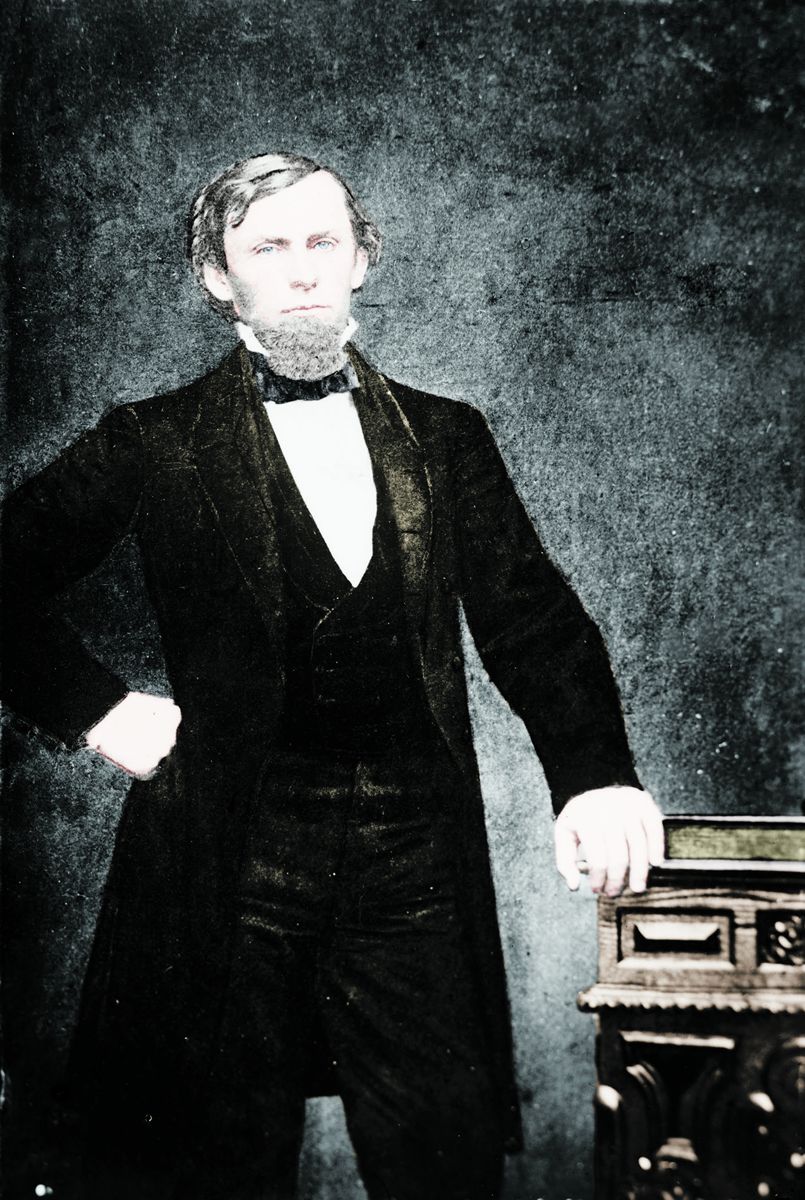
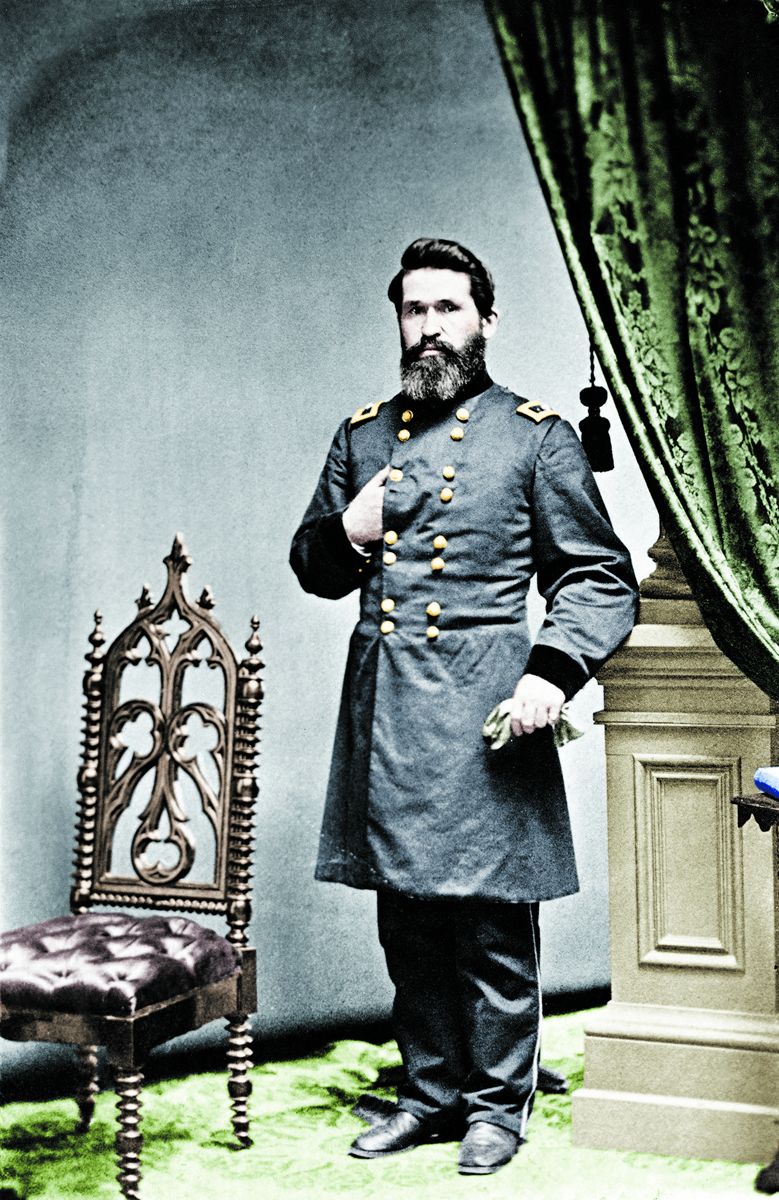
You will soon hear of one of the damnedest fights or foot races that had taken place lately.” – U.S. Gen. James G. Blunt After losing the March 7-8, 1862, Battle of Pea Ridge, Ark., C.S. Gen. Earl Van Dorn left the region for the Mississippi River, taking all available troops, artillery, and supplies with him. On May 13, 1862, C.S. Gen. Thomas C. Hindman took command of the Trans-Mississippi District. The “Fire-Eater” former U.S. Congressman was nationally known for his advocacy of state’s rights. On arrival Hindman announced, “I have come here to drive out the invader or perish in the attempt.” Within seventy days Hindman had instituted martial law, enforced conscription, established price controls, and pulled together a rudimentary army. On Nov. 28, C.S. Gen. John S. Marmaduke’s cavalry fought Gen. James Blunt’s, 1st Division, Army of the Frontier cavalry. The Battle of Cane Hill, Ark., lasted nine hours as the fighting traversed 12 miles of woods, valleys, and hills. The fight ended with Blunt isolated from Federal forces 100 miles away in Springfield, Mo. Blunt was a Kansas physician and abolitionist who, with John Brown, aided slaves escaping into Canada. According to a Federal soldier, he was also, “a hearty fighter and seemed to think that it was the height of strategy to get himself surrounded by the enemy and fight his way out.” Blunt placed his men in a defensive position around Cane Hill and announced, “I have decided to hold on at all hazards.
Hindman considered it an opportunity to drive out the invaders. He set out from Van Buren, Ark., on Dec. 3 with 9,000 infantry, 2,000 cavalry, and 22 pieces of artillery. Hindman’s plan was for the infantry to secure the mountains and attack the enemy’s front while the cavalry attacked the rear and flanks. Blunt knew he was in a vulnerable position. As his men fortified the area, his scouts, mostly Native-Americans, watched Hindman. Twelve hours before the Confederates left Van Buren, Blunt sent a message to Gen Francis J. Herron, 2nd Division, Army of the Frontier, for reinforcements. During the Battle of Pea Ridge, Herron had earned the Medal of Honor for his actions. Months later Herron took his staff to see where he had been wounded and captured. His horse’s body still marked the spot. The 1st Ark. and 7th Mo. U.S. Cavalry heeded Blunt’s call for reinforcements. The Dec. 7, Battle of Prairie Grove began between Fayetteville, Ark., and Cane Hill as the Federals were routed by the Marmaduke’s Cavalry. The Federals rushed back towards Fayetteville. The Confederates followed their fleeing foe, capturing prisoners and reaping the bounty left behind. During the pursuit, Marmaduke was stunned to see Herron’s troops marching towards him. Herron had left Springfield on Dec. 3 for the 110-mile march with some units averaging 35 miles a day. Other units marched the final 66 miles in 30 hours. The pace caused attrition. “… Our boys are laying along the road side every mile between this point and Springfield entirely disheartened completely exhausted can go no farther,” wrote one soldier. An officer of the 37th Ill. recalled, “… men were carrying their shoes and marching in their stocking feet on account the blisters on their feet,” over roads covered in icy slush, mud, and sharp rocks. Another unit refused to continue to carry their packs and left them by the roadside. Their commander stowed them in the wagons.
Approximately ten miles before reaching Blunt, Herron was shocked to see blue coats riding “in wildest confusion” towards him. It took shooting a man out of his saddle to slow the stampede. Unlike their inexperienced brethren, the new arrivals got ready to face the rebels and advanced at the double-quick. “Nearly every one had sore feet from the effects of the hard march, but we all forgot our feet and pushed forward,” wrote William Clayton. The Confederate cavalry reeled back and positioned their six 6-pdr. and four 12-pdr. howitzers on the foliage covered hill above the Illinois River. Herron placed his four 10-pdr. Parrotts, six 3-in. ordnance rifles, six 6-pdr. James rifles, one 6-pdr., and three 12-pdr. howitzers on Crawford’s Prairie across the river. About 1:30 p.m. the Confederates let loose their barrage. “So completely were the men exhausted that I saw them sleeping quietly around, paying no heed to the fierce missiles,” reported Lt. Col. John C. Black, 37th Ill. The Confederate firing stopped after Hindman told his men to stop wasting ammunition. The Federals continued to fire. “Nothing makes a man shoot so coolly as not being shot at in return,” remarked a Confederate officer. Through the gaps of greenery only a few Confederates could be seen. Herron may not have realized that he was outnumbered two to one. He ordered about 500 men up the hill. The men were met with a “perfect hail of bullets” and the survivors chased off the hill. Their pursuers were charged out of the foliage were, in turn, met with cannon fire and escaped back up the hill. Herron again ordered about 500 men up the hillside, “littered with corpses, cripples, and discarded weapons and clothing,” repeating the cycle. According to Herron, “The fighting was desperate beyond description.” In the meantime, Blunt hearing the shooting in the distance, realized that Herron’s troops were engaging the enemy. Rushing to the battlefield, the infantry left the road to double-quick through the fields, keeping up with the galloping cavalry. “We charged with a shout,” recalled a soldier. Blunt with his 22 cannon and men arrived just in time to bolster the Union line. Both sides held firm as the battle raged until dusk. Herron had stragglers with supplies arriving. Hindman didn’t. His men lacked the ammunition and food to fight two armies or the ability to slip away without a ruse. Under a flag of truce, the two opponents met, ignoring the usual courtesies. “Well I suppose General you give up,” began Hindman. Instead Blunt agreed to give Hindman the opportunity to care for the wounded and gather the dead. To Blunt’s fury, during the night Hindman’s army slipped away. Despite Hindman’s efforts the “invader” remained. As a civilian described it, the battle was the “deathblow to rebel hopes in Arkansas.” Sources: •
Shea, William L. Fields of Blood: The Prairie Grove Campaign: The University of
•
•
North Carolina Press, 2009 Neal, Diane. Lion Of The South: General Thomas C. Hindman: Mercer University Press, 1997 Shea, William L. War in the West: Pea Ridge and Prairie Grove: State House/McWhiney Foundation Press, 2012
Stephanie Hagiwara is the editor for Civil War in Color.com and Civil War in 3D.com. She also writes a column for History in Full Color. com that covers stories of photographs of historical interest from the 1850’s to the present. Her articles can be found on Facebook, Tumblr and Pinterest.