
The Unfinished Fight
The Artillery Fuze
By Craig L. Barry · Originally published August 2019 · pp. 10–11
“The Ordnance Department of the Confederate States has accomplished immense results of which the people are almost wholly ignorant…From the Richmond Arsenal and the various other depots throughout the States, come all the various grades of cannon, from the mountain howitzer to the columbiad; all small arms; all cavalry equipment for man and horse; all artillery equipments, and all ammunition for infantry, artillery and cavalry.” (Richmond Enquirer Nov. 14, 1864). “Many of the fuzes exploded prematurely, and about half of the friction primers failed.” (Lt. Col. Kemper, C.S. Artillery, Dec. 26, 1863).
Brass friction primer, non-excavated, complete. The reliability of Confederate artillery seems to depend on whether you get your information from the Richmond Enquirer or from trying to fire the artillery piece yourself. Artillery misfires seemed particularly vexing for the Confederate Ordnance Department early in the war, and the failure of the artillery shells to detonate as intended “could usually be traced to defective fuzes and primers.” Union artillery also had its share of misfires, but seemed to have fewer failures from their primers and fuzes. The first step in successfully shooting any kind of gun is (of course) igniting the gun powder used as a propellant. This is the role of the primer, which we will concentrate on here. If a cannon failed to fire, the primer was a good place to begin the investigation. General John B. Magruder wrote Ordnance Chief Josiah Gorgas in September 1861 that not one of his first shipments of friction primers from the Richmond Arsenal had worked. A second batch arrived, and Magruder noted that ironically that the new primers, “…were supplied in the place of others which were worthless, and these were worthless themselves.” Gorgas for his part blamed it on unskilled artillerymen. Who knows? However, the problems with C.S. Arsenal primers and fuzes were well documented. Artillery is after all both a science and an art. And to be fair, the South had to create an armaments industry virtually from scratch while the Civil War was in progress. A quick explanation is in order on the distinctive period spelling of “fuze” with a ‘z.’ In the Civil War-era, a “fuze” was a time delayed, slow burning igniter used either as the priming charge or with the projectile itself. For example, the “slow match” and linstock primer ignition was called a “fuze.” The fuze was also used in projectiles. The so-called “timed” fuze was the most commonly employed form of projectile detonation. The artillerist would cut through the train at the appropriate time mark before loading the projectile into the cannon. The flame from the main charge was intended to light the timed fuze in the projectile. Another type was the percussion fuze which exploded the projectile when the fuze made contact with an object. Most percussion fuzes employed a plunger-and-anvil method of detonation. There were chemical concussion fuzes and
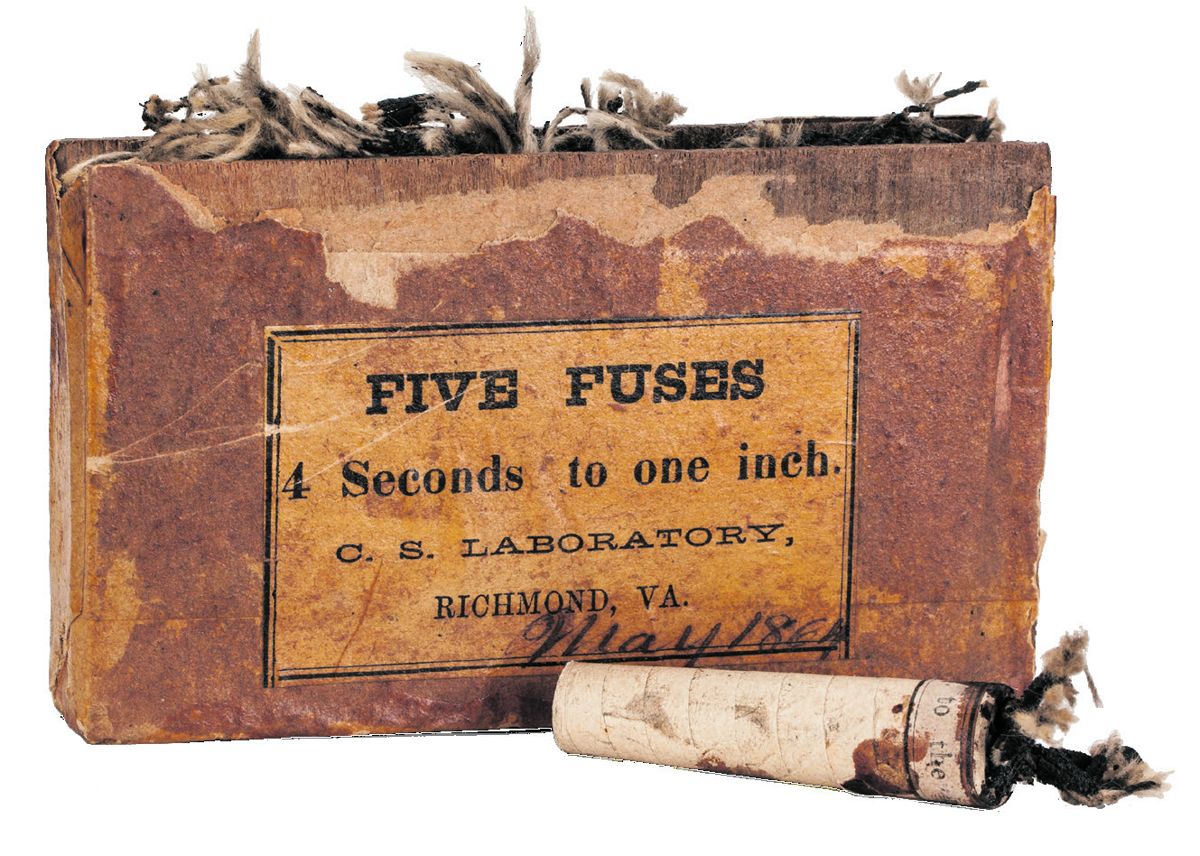
This “4 second fuses to one inch” fuse box was manufactured at the C.S. Laboratory in Richmond, Va., in May 1864. The box is 4.51 inches wide x 2.62 inches high x .80 inch thick. These paper time fuses have numerous wicks that are 1 inch long. The length of the paper time fuse is 2.08 inches. Top diameter of the fuse is .55 inch and tapers to .41 inch at the base. The outer covering is wax paper for waterproofing. The box holds five paper time fuses. (Courtesy Atlanta History Center)
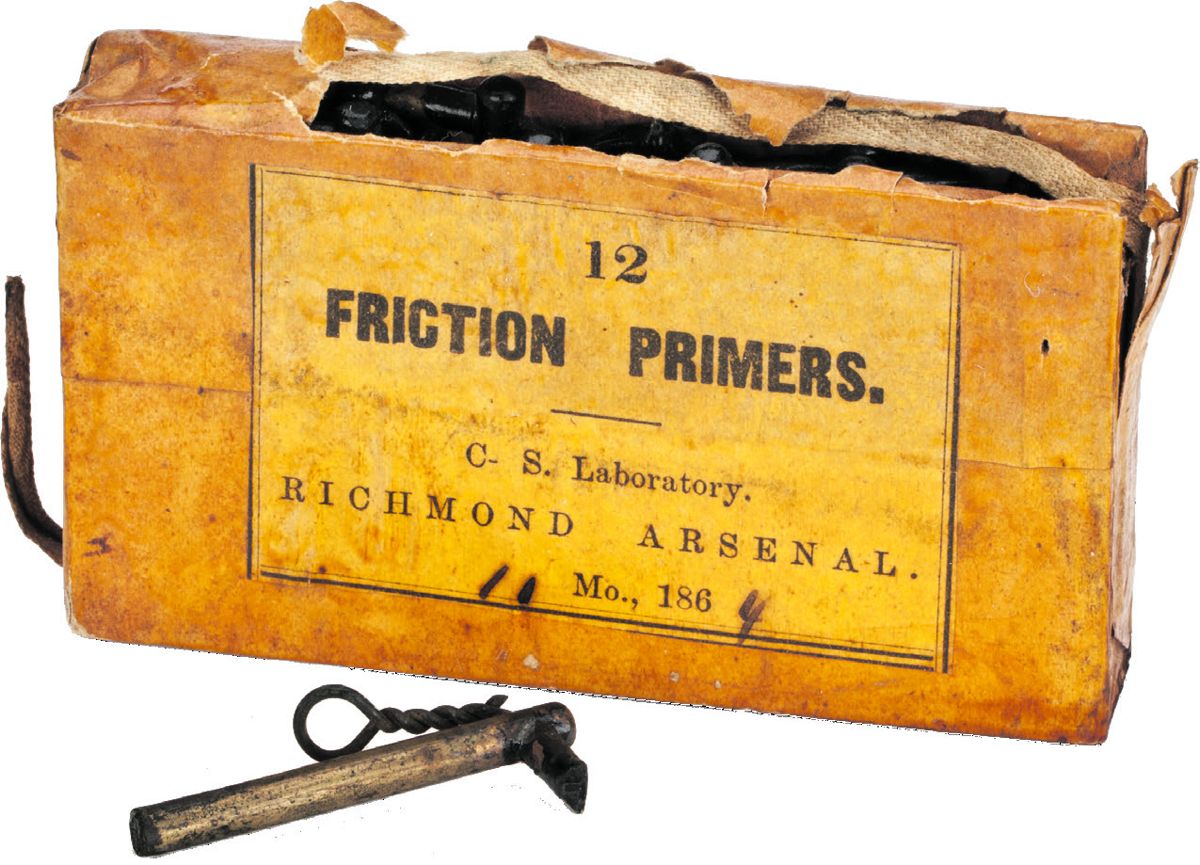
Paper wrapping is marked 12 / FRICTION PRIMERS. / C- S. Laboratory. / RICHMOND ARSENAL. / 11 Mo., 1864. Box is 4.13 inches wide x 2.34 inches high x .74-inch thick. Friction primer is .189-inch in diameter and is 1.83-inches long. There are six holes in the wooden box each containing two friction primers. (Courtesy Atlanta History Center) combination types, but the two main types were timed fuze and percussion. The timed fuze was the most problematic. (See Jack Melton, “How Artillery Fuses Worked” www.civilwarartillery.com). In the modern military, the meaning of fuze is distinct from the alternate spelling of fuse. A slow burning igniter would be called a “fuse” and a “fuze” (with a z) would indicate a more complicated mechanical or electronic detonator. The spelling of “fuze” with a ‘z’ and fuse with an ‘s’ were used during the mid-19th century spellings and are not consistent in period publications, etc. Cannon are deceptively simple, nothing really but a metal tube closed on one end. In that closed end is a small hole leading down to the main powder charge. In the earliest cannon, this hole was filled with finely ground powder which was then ignited with a hot ember or torch. With the advent of black powder hand-held guns, a new method of ignition was necessary. It goes without saying that holding a red hot rod while trying to pour a charge of black powder down a barrel is a good way to get killed. Also, trying to shoulder the musket with one hand, aim at the target, and look for the touchhole so you could fire the charge with the other hand was clumsy. One method of firing the charge was the “slow match,” hence the term matchlock musket. The “slow match” was usually a length of hemp twine or cord that had been chemically treated with an oxidizer to make it smolder slowly without a visible flame and last for an extended period of time. This same technology was also employed by artillerymen. The slow burning cord was held off the ground with a stick called a linstock. The cannon vent was charged with either a priming tube of powder or loose powder; then the tip of the “slow match” held by the linstock was touched to the vent to ignite the charge. Based on advances in small arms technology, the matchlock musket was replaced by the flintlock around 1630 or so, but “slow match” and linstock were still in use for field artillery when the Civil War began. As late as 1864, Union forces in the Trans-Mississippi Theater noted that Confederates were firing their artillery with “matches and fuze” presumably meaning the linstock and slow match. Obviously, friction primers were widely available by then but it appears that slow match was still used late in the war. It bears noting that in the Western and TransMississippi theaters, some flintlock rifles were still in the ranks in mid-1864. When did artillery begin to follow small arms and implement the newer forms of ignition like the flintlock? In 1782, the British navy first employed flintlock fired cannon aboard their warships. These can be seen being used in the film, Master and
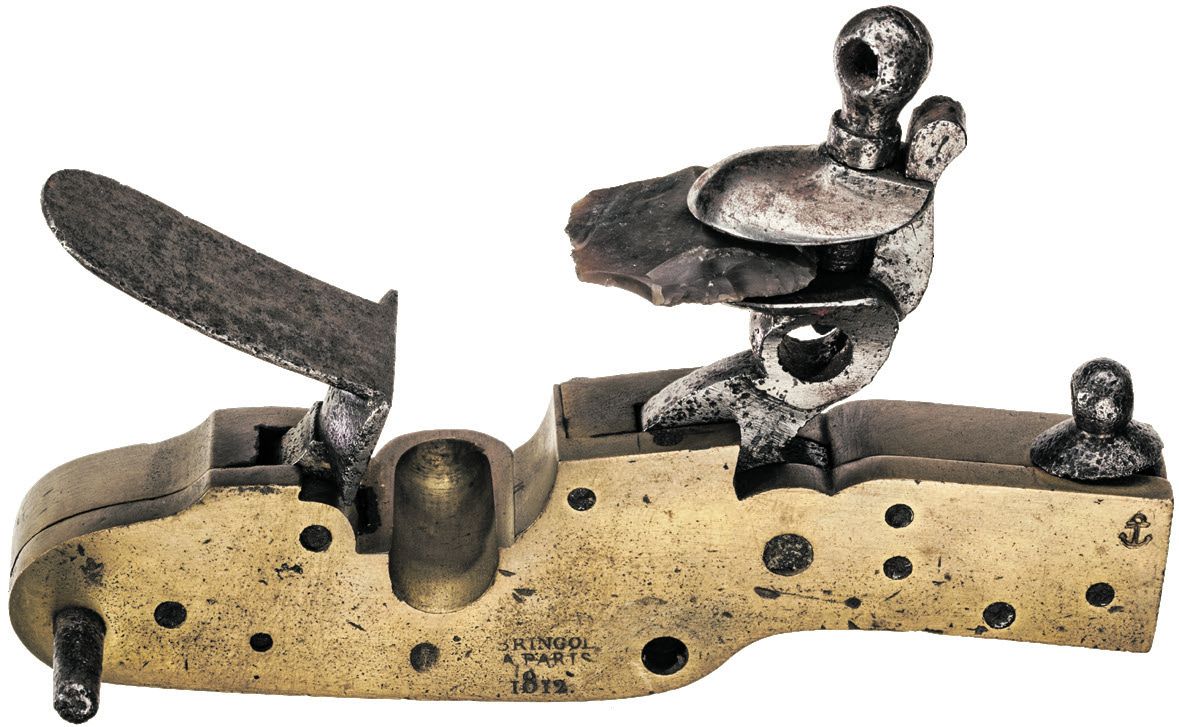
This is a rare 1812 French manufactured flintlock ignition system for cannon marked BRINGOL / A PARIS / 1812. Prior to cannon ignition ‘locks’ being used, typical firing of cannon would be with a quill primer or open powder train which was touched off with either a handheld linstock or portfire. Use of either of these methods required the gunner to be in close proximity to the cannon’s vent and left the artillerist subject to possibly be in line of the cannons’ recoil, or in the event of the failure of the tube; undoubtedly in harms way. The brass body consists of two pieces with the release spring and cocking mechanism inside, as typical with a flintlock gun. At the rear of the lock, is an iron piece which has a hole in it for the lanyard line to attach. Black powder was filled into the pan and the frizzen closed to protect the powder from the wind and elements. The hammer which held a flint was pulled back or cocked readying the piece. A quick pull on the outstretched lanyard released the hammer and the flint would strike the steel frizzen hopefully creating a spark which would instantaneously light the powder in the pan and set off the propellant charge. Cannon locks would either mount onto a raised cast section on the barrel next to the vent, or onto an applied mount next to the vent. On some older cannon barrels you can see the cast on mounts, or the threaded holes for screws used for attaching the mount next to the vent. The lock pictured, has in the front a pin that slid into a receiving hole, and a hole through the brass housing for a bolt to secure it. The lock measures overall, approximately 6 5/8 inches in length. Cannon locks are very rare to find today. Eventually flintlock style cannon locks were replaced with a percussion style system of ignition which was a further improvement.
(David Kornelly collection)
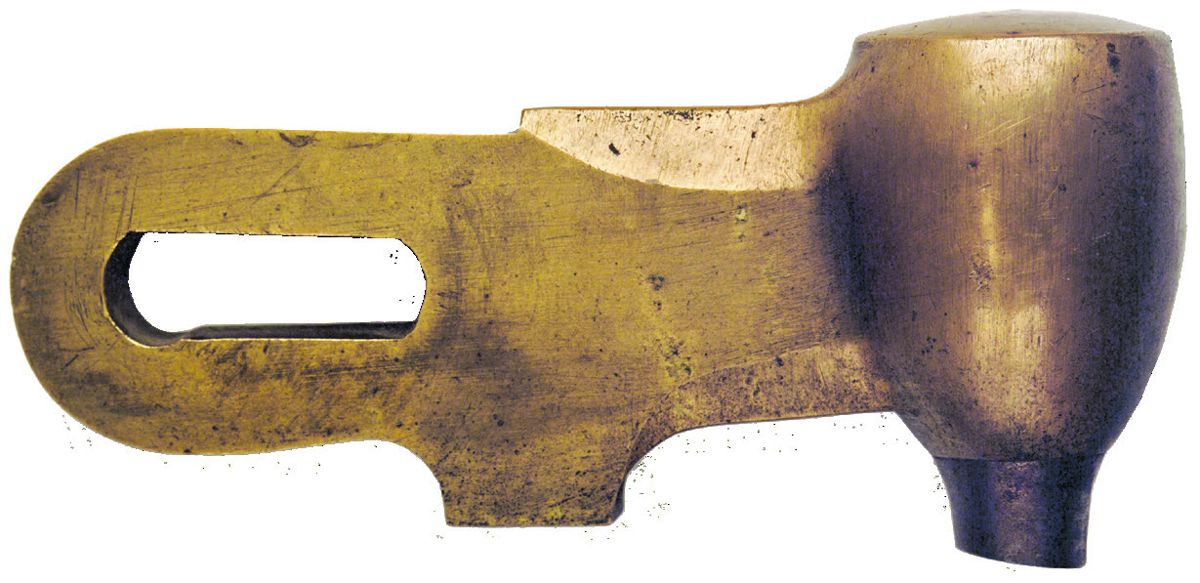
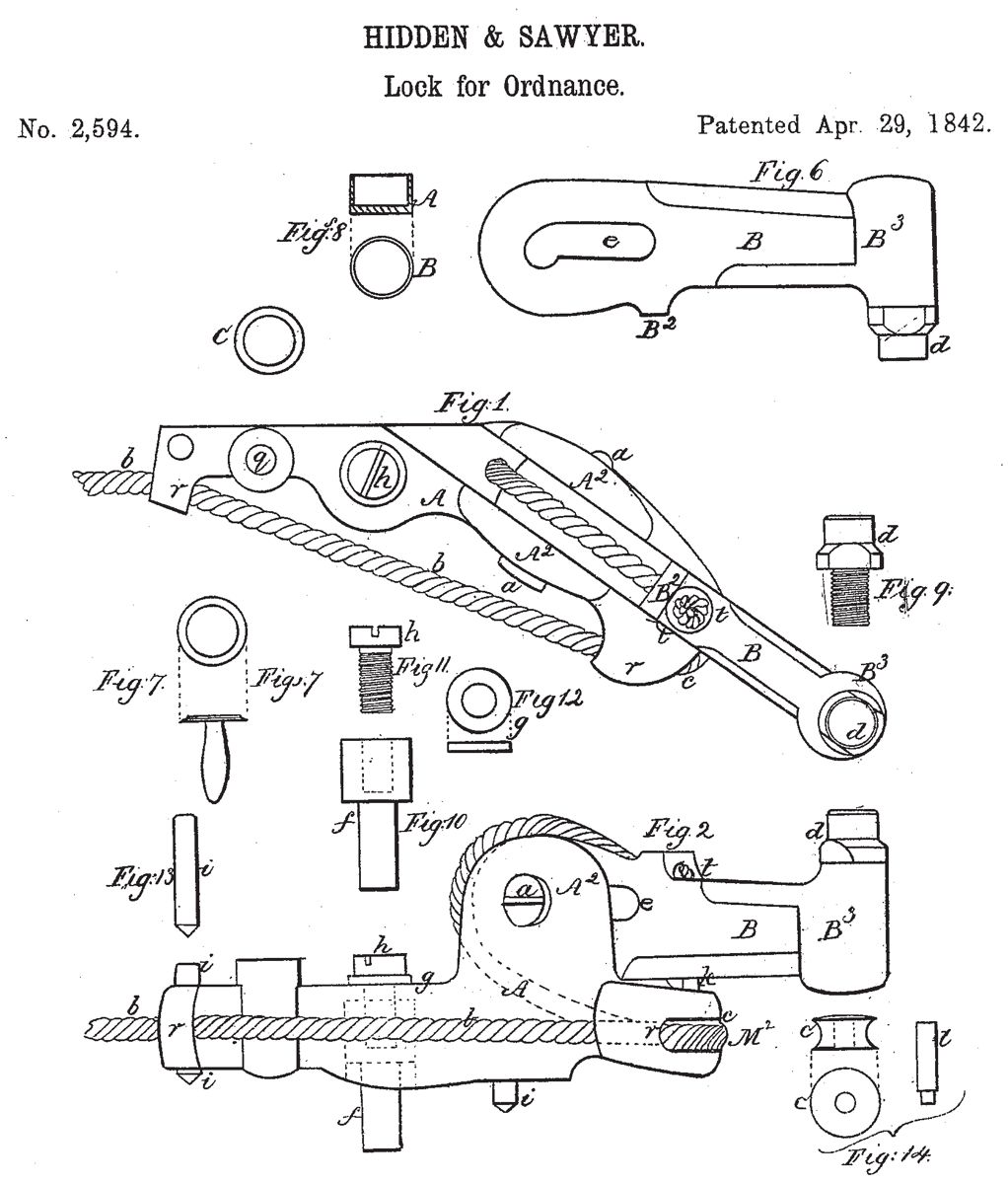
Commander: Far Side of the World set during the Napoleonicera. By the mid-1840s, naval artillery was produced with the newer percussion cap lock system, following the trend in military small arms. The percussion artillery cap-locks were fired with a lanyard. Adapting the percussion cap-lock to artillery was tricky due to the gas pressure coming up the vent after igniting the round. The surging pressurized gas from the vent blew back the hammer, damaged it and rendered the cannon at least temporarily out of commission. The solution was found with the so-called “Hidden” (designed by Enoch Hidden and patented Jan. 14, 1831) flint-lock ignition system. The Hidden caplock was attached to an oblong mass of metal near the vent called the lock piece. On shell guns, the hammer was fitted into a slit cut into a lug cast near the vent. The Hidden percussion caplock was also used with the Parrott and other rifled ordnance.
To fire the piece, a percussion primer in the shape of a 2 ½-inch-long quill tube topped with a wafer was first inserted in the vent. Then the lanyard was steadily and quickly pulled, rotating the hammer on its bolt until it was brought down on the vent setting off the percussion primer. Continued pull on the lanyard drew the hammer clear of the vent avoiding the erosion caused by gasses rushing from the vent. To obtain this action, an inch-long slot was cut at the rear of the hammer. In contrast to the hand held weapons, no springs were included in the Hidden mechanism. The percussion caplock artillery was somewhat superseded in the late 1850s by lower cost friction primers. The friction primers fit into the vent, much like the older powder tubes and were fired with a lanyard, like the lock type artillery. The friction primer consists of a brass tube, open at one end. At the closed end, a small hole of about the same diameter of the tube is drilled to one side, and short length of similar tubing is inserted and soldered into place. Opposite this short length of tubing is a hole to receive the priming wire, a length of brass wire with a flattened and serrated end. The short tube is lined with a friction powder similar in composition to the head of a friction match. The priming wire is inserted through the head of the long tube and into the short tube, which is then crimped to hold the end of the serrated wire in place. The long end of the priming wire is twisted into a loop. The head of the primer is then sealed and, when dry, the main body of the primer (the longer tube) is filled with fine musket powder and the open end sealed with wax. The resulting product is effectively waterproof, which is one of the big advantages the friction primer had over the linstock. In use, the primer is simply placed in the vent hole of the cannon, with the lanyard hooked to the loop of wire. When the lanyard is pulled, the serrated end of the priming wire ignites the friction composition. This fire ignites the musket powder in the body of the primer, which flashes through the vent and sets off the main charge. The chain reaction ignition is nearly immediate. The wire being quickly jerked through the fulminate-of-mercury compound is the reason this type of cannonprimer is called a “friction primer.” To make the wire capable of creating the necessary friction, the final ½ inch of the wire was “roughened” with a knife-blade or a file. If the wire were smooth it would not create the necessary amount of friction to ignite the compound. Wire on a few original friction primers from one arsenal was closely inspected and found to have two tightly wound circular twists, and the total length when straightened-out measured about one and one half inches. However, friction primers from other arsenals appear to have a longer wire or more twists in the wire. Was this intentional? Other friction primers identified as Civil War-era were made from copper wire instead of brass. Despite occasional defects, friction primers were the most reliable and most common method of artillery ignition during the U.S. Civil War-era. Tragedies were not unknown at the time and not all the friction primers made by Confederate arsenals were duds; in fact, far from it. According the Richmond Whig newspaper, in mid-March 1863, a young woman employed at the Brown’s Island laboratory building in Richmond was making friction primers on a perforated board and decided that it would be faster to remove all the primers at once by knocking the boards together. The ensuing explosion blew the roof off and knocked down the walls of the laboratory building resulting in a temporary shutdown of the Richmond Arsenal. From this we know some C.S. friction primers were not completely defective. Craig L. Barry was born in Charlottesville, Va. He holds his BA and Masters degrees from the University of North Carolina (Charlotte). Craig served The Watchdog Civil War Quarterly as Associate Editor and Editor from 2003–2017. The Watchdog published books and columns on 19th-century material and donated all funds from publications to battlefield preservation. He is the author of several books including The Civil War Musket: A Handbook for Historical Accuracy (2006, 2011), The Unfinished Fight: Essays on Confederate Material Culture Vol. I and II (2012, 2013) and three books (soon to be four) in the Suppliers to the Confederacy series on English Arms & Accoutrements, Quartermaster stores and other European imports.