
“If Farragut had only been here…”
By Bruce S. Allardice and Wayne L. Wolf · Originally published August 2019 · pp. 6–7
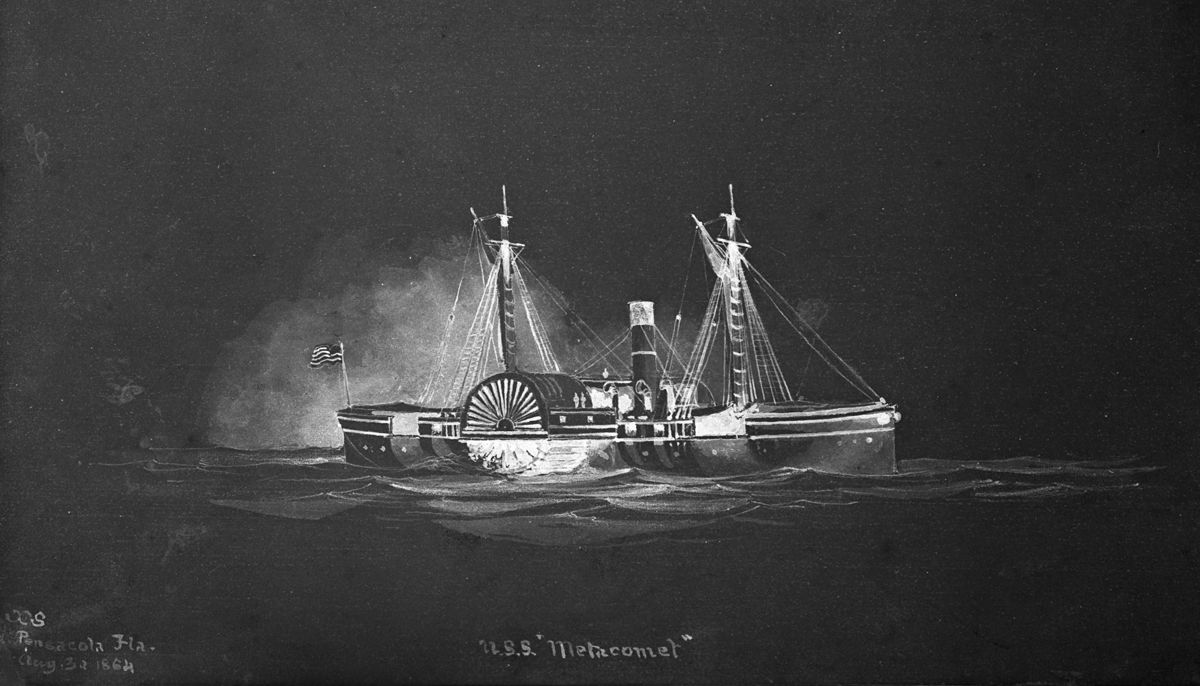
Blockade duty during the Civil war usually proved to be deadly dull… weeks of boredom, punctuated by moments of pure excitement. The following, recently discovered, letter by Engineer George P. Hunt details some exciting times during the naval blockade of Mobile, Ala. He is critical of Captain Thornton Jenkins,1 temporary commander of the blockading squadron, for being too passive, and wishes that Admiral Farragut, the regular commander, had been present. Hunt suspects that his ship, the Metacomet, is stationed in the ship channel where blockade runners never run, because the commander has the ship’s captain on his “Black List.” He notes that the boredom of patrol duty could be enlivened by a boat race. During the Civil War, George P. Hunt (1837–1887) wrote numerous letters to his fiancé, Cordelia Eames (1833–1900).2 The English-born Hunt entered the U.S. Navy in July 1861 as 3rd Assistant Engineer. By 1880, he had risen to the rank of Chief Engineer, and was rated an officer of “marked ability.” Much of his wartime service was on the USS Metacomet, a sidewheel steamer built in 1863. The 1,173 ton warship carried 9 cannon. Posted to the West Gulf Squadron, it distinguished itself in the Battle of Mobile Bay.
George P. Hunt. (HistoricalShop.com)
U.S.S. “Metacomet” Off Mobile April 12/1864 Dear Miss Eames, Your two letters with a postscript from your father came to hand on the 25th Mar. Very pleased indeed I was to receive them. They came together with letters from home while we lay in the Miss. Sound, blockading Grant’s Pass. I had quite a large mail and ‘twas very acceptable. I can assure you [I] had been suffering from fit of the blues for several days. Turned into my bunk after dinner to try & sleep it off. When I awoke found my letters alongside of me. Thanks for the acct. of your Fair.3 Should have been very glad to have been there with you. You have done remarkably well in B[rooklyn] and I expect you will be quite proud. We are all in a regular growl since yesterday morning. What do you think? Two large steamers run in right under our nose & both escaped. One Clyde built steamer, the other American. The first a side wheel steamer, double smokestack, a little larger than the Cumberland.4 Running along shore got aground about 3/4 of a mile from the fort. Saw her at sunrise. We ran down to the flagship “Oneida,” asked permission to go up & shell her or try & get her off. The senior officer Capt. LeRoy5 would not allow us but ordered us back to our station & there we had to lay & see the Rebs bring along their steamers and barges about 11 A.M. & lighten her up after which she of course got in safe by noon. There were 11 vessels laying blockading here, “Itasca,” “Pinola,” “Oneida,” “Ossipee” and another laying away out to sea. The “Penguin” & “Albatross” & “Genesee” lay
Captain William E. Le Roy. (Wikimedia Commons)
nearer the shore in the Pelican Pass. “Conemaugh” in the Swash Channel. The most important port off here. We lay in the main Ship channel where nothing has ever been known to try to run out (because we are on the Black List) I believe. The “Pembina” & “Seminole” lay between us, if any of the vessels in the Pelican Pass or Swash Channel had had picket boats out or perhaps kept a better lookout they could have signaled & ten chances to one but they would have frightened him & drove him out to sea again & then we should have had a jolly good chase. However he escaped. We thought at least that the fleet, &c., would be better stationed to prevent such a thing occurring again, but at daylight this morning what should we see but a splendid American steamer, double smokestack, sidewheel, about 1800 to 2000 tons (The “Austin” of Havana)6 further had aground in the same channel, Swash Channel) about 1-1/2 miles from the fort. The flag officer would not allow us to do anything to prevent them coming with their steamers to tow her off. They tugged away until late in the afternoon when she got away safe. ‘Tis provoking to say the least of it. If Farragut had only been here we might have done something. There are over 40 steamers laying in Nassau intending to run the blockade. They may come for evidently but little is to be done to prevent them from “running in” there while we are so afraid of our vessels. To be sure some of us might get hurt, & as the Rebs may be wanting a few thousand more English rifles & a few more Whitworth or Brookes guns can and may yet be mounted on Fort Morgan to greet our ironclads whenever they make their advent here. Why I suppose
USS Metacomet.
Admiral David G. Farragut. (Library of Congress) the safest thing for us perhaps is to let them alone. Admiral Farragut is at New Orleans now. Capt. Jenkins of the Hartford is Comndg. this Division. He is at Pensacola, but expected down shortly. We were there for coal last week. Left Sunday morn at 10 o’clock, & had a chase with the fastest vessel of this squadron, the “Eugenie.”7 The mail boat she had 6 miles the start on us. I was on watch from 8 to 12M. & was just in my element. We gained upon her handsomely the first hour. By that time I had everything in good trim for a race, as I did not know she was bound our way until after that start. 11 A.M. Capt. & all hands on deck getting excited. He sent me a bottle of sherry down into the engine room & told me if I passed her he would give me another. I told him I should give this to the firemen. No says he, I will send them a lunch which he did in the shape of 12 bottles of all with crackers & cheese. We gained nearly 3 miles upon her the next hour to quarters. Capt. would have me keep by the engine until we got to
Map of entrances to Mobile Bay, showing Swash and Main Ship Channels. Mobile as we were both going to the flag ship & he wished to get there first. We went along bravely. Arrived at the flagship 1-1/4 to 1-1/2 ahead of their crack steamer. We came in making 14 knots. The flag officer thought we came in at a fearful rate. Our capt. told him we were only making 14 knots. We made the capt. of the Eugenie so angry that today, instead of bringing our mails alongside as he usually does he left them aboard the 0[neida]. So if we want them we may fetch them. Well, I suppose you think the above is dry & uninteresting. If so excuse me for troubling you with it. But when they stick a vessel like this that can beat their crack steamer nearly 8 miles in a 4 hour chase, into the worst station there is off here it vexes a fellow & besides that when there is a chance of a fight & doing some good either directly or indirectly to be obliged to sit still with our hands tied fast is worse. Most likely more steamers will be along here as the moon goes down at 1 A.M. & after that they have plenty of time to run in. The “Admiral” is expected soon bound north. Shall finish this & forward by her. I spent a pleasant time in Key
West two last evenings, & also in New Orleans. Met several of my friends on the other vessels. Have no intimate acquaintances ashore there. Went to the theatres there in the evening generally with some of my chums. There was quite a lively time there, a grand review at Carrollton, after which Gen. Banks & Staff attended the Academy of Music. I generally took my meals ashore (but we are all obliged to sleep on board) as I was then in a mess with the four Vol. Assts. & we had nothing to eat scarce. Have lost 13 lbs. since leaving N.Y. They are too fond of the almighty dollar. Expect to live upon about 10 Dollars each per month. I could not & would not endure it when better stores could be obtained. I wrote a letter to the Fleet Engineer, New Orleans, stating how I was situated & asking for a change. Should have got it. Have no doubt. Only the Capt. & Chief became aware of what I was trying for (The Fleet Engineer is one of the oldest Engineers in the Navy & was President of the Board of Examiners when I entered the service). In the Board Room there is a mess composed of the Chief Eng., Lieut. Commdg., Paymaster, Surgeon, Sailing Master & Three Engineers. So somehow or other through the influence of the Capt. & Chief I was invited to join their mess. Being on good terms with them all & especially the Capt. & now that I have got everything in good order I concluded to retain my letter & join their mess. Since then I have been very comfortable & shall be I believe. I have received the illustrated paper you sent me & also the Tribune from your father. Thanks. Am looking for a letter from you when we get our mails tomorrow. We have had some very cold weather off Mobile. Yesterday was very warm. The first warm day we have had. Temp 89 to 94 degrees. You think I tire of reading long letters. If I were to tell you how many times I read my last budget you would not think so. You ought to be sent on the blockade for saying so. Adios. George P. Hunt 1. 2.
Endnotes:
Thornton A. Jenkins (1811-93). Other letters of Hunt were published in Civil War News, May 2019. A reference to the “Brooklyn and Long Island Fair, in aid of the Sanitary Commission,” held Feb. 22nd. Probably the Scottish (Clyde) built blockade runner Denbigh,
which so regularly ran the Mobile blockade to Havana, Cuba, that it was nicknamed “the packet.” The Americanbuilt ship was probably the Alice, another famously successful blockade runner. See Wise, Lifeline of the Confederacy, which notes that these two ships arrived in Mobile in April. William E. Le Roy (1814–88). The “Austin” was the former name of the blockade runner Donegal. She was Americanbuilt, as Hunt observes. Two months later, Hunt’s Metacomet captured the Donegal. See ORN vol. 21, p. 334. The Eugenie was a former blockade runner that served the Union navy as a supply ship. It was a compliment to Hunt that the Metacomet’s engines could overtake a ship known for its speed.
Bruce S. Allardice is Professor of History at South Suburban College in Illinois. He is a past president of the Civil War Round Table of Chicago. Wayne L. Wolf is past president of the Lincoln-Davis Civil War Roundtable.