
Hollywood History
By Stephen Davis · Originally published August 2019 · pp. 18–19
Disney’s movie The Great Locomotive Chase (1956) was based on the Andrews railroad raid in Georgia in 1862. John Ford’s The Horse Soldiers (1959) was based on Benjamin Grierson’s cavalry raid in 1863, just as Alvarez Kelly (1966) related to Wade Hampton’s Beefsteak Raid in 1864. We could go on about how filmmakers either recreate Civil War history, or reimagine it. Another instance of this is The Raid (1954) directed by Hugo Fregonese, based on the actual raid on St. Albans, Vt., led by Lt. Bennett H. Young on Oct. 19, 1864. In this one, Van Heflin stars as a Confederate officer, Maj. Neal Benton. He leads some twenty Southern cavalrymen out of Canada in a raid on St. Albans, a town fifteen miles south of the Canadian border. The movie gets the raid’s date correctly, but spins chronology by having Sherman marching across Georgia at the time; Sherman did not leave Atlanta for the sea until Nov. 16, 1864.
The Story of the Confederate Northern Campaign Confederate Operations in Canada and the North by Oscar A. Kinchen. (Author’s collection)
General Bennett H. Young Confederate Raider and a Man of Many Adventures by Oscar A. Kinchen, Ph.D. (Author’s collection)
for Northern raids. Traveling to Richmond, Young secured a meeting with Seddon and won approval. The lieutenant was instructed to scout out towns along the U.S.-Canada border suitable for raiding with some twenty men who had escaped Northern prisons and were in Canada. Secretary Seddon authorized Young’s men to loot and burn banks, stores, factories, and railroad stations. Seddon added particulars in a letter of August 20, 1864. “It is but right,” he wrote, “that the people of New
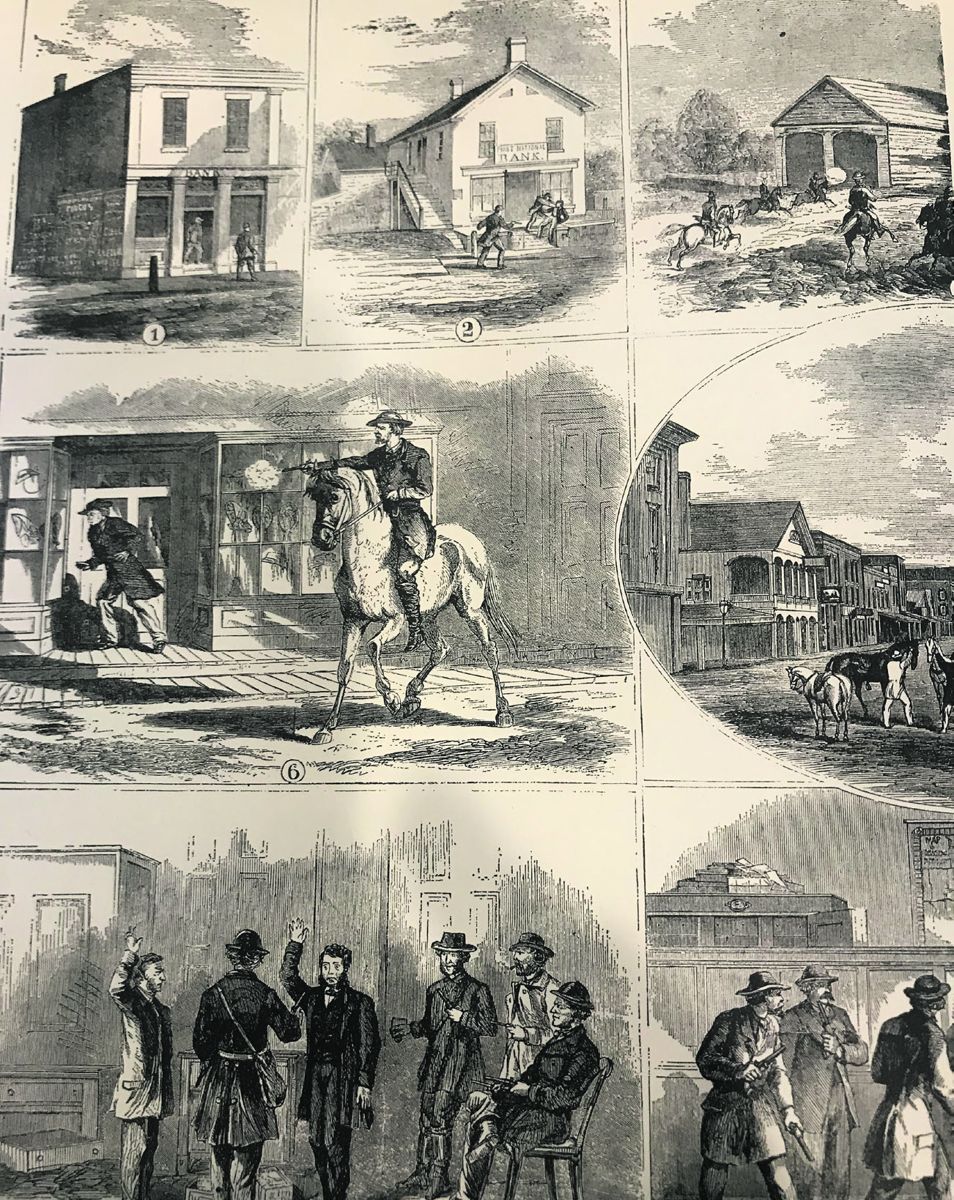
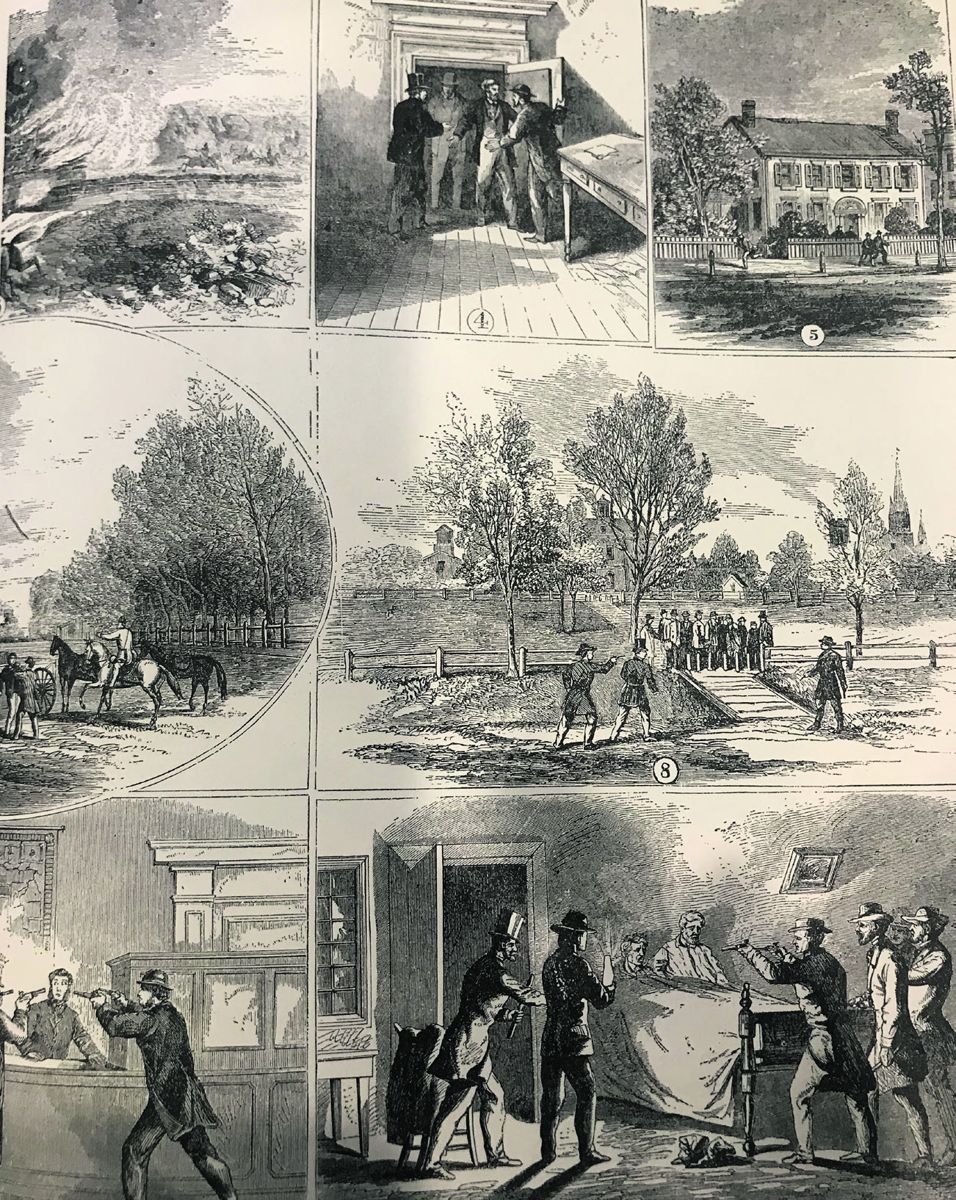
England and Vermont especially, some of whose officers and troops have been foremost in these excesses and whose people have approved of their course, should have brought to them some of the horrors of such warfare.” The secretary added a hint as to his preferred targets; “you will visit Burlington and St. Albans.” Confederate authorities envisioned a series of such raids; similarly, in the movie Major Benton tells his men that after St. Albans there would be more such forays. Lieutenant Young and twenty men slipped into St. Albans in small groups and found rooms in hotels on the night of October 18. Midafternoon of Oct. 19, they gathered in the street, took off their coats to show their Confederate uniforms and announced they were taking possession of the town in the name of the Confederate States. They ordered the citizens in the streets into the central square. While some men robbed banks and rounded up horses, others set fires with glass jars of Greek fire. All of this is depicted in the movie. The Confederates, in brand-new spiffy uniforms, surprise the townspeople, rob their banks, and burn a lot of buildings before riding off. Federal cavalry arrive to chase them, but Benton’s troopers burn a bridge and foil the pursuit. It’s actually a pretty nifty movie. Among Major Benton’s troops are Lee Marvin, who later won a Best Actor Oscar as the drunken Kid Shelleen in Cat Ballou [1965], and Peter Graves, Jim Phelps in TV’s “Mission Impossible.” It’s Graves/Captain Dwyer who tells Van Heflin that the men have scooped up $90,000; actually, it was closer to $20,000. The film’s love interest, Katy Bishop, is a Union officer’s widow played by Anne Bancroft; think Mrs. Robinson in
The Graduate. In the actual event, some residents opened fire from windows; three Confederates were wounded. After about an hour Young and his band mounted up and rode off. In The Raid, a lone Federal portrayed by Richard Boone, Paladin in the “Have Gun, Will Travel” TV drama of 1957–63, fires on the Rebels, wounding a few. Back to history. The few Federal soldiers in town gave chase to Young and his band. Eight miles off the Confederates burned a bridge to halt the pursuers. Yup, this too is in the movie, when Major Neal looks back on the Yankees stalled on the other side of the river. In the actual event, the Southerners reached Canada about 9 p.m., changed back into civilian clothing and dispersed. Eventually Young and five of his men were caught and arrested in Quebec. U.S. authorities requested their extradition, but the Canadian government refused. They were ultimately released. At the end of the movie, Katy consoles her son Larry, played by Tommy Rettig, of TV’s “Lassie,” as she remembers what Neal, who lost his family and home to Sherman’s troops, once told her: if Southerners came and burned St. Albans, would you
Van Heflin The point in the film, though, is correct: just as Major Benton’s troopers seethe to exact revenge on the Vermont town for the depredations of Sherman’s Yankees against Southerners and their property, so too did Lieutenant Young seek retaliation for the excesses being committed by Federals in 1864. He explained his ideas to Clement Clay and Jacob Thompson. Clay had been tapped by the Confederate government to slip into Canada and from there try to foment peace sentiment among disaffected Northerners. President Davis himself requisitioned $1 million for the operation out of a “secret service” fund administered by Secretary of State Judah Benjamin to accomplish this task. After hearing Young, Clay wrote Secretary of War James A. Seddon endorsing Young’s plan understand? A slight smile on her face suggests that she does. Sources •
•
•
•
•
•
John M. Cassidy, Civil War Cinema: A Pictorial History of Hollywood and the War Between the States (Missoula, MT, 1986). Ch. 7, “Hollywood and History: Factual Events on Film” (pp. 113-32, with focus on The Raid, The Great Locomotive Chase, The Horse Soldiers and Alvarez Kelly). Robert H. Fowler, “Raid on St. Albans, Vt.” In Patricia L. Faust, ed., The Historical Times Illustrated Encyclopedia of the Civil War (New York, 1986), p. 651. John W. Headley, “The Confederates Raid Vermont” in Philip Van Doren Stern, Secret Missions of the Civil War (New York, 1959). Pp. 242-46. Oscar A. Kinchen, Confederate Operations in Canada and the North: A Little-Known Phase of the American Civil War. North Quincy, MA, 1970. Oscar A. Kinchen, General Bennett H. Young: Confederate Raider and a Man of Many Adventures. West Hanover, MA, 1981. Roy Kinnard, The Blue & Gray on the Silver Screen: More Than Eighty Years of Civil War Movies. Secaucus, NJ, 1996. Pp. 132-35 (including cast of major characters in The Raid).
Steve Davis of Cumming, Ga., has long been interested in Hollywood’s depiction of American wars. Some years ago he taught a course at Atlanta’s Oglethorpe University on “Studying America’s 20th Century Wars Through Film.” Text was Frank J. Wetta and Stephen J. Culley, Celluloid Wars: A Guide to Film and the American Experience of War (1992). Featured films, which we viewed in their entirety on Saturday mornings, were All Quiet on the Western Front (1930); Sahara (1943); Paths of Glory (1957); Pork Chop Hill (1953); Patton (1970); and Go Tell the Spartans (1978—when offered a drink, Burt Lancaster answers, “Always”).