
Henry G. Heidebrink
By Charles H. Bogart · Originally published August 2019 · p. 9
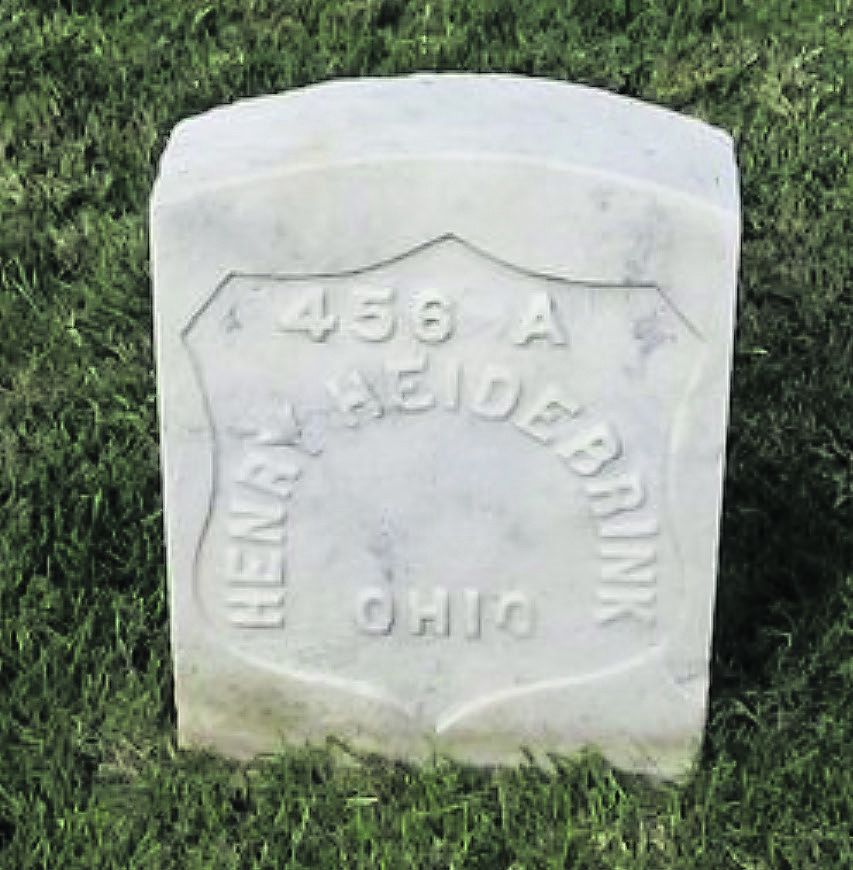
Recently Kent Masterson Brown, President of the Lexington, Ky., Civil War Roundtable challenged the membership to write an article about their Civil War relative for posting on the roundtable’s website. I decided to write about my great grandfather Henry Heidebrink, I had heard from my grandmother Nobbe, when a child, about her father who served in the 108th Ohio and died at the Soldier Home in Dayton, Ohio. With the help of my computer I set out to write the story of Private Henry Heidebrink. To my surprise the story Grandma Nobbe told of her father turned out to be somewhat different from what I found on the internet. A search on the internet confirmed that Henry Heidebrink had been born in Prussia circa 1841 and came to the United States with his parents circa 1850. He and his parents settled in the Over-the-Rhine area of Cincinnati, Ohio, where Henry was employed as a cigarmaker. To my surprise, I found that on June 26, 1861, Henry Heidebrink joined Company K, 13th Ohio Infantry Regiment, as a musician. The 13th Ohio Infantry was first raised as a three-month regiment; at the end of this service, it was reorganized as a three-year regiment. It mustered into the Federal Army at Camp Dennison, Ohio, on June 22, 1861, under Lt.
Colonel William Sooy Smith. During the period June 1861 to April 1862, the 13th Ohio saw duty in a number of different locations. In June 1861, the regiment left Camp Dennison and traveled by steamboat to Parkersburg, (West) Virginia. The regiment participated in the Western Virginia Campaign of July 6-17, 1861. The 13th Ohio then garrisoned Sutton, Va., during August 1861. The regiment next fought in the Battle of Carnifex Ferry, Sept. 10, 1861, where Henry Heidebrink was wounded in the shoulder. The 13th Ohio suffered in this engagement 1 KIA, 3 DOW, 16 WIA, and 2 MIA. Grandma told me her father had been wounded in North Carolina at the surrender of the Confederate Army to General Sherman. After the Battle of Carnifex Ferry, the 13th Ohio took part in operations in the Kanawha Valley and New River Region until early November 1861. From November 12-16, 1861, the 13th Ohio participated in the failed campaign to capture Confederate troops serving with General John B. Floyd. After this failed operation, the 13th Ohio travelled by steamboat down the Ohio River to Jeffersonville, Ind. On December 11, the Thirteenth crossed the Ohio River and moved south to guard the Louisville & Nashville Railroad between Elizabethtown and Bowling Green, Ky. In
February 1862, the 13th Ohio marched to Nashville, Tenn., where it took up garrison duties. While on garrison duty at Nashville Henry Heidebrink was medically discharged. On January 1, 1864, Henry Heidebrink, having recovered from his wound, signed on to become an infantryman in the 108th Ohio Infantry Regiment. The 108th was a Cincinnati regiment organized in August 1862 at Camp Dennison for threeyear service. It was commanded by Lt. Col. George T. Limberg. In November 1863, to bring the 108th back up to strength, a recruiting party was sent to Cincinnati. Henry Heidebrink was one of the men recruited, joining the regiment on Jan. 1, 1864. The new recruits were sent to Camp Dennison where they were organized into Companies I and K. These two companies were mustered into the Army on March 1, 1864. Henry Heidebrink was now a private in Company K, 108th Ohio. I would suspect that the bounty being paid to men joining the Army at this time had something to do with Henry re-enlisting. In January 1864, the 108th Ohio was assigned to the 2nd Brigade, 2nd Division, XIV Corps. It would serve with XIV Corps until the end of the war. Companies I and K joined the 108th in late April at Chattanooga, Tenn. The 108th took part in Sherman’s advance on Atlanta, Ga., and saw action at Tunnel Hill, Rocky Face Ridge, Buzzard’s Roost Gap, Resaca, the capture of Rome, occupation of Dallas, New Hope Church, and the Battle of Kennesaw Mountain. Thereafter, from July until November 1864, the 108th guarded the Western & Atlantic Railroad between Kennesaw and Atlanta. On November 1, 1864, the 108th Ohio was relieved of guard duty. On November 14th, the regiment moved out from Atlanta as part of Sherman’s March to the Sea. Savannah, Ga., was taken by Sherman’s troops on Dec. 21, 1864. The 108th, after refitting at Savannah, took part in Sherman’s advance through the Carolinas, from January to April 1865. In North Carolina, the 108th participated in the battles of Averasboro, and Bentonville, (1 KIA and 4 WIA). They then occupied Goldsboro, March 24, 1865, and Raleigh, April 14, 1865. The regiment was present at the surrender of General Joseph E. Johnston’s Army of Tennessee at Bennett’s House on April 26, 1865.
The 108th then marched to Washington, D.C., and on May 24, 1865, participated in the Grand Review of the Armies. The 108th Ohio, less Companies I and K, mustered out at Washington, D.C., on June 9, 1865. Companies I and K were ordered to travel by train to Louisville, Ky., for occupation duty. They mustered out on July 22, 1865. Henry Heidebrink, upon being discharged from Company K at Louisville, returned to the Cincinnati, where he married Catherine Moemkel. Their daughter Rose Heidebrink (grandma Nobbe) was born in 1881; she married Henry Nobbe. The Nobbe’s, in turn, had a daughter, Ruth E. Nobbe, who married Howard C. Bogart, who, in turn, had a son, me Charles H. Bogart. During the 1870s and early 1880s, Henry Heidebrink was in constant trouble with the Cincinnati Police Department due to alcohol related incidents. He was arrested on numerous occasions for disturbing the peace, public drunkenness, and assaulting his wife. In 1893, he filed for divorce claiming Catherine had been unfaithful. She, in denying this allegation, stated that Henry had been placed in the workhouse seven times to recover from drunkenness after assaulting her. The divorce proceedings were dropped either because, as a Catholic, Catherine was opposed to divorce, or she wanted to insure she would collect Henry’s pension. Catherine supported her family by working in a Cincinnati clothing factory. On August 30, 1884, Henry Heidebrink entered the National Home for Disabled Volunteer Soldiers at Dayton. Henry left the Home in 1891, returned in 1906, left in 1907, and returned again later that year. During the period 1884 to 1911, Henry Heidebrink was living in Dayton, and Catherine Heidebrink in Cincinnati. In 1911, Henry Heidebrink moved from the Home for Disabled Volunteer Soldiers at Dayton to the Home for Disabled Volunteer Soldiers in Hampton, Va. This move was apparently to put some distance between him and his wife. He died at Hampton on Aug. 25, 1923, and was buried in the Hampton Veterans Cemetery. His wife Catherine preceded him, dying in Cincinnati on July 23, 1920. The tale of Henry Heidebrink as told by the internet is very different from what I remember Grandma Nobbe telling me about her childhood. Glad I did the research but wish Grandma Nobbe was still here so I could ask her about her childhood with her parents.