
This And That
Going Paperless
By Gould Hagler · Originally published August 2019 · pp. 26–27

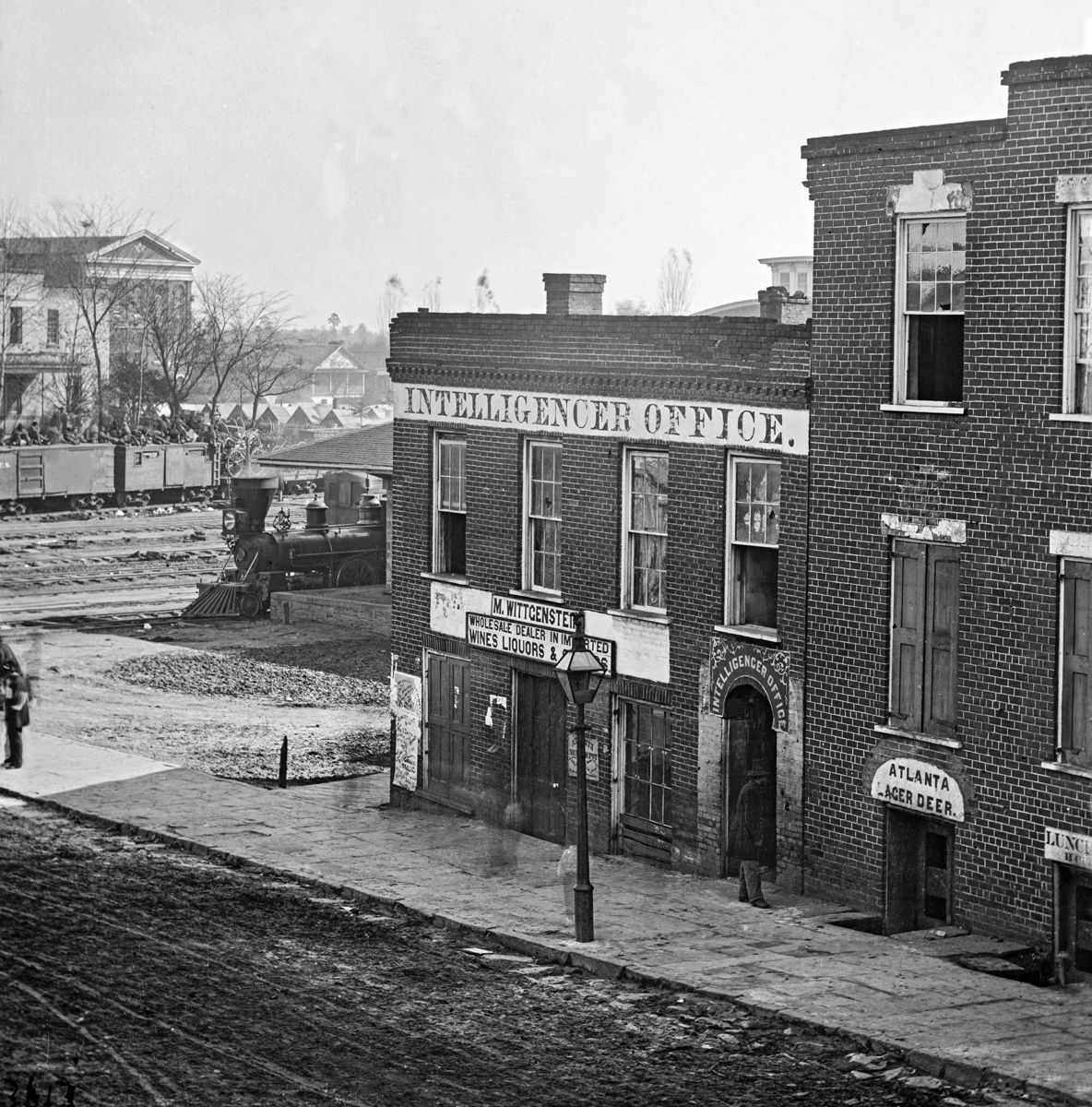
An errant tee shot from the Atlanta Country Club’s 13th hole will transport the ball a century and a half back in time. The ball will fly out of bounds, out of the prosperous suburban neighborhood, and onto a wooded hill overlooking ruined stone buildings on Sope Creek. These ruins were once the Marietta Paper Mill, one of the few facilities in the South manufacturing paper, a product in short supply from the outset of the Civil War. The mill’s destruction by Union forces on July 5, 1864, contributed to the already severe problems that plagued Confederate newspapers. Lack of paper wasn’t the journalists’ only headache, but it was a major one, and one that hampered their operations from the start of the conflict to its finish. Most of the paper used by Southern newspapers and, of course, by other users of the product, including musket cartridges. was imported from the North or Europe. The interruption of these supplies quickly caused shortages, price increases, and often a diminution in quality.
Ruins of Marietta Paper Mill.
A review of newspaper articles published during the war shows how owners struggled to continue their operations in the face of these difficulties. On June 12, 1861, the Bellville Countryman, a Texas weekly, published “but half a sheet,” because of the scarcity of paper and warned readers to expect more of the same and worse. “Unless the blockade is raised before long many newspapers will have to suspend for want of the article….” Four months later the Athens (Ga.) Southern Watchman cut its size to a half sheet and told readers “We were obliged to yield.” The same edition reported that, “One third of the papers in the Confederate States have been entirely discontinued; while of the remainder, more than one half are published either on a half sheet or have been reduced in size.” In November the Austin State Gazette reported that only two newspapers in its “exchange” were still printed on broad sheet. That same month the Charleston Mercury reduced its size. In March 1862 the Washington
(Ark.) Telegraph announced that it too was shrinking as it reminded readers “the Paper Mill at Nashville is in the hands of the enemy [and] the blockade still exists.” Even as they conserved paper by printing on half sheets, and by using smaller type, shrinking margins, and devoting less space to ads, newspapermen still scrambled to get the paper they needed—and they suffered sticker shock when they did find some for sale. On April 22, 1862, the Southern Watchman skipped an issue; there was no paper to print it on. The following week the Watchman announced that an ample supply had arrived, “but oh! what a price – $7.50 per ream,” double the price paid a year earlier. Worse still, the Watchman had a collections problem. How can a publisher pay for his supplies when some customers “refuse or fail to pay”? As one would expect, the newspapers had to raise their own prices. The Augusta (Ga.) Daily Chronicle and Sentinel went up to $8 per year in July 1861. The paper’s proprietor and the owner of the Augusta Constitutionalist made a joint announcement about their agreed-upon terms, which included cash on the barrel head. (It seems Messrs. Jones and Gardner were not hampered by anti-trust laws.) The publishers of two Savannah newspapers made a similar joint announcement the following February. In April 1862, the Charleston Mercury carried news about the price of four Richmond papers, which ranged from $8 to $12 per year. The Dallas Herald doubled its rates in early 1863 to $5 per year. Articles in the Athens (Ga.) Southern Banner and the Columbus (Ga.) Enquirer provide lessons in newspaper economics, describing the cost of various supplies and services. Even with higher subscription rates they were losing money with every copy they sold. Of course, the subscribers were in a pinch too. In July 1861, even before the first major battle of the war, the Bellville Countryman told its Texas readers that it was willing to barter. Running a newspaper “requires money,” the editor wrote, “or something that will sustain life. Country publishers can use much of the produce of the farm and workshop in lieu of money.” The following October the Athens Southern Watchman also invited cash-strapped readers to pay in “any kind of country produce – corn, wheat, flour, oats, rye, butter, hay, shucks, fodder, chickens, eggs – any thing that can be eaten or worn, or that will answer for fuel.” Mind you, this was in 1861, not 1865. The papers’ prices went up; their size went down; and their overall quality suffered. Brown paper was common. Other shortcuts produced bizarre results. In December 1862 the Natchez Daily Courier received an issue from one of its exchanges “printed on the white side of wallpaper.” The following March the
Richard McMurry holding replica of July 2, 1863, newspaper from Vicksburg, printed on wallpaper. This edition was set but not printed when the city fell. Finding the paper typeset and ready to go, some clever Yankee printers added an item announcing the Confederates’ surrender. (Gould Hagler) Mobile Register and Advertiser joked about receiving a paper from Louisiana that was beautifully illustrated “by masters – of the school of paperhangers.” Of course, the shortage was not limited to print paper, but to paper used for all the facets of the business. The Washington Telegraph didn’t report having to print on wallpaper, but in May 1862 advised that “We have used up all the supply of our editorial office, and invaded our stocks of law stationery. At length we have destroyed all our legal blanks by writing editorials on their backs, and now we use the yellow ruled leaves, we have from an old ledger.” And regular folks, too, not just journalists, had trouble getting the paper they needed. The Columbus Enquirer received a letter to the editor inked on “a leaf from an account book of a mercantile house…just one hundred years ago – 1762.” That reader was desperate to have his say. With supplies restricted and prices rising, entrepreneurs saw opportunities in the paper mill business. Some mills were already in operation, of course, like our facility adjacent to the 13th hole. Others were built during the war at Mobile, Atlanta, and Manchester, Ga. There were plans to build paper mills in Texas and Louisiana; it is unclear if these plans came to fruition. Sometimes new mills were just hoped for in newspaper editorials. In April 1863 the Natchez Daily Courier listed 20 paper mills operating in six Confederate states. No one will be surprised to learn that these businesses confronted challenges just as severe as those faced by their newspaper customers. They too had to battle for raw materials and deal with labor shortages, inflation, routine perils like fires, and un-routine perils like invading armies. One mill refugeed south when an enterprising Georgian bought mill machinery in Tennessee in 1863, “just before a raid of the enemy swept through the region in which it was located.” Newspapers became advocates of recycling. “Rags! Rags! Rags!” blared numerous headlines above articles urging people to save their rags, assuring them that the paper mills were paying good prices for the material. By January 1863 the price of rags had risen 800%, according to the Charleston Mercury, and not just cloth rags were sought. The papers begged readers to save ashes, scraps of rope and thread, refuse cotton, flax, hemp, corn husks— anything that could be pulped and processed into paper. Some mills limited sales to customers who helped supply the desperately-needed raw materials; consequently, newspapers did more than advocate. Bring your rags to us, they pleaded, and we will pay top dollar. “10,000 Pounds Of Rags Wanted at This Office, For Which the Highest Market Price Will be Paid!!” shouted the Columbus Enquirer on Oct. 13, 1863. With the ashes, corn husks, and whatnot, the quality suffered. The Atlanta Southern Confederacy complained in early 1863 that much of the paper bought from the Marietta mill was unsatisfactory and would not run through the press. For good paper or bad, prices continued to rise. A ream of paper cost the Athens Southern Watchman $15 in May 1863, up from the pre-war price of $3.50. In Texas things were much worse. In August the San Antonio Herald and the Galveston Weekly News paid $100 per ream, according to the latter publication on August 26. Eight months later the Austin State Gazette said “the same amount of paper that formerly cost us $3.50 in specie, now costs us $360 in Confederate money.” This alarming fact demonstrates the collapse of the currency’s value as much as it does the increase in the price of paper. By this point in the war some papers were demanding payment in specie, as were the paper mills. There were some accusatory editorials with headlines like “Profits of Extortion,” but these were rare. It seems that the newsmen understood that their suppliers were as stressed, strained, stretched, and starved as they were. There were also complaints that the blockade runners did not allot sufficient space to this vital cargo. The government too was shortsighted, say the editors, when it did not exempt newspaper hands and paper mill workers from the draft. The agent for the Marietta Paper Mill explained in a letter to the Atlanta Intelligencer (Sept. 10, 1863) that he would be able to supply no more paper until the government detailed workers to man his machines. “I do not exactly comprehend how it is that Government agents insist upon the absolute necessity for the Government to have paper,” he wrote, “and yet refuse us our hands.” More and more papers suspended operations as the economy worsened with the war, and surely many a newspaperman went a-soldiering. The paperless editor of the Dallas Herald signed up early in 1862. Wartime newspapers contain scores of items on the shuttering of other papers. As the Columbus Enquirer put it, “We can but [express] our deep grief at the early loss of our boon companions, and pray that our fate be not too soon like theirs.” The story of Southern newspapermen’s struggles during the Civil War is a tale of woe and hardship, but it is also a tale of persistence and resourcefulness. The publishers improvised and by one means or another made do for as long as they could. The journalists also maintained their sense of humor: The Mobile paper in the spring of 1863 relayed a jape from the wags at the Winchester Bulletin, who advised “people in that region to write letters on the backs of one dollar bills, for the sake of economy.” Who said the money was worthless? When forced to suspend, they bounced back as they could. The Dallas Herald ran an item in September 1863 welcoming the Marshall Republican back into the brotherhood after a forced hiatus of several months. The Republican was again knocked down and again rose from the mat a year later, as the Galveston paper happily reported. As unlikely as it seems, two new papers were established in Texas late in the war: the Army and Navy Messenger in the fall of 1864, and another publication in 1865, less than two months before Appomattox. That required faith, but the founders had plenty of that. The other startup was the Texas Christian Herald, published by the Baptist State Convention. Sources: The newspaper accounts used for this article were compiled by Vicki Betts, a librarian at the University of Texas at Tyler. Betts, Vicki, “Paper Manufacturing and Paper Shortages in the South, 1861– 1865” (2016). Special Topics. Paper 18. http://hdl.handle.net/10950/790. Gould Hagler is a retired lobbyist living in Dunwoody, Ga. He is a past president of the Atlanta Civil War Round Table and the author of Georgia’s Confederate Monuments: In Honor of a Fallen Nation, published by Mercer University Press in 2014. Hagler speaks frequently on this topic and others related to different aspects of the Civil War and has been a regular contributor to CWN since 2016. He can be reached at [email protected].