
The Graphic War
Globe Tavern or Weldon Railroad, August 1864
By Salvatore Cilella · Originally published August 2019 · pp. 20–21
This column highlights prints from the Civil War, discusses their meaning, and most importantly, details what the print maker or artist was trying to achieve. Like a few Civil War battles, the Battle of Weldon Railroad, Globe Tavern, or the Battle of Six Mile House, carried more than one name. The locus of the fight, over three steaming days in August 1864, occurred three miles south of Petersburg as Grant settled into the city’s siege. The rail line at that point connected Petersburg with Wilmington, N.C., and was vital to supplies for the besieged city. The Federal force, the V Corps led by Major General Gouvernor Warren, began destroying the tracks near Globe Station around 9 a.m., the morning of the Aug. 18. An attempt by Confederate General P. G. T. Beauregard’s three infantry brigades to dislodge Warren was not successful. The next day, Aug. 19, three Confederate brigades under Major General William Mahone, made impressive gains pushing the Federals away from their destruction of the rail line until the Federal IX Corps stopped them. Although the Union forces suffered nearly 3,000 casualties, they held their ground. The following day, Aug. 20, a Confederate war council planned a new offensive, which they tried to implement the next day, but the Federal troops had created a stronger counter defense snuffing out the rebels final attempt. Bufford’s of Boston produced the lithograph print of the battle. It was drawn by Richard Holland, who previously has never been identified. Holland was a resident of North Bridgewater, Mass., who enlisted in the 9th Mass. Light Artillery, which is prominently featured center right in the print’s main scene of the last day’s fighting. He stated his occupation as painter. Holland served the entire war and later became a member of the GAR post #13, (Fletcher
Webster) in Brockton, Mass. He died January 12, 1906.1 Holland’s lithograph featured the three days of battle, August 18, 19, and 21. The 18th and 19th are depicted in the upper left and right corners as inserts. The main act in the drama, August 21, shows several Federal batteries and the 16th Maine, repelling Brigadier General Johnson Hagood’s South Carolina brigade, which lost 50%
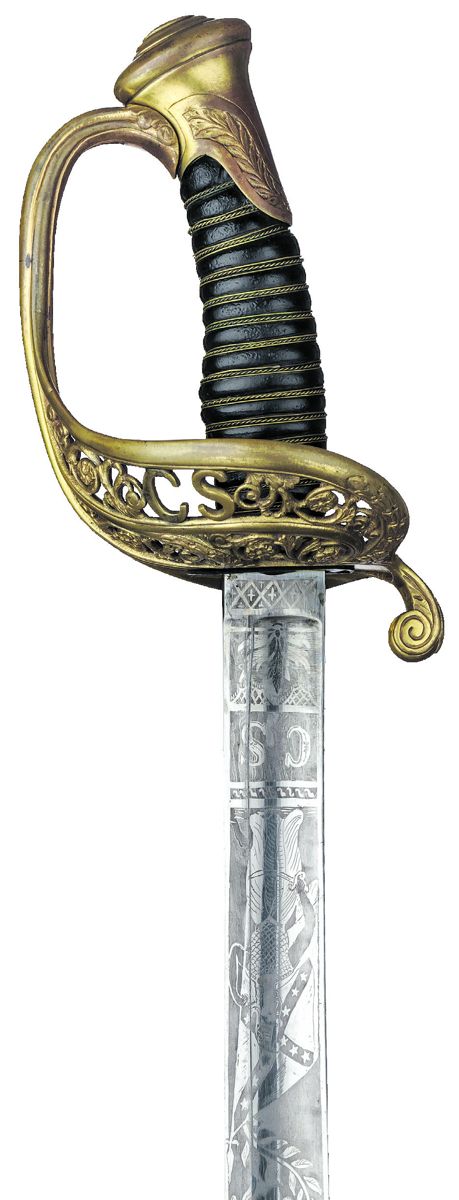
Etching on blade reads: PRESENTED TO MAJOR GENERAL WILLIAM MAHONE BY THE CITIZENS OF PETERSBURG VA IN APPRICIATION [sic] OF HIS SKILL ENERGY AND GALLANTRY IN DEFENCE [sic] OF THEIR CITY DURING THE CAMPAIGN OF 1864.
of its men that day. Other units identified in the title margin are the 5th NY, the 1st NY artillery, and one regular army battery. The main character in the drama, the rail line, cuts across the main image, showing the battle from the Federal prospective. The Federal line held, forcing Lee to off-load his supplies below Petersburg and ship them north to Richmond and Petersburg on wagons.
Major General William Mahone’s presentation sword. (Donald Tharpe collection, Jack Melton, photographer)
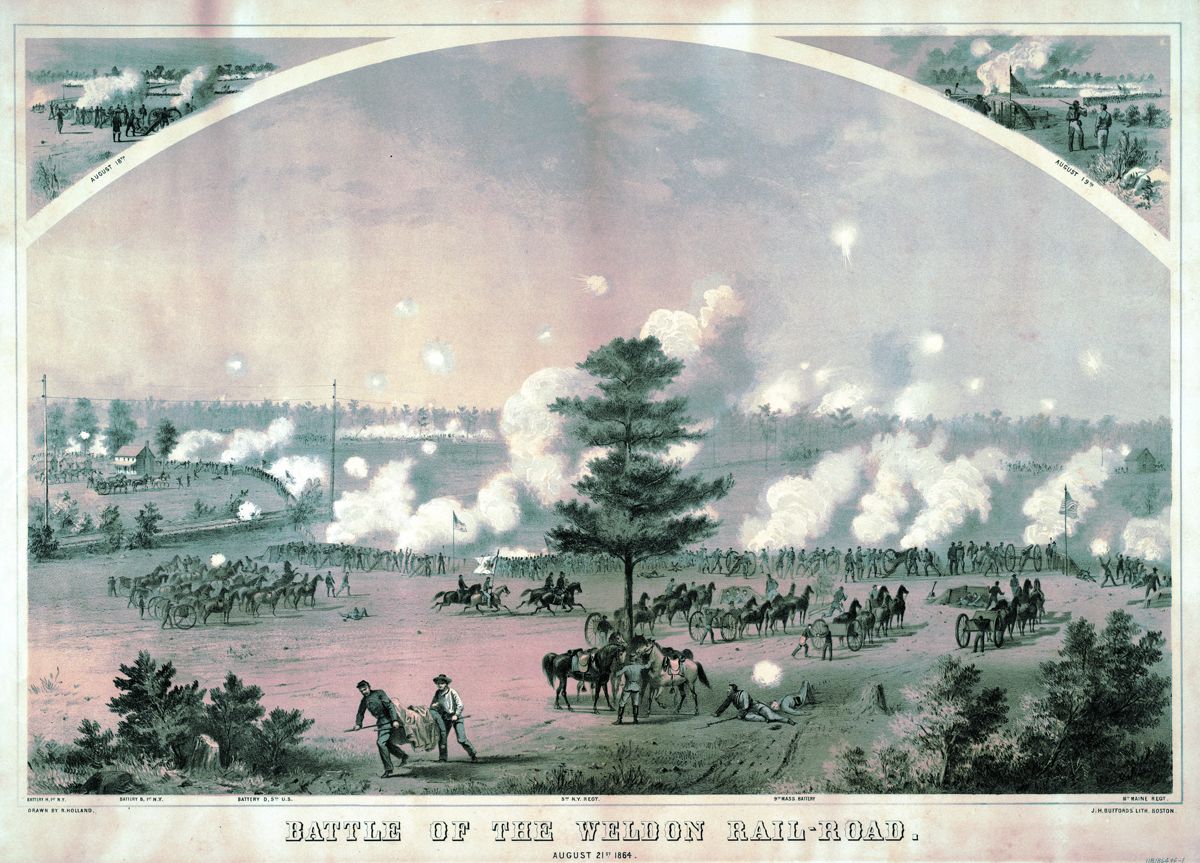
Holland and Bufford’s lithograph is undated, but it was probably executed shortly after the battle and probably from sketches and notes Holland prepared on the spot. As one Civil War dealer remarks: “The image is finely rendered and lithographed, presenting an almost photographic feel to the print.” 1.
Endnote:
Richard Holland, http://www.civilwardata.com/active/hdsquery.dll?SoldierHistory?U&36767. See also John Horn, The Destruction of the Weldon Railroad: Deep Bottom, Globe Tavern, and Reams Station, August 14–15, 1864. Lynchburg, Va.: H. E. Howard, Inc., 1991; Robert E. L. Krick, “Weldon Railroad August 18–21, 1864.” Civil War Magazine 67 (April 1998): 22–27; Captain Charles H. Porter, “Operations Against the Weldon Railroad, August 18, 19, 21, 1864.” Papers of the Military Historical Society of Massachusetts, 4: 243–66. Boston, The Military Historical Society of Massachusetts, 1906 and A. W. Greene, “Battle of the Weldon Railroad.” Encyclopedia Virginia. Virginia Foundation for the Humanities, 18 Sep. 2012. Web. 25 Apr. 2019. First published: March 18, 2009 | Last modified: September 18, 2012. Salvatore Cilella is retired after 43 years in the museum field. His last position was President and CEO of the Atlanta History Center. He is the author of several articles and books. His most recent books are Upton’s Regulars: A History of the 121st New York Volunteers in the Civil War (U. Press Kansas, 2009) and The Correspondence of General Emory Upton, 1856–1881 (U. Tennessee Press, 2017) edited. He is currently editing “Till Death do us Part, The Letters of Emory and Emily Upton, 1868–1870” to be published next year by the University of Oklahoma Press.