
Through The Lens
Eye in the Sky
By Stephanie Hagiwara · Originally published August 2019 · pp. 14–15
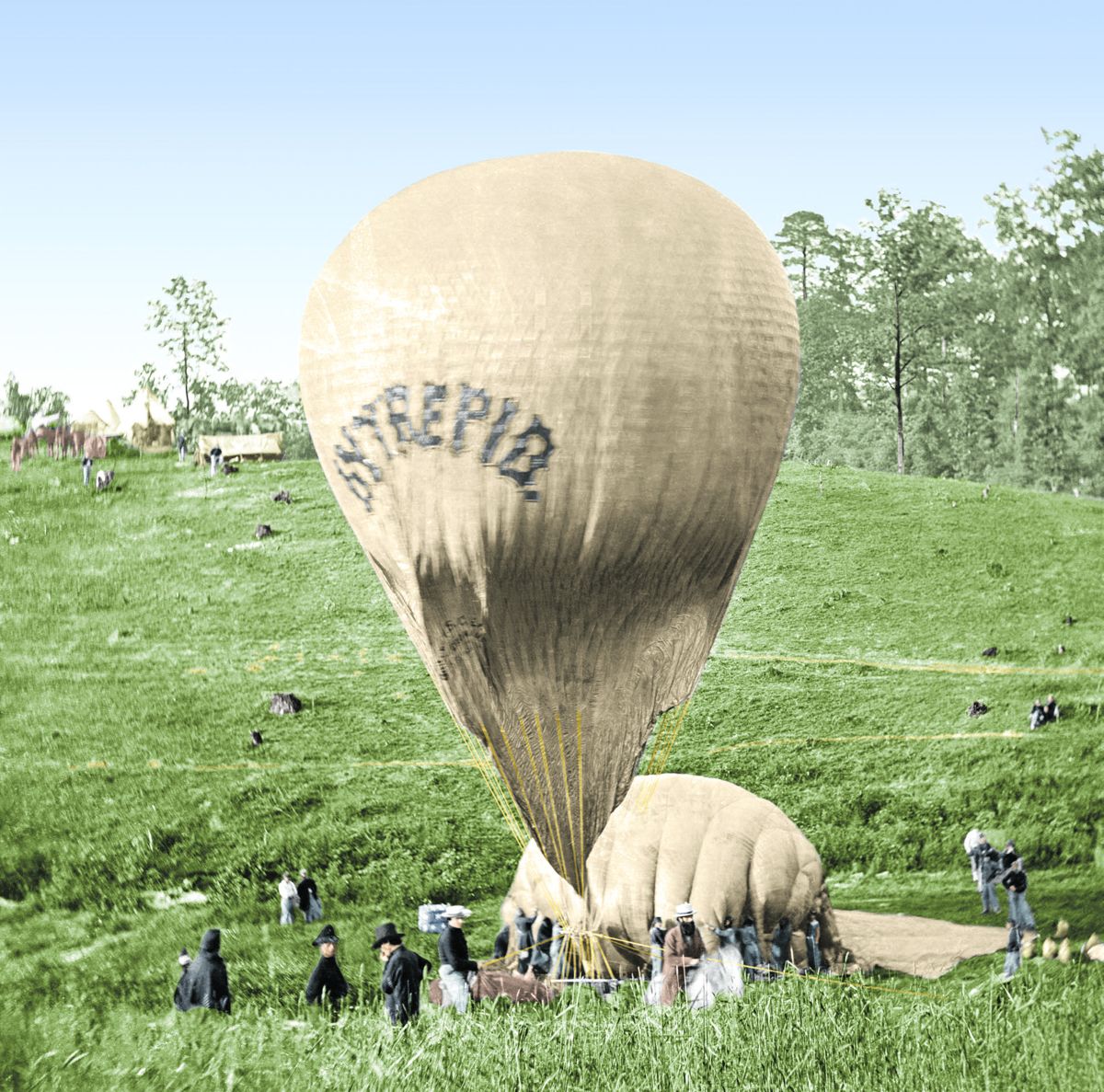
“A hawk hovering above a chicken yard could not have caused more commotion than did my balloons when they appeared before Yorktown, [Va.].” – Professor Thaddeus Lowe In March 1862, U.S. Gen. George McClellan launched the Peninsula Campaign with the goal of capturing the Confederate capital of Richmond, Va. Accompanying McClellan was Thaddeus Lowe and the Balloon Corps. Lowe had convinced President Abraham Lincoln of the value of having a transportable surveillance post that could observe “an area nearly fifty miles in diameter.” A converted coal barge, The General Washington Parke Custis, became the United States’ first aircraft carrier. Its deck was cleared of any item that could entangle the balloons. It was named for George Washington’s step-grandson and father-in-law of future Confederate General Robert E. Lee. It transported two gas generators to fill the balloons, along with the balloons, the Constitution, the Washington and the larger Intrepid, able to ascend higher while carrying an additional operator and a telegraphic apparatus. It took four army wagons to bring the corps to the Yorktown, Va., area. During the campaign, Lowe’s balloons made many ascensions. The Confederates would salute the balloon with “an iron hail” and attempt to hide their movements from the overhead observers. Despite their efforts, estimates were made of unit size by counting campfires or by noting the size of the dust cloud raised by maneuvering troops. Still, McClellan preferred to believe other intelligence that his Army of the Potomac was outnumbered. At Yorktown, Lowe noticed that the incoming wagons were lighter than the outgoing wagons. He concluded that the Confederates were not resupplying. On May 4, it was Lieut. George Armstrong Custer’s assignment to climb into the willow basket, or “car,” to observe the enemy with his field glasses, compass, pencil, and notebook. About 2 a.m., Custer became aware the Confederates had left Yorktown instead of facing McClellan’s siege machines. By dawn the Confederate withdrawal was confirmed when he couldn’t spot any breakfast fires. Headquarters was alerted. The Federals dashed after their fleeing foe. By mid-May, C.S. Gen. Joseph Johnston’s Army had withdrawn to within seven miles of Richmond. Federal soldiers could hear the city’s bells chime the hours from their camps.
McClellan, convinced his forces were outnumbered, waited for U.S. Gen. Irvin McDowell’s forces to join him before attacking the city. Instead, McDowell was sent to the Shenandoah Valley, Va., in response to Gen. Thomas “Stonewall” Jackson’s troops posing threat in that area. The night before the Battle of Seven Pines, May 31, a thunderstorm “in which the very sluice gates of heaven seem to be opened,” rapidly swelled the Chickahominy River and turned the landscape east of Richmond into a swamp. A lightning bolt killed the quartermaster of the 44th N.Y. and stunned twenty men. Four men of the 4th Ala. were killed in a single strike at “Camp Lighting.” Johnston was “elated;” the flooding would aid in protecting Richmond. Johnston’s plan was to attack on the Chickahominy’s south bank where Federal forces were fewer Confusion quickly arose as green commanders led green troops from different locations toward their objectives. Instead of using three parallel roads to attack the enemy, multiple divisions crowded a single road. Fed up with waiting, C.S. Gen. D. H. Hill began the attack five hours after the scheduled start time. During the morning, Lowe had not been able to launch his largest balloon, the Intrepid, due to the wind. From the Washington, Lowe realized a large battle was brewing. He sent a message to have Intrepid, inflated as he made a “mad gallop for the balloon camp.” On arrival he realized that it would take an hour to fill Intrepid, but the Constitution was already filled. Spotting a ten-inch camp kettle, Lowe had a makeshift valve created, “transfusing” gas from one balloon to the other. Back up in the air, Lowe “made an observation that showed that the Confederates were marching … [to] attack our troops on the right bank of the Chickahominy before the completion of the bridge would permit those on the left bank to join them. This would mean the destruction of our army.” Lowe sent dispatches alerting McClellan. U.S. Gen. Edwin “Bull” Sumner was ordered to cross the Chickahominy. An engineer protested that floodwaters were breaking the bridges making the crossing not only unsafe but impossible. After 43 years in the army, Sumner had a “narrow focus” and could not be deterred. “Impossible!” Sumner roared, “Sir, I tell you I can cross. I am ordered!” On the bridge “men went in up to their waists; horses floundered and fell down.” After the Lower

Bridge was swept away, the men crossed over a “Grapevine crossing.” Five of Edmund Kirby’s Battery I, 1st U.S. Artillery, guns made the crossing; one gun stuck in the mud. The infantry and battery slogged on, arriving near Fair Oaks, Va., about 5:30 p.m.; just in time to save the Federal position. Despite Lowe’s assertions that his dispatches saved the army from a major defeat, the use of the Balloon Corps steadily diminished after the Peninsula Campaign. After the May 1863 Battle of Chancellorsville, Va., the Balloon Corps was dismantled. Its legacy is as the forerunner of the modern artillery observer, responsible for directing fire on to a target. While the Federal Balloon Corps did have its supporters, one of the more surprising is C.S. Gen. Edwin Porter Alexander. Before he was a general, artillerist Alexander was tasked as the military observer in the Confederate’s balloon. Alexander saw the Battle of Gaines Mill from a balloon. He was “sure that on certain occasions skilled observers in balloons could give information of priceless value.” After the war Alexander remarked, “I have never understood why the enemy abandoned the use of military balloons early in 1863 after having used them extensively up to that time. Even if the observers never saw anything, they would have been worth all the cost for the annoyance and delays they caused us in trying to keep our movements out of their sight.” Sources: • Govan, Dr. Gilbert E., A Different Valor: The Story of General Joseph E. Johnston, C.S.A. • Sears, Stephen, W., To the Gates of Richmond; The Peninsula Campaign • Alexander, E.P., Pickett’s Charge, The Century Illustrated Monthly Magazine, Volume 33, page 465 • Holmes, Richard., Falling Upwards • Scott, Joseph C., The Infernal Balloon: Union Aeronautics During the American Civil War, Army History No. 93 (Fall 2014), pp. 6-27 Stephanie Hagiwara is the editor for Civil War in Color.com and Civil War in 3D.com. She also writes a column for History in Full Color. com that covers stories of photographs of historical interest from the 1850’s to the present. Her articles can be found on Facebook, Tumblr and Pinterest.