
Book Reviews
Book Reviews — August 2019
Originally published August 2019 · pp. 38–44
Civil War News book reviews provide our readers with timely analysis of the latest and most significant Civil War research and scholarship. Contact Stephen Davis, Civil War News Book Review Editor. Email: [email protected].
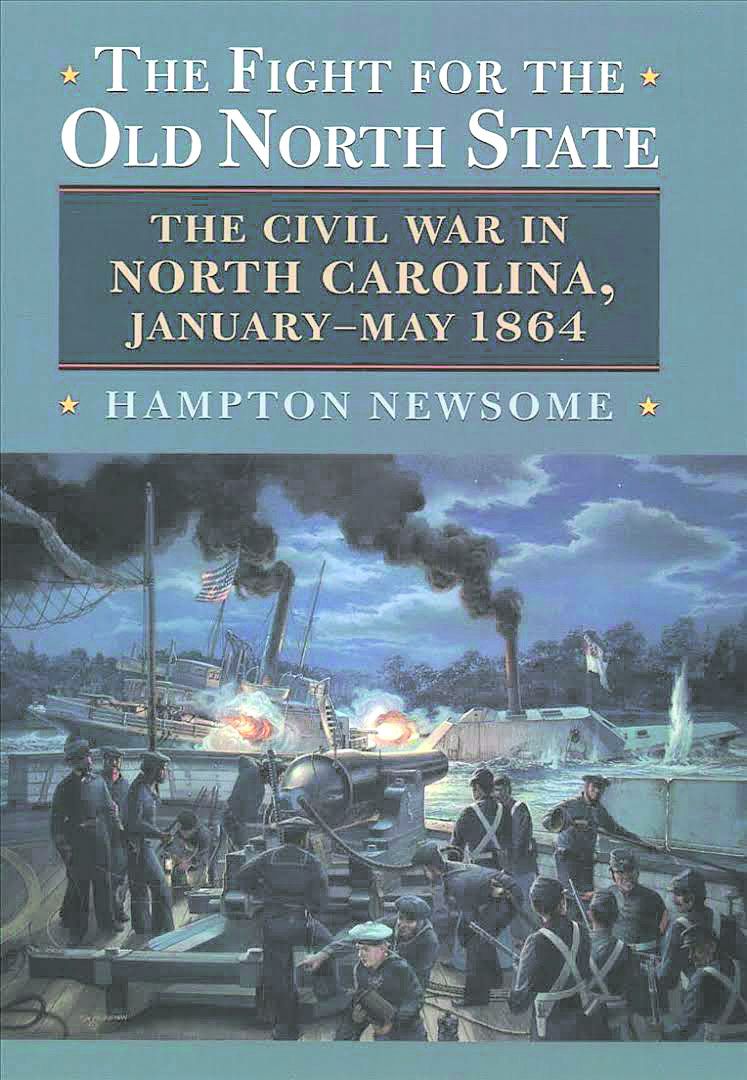
Something New to Learn about 1864 North Carolina The Fight for the Old North State: The Civil War in North Carolina, January-May 1864. By Hampton Newsome. Illustrations, maps, notes, appendices, bibliography, index, 467 pp., 2019. University Press of Kansas, www.kansaspress.ku.edu. $34.95 hardcover. Reviewed by Joan Wenner, J.D.
The Fight for the Old North State takes us on a detailed, factfilled journey through joint land and water operations by Federals and Confederates in their struggle for North Carolina during the early part of 1864. The social and political climate in the state is expertly relayed by Hampton Newsome through his thorough research. Early on Newsome writes, “As 1863 came to a close, there was much to fuss about. The growing distrust between North Carolina and Virginia, a situation that predated the Civil War, remained a source of tension.” I add a comment from my research that also helps set the stage for what was on the horizon for the Tar Heel state. Greenville judge George Howard in a letter to his wife in July 1863 (whom he had sent away for safety), wrote, “I am as busy as a bee preparing for the coming of the
Yankees, probably here this summer.” Governor Zebulon Vance’s cries for help went unfulfilled as Federal forays created more and more panic. “North Carolina was not left with enough troops ‘to protect a potato patch,’” he complained; “our state is not receiving justice.” Along with the narrative of operations, battles, and listing of participants, the author’s selection of maps and illustrations provides a clear “lay of the land” for those not familiar with the state’s vital supply network of rail lines, coastal region, and ports. New Bern was the significant prize for the Federals, though additionally of importance were Wilmington, Washington, Roanoke Island, Morehead City, Beaufort and crucial Plymouth, known for the success of the ironclad CSS Albemarle in its clash with the USS Southfield gunboat. Newsome explains the plans devised by both sides at the highest levels, including Burnside, Butler, Peck, Foster, Cooke, Pickett, Ransom, Wood, Hoke, Terry and those of naval note. Perhaps some will recall Sherman’s notice to his commanders while he marched north toward Richmond: “Do not let your command rest on its oars, but keep them going all the time, even if for no other purpose than to exhaust the enemy’s country, or compel him to defend it.” Hampton Newsome’s recommended book tells the chain of events—the highs and the lows, the bumbling and the courageous, from January to May, 1864 in the Old North State. It’s all here. Joan Wenner, J.D. is a longtime contributor to Civil War News. A native New Yorker based in eastern North Carolina, she has visited many of the sites mentioned. She has a special interest in naval operations and courts-martials. Email: [email protected].
Rehabilitating Meade’s Reputation as Commander
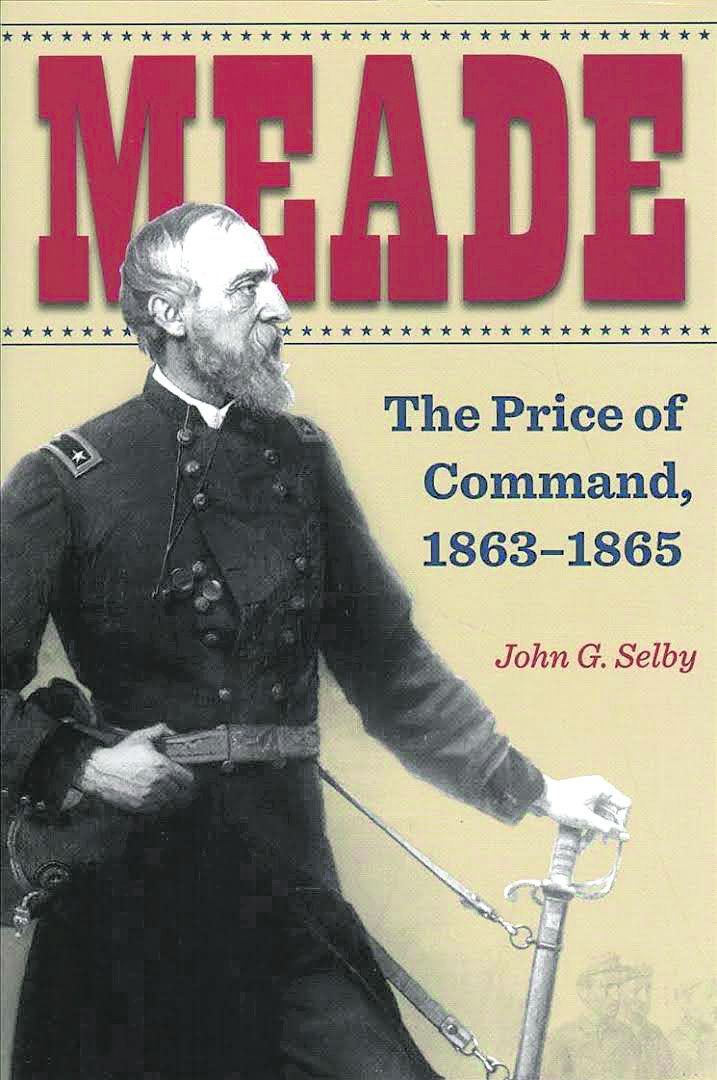
Meade: The Price of Command, 1863–1865. By John G. Selby. Notes, index, maps, 370 pages, 2018. Kent State University Press, www.kentstateuniversitypress.com. $49.95 cloth. Reviewed by Thomas J. Ryan
John Selby’s goal in this study is to “reassess [George G.] Meade’s leadership” as the commanding general of the Union Army of the Potomac during two harrowing years of the Civil War. He desires to amend the view of Meade as a “thin skinned leader of limited imagination, nerve, and drive” who was dependent on Gens. Ulysses S. Grant and Philip Sheridan in his quest to defeat Gen. Robert E. Lee’s Army of Northern Virginia on the field of battle. The author challenges the evaluations of other historians regarding Meade, including Allen Guelzo’s contention that Meade did not want to “risk battle at Gettysburg” and preferred “withdrawal” from the area. He differs with Gordon Rhea’s views regarding who made the decisions when Meade served directly under General in Chief Ulysses S. Grant, and relies on a variety of primary and secondary sources to counter assessments he considers unnecessarily critical of Meade on the personal level as well as of his military leadership. While the focus remains primarily on Meade, Selby provides a comprehensive discussion of Army of the Potomac operations from Gettysburg to Appomattox. He gives Meade the benefit of the doubt regarding his command ability and personal conduct given the stressful and physically demanding conditions in which he operated. He describes Meade as competent and reliable, if not inspirational and heroic, and a man who, at times, was sarcastic, impatient, quick-tempered, reserved, suspicious of the press, and wary of politicians. Most importantly, he lacked “a deep reservoir of support among the foot soldiers of the army.” Yet, in Selby’s view, Meade had more nerve than Gen. George McClellan, tolerated a high casualty rate on offense or defense, avoided open fights with politicians, never boasted like Gen. John Pope, managed an army of 100,000 men, worked closely with his corps commanders, and exhibited better tactical instincts and more resolve than Gen. Joseph Hooker. John Selby has invested considerable time and effort in making the case for a more favorable and realistic view of Meade’s generalship, and his presentation is clear, concise, and offers a scholarly contribution to the historical record. However, it should be pointed out that Meade had opportunities to gain the advantage over Lee that he ignored. For example, message exchanges in the Union Bureau of Military Information (BMI) files at the National Archives and Records Administration demonstrate that multiple options existed for Meade other than a frontal attack on Lee’s fortified position near Williamsport, Maryland. Meade learned that Lee’s army was clustered around Hagerstown on July 9 and 10, which provided the opportunity to march part of his army to Williamsport and block Lee’s forces from gaining access to the river. However, he missed or ignored this opportunity. Meade took no action when the BMI informed him that Rebel wagon trains of pontoons and ammunition were moving from Winchester, Virginia, to Williamsport, and the fact that Lee deployed a detachment of cavalry to hold open an escape route upriver. Meade also chose not to send a force across the river to destroy Lee’s pontoon bridge under construction at Falling Waters. This would have prevented Lee’s ability to move his artillery and wagons loaded with wounded soldiers, munitions, supplies, and a sizable amount of booty across the swollen river. Meade also ignored the BMI’s estimates of Lee’s troop strength that were accurate within a small percentage of the actual figures, insisting the enemy force was equal in size to his own—while providing no evidence for these erroneous assertions. At Williamsport following the Battle of Gettysburg, Meade’s forces outnumbered Lee’s by a ratio of about 2 to 1. Selby would have benefited by consulting published sources such as The Secret War for the Union by Edwin C. Fishel and a series of articles in Gettysburg Magazine that address the BMI’s operations during the Gettysburg Campaign. Similarly, Grant’s Secret Service by William B. Feis, Scouting for Grant and Meade, edited by Peter G. Tsouras, and Southern Lady, Yankee Spy by Elizabeth R. Varon provide insight into the intelligence advantage that Meade and Grant had over Lee during the Overland Campaign and the siege of Petersburg. Information available from these resources enhances the ability to evaluate Meade’s performance during two years as an army commander. Read Meade: The Price of Command, 1863– 1865 for a perceptive analysis of George G. Meade’s personality traits and command preferences, while consulting the other recommended sources for consideration of Meade’s operational alternatives based on information the BMI provided regarding the enemy’s strength, disposition, and intentions—vital factors in hastening an end to the war in the East. The collection, analysis, and effective use of intelligence is a fundamental requirement for successful military operations, a concept that Meade struggled to accept during his tenure in command of the Army of the Potomac. Advantageously for the Union cause, U.S. Grant came to embrace and employed these functions to defeat the Confederate forces. Thomas J. Ryan is the author of Spies, Scouts, and Secrets in the Gettysburg Campaign: How the Critical Role of Intelligence Impacted the Outcome of Lee’s Invasion of the North, June-July 1863. His latest book, written with co-author Richard R. Schaus, titled “Lee is Trapped, and Must be Taken”: Eleven Fateful Days after Gettysburg, July 4-14, 1863, is scheduled for publication by Savas Beatie later this year.
A New Look at Lew Wallace Politician in Uniform: General Lew Wallace and the Civil War. By Christopher Mortenson. Annotations, bibliography, illustrations, maps. 298 pp., 2019. University of Oklahoma Press, www.oupress.com. $34.95 hardcover. Reviewed by John Foskett
Civil War students’ knowledge of Major General Lew Wallace’s military career is generally limited to the unending debate over his division’s failure to timely arrive on the field at Shiloh on April 6, 1862, during the first day’s crisis for Ulysses Grant’s Army of the Tennessee. Most also have some familiarity with the crucial stand at the Monocacy River outside Washington in July 1864 when Wallace, in command of an outnumbered force, including his own VIII Corps, held off Jubal Early’s raiding Confederates long enough to nullify the Rebel assault on the capital. Christopher Mortenson has ably covered these events and much more in his new assessment of Wallace’s Civil War experience. Like Gail Stephens in her 2011 book Shadow of Shiloh, Mortenson confines himself to brief background on Wallace’s youth, his military service in the Mexican War which (to Wallace’s chagrin) did not involve combat, and his pre-Civil War activities as a lawyer and Indiana state legislator. Mortenson also gives minimal coverage to Wallace’s postwar accomplishments, including his authorship of the novel Ben Hur. Beyond that, as Stephens did, the author tightly limits his focus on the Civil War, beginning with Wallace’s command of the 11th Indiana infantry (which he helped raise), his elevation to brigade and then division command, his promotion to major general, and his role in commanding various military departments. Mortenson finishes with Wallace’s clandestine mission to negotiate a peace in Texas and to support Mexican liberationists, as well as his prominent role on the tribunals convened for the Lincoln assassination conspirators and for the trial of Henry Wirtz, commandant of the notorious POW facility at Andersonville. Despite similarity in scope, Mortenson’s approach differs from that used by Stephens. Mortenson examines Wallace’s Civil War experience through dual lenses—(1) the clash between the values of the professionally-trained soldier and those of the amateur civilian/“politician” and (2) the aggressive “martial”/“rough” notion of manhood which was prevalent in the era. In Mortenson’s eyes these factors combined to make Wallace his own worst enemy and accounted for the frustration of his own military ambitions. Mortenson’s framework is useful but the author may take the analysis too far in some instances. Mortenson’s repeated apportionment of the lion’s share of blame to Wallace for his several disputes with his superiors causes some skepticism. Wallace was far from alone on any list of officers, both professional and civilian, who ran afoul of Secretary of War Edwin Stanton, Chief of Staff Henry Halleck, or Indiana Governor Oliver Morton. Even his clash with Grant seems to have resulted mostly from a misunderstanding regarding the “wrong road” question at Shiloh, for which both were in part responsible. As for the “professional–citizen/politician” dichotomy, plenty of West Point-trained officers shared traits of untrammeled ambition, glory-hunting, and contentiousness. Names such as Joseph Hooker, Judson Kilpatrick and George Custer come to mind. In contrast, a variety of citizen-soldiers fit into the disciplined military culture, including John Logan, Jacob Cox, James Wadsworth and Frank Blair. There was no shortage of disdain by West Pointers for politicians-turned-officers—with some justification—but the role which that played in Wallace’s experience may be overly emphasized. Mortenson also seems unduly inclined to attribute every decision by Wallace to a consuming drive for military fame. Indulging in the “mind reading” of historical figures can be risky business. Mortenson’s decision to focus on Wallace’s shortcomings certainly is reasonable, especially when compared with Stephens’ tendency to favor Wallace in his persistent friction with superiors. Occasionally, however, this approach seems to minimize Wallace’s military accomplishments. For example, Wallace clearly played his part in his division’s leisurely, “by the book” march to the field of Shiloh on April 6. But on April 7 Wallace twice executed careful, effective turning movements on the Union right which forced the Confederate line to retreat. Mortenson gives Wallace sparse credit for this achievement. Mortenson’s most persuasive analysis covers Wallace’s performance in non-combat roles. This includes his orchestration of an effective defense at Cincinnati during the Confederate invasion of Kentucky in fall 1862 and his adept handling of the Middle Department during much of 1864. Mortenson compellingly demonstrates that Wallace’s skills as a politician and lawyer helped him gain objectives which might have eluded a military professional. There are thoughtful insights as well. For example, in his autobiography Wallace claimed that on April 3 or 4, 1862, he forwarded to Grant intelligence from his scouts that Albert Sidney Johnston’s 40,000 Confederates were on the march to assault the bulk of Grant’s army at Pittsburg Landing. Mortenson flatly states that the story is “hard to credit.” This reviewer has extensively researched the claim and concludes that it was almost certainly a fabrication concocted by Wallace after Grant’s death. Mortenson has used a number of primary sources as well as several reliable secondary works. If I have a criticism about the latter, it is the author’s apparent failure to access some of the recent scholarship, such as Timothy B. Smith’s excellent and somewhat revisionist Shiloh: Conquer or Perish (2014). Notwithstanding these criticisms, Mortenson’s book is an important addition to the literature on so-called “political generals.” The book also is well worth purchase by those with an interest in Wallace’s campaigns, especially as a complement to the equally well-done Stephens book. John Foskett is a practicing attorney in Boston. In addition to numerous reviews in Civil War News, he has given Civil War Roundtable presentations on the subject of Civil War field artillery tactics.
A Complex Relationship Clarified Lincoln and the Abolitionists. By Stanley Harrold. Images, notes, bibliography, index, 168 pp. 2018. Southern Illinois University Press, www.siupress.com. $24.95 cloth. Reviewed by Tim Talbott
A welcome addition to the ever-growing Concise Lincoln Library, published by Southern Illinois University Press, is noted abolitionist historian Stanley Harrold’s contribution, Lincoln and the Abolitionists. In order to understand the relationship between Abraham Lincoln and the abolitionists, Harrold contends that it is important to understand their vastly different backgrounds. Lincoln, born in slaveholding Kentucky, raised in southern Indiana and frontier Illinois, was a product of the environment and the people he grew up with. Although often commenting on the basic immorality of slavery, largely as a violation of the revered Declaration of Independence, as a young man, and even deep into his political career, Lincoln felt slavery was a political conundrum that would be difficult to solve. And, as Harrold puts it so well, “being ‘antislavery’ was not the same thing as being an abolitionist.” Harrold explains that once Lincoln embarked on his political career, it was those politics that kept him from moving into the abolitionist camp. Taking on a political life as a Whig and revering “The Great Compromiser” Henry Clay as his ideal politician left Lincoln with a pragmatic approach to what would be the future of slavery in the United States. The man who would be one day become known as “The Great Emancipator” knew that any success he was to have in politics—particularly in local and state politics—depended on meeting in agreement, at least on a certain level, with those who cast the votes. Lincoln often saw abolitionists as disrupting the Union and thus chose to maintain a rather conservative stance on the institution of slavery and race relations in Illinois, and reject the more radically perceived abolitionist view of immediate and uncompensated emancipation. He knew doing so was instrumental to his success in climbing the political ladder. The majority of Lincoln and the Abolitionists focuses on the Railsplitter’s rise to the presidency, and rightly so. As mentioned above, understating Lincoln’s background is prerequisite to understanding how he viewed abolitionists and approached their methods. However, the short treatment—always a challenge with a “concise history”—on the often fraught relationship between President Lincoln and abolitionist leaders like William Lloyd Garrison, Wendell Phillips, Horace Greeley, and Frederick Douglass leaves considerable room for further examination. Despite this fact, Harrold makes clear that abolitionist pressure influenced many of Lincoln’s decisions regarding slavery during his presidential terms. Lincoln and the Abolitionists clearly achieves its goal in providing a short, thoroughly researched, yet highly-readable explanation of the sometimes rocky relationship between the two parties. Despite their differences in backgrounds, political ideology, and ultimate goals, both Lincoln and the abolitionists, and thus their interactions, left a tremendous impact on the history of the United States that still resonates today. Harrold’s book makes that particular relationship dynamic ever so more understandable for both casual learners and wellversed historians. Tim Talbott is the Director of Education, Interpretation, Visitor Services, and Collections at Pamplin Historical Park and the National Museum of the Civil War Soldier in Petersburg, Va. He is currently researching the various combination of elements that ultimately led to emancipation.
Engines of Rebellion: Confederate Ironclads and Steam Engineering in the American Civil War. By Saxon T. Bisbee. Photos, drawings, appendices, notes, bibliography, index, 280 pp., 2018. University of Alabama Press, www.uapress.ua.edu. $59.95 hardcover.
As everyone who reads much of anything about the Confederate Navy soon realizes, Secretary Stephen Mallory managed to accomplish quite a lot with very little—especially when compared to the deployable assets available in the North. He and the South were not always (or often) well served by those tied into the naval industrial complex. Because of Engines of Rebellion, a new book by Saxon T. Bisbee, it is much easier to understand the rich complexity of what went on within the ironclad program and especially the complex machinery needed to operate the vessels. Early on Mallory realized that the Confederacy could not compete with the Union in building traditional warships and decided instead to pump resources into ironclad construction. By the time the war ended, the South had begun construction on fifty such vessels and had completed or nearly outfitted twenty-eight of them. The iron ships proved they were powerful in battle in Hampton Roads (CSS Virginia), on the Yazoo and Mississippi rivers (CSS Arkansas), in Charleston against the Federal blocking squadron (CSS Chicora and Palmetto State), and in Mobile Bay (CSS Tennessee) and elsewhere. What they lacked was the machinery capable of handling their massive weight. We know a substantial amount about the ships themselves and their (usually) short lives, but until now almost nothing about the engines and other important equipment found below decks. Bisbee begins with something of an encapsulated overview of the book as a whole, a very detailed and technical introduction (though it is much more than that) describing the steam power plants of the day, the Confederate ironclad program, hull-types, auxiliary machinery, etc. While interesting, it is also very detailed and littered with engineering jargon that had me flipping to the back of the book to study the glossary (thereby proving its worth). Whether this level of detail is needed is arguable, but it sets up a much better understanding of the balance of the book for readers determined to understand the minutiae included within these pages. The first iron ships were conversions from existing ships: the CSS Manassas from the steamer Enoch Train; the CSS Virginia from the steam frigate USS Merrimack; and CSS Baltic from a prewar iron and cottonclad sidewheeler. Unable to match their needs with the right engines and machinery, the South had no choice but to use what was available. That they proved ineffective is no surprise, but the technology was still in its infancy, and that it worked as well as it did under the circumstances is something of which the author takes note. Most of the balance of Engines of Rebellion is segmented by the type of ship under discussion, for example, the Richmond Class — CSS Richmond, Chicora, Palmetto State, etc.— the Tennessee Class—CSS Tennessee, Columbia—and so forth, and how the various designs selected worked with the machinery available to power them. Different hull designs, for example, worked better with different engine plants, boilers, and so on. One thing made clear is that the Confederacy got better at designing and building ironclads as the war went on. To a degree, part of the failure of the ironclads had to do with their conflicting purpose. Harbor defense or oceangoing to break the blockade? Slow lumbering behemoths in still waters, or faster offensive ships, nimble but powerful? The conflicts led to compromises that created serious flaws in each of the ships built from scratch, rather than created on the fly via conversion. As the war progressed, the Confederacy needed smaller and simpler designs with a focused need on ships capable of defending harbors like Mobile, Wilmington and Charleston. Still, the iron added significant weight that increased draft in often notoriously shifting and treacherous waters. Finding good reliable steam plants plagued the South until the end of the war. Dwindling skilled labor helped induce cleaner designs, including diamond-shaped hulls, though few records seem to exist to make definitive conclusions as to their efficacy (the Albemarle being, perhaps, the lone exception). Late-war designs came too late to see any combat but promised much, since they were constructed or undergoing construction on the shoulders of several years of trial and error. Readers seeking a complete history of ironclad warfare will be disappointed, but that is not the purpose of Engines of Rebellion. An appendix featuring a list of each of the ironclads, its specifications, machinery and final location (if known) is interesting and helpful. What is not helpful is the manner in which the nearly 50 illustrations were reproduced. The drawings, plans and photographs are especially valuable because of the technical nature of this study. Unfortunately, most of them are reproduced too small to be of any use—a curious design oversight for a book of this nature. Those caveats aside, Bisbee is to be applauded for his level of research and the organization of his groundbreaking study. This information is available nowhere else, and without it students only had an incomplete picture of the complex creatures that were Southern ironclads. Why they worked as well as they did—and why they didn’t—has now been answered much more satisfactorily. Stephen Mallory was right: Southern naval efforts accomplished much more than most people ever realized. Theodore P. Savas is the owner and managing director of Savas Beatie Publishing in El Dorado Hills, Cal. He has written about and lectures frequently on Civil War naval topics.
The Complex Creatures That Were Southern Ironclads
In his remarkable book, Believing is Seeing (2011), Errol Morris explores the mysteries of photography, especially images of historical events and personages. Continuing in that spirit of imaginative scholarship is Matthew Fox-Amato’s Exposing Slavery: Photography, Human Bondage, and the Birth of Modern Visual Politics in America. The institution of slavery had centuries when daguerreotypy was invented in France in 1839. Reported in newspapers, the process was brought to this country, where experimenters improved it as wet-plate collodion photography. By 1850 almost a thousand cameramen were in business in the U.S., offering everybody a chance to have their pictures taken. Enter Prof. Fox-Amato, who teaches at the University of Idaho, and who developed this book from his doctoral dissertation at Southern California. Exposing Slavery looks at how photography was used in distinctly different ways by slaveowners, abolitionists, Union soldiers and enslaved African Americans themselves. Take the photograph on the cover of the book, that of little Charlotte Middleton and her enslaved nurse, Lydia, taken by Charlestonian George S. Cook in the late 1850s. The author puts it best: “through the circulation and display of images of well-dressed bondspeople and portraits of enslaved caretakers with white children, enslavers projected a comfortable, harmonious, and familial form of bondage,” allowing Southern whites to “persuade themselves and others of the just and beneficial nature of slavery.” But danger lurked here. The Lydia posing as “property” is simultaneously having her personhood affirmed and preserved by Cook’s camera. “In the first thor explains, “enslaved people had begun entering southern daguerreotype saloons of their own volition, posing for cameras, and leaving with visual treasures they could keep in their pockets.” The same thing happened in the antebellum North. Frederick Douglass had his picture taken more than 160 times—more than Lincoln—and in doing so he was casting his image as not only a man, but a defiant one at that (see Samuel Miller’s daguerreotype 1847/1852). In his chapter “Realizing Abolition,” Fox-Amato discusses how abolitionists recognized and employed photography as a powerful antislavery weapon. The Branded Hand of Captain Jonathan Walker, a daguerreotype made in 1845, shows closeup Walker’s outstretched left hand branded with “SS”—slave stealer. (Walker, a northern white shipwright, had helped seven slaves escape from Florida to the Bahamas, but was caught, tried and sentenced to brief imprisonment but a lifetime scar.) Abolitionists reproduced the picture widely in newspapers and pamphlets as an irrefutable portrayal of slavery’s horrific violence. “Years later, as the Civil War raged,” the author states, “Union soldiers would orchestrate pictures with fugitive slaves that envisioned racial hierarchy as slavery fell.” When Timothy O’Sullivan photographed a group of Union officers in Virginia in the spring of 1864, he included in the scene a young black man holding a pitcher—an image, Fox-Amato writes, that “fused racial hierarchy with a sense of place, white privilege, and black subservience.” To Northern whites worried about the status of millions of soon-to-be freedpeople, such pictures offered assurances that after emancipation, blacks were ready to accept a subordinate role in white society. These instances only hint at the intellectual richness of Exposing Slavery. I echo the observation of one admirer of Fox-Amato’s book: “the links between photography and American thinking about slavery are so clear here, one wonders how they could have remained hidden in the archives for so long.” Stephen Davis is Book Review Editor for Civil War News. His new book, 100 Significant Photographs of the Civil War—Atlanta Campaign, is due out August 2019.
Private Confederacies: The Emotional Worlds of Southern Men as Citizens and Soldiers. By James J. Broomhall. Illustrations, notes, bibliography, index, 240 pp., 2019. University of North Carolina Press, www.uncpress.org. $29.95 softcover. Reviewed by Meg Groeling
Author James J. Broomhall is an assistant professor of history at Shepherd University and director of the George Tyler Moore Center for the Study of the Civil War. This book is part of Civil War America, edited by Peter S. Carmichael, Caroline E. Janney, and Aaron Sheehan-Dean. Civil War America is a series of books interpreting the history and culture of the Civil War-era and beyond in a broad and diverse manner. Broomhall has followed the private writings (letters, diaries) of several Southern men from the antebellum years through the Civil War, emancipation and Reconstruction. He has chosen a diverse group of men, although each is from a slaveholding family. For example, Georgia native George Anderson Mercer kept a diary from the age of fifteen. His words represent a complex but familiar portrait of southern masculinity based on “Christian gentility, ideological expression, and emotional communication.” Future Confederate general Edmund Kirby-Smith wrote of similar feelings. When these men became soldiers, they continued to write. For southern men, the crises of war forced a transfiguration of ideas upon the private, emotional worlds of those who fought for the South. Before the war, a “southron” defined himself by his relationship to slaves, women, and children. White supremacy and control denoted his role in society. In the Confederate armies, however, men were forced to associate with a variety of other men, many not from the elite or even middling class. The decisions of other men now controlled his daily actions, his food, and his clothing. Men, now separated from their families, created other support groups from within the military. Without this support, the chaos and trauma of battle, wounding, illness, and death could have seemed impossible to bear. How each man dealt with these issues is the premise of Private Confederacies. When southern soldiers returned to civilian life, the changes they experienced once again left many emotionally vulnerable. There were several outcomes of these experiences. Most men found ways to define themselves once again, even in times of emancipation and Reconstruction. Some others, however, found that bitter, aggressive masculinity defined their reaction to such significant changes. Sadly, the latter choice led to the creation of vigilante organizations with their legacy of lynchings and the Ku Klux Klan. Private Confederacies is an essential contribution to a growing number of resources concerning the mentality and actions of southern men and women before, during, and after the Civil War. Good, new work is appearing in this area, and each one takes a step toward helping readers understand just how the myth of the Lost Cause not only came into existence but persisted for so long. Books such as Joanne Freeman’s The Field of Blood, Ben Wynne’s The Man Who Punched Jefferson Davis, Diane Miller Sommerville’s Aberration of Mind, and Jarret Ruminski’s The Limits of Loyalty join Tony Horowitz’s seminal Confederates in the Attic as the waning of the Lost Cause pushes us to more clearly understand the hearts and minds of southerners who fought in the Civil War. James J. Broomall’s book makes a significant contribution to this worthy effort. Meg Groeling, of Hollister, Cal., received her Master’s degree in military history, with a Civil War emphasis, from American Public University in 2016. Her next book, First Fallen: The Life of Col. Elmer Ellsworth, will be published by Southern Illinois University Press.
Single, White, Slaveholding Women in the NineteenthCentury American South. By Marie S. Molloy. Illustrations, notes, bibliography, index, 240 pp., 2018. University of South Carolina Press, www.uscpress.com. $39.99 hardcover. Reviewed by Claire Affinito
In Single, White, Slaveholding Women in the NineteenthCentury American South, historian Marie S. Molloy examines a relatively overlooked group in nineteenth-century Southern society: single white slaveholding women. Traditionally, studies of slaveholding women have focused exclusively on married plantation mistresses and socialites. Molloy brings slaveholding single women into the spotlight by highlighting how these women maneuvered in a society that expected them to marry and bear children. Molloy argues that the Civil War provided single women with the opportunity to accelerate personal, social, economic and legal change that fostered the acceptance of their existence in society. Molloy’s work covers a wide expanse of time by considering gender norms and behavior from the antebellum through the postwar era. Molloy defines singleness to include nonmarriage, widowhood, separation and divorce. Through the stories of individual women, she highlights how all varieties of single women navigated their precarious position. To place these single women in context, Molloy begins with a description of the gender roles of Southern society. She investigates the hierarchical structure of Southern society and how the position of women in this structure dictated acceptable behavior for women. In Southern society, women were expected to conform to the social paradigm known as “The Cult of True Womanhood.” To be an ideal Southern lady, women were expected to uphold “the four cardinal virtues”—piety, purity, submissiveness, and domesticity. Along with exemplifying these traits, women were valued for their roles as mothers and wives. This left single women with few options. Single women were viewed as redundant, odd, or even socially deviant by choosing not to marry and have children. Molloy describes how single women found ways to define themselves as valuable and respected members of society.
Single Southern women coped with societal constraints in various ways. Molloy argues that the Civil War allowed these women to forge a legitimate rival to the Cult of True Womanhood with the Cult of Single Blessedness, which emphasized the contributions of single women inside and outside of the home. Women expanded the traditional and acceptable roles of domestic caregivers, nurses and teachers. The Civil War and subsequent postwar challenges provided single women with ample opportunities to augment these home roles and find a place for themselves in society. And, in turn, these new roles gave women greater autonomy and economic independence. This book is broken down into five chapters. Each chapter ends with a brief summary that provides an excellent wrapup for each of Molloy’s main points. The chapters focus on topics including the construction of Southern femininity, the role of single women in the family, work, female friendship, and law, property and the single woman. Molloy uses diaries, letters, journals, court cases, petitions and laws to paint a picture of challenges and triumphs of unmarried, divorced and widowed women and how their situations changed throughout the nineteenth century. However, the women investigated in this work are of the highest class. A look at middle- and lower-class single women would round out this already excellent study. This book is an essential read for those interested in gender and sexuality. It provides a more positive look at the role of single Southern slaveholding women in society. Single, White, Slaveholding Women in the Nineteenth-Century American South delves beyond the traditional plantation lady to provide a nuanced look at the Southern female experience. This past spring Claire Affinito graduated from Shepherd University with a bachelor’s degree in history. She has recently begun a nine-month internship at the Antietam National Battlefield. In this internship she will focus on providing education and interpretive programs to visitors that focus on the battle, the aftermath, and its impact on local citizens.
War Matters: Material Culture in the Civil War Era. Edited by Joan E. Cashin. Photos, notes, index, bibliography, 263 pp., 2018. University of North Carolina Press, www.uncpress.org. $29.95 paperback. Reviewed by Salvatore Cilella
When I was in museum school (during the medieval ages), we learned that material culture was all those “things” that man has produced that have earned him money, made him comfortable, made him uncomfortable, increased his lot in life, decreased his lot in life and generally could be described as all those things you see in museums. The term came into the mainstream museum world in the 1970’s when James Deetz, a young anthropologist/archeologist, began using the term to help identify different cultures and societies through his diggings and explorations. A classmate of mine, Thomas Schlereth, also helped popularize the term in the museum field when he recognized that all those everyday things in our attic and basement were worthy of our study to understand our and other cultures. Indeed, Deetz’s book, In Small Things Forgotten, argued that the written word alone failed to provide an adequate picture of the past. Schlereth’s Artifacts and the American Past explored in detail the motivations driving the production of material cultures. All human creations— maps, photographs, art, music, artifacts—are all central to our study of history and anthropology. Editor Joan E. Cashin’s War Matters narrows the microscope on the material culture to that produced during the American Civil War and comes up with some pretty surprising results, along with some more traditional “things.” Her introduction, aptly entitled “The Idea of Things,” explores the current academic controversies surrounding the concept of “material culture,” and the ten essays that follow illuminate the “battle.” Traditional pieces with self-explanatory titles include Jason Phillips’ “John Brown’s Pikes,” Ronald and May Zboray’s “Saved by a Testament, Books as Shields Among Union and Confederate Soldiers,” and Earl Hess’ “The Material Culture of Weapons in the Civil War.” Two of the most compelling essays are Peter Carmichael’s “The Trophies of Victory and the Relics of Defeat: Returning Home in the Spring of 1865,” and Yael Sternhell’s “The Stuff of Defeat: Material Culture and the Downfall of Jefferson Davis.” Carmichael examines a witness tree under which Robert E. Lee stood prior to his meeting with Grant at Appomattox. Once the surrender was announced, soldiers from both sides recognized the importance of the tree and literally tore it to shreds for a souvenir of the day—for one group, a sad remembrance of defeat, for the other, a reminder of victory as both sides seemed to understand it was symbolic of peace at last. Sternhell’s essay recounts the brief history of Jefferson Davis’ personal effects after his capture, their confiscation and his twenty-year struggle to regain possession of them. To Davis, Sternhell argues, his loss of his possessions was the final indignity. Perhaps the most arresting article in this slim volume is Robert D. Hicks’ “Scabrous Matters: Spurious Vaccinations in the Confederacy.” After presenting the traditional definitions of material culture, Hicks argues the
“lymph and crusts (scabs from vaccinations) are artifacts” as well. After all, they are produced and used by man. If a doctor’s bag included all manner of instruments to cut and probe, why not dead smallpox virus that can be used to inoculate? Hicks argues successfully that the samples of virus, crusts, lymph, and vaccine were no more unusual than the other items in a physician’s bag. In the end I had to admit that, as strange as smallpox vaccinations are as an indicator of material culture, they do indeed fit the definition and are worthy of our attention. The most important theme in all ten chapters is how different groups learn that the objects could “speak” to them. Each may have interpreted them differently, but on the bottom line, each author presents sufficient arguments that historians who dismiss material culture and rely only on the written word, miss an important aspect of the historical narrative. To whom would a book like this appeal? Do you read for information or affirmation? Probably the general reader and student of the war will find new information and thus greater knowledge concerning our great national tragedy. Museum leaders who have not gotten wind of this work should read it. The voracious reader of battles and leaders will probably take a pass on this, much to his or her regret. It is an eye-opener and a fascinating take on the war that has occupied the American imagination for the last 150 years.
Salvatore Cilella is the retired CEO of the Atlanta History Center, after serving 43 years in the museum field. He is the author of Upton’s Regulars, (University of Kansas Press, 2009) and editor of The Selected Correspondence of General Emory Upton (University of Tennessee Press, 2017). He is currently editing Upton’s letters to his wife (1868–1870) for publication by the University of Oklahoma Press.
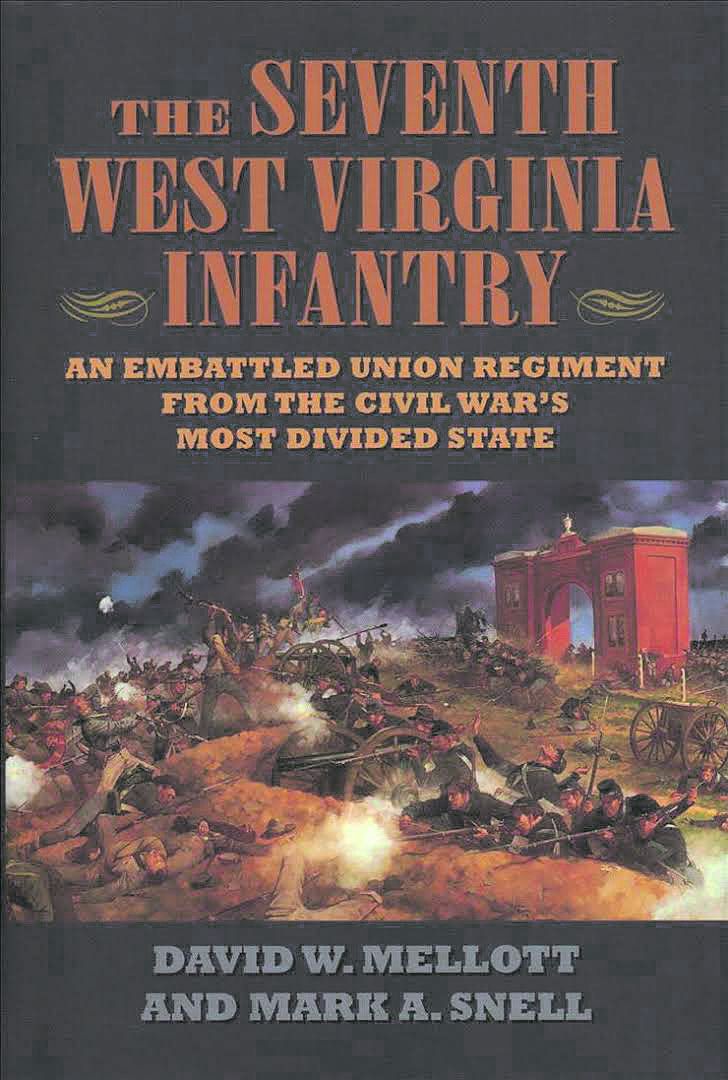
The Seventh West Virginia: “Their Deeds Are Their Monuments” The Seventh West Virginia Infantry: An Embattled Union Regiment from the Civil War’s Most Divided State. By David Mellott and Mark Snell. Appendices, notes, bibliography, index, 368 pp., 2019. University Press of Kansas, www.kansaspress.ku.edu. $34.95 cloth. Reviewed by David Marshall
After fighting a few minor skirmishes, one of its own soldiers named this regiment from West Virginia the Bloody Seventh. By the end of the Civil War, 315 members died of injuries, illness, or from other causes. Out of a total four-year enrollment of 1,528 enlisted officers and men, the Seventh’s mortality rate was 20.6 percent. After a year of skirmishing, marching, serving on occupation duty and participating in a few battles in the Shenandoah Valley, the Seventh was transferred to the Army of the Potomac in early 1862. There it remained an integral part of the Second Corps until the end of the conflict. These fighting men fought in more major battles in the eastern theater than any other from the newly admitted thirty-fifth state, including Winchester, Antietam, Fredericksburg, Chancellorsville, Gettysburg, the Overland Campaign, and Petersburg. In December 1862 the regiment’s name was changed officially to the “Seventh Union Virginia Volunteers.” Following official statehood on June 20, 1863, the regiment was renamed the “Seventh West Virginia Infantry” and became part of the Gibraltar Brigade. One third of these fighting men came from outside the Mountain State, including nearby Appalachian counties in Ohio and Pennsylvania. The survivors who reenlisted in 1864 became members of the Seventh West Virginia Veteran Volunteers and were present when Robert E. Lee surrendered the Army of Northern Virginia at Appomattox Court House. This monograph is the result of more than two decades of research by David Mellott and Mark Snell. The statistical appendices included are the result of research by Professor Snell that was originally entered into a data base of West Virginia soldiers created during his tenure as the founding director of Shepherd College’s Center for the Study of the Civil War in 1993. It is not written in the standard format of well-respected military works such as John Pullen’s Twentieth Maine Infantry, The First Minnesota by Richard Moe, The Twentieth Massachusetts by Richard Miller, or The 11th Pennsylvania Reserves by Joseph Gibbs. However, it utilizes social details that provide a greater understanding of the men’s lives and their political history. The authors provide an in-depth look at the regiment’s members from a socioeconomic, military, medical, and personal point of view. Statistics include casualties for all of the Seventh’s engagements. An Embattled Union Regiment from the Civil War’s Most Divided State successfully tells the story of individuals and their place in West Virginia’s Civil War history. In 1860 more than half of the families living in the Southern Appalachian region were poor and only 18 percent were slaveowners, with the fewest living in West Virginia counties. Most people living in western Virginia favored the Union and not secession. As a result, many fought against the Confederacy and the slave oligarchy of eastern Virginia in support of the Union. This classic study would have been enhanced by an order of battle, a listing of soldiers who fought with the 7th and more maps. In the end, 577 soldiers of the Seventh West Virginia Veteran Volunteers received honorable or medical discharges at war’s end and made it back home. This is a well-written book on the Seventh West Virginia Infantry. Each battle this regiment participated in is covered in detail. Students and enthusiasts will gain a great deal of insight into common soldiers and their officers. Like most modern regimental histories, the authors do not seek to glorify the men of the 7th, but simply to understand and report the reality of the soldiers’ experience. The text is complemented by 38 photographs and twelve outstanding maps produced by cartographer Hal Jespersen. This narrative is a first-rate work that should appeal to anyone with an interest in regimentals in general and West Virginia in particular. I highly recommend this publication as a memorable regimental history. David Marshall has been a high school American history teacher in the Miami-Dade School district for the past thirty-two years. He is president of the Miami Civil War Roundtable Book Club. He has given presentations to Civil War Round Tables on Joshua Chamberlain, Ulysses S. Grant, Abraham Lincoln and the battle of Gettysburg.