
Stuart Scouts for Ride Around McClellan
By Carl L. Sell Jr. · Originally published April 2019 · p. 27
This is the first of two articles about Jeb Stuart’s local scouts who led his large cavalry force during rides around Major General George McClellan’s Union army in 1862. The second article reports on the Chambersburg Raid will appear in a future Civil War News. Before he set off on his Ride Around McClellan in June 1862, Brigadier General Jeb Stuart made sure he knew exactly where he was going. Familiar with most of the route, he wanted to make sure there would be no wrong turns or delays. After all, his reputation with his new commander, General Robert E. Lee, was on the line. The success of the ride would lead to Stuart being named a major general a month later. Stuart drafted two lieutenants from New Kent County to lead the way from Old Church to the Chickahominy River, a stretch of the route largely unknown to Stuart and his regular scouts. Jones Rivers Christian and Richard Edgar Frayser grew up in the area and knew the way. In fact, Christian was born at “Sycamore Spring” plantation on the Chickahominy, just where Stuart wanted to cross. Both Christian and Frayser were members of
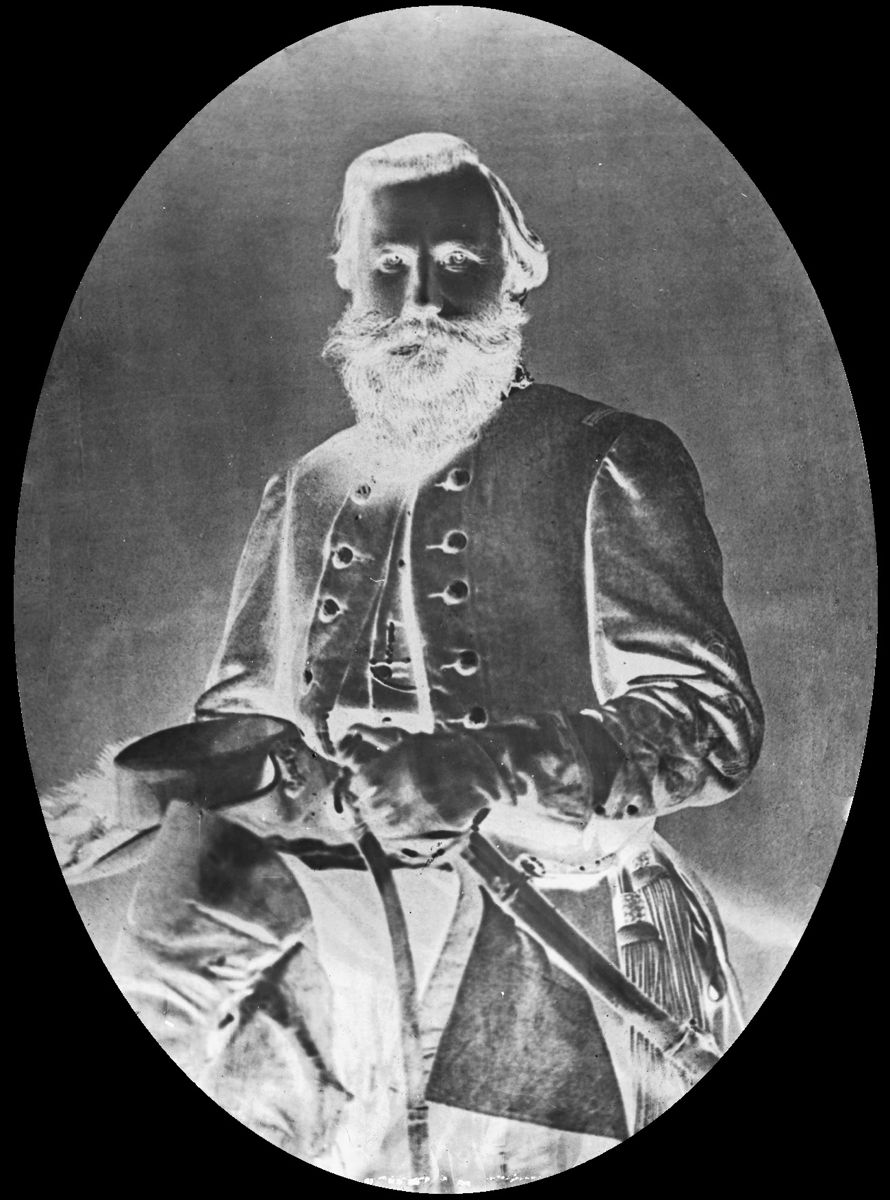
J.E.B. Stuart.
the New Kent County Dragoons, which became Company F, Third Virginia Cavalry; both enlisted on June 28, 1861. Christian first led Stuart’s column to a little-known ford on his family’s property. However, the stream was too wide and the water too swift to get everyone safely across. They diverted to the nearby site of Forge Bridge, but found it destroyed by the high water. After a herculean effort using boards and timbers from a nearby abandoned warehouse, the bridge was rebuilt and the column got safely across. The bridge was then set on fire to stop any Union pursuit. Prior to being selected by Stuart to help lead the way from the Old Church to the Chickahominy, Frayser was largely unknown. However, his intimate knowledge of New Kent County caught Stuart’s eye and a star was born. Not only did Frayser help lead the way, he was chosen to convey news of the safe journey to Stuart’s wife, Flora, and Virginia Governor John Letcher in Richmond. Christian, born in 1835, was one of five boys who had grown up on the plantation and had spent most of his life there. He had been elected a second lieutenant on April 25, 1862, and elevated to first lieutenant on Oct. 24, 1862, followed shortly thereafter with
(Library of Congress)
promotion to captain on Nov. 11. He served directly with Stuart until the end of the Seven Days Campaign, then returned to his company. On May 8, 1864, during the Wilderness Campaign, Christian was captured and sent to Fort Delaware on an island in the middle of the Delaware River. He then was sent to Morris Island in Charleston Harbor, S.C., where he became one of the “Immortal 600,” used as human shields to protect Union artillery from nearby Confederate guns. Frayser also was captured and sent to Charleston. Christian was transferred to a prison at Hilton Head, S.C., and remained there for the rest of the war. He was paroled on June 16, 1865. Returning to Richmond, he worked as a clerk in the city’s post office. Suffering from neuralgia, he entered the R.E. Lee Camp Soldiers Home in Richmond where he died May 20, 1895. He is buried in Hollywood Cemetery. Christian never married. Frayser’s arrival in Richmond after the Ride Around McClellan was greeted with acclaim. Governor Letcher, Stuart’s cousin, was so elated with the news that he presented Frayser with a gubernatorial order for a sword of his choosing. Stuart appointed Frayser as his signal officer and elevated him to captain. His role as a signal officer would produce other assignments as the war progressed. On May 12, 1864, the day after Stuart was mortally wounded at Yellow Tavern, Frayser was captured at Spotsylvania Court House. After three months in prison at Fort Delaware, Frayser was sent to Morris Island Prison in Charleston Harbor, S.C. Despite the poor conditions, all the prisoners survived six weeks as human shields. Frayser was sent back to Fort Delaware and then exchanged in February 1865 because of poor health. He returned to duty with the Army of Northern Virginia and was paroled at Appomattox. The son of a Methodist minister born in 1830, Frayser was orphaned early in his life and worked in a local store in New Kent County to earn his keep. As a young man, he moved to Richmond to work in the post office. In 1854, he returned home to start his own store before enlisting in the Confederate army. After the war, Frayser worked for a newspaper in Richmond, earned a law degree, and opened his own practice. He died Dec. 22, 1899, and is buried in Richmond’s
Hollywood Cemetery. His wife, Mary Armistead Frayser, who was ten years older, died in 1891. No children are listed. Carl Sell has written a book updating information about Jeb Stuart that includes proof that he communicated with Richmond during his ride to Gettysburg in 1863. All proceeds from the book are earmarked for the preservation of Stuart’s statue on Richmond’s Commonwealth Avenue that recently was restored by the Stuart-Mosby Historical Society. Sell also has written books about his great grandfather and great uncle, both of whom survived Pickett’s Charge at Gettysburg. Carl can be contact by email at [email protected].