
Rescuing Old Joe
By Philip Leigh · Originally published April 2019 · p. 7
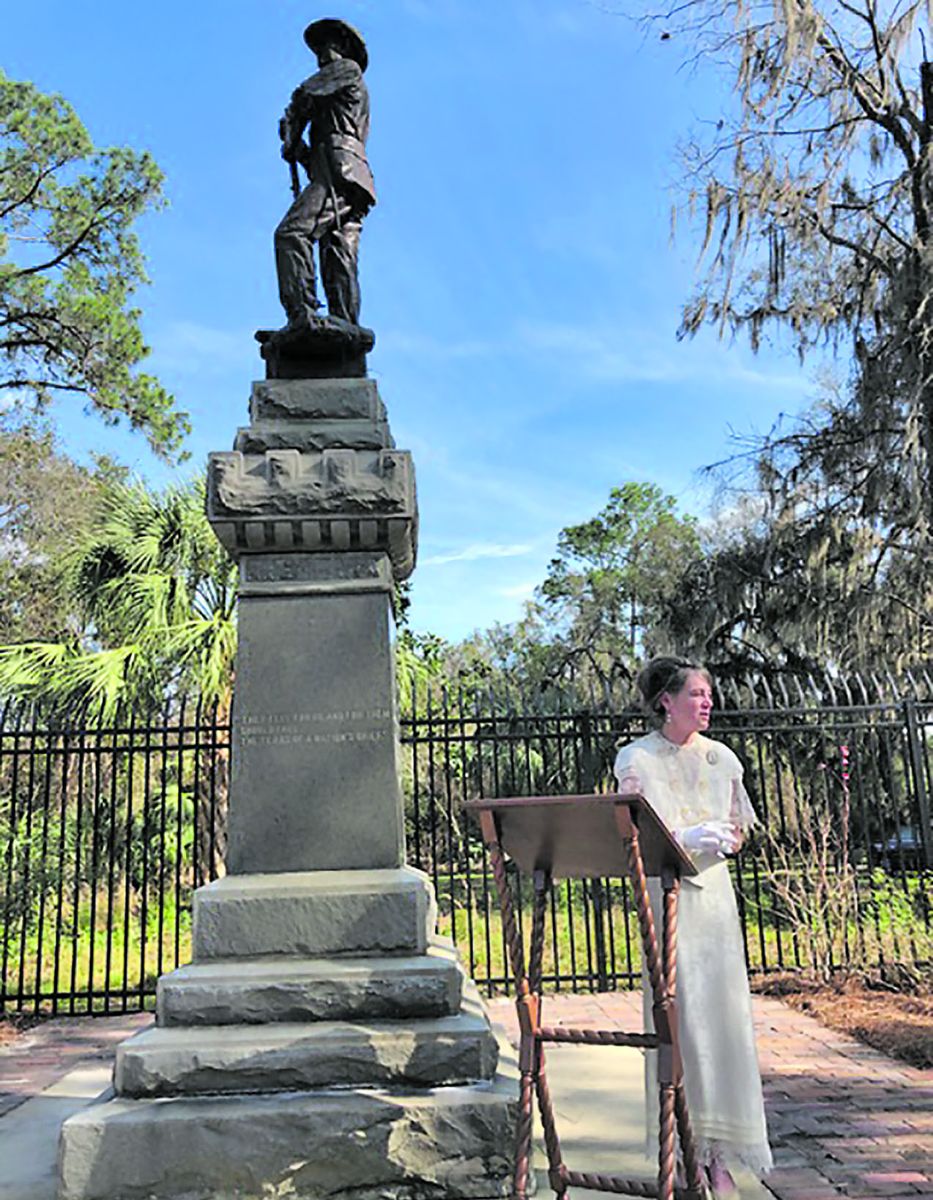
Whoever weds himself to the spirit of this age will find himself a widower in the next. — William Inge Few realize that Florida was so committed to The War Between the States that she gave more soldiers to repel Northern invaders than she had registered voters. Gainesville was among the towns that responded. As a result, the local United Daughters of the Confederacy (UDC) chapter later erected a statue of an ordinary infantryman honoring the hometown boys who had fallen, including many buried anonymously far from home. When erected in 1904, most of the living veterans were in their sixties and seventies. In May 2017 the county commissioners voted to remove the monument, which had become fondly known to most residents during the previous 113 years as Old Joe. After the vote, one audience member raised her hand to ask a question. The Chair recognized Nansea Markham, President of the local UDC chapter. She asked, “What will you do with the memorial?” The county attorney explained that the statue would be sold at auction if it was worth over $2,000. Otherwise Joe would be scrapped. Nansea stood and held an old document at shoulder height before saying, “I’m sorry. You cannot do that.” Motioning with the papers she added, “This is the original 1903 document pertinent to Old Joe’s legal status. It shows that he remains the property of the United Daughters of the Confederacy.” The commissioners held an impromptu conference as the audience looked on. Afterward the Chair announced that the commission would give the UDC sixty days to accept the return of Old Joe. He added that if the offer was accepted the UDC would be responsible for all moving expenses and must complete the move within sixty days of acceptance. One commissioner who voted to remove the statue had previously announced that he would not allow the county to spend a single dime to move the memorial. He would rather see it destroyed. Although Nansea was relieved for one last chance to save Old Joe, her chapter had less than $1,000 in the bank. Given the security requirements and care required to safely relocate so old an object, she worried the task might be too difficult. The next morning, however, she began to get supportive phone calls and emails. Many previously silent sympathizers recognized her from earlier Old Joe hearings before the commission and other local organizations during the preceding two years. One phone call from a Vietnam vet lit a fire in her heart. He explained that the American soldier’s creed requires that a warrior will “never leave a fallen comrade.” He told Nansea, “That’s how I see Old Joe’s situation. You are rescuing him. He is a veteran and I cannot leave him fallen on the ground to be scrapped. I will send you money.” Realizing that many older Americans now cringe with shame at how they treated returning Vietnam vets in the 1960s and 70s, Nansea reasoned that the same might apply to Old Joe in the years ahead. Thereafter she took every phone call and replied to every email. Many originated beyond Florida’s borders, including states above the Mason-Dixon Line. She took suggestions such as creating a FaceBook page and a GoFundMe Internet site. But she never directly asked for money. It started arriving anyway. She mobilized the UDC chapter members to send a hand-written “thank you” note to every donor. On July 20, 2017, she notified the county commission: “We [the UDC chapter] accept the Confederate Soldier Statue.” Her laconic acceptance prompted repeated media inquiries including from national organizations such as The Washington Post and National Public Radio. She took the phone calls but politely declined to be interviewed or quoted. “Why?” asked one NPR reporter. “An interview would add publicity to help you raise money to move the statue.” “That’s true,” said Nansea, “but it might also attract unwanted attention. My job is to get Old Joe safely moved. I don’t want publicity that might trigger vandals.”
By mid-August the Gainesville UDC chapter had raised $30,000 and secured a site for Old Joe on private property adjacent to a cemetery containing the bodies of some Confederate veterans. The county attorney required Nansea to sign a twelve-page agreement that held the UDC chapter liable for any damages caused by Old Joe’s removal. Her group was also responsible for security in the event of interference from protesters. Unfortunately, violent anti-Joe demonstrators were a genuine threat. They realized that the county government would do nothing to protect the memorial. As a result, they eagerly awaited the moving day when they assumed the media would be present. But Nansea fooled them. In the days leading up to the move she organized theatrics in which volunteers pretended to be dissembling Old Joe but did little actual work. Rain arrived on the true moving day. It was enough to keep the protesters away until the moving crew was ready to drive off. Although a dubious zeitgeist drove Old Joe from public grounds, his valor remains intact. The Kirby Smith Chapter of the United Daughters of the Confederacy rescued it. Note: Nansea’s name is pronounced Nancy.