
Critic's Corner
Bill Arp, So Called
By Stephen Davis · Originally published April 2019 · pp. 38–39
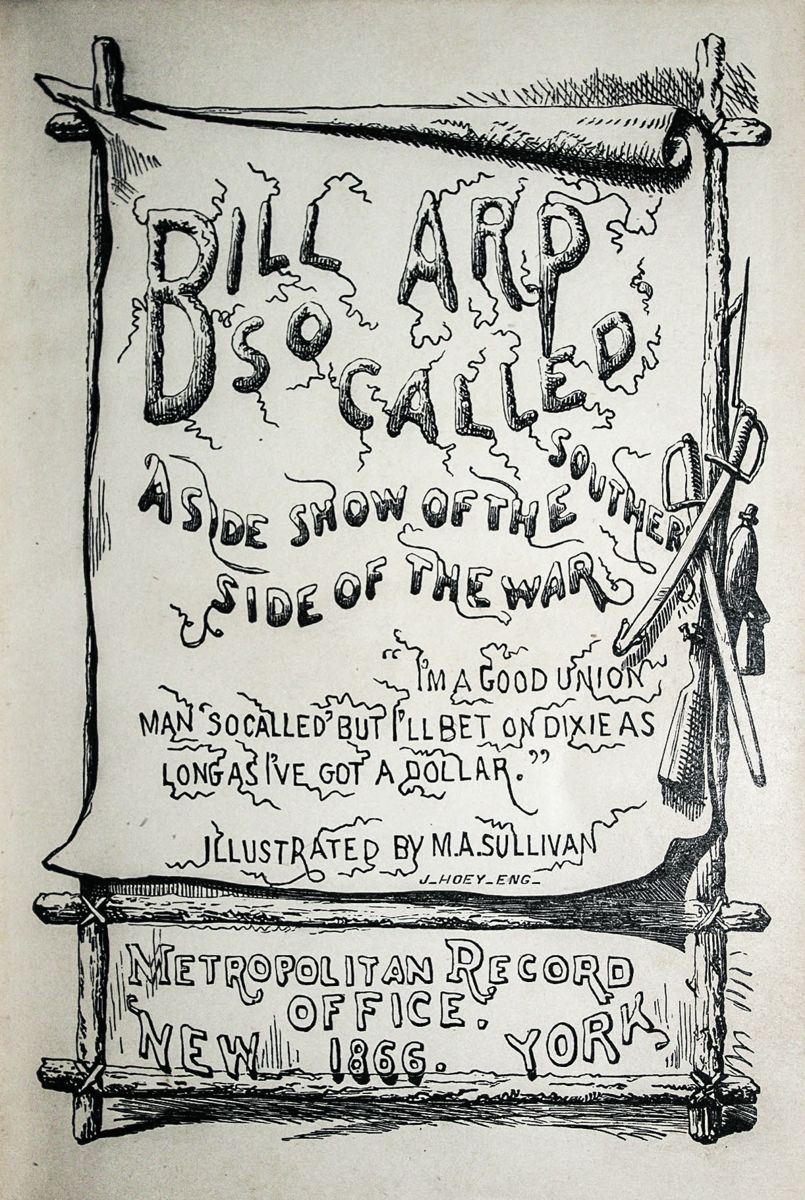
Fifty years ago, a writer for the Atlanta Constitution admitted that she did not know much about a regular columnist who had written for the paper in the late 1800s: Bill Arp. Boy, did she take a thumpin’! “Not know Bill Arp! Shame on you!” scolded one reader. An elderly Georgia woman wrote, “everybody who professes to be literate should know his name if not his works.” Well, I won’t go that far, but I love Bill Arp’s writing, and am proud that I own a copy of his Bill Arp, So Called: A Side Show of the Southern Side of the War (1866). I had my granddaughter, Haley Hawk, take pictures of it for this article. “Bill Arp,” of course, was a pseudonym. Charles Henry Smith was born in Lawrenceville, Ga., about thirty miles northeast of Atlanta, on June 15, 1826. He attended local schools and at nineteen entered Franklin College, now the University of Georgia. Smith showed his literary bent by editing a college newspaper. He never graduated, though; his father’s illness forced him to return home and run the family’s general store. Smith got married, studied law and joined a firm. In 1851 he took his wife and two children to Rome, Ga., seventy miles west of Lawrenceville. In Rome, Smith joined another law practice and acquired nine slaves by the time the war started. After Fort Sumter he joined a local militia company, which became part of the 8th Georgia Infantry. Traveling with it to Virginia, in June 1861 he was appointed regimental commissary with the rank of major.1 Smith’s calling, however, was not in the field, but on the newspaper page. When, on April 15, 1861, President Lincoln issued his call for rebellious Southerners “to disperse, and retire peaceably to their respective abodes,” a proclamation that Southerners frankly found hilarious, Smith decided to capitalize on the mood with an article in his local paper, the Rome Courier, written in dialect for funnier effect. “Mr. Linkhorn—Sur,” it respectfully began, as Smith sought to explain to the president why he and his fellow Southerners could not, in fact, disperse. “The fact is, we are most obleeged to have a few more days, for the way things are happening, it is utterly onpossible for us to disperse in twenty days….I tried my darndest yesterday to disperse and retire, but it was no go.”2 As Smith later recalled in Bill Arp’s Scrap Book (1884), he read his draft letter to “Mr. Linkhorn”
before a few friends. One William Arp, a Roman resident, asked what pen name Smith would use when submitting it. “I don’t know yet,” the author replied. “Well, ‘Squire,” Arp answered, “I wish you would put mine, for them’s my sentiments.” Smith agreed that he would.3 I like what James C. Austin, professor at Southern Illinois University, wrote a half-century ago about what happened next. Editors of other newspapers, in search of spicy copy, reprinted the letter. Its clean satire caught the fancy of a good many Southerners, and some months later the author wrote a second letter to Lincoln, then a third and a fourth. “Bill Arp,” the simple Georgia cracker, became known all over the South. The letters spoke the sentiments of the average man, they gave him something to laugh about in bitter times, and they rallied him to the Southern cause. As they continued to come—no longer addressed to President Lincoln—Bill became a Southern institution, a kind of national jester for the Confederacy. Bill Arp continued to poke fun at the Northern president. “Mr. Linkhorn, sur, privately speakin,” he wrote in one letter, “I’m afeerd I’ll git in a tite place here among these bloods, and have to slope
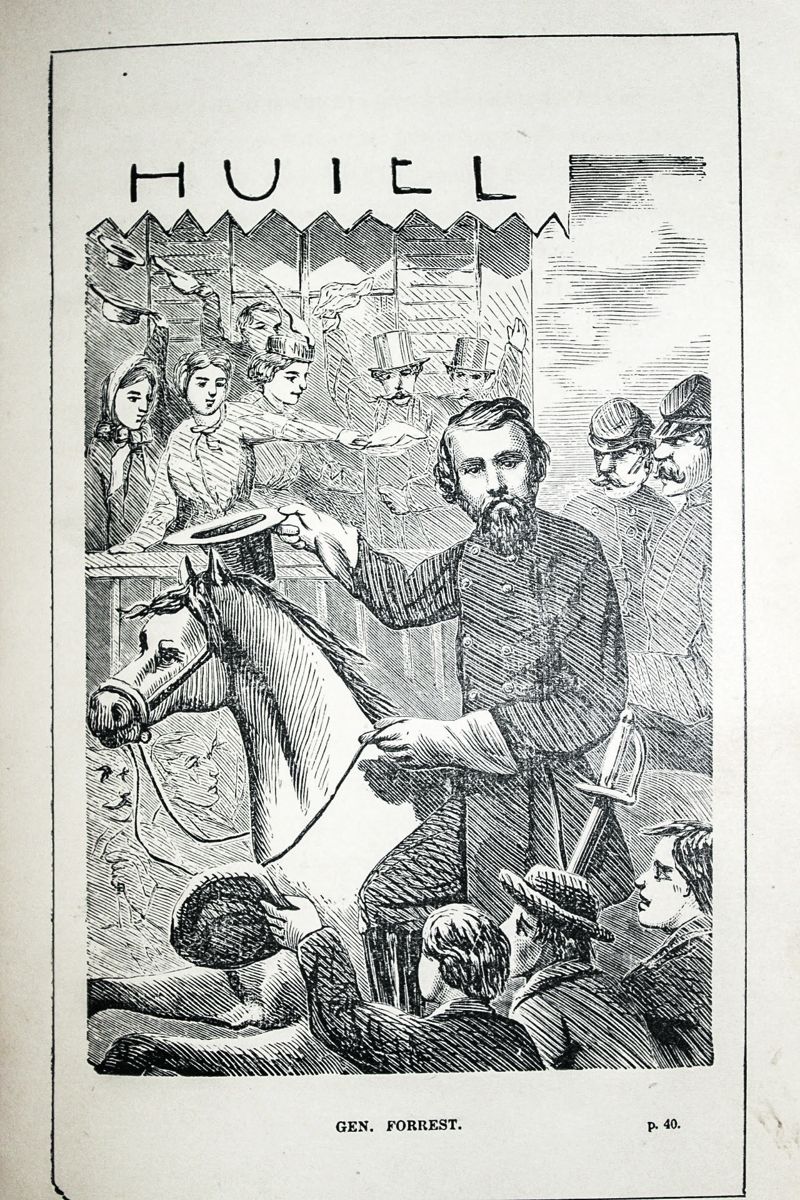
Smith portrait: Born in Georgia in 1826, Charles Henry Smith entered the profession of law, joining a practice in Rome, fifty miles northwest of Atlanta. out of it, and I would like to have your Skotch cap and kloak that if any papers ever produced a more thorough sensation than did the letters written by Major Smith during the War.”5 Major Smith eventually received a medical discharge from the army, and returned to Rome. His further letters appeared in the Atlanta Southern Confederacy, addressing news of the day. Thus after Bedford Forrest hunted down the Yankee raider Streight west of Rome in the spring of 1863, Smith wrote “Messrs. Adair & Smith” (Confederacy editors George Adair and Henly Smith) on how Romans had lionized General Forrest in the city. Smith was in Rome when Sherman’s forces approached the city in May 1864. He and his family joined most of the citizenry in a panicked flight from the city. But of course he turned his experience into a funny column, one of my very favorites. “Bill Arp, the Roman Runagee” was first published in the Atlanta Southern Confederacy on May 29, 1864. It was reprinted in Bill Arp’s Peace Papers (1873), a collection of articles written during and after the war. In the piece Arp describes the approach of Union forces toward Rome. “Not many days ago the everlasting Yankees (may they live always when the devil gets em) made a valyunt assault upon the sitty of the hills,” Arp explained, suggesting that Rome, Ga., like its Italian counterpart, was called the “city of the seven hills.” But alas for human hoaps! Man that is born of woman (and there is no other sort that I know of) has but few days that is not full of trubble. Altho the troops did showt, altho their brass band music swelled upon the gale, altho the turkey bumps ris as the welkin rung, altho the commandin Genrul asshoored us that Rome wer to be held at every hazerd, and that on to-morrer the big battle wer to be fout, and the fowl invaders hurled all howlin and bleedin to the shores of the Ohio, yet it transpired sumhow that on choosdy night the military evakuashun of our sitty was preemptorly ordered.6 Like most Roman “runagees,” the Smiths resettled in Atlanta. On June 3, a local paper, the transplanted Memphis Appeal, announced that “’Bill Arp’—Chas. H. Smith, Esq., better known as ‘Bill Arp,’ attorney and counselor-at-law, has opened an office in this city, with Col. J.W.H. Underwood.” He also continued to write for the Atlanta newspapers, and readers loved it. “Volo” wrote in from Roswell, north of Atlanta,
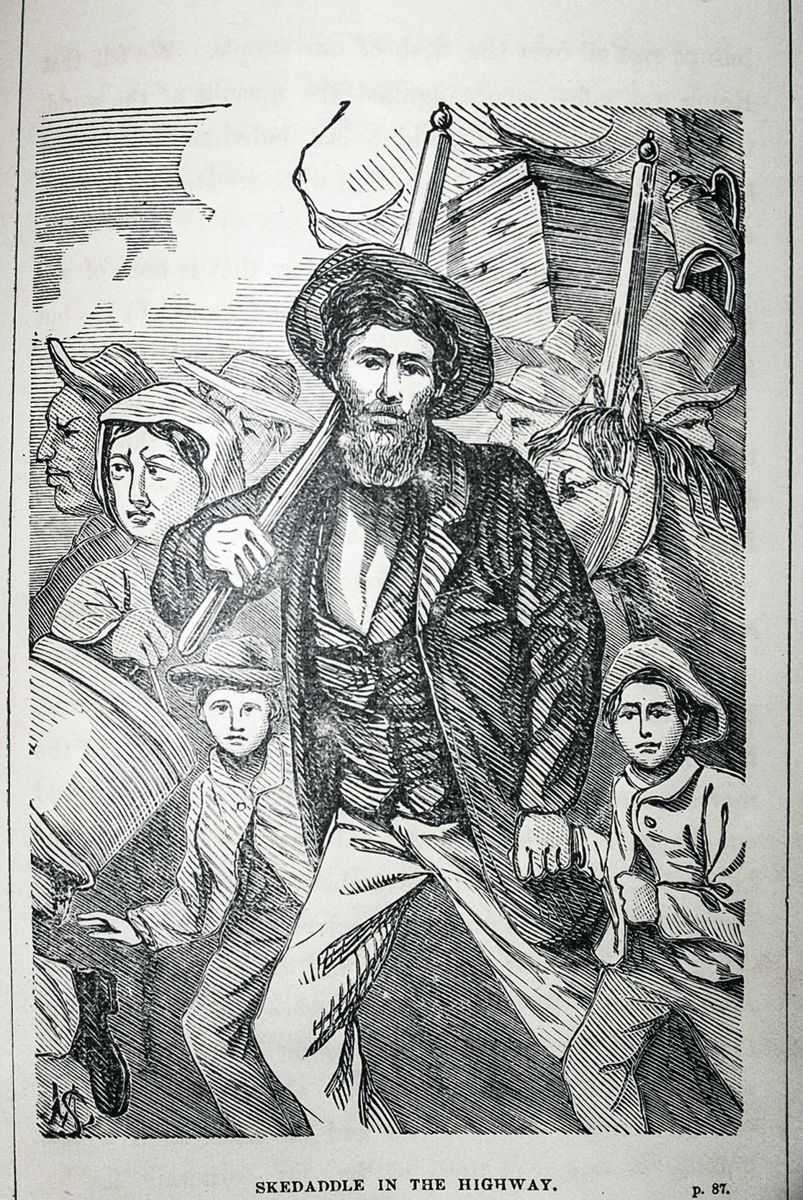
“we have received today’s Confederacy, and I assure you ‘Bill Arp’s’ letter was read with shouts and with ‘good’ from every tongue.”7 Smith was in Atlanta when the Yankees had gotten so close to the city that they were able, beginning on July 20, to fire artillery shells into Atlanta. The panicked citizenry began packing up and heading out, as Arp related, albeit (as usual) as a comic feature. About this time the fust big shells kommensed skatterin their unfeelin kontents among the sububs of that devoted sitty. Then cum the big paniks….All sorts of peepul seemed movin in all sorts of ways, with an akselerated moshun. They ganed ground on their shadders as they leened forwerd on the run, and their legs grew longer at evry step….Kars was the all-in-all….The passenger depo was throngd with ankshus seekers of transportashun. “Wont you let these boxes go as bagidge?” “No madam, its onpossible.” Just then sumbodys family trunk as big as a niter buro was shoved in, and the poor woman got desprite. “All I’ve got ain’t as hevvy as that,” sed she, “and I am a poor wider, and my husband was killed in the army. I’ve got five little children, and my things hav got to go.” We took up her boxes and shoved em in. Another good woman axed very anxshusly for the Makon trane. “There it is, madam,” sed I. She shuke her hed mournfully and remarked, “You are mistakin, sur, don’t you see the injine is hedded rite up the State Road towards the Yankees? I shant take any trane with the injine at that end of it. No, sur, that ain’t the Makon trane.” By and by the shells fell as thick as Guvener Brown’s proklamashuns, causin a more speedy lokomoshun in the xsiled throng who hurrid by the dore….All day and all nite long the iron hosses were snortin to the ekoin breeze. Trane atter trane of goods and chattels moved down the rode, leavin hundreds of ankshus fases waitin their return. There was no method in this madness. All kinds of plunder was tumbuld in promiskuously. A huge parlor mirrer, sum 6 foot by 8, all bound in ilegant gold, with a barass buzzard a spreddin his wings on the top, was sot up at the end of the kar, and reflekted a butiful assortment of parler furnichure to match, sich as pots and kittles, baskets and bags, barrels and kegs, bacon and bedsteds, all piled up together.8 Smith and his family returned to Rome in December 1864, after
Sherman and his army had set out for Savannah and the sea. He resumed his law practice and in 1868 was elected mayor of Rome. A decade later the Smiths moved to Cartersville, the county seat of Bartow County. “Bill Arp” continued to write humorous pieces on the War and Reconstruction for the Atlanta Constitution, whose editor, Henry W. Grady, became a close friend. These and his wartime articles were published in several collections. In Bill Arp’s Peace Papers (1873), the author muses on the republication in Richmond during 1864 of Victor Hugo’s Les Miserables. The book became a hit among Confederate soldiers in Virginia, who started calling it (and themselves) “Lee’s Miserables.” This prompted Bill Arp to comment, “sum frog-eatin Frenchman hav writ a book and kalled it ‘Lee’s Miserbels,’ or sum other sich name, which I spose contain the misfortunes of poor refugees in the wake of the Virginny army. Genrul Hood hav also got a few miserbels in the suberbs of his fiting ground….” “Hood’s Miserables” has yet to catch on in the literature, but leave it to Bill Arp to give it a try. The famed writer died Aug. 24, 1903, and is buried in Cartersville’s Oak Hill Cemetery. At the funeral service, a clergyman declared that Bill Arp’s name “was known around the world.”9 Even Bill would have found that statement “a little steep.” But it was solidly grounded in the tradition of comic exaggeration that one sees so often in Southern literary humor.* *I’ll give one of my favorite examples. In Life on the Mississippi (1883), Mark Twain comments on the mosquitoes swarming around Lake Providence, La. A local had told Twain that the insects were so huge as to be dubbed “Lake Providence colossi.” “He said that two of them could whip a dog, and that four of them could hold a man down,” Twain recorded. “He told many remarkable things about those lawless insects. Among others, said he had seen them try to vote.” “Noticing that this statement seemed to be a good deal of a strain on us, he modified it a little,” the writer continued; “said he might have been mistaken, as to that particular, but knew he had seen them around the polls ‘canvassing.’” 1.
What’s In A Name? 1. Two Union generals were named for this famous explorer who “discovered” the New World in 1492. 2. Another Northern general bore the name (in Latinized version) of this Italian explorer after whom “America” was named. 3. Four Federal and two Confederate generals bore the name of this first president of the United States. 4. Another four Civil War generals carried the name of this famous Pennsylvanian, author of Poor Richard’s Almanack. 5. One Federal general was named for Napoleon Bonaparte, but surprisingly two were named for this king of Sweden (reigned 1611– 1632), credited with establishing his country as a world power. 6. Three Union generals were named for this president of
Endnotes:
David B. Parker, Alias Bill Arp: Charles Henry Smith and the South’s “Goodly Heritage” (Athens: University of Georgia Press, 1991), 3-14; Richard Michael Allen, comp., The 8th Georgia Volunteer Infantry
Regiment, 1861–1865 (El Dorado Hills CA: Savas Beatie, 2018), 36. Ford Risley, ed., Dear Courier: The Civil War Correspondence of Editor Melvin Dwinell (Knoxville: University of Tennessee Press, 2018), 319 n. 2 (“he began writing satirical essays for the Courier”); Parker, Alias Bill Arp, 52-54. Bill Arp’s Scrap Book; Humor and Philosophy (Atlanta: Jas. P. Harrison & Co., 1884), 7-8. James C. Austin, Bill Arp (New York: Twayne Publishers, 1969), 19; Carole E. Scott, “Writing under the nom de plume ‘Bill Arp,’ Charles H. Smith achieved fame as the Confederacy’s jester,” America’s Civil War, May 2004, 16. Anne M. Christie, “Civil War Humor: Bill Arp,” Civil War History, vol. 2 (September 1956), 103. Parker, Alias Bill Arp, 57-58; “Bill Arp, the Roman Runagee,” Atlanta Southern Confederacy, May 29, 1864; Bill Arp’s Peace Papers (New York: G. W. Carleton & Co., 1873), 67-68. “Local Intelligence,” Memphis Appeal, June 3, 1864; “Volo,” “On the Right Wing,” Atlanta Southern Confederacy, June 22, 1864.
the United States who served 1829–1837. 7. A Confederate and a Federal general bore the name of this famed American officer whose service bridged the War of 1812 to the start of the Civil War. 8. One Federal general was named after this third U.S. president. 9. Similarly, a Union general bore the name of this sixth president of the United States. 10. Finally, let’s hear it for classical composers. A Northern general carried the name of this Austrian composer who in his lifetime (1732-1809) wrote more than a hundred symphonies. Answers found on page 46. Steve Davis is the Civil War News Book Review Editor. He can be contacted by email at: [email protected].
Quoted in Stephen Davis, What the Yankees Did to Us: Sherman’s Bombardment and Wrecking of Atlanta (Macon: Mercer University Press, 2012), 127-28. John D. Eidson, “Charles Henry Smith (‘Bill Arp’),” in Kenneth Coleman and Charles Stephen Gurr, eds., Dictionary of Georgia Biography, 2 vols. (Athens: University of Georgia, 1983), vol. 2, 895; Bill Arp’s Peace Papers, 81.
Stephen Davis, of Cumming, Ga., has long had an interest in Southern literature. At Emory University he took his Ph.D. in American Studies; his dissertation was titled “Johnny Reb in Perspective: The Confederate Soldier’s Image in the Southern Arts.” During his time as graduate student he had published “Mark Twain, the War, and Life on the Mississippi (Southern Studies, Summer 1979) and “Turning to the Immoderate Past: Allen Tate’s Stonewall Jackson (Mississippi Quarterly, Spring 1979).