
Aboard the Ironclad Ram Arkansas with Naval Surgeon H.W. Macrae Washington
By Bob Ruegsegger · Originally published April 2019 · p. 21
His earthly remains are interred near the moss-covered brick wall that marks the inner burial ground surrounding Ware Church in Gloucester County, Va. Encircled by family members who have also gone to their rewards, Dr. H.W. Macrae Washington presumably rests in perfect peace. On the Washington family monument, the years of his birth and death are inscribed: 1835 – 1915. On his grave, there is a rusty cast-iron Maltese cross bearing a wreath, flag, and letters CSA in relief. As a student at the College of William and Mary in 1852, Washington could never have imagined that he would resign his commission, along with 499 other Southern officers, in the United States Navy in 1861 and offer his services to a fledgling Confederate Navy. While Captain Sidney Smith Lee, Captain Franklin Buchanan,
Dr. H.W. Macrae Washington rests in peace in Gloucester, Va., surrounded by his kin.
Washington Monument This monument marks the burial site of Dr. Washington and his relatives. The site includes the grave of George Washington.
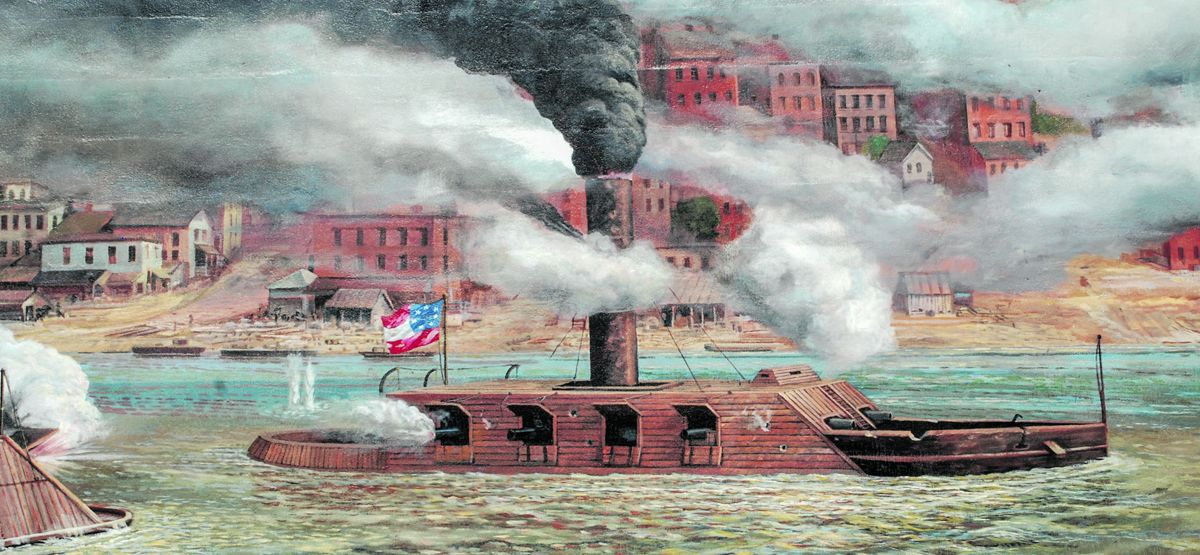
Commander Matthew Fontaine Maury, and Surgeon H.W.M. Washington all tendered their resignations in 1861, the United States Naval Register 1862–63 officially, and incorrectly, lists their names and the names of 136 other Southern officers as dismissals rather than resignations, perhaps out of vindictiveness. While Washington served as surgeon aboard the gunboat CSS Chattahoochee and ironclad CSS Fredericksburg, his most dramatic encounter with history occurred while he was surgeon aboard the ironclad ram CSS Arkansas. Begun in Memphis and hastily completed in Yazoo City, Miss., the Arkansas successfully, albeit briefly, challenged the US Navy Mississippi River squadron above Vicksburg. Construction of the formidable twin-screw ram Arkansas began at Fort Pickering, a landing below Memphis; after the fall of New Orleans, the vessel was towed to Greenwood, Miss., on the Yazoo River for completion. Under pressure of the Federal advance up the Mississippi, Lt. Isaac Newton Brown and a large workforce composed of slaves and soldiers worked 24 hours a day to finish the vessel. With a crew of 200 sailors, soldiers, firemen, and boys the CSS Arkansas steamed down the Yazoo River from Liverpool Landing toward Vicksburg to take on supplies. The Federal ironclad Carondelet, ram Queen of the West, and the gunboat Tyler met the Confederate ironclad descending the Yazoo River while they were on a reconnaissance mission. The Arkansas, 165 feet in length and armed with powerful naval guns, rifled cannon, and Columbiads, ferociously engaged the Federal force, disabling the Carondelet and chasing the other enemy vessels down into the Mississippi River. With ailing engines and significant visible damage, the Rebel ironclad fought her way past Farragut’s stunned fleet anchored in the Mississippi and arrived under the guns of the Vicksburg batteries to a cheering crowd that had observed her valiant struggle on the river. The heroic dash of the Arkansas down the Yazoo and Mississippi rivers to Vicksburg was not without considerable human cost. The Arkansas casualties were 16 men killed and 17 wounded. Federal losses, according to accounts published in Northern papers, were over 120 men killed or wounded. During the historic clash between Arkansas and the Federal fleet, Surgeon H.W.M. Washington, as well as Assistant Surgeon C.A. Morfit of Maryland, must certainly have, to say the least, had their hands full tending the dying and the wounded below the ironclad’s gun deck. “I was taken below, wounds were dressed, and returned to my gun shortly afterwards,” noted Acting Master’s Mate John A. Wilson, an Arkansas crew member. Wilson suffered minor wounds in the arm and leg from flying iron and wood fragments when a shell pierced the port side of the armored casemate and exploded. “In this engagement, it would be invidious to mention any particular man or officer for acts of bravery; all hands did their duty well, honestly, and courageously,” added Wilson. “The scene around the gun deck upon our arrival at Vicksburg was ghastly in the extreme. Blood and brains bespattered everything, whilst arms, legs, and several headless trunks were strewn about,” wrote Wilson, an eyewitness. “The citizens and soldiers of the town crowded eagerly aboard, but a passing look at the gun deck was sufficient to cause them to retreat hastily from the sickening spectacle within.” The remainder of that dramatic day was spent burying the dead, sending casualties ashore, cleaning the vessel, and carrying out repairs. When Wilson was transferred to a hospital at Edwards Station, he wrote that he found Surgeon Washington and Lt. Barbot of the Arkansas presumably treating the casualties or recovering from their own wounds.
After having been through such an ordeal, Dr. Washington could never have any doubts about what he had done during the engagement in terms of handling the casualties, but he must have had some doubt as to exactly what transpired upon the river while his was up to his elbows in gore. Washington was apparently so much a part of the action that he evidently was unable to comprehend the overall picture. Thirty-four years after the engagement, evidence of his request for a detailed account of the action in which he participated appeared in Confederate Veteran. “Dr. H. W. M. Washington, of North, Virginia, served on the CSS Arkansas, and would like to see some account of her performances about Vicksburg,” noted S.A. Cunningham, editor. The Arkansas, doomed from the beginning because of inadequate engines, saw two additional actions in her brief but exciting career. While undergoing repairs to her engines, armor, and smokestack under the protection of Vicksburg’s shore batteries, the Arkansas was attacked by the Federal ironclad Essex and the ram Queen of the West. Although the Federal assault was successfully repelled, seven of the ironclad’s crew were killed and six more injured. In spite of the fact that her engines were in poor working order, the Arkansas was ordered down the river to support a Confederate attack on Baton Rouge. The Arkansas never made it to Baton Rouge. She ran aground when her engines failed completely and could not be repaired. With the Federal fleet bearing down on the disabled ironclad, the situation was indeed hopeless.
After running out her guns and setting the ironclad ablaze to avoid Federal capture, her officers and crew went ashore. A well-aimed shell fired from the Federal ironclad Essex sealed her fate by striking the magazine and causing a violent explosion. The Confederate vessel, utterly destroyed, settled quickly into a watery Mississippi River grave somewhere just above Baton Rouge. Washington survived the CSS Arkansas by more than 50 years. Although he subsequently served aboard the ironclad CSS Fredericksburg on the James River, he never again saw combat comparable to that he experienced aboard the Arkansas. The echoes of the ironclad’s arsenal have long since dissolved into muffled silence, and the courage of her stouthearted crew has faded into the fabric of American history. The fragmented remains of the CSS Arkansas have settled deep into the Mississippi mud. Dr. H.W. Macrae Washington reposes in comparative tranquility today in a partially shaded family plot at Ware Church with only the soothing hum of light traffic on John Clayton Memorial Highway [Route 14] to disturb his eternal rest. Bob Ruegsegger is an American by birth and a Virginian. His assignments frequently take him to historic sites throughout Virginia, the Mid-Atlantic, and the Southeast. His favorite haunts include sites within Virginia’s Historic Triangle—Jamestown, Yorktown, and Williamsburg. Bob served briefly in the U.S. Navy. He is a retired educator and has been an active newspaper journalist for the last twenty years.