
Critic's Corner
Virgil Carrington Jones’ Ranger Mosby (1944)
By Stephen Davis · Originally published September 2018 · pp. 38–39
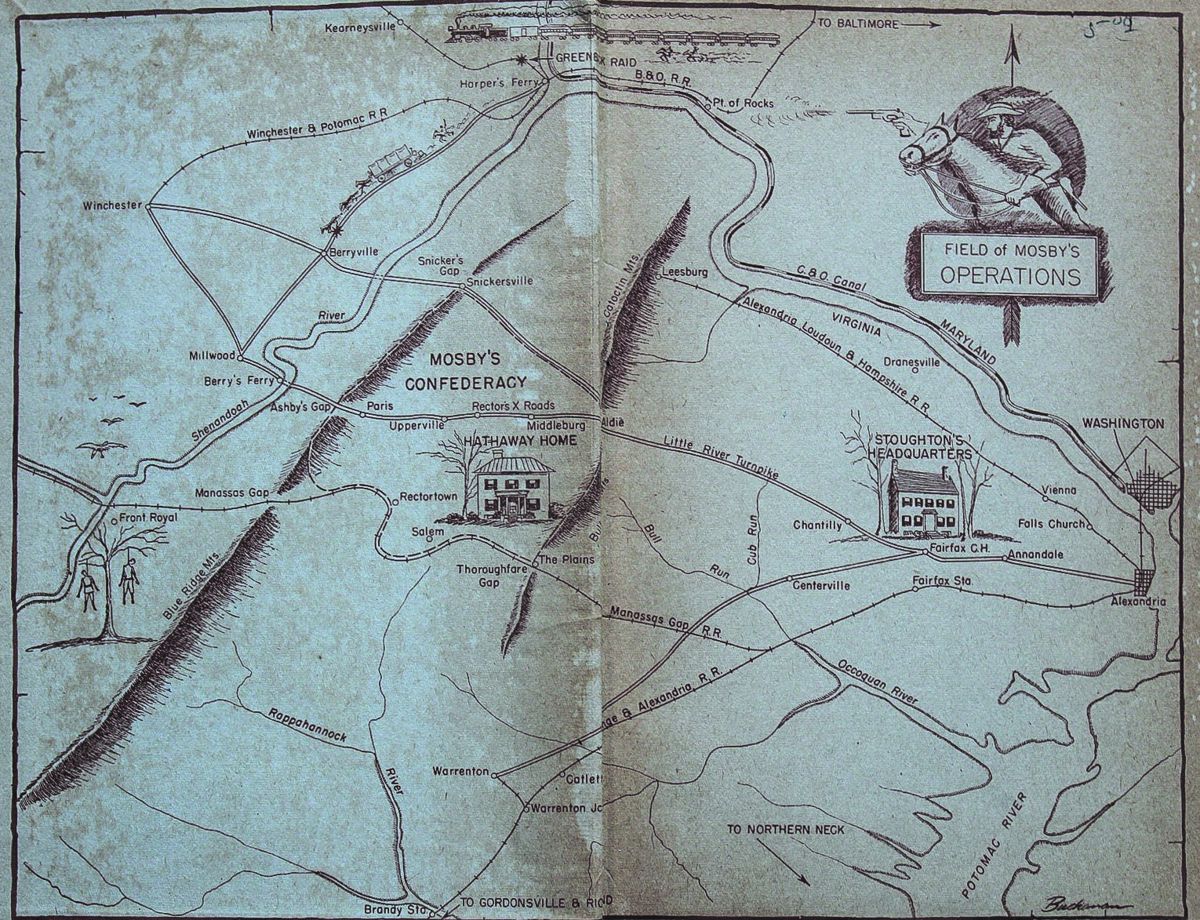
“How long have you had that book?” My son asked me that question as we sat in the Atlanta airport, waiting to board our flight. I was showing him Virgil Carrington Jones, Ranger Mosby, the work I had chosen to (re-) read on our trip to San Juan. “I don’t know,” I replied in answer to his question. “Maybe forty years?” I pointed to the seller’s price, penciled inside the front cover; “5oo.” Yes, I had bought Jones’ biography way back when a Civil War classic could be purchased for what it costs to buy two cups of coffee today. Even better: I bought it from my great professor, Bell Wiley, around 1970, when he was downsizing his Emory University office library. Occasionally, as I subsequently read that copy, I found he had made little marks in the margins (e.g., on page 174, where Jones claimed that the operations of Mosby and other partisan rangers extended the life of the Confederacy by six months). I told Heath that, like many buffs, I started buying Civil War books in high school. But I did so even more in college, especially after taking Dr. Wiley’s Civil War course at Emory my junior year. Professor Wiley would give us typewritten lists of recommended books on various war topics. I remember taking his lists to Atlanta’s second-hand bookshops (there were more of them back then), and referring to them as I considered possible purchases. In his two-volume bibliography, Civil War Books (compiled with Allan Nevins and James I. Robertson Jr.) Wiley judges Jones’ biography “a popular study, conveying the romantic character of Mosby and his exploits.” It very much indeed does that—hence my decision to enjoy it once more as a “beach read.” Jones researched and wrote his book starting in 1938, when Mosby’s son and daughters were still alive. He was able to consult with Dr. Douglas Southall Freeman on factual details. “Partisan warfare was a serious practice with this man who put aside his law books to defend the South,” Jones writes. With anywhere from a dozen to eighty men, he conducted forays in three counties of northeastern Virginia that eventually came to be called “Mosby’s Confederacy.” “Wagon trains were raided. Bridges were burned. Ammunition and arms and supplies were captured.
Pickets, scouts and stragglers were gobbled up as if the earth had opened and swallowed them.” Federals tried repeatedly to hunt down and apprehend the partisan raider, but in vain. A frustrated Phil Sheridan finally concluded that it was “well nigh impossible,” because Mosby knew the country better than he did. “They struck quickly, according to their code and their leader’s belief that surprise was one of the greatest weapons of offense. And they retired with the same rapidity with which they had come, scattering to the four winds of the earth, to meet again in a few minutes, a few hours, or a few days.” Sometimes using a novelist’s ear for conversation, and a painter’s eye for scenery, Jones tells the story of John Mosby’s life with the refreshing jauntiness of a morning’s horseback ride. He joined a cavalry company in January 1861, at the age of twenty-seven. After Virginia’s secession, Mosby’s company became part of the 1st Virginia Cavalry, led by Jeb Stuart that eventually became a unit in what would later be the Army of Northern Virginia. At the battle of Manassas, July 21, Stuart’s men were up early for reconnaissance. Years later Mosby remembered proudly riding as No. 1 in the first set of fours at the head of his squadron. Jones notes this from Mosby’s Memoirs, and adds in a note that the incident “has been confirmed to the author by Beverly Mosby, who recalled that he often heard his father remark on the fact.” During the fall and winter of 1861–62, Mosby caught the eye of his superior, Brigadier General Stuart, was promoted first lieutenant, and made adjutant of the First. Mosby rode with Jeb around McClellan’s army in June ’62, earning Stuart’s further commendation. After the Confederate Congress passed its Partisan Ranger Act in the spring of 1862, Mosby proposed raising a command to raid behind enemy lines near Washington to Stuart. Nothing came quickly of the idea, so Mosby served on Stuart’s staff at Second Manassas and Sharpsburg, sometimes riding out on scouting patrols. Finally, in late December ’62, Stuart authorized Mosby to operate in the area of Fairfax Court House with nine men. After Mosby brought in twenty-two prisoners and as many horses, a delighted Stuart gave him more men. “That day,” as Jones put it, “meant Mosby’s actual farewell to the regular service.” He had now become a Partisan Ranger. He attacked Union picket posts, captured, and paroled his prisoners, then let his men divide the horses and weapons taken. Mosby had earlier resigned his lieutenancy over the practice of units electing their officers, and though Stuart had promised him an officer’s commission, in the spring of 1863, Mosby was leading his men without rank. The matter came to General Lee’s attention; he followed Stuart’s practice at the time of referring to Mosby as “captain.” In February 1863, he was only commanding some two dozen rangers but word of Mosby’s exploits brought in more volunteers. One was actually a Yankee sergeant, James F. Ames, who had deserted from the 5th New York Cavalry. Sternly grilled by the suspicious Southerners, Ames gave his reason: with Lincoln’s Emancipation Proclamation, recently issued, “the war had become a war for the Negro instead of a war to save the Union.” “Big Yankee” Ames proved to be a loyal Mosby Partisan until his death in October 1864. Mosby’s rank as lieutenant was reinstated; the raids and forays continued. For instance, at Aldie, March 2, 1863, two captains and seventeen men were captured, plus twenty-three horses. Jones describes the exploits zestfully, without the starchiness, I have to say, of academic prose. As Mosby and his men rode toward Fairfax Court House, “the continual creak of saddle leather, the muffled crunch of leaden feet and the silky purr of horses breathing were the only sounds that rose from the silent column.” Probably Mosby’s most famous feat was his ride into Fairfax on the night of March 8-9, 1863. With twenty-nine men, he sneaked past Federal guards into town and captured a sleeping Brig. Gen. Edwin Stoughton, two captains, thirty privates and fifty-eight horses— all without a shot or a casualty. Stuart was so pleased that he handed Mosby his commission as captain. General Lee had seen to the promotion, with a special order issued on March 23 expressing the appreciation of no less than President Davis. Stuart added in a note, “Your praise is on every lip, and the compliment of the President has paid you is as marked as it is deserved.” This brought in more volunteers; fifty-five men were riding with Mosby in late March ’63. He usually didn’t divulge his plans on a raid; partly out of concern for his men’s safety should they be apprehended, but mostly to keep the enemy in the dark. After a raid on Chantilly brought back thirty-six prisoners and many horses, General Lee was heard to exclaim, “Hurrah for Mosby! I wish I had a hundred like him!” Lee sought permission from the president to promote Mosby to major of Partisan Rangers, just two weeks after he had won his captaincy. He got it. Armed with a howitzer, Mosby’s band captured a train near Catlett’s Station, May 30, 1863. On June 10, his command of about a hundred men was organized as Co. A, 43rd Battalion, Partisan Rangers. Later, two more companies were formed. Even though General Lee thought the operations of partisan rangers were hurtful to the service (essentially luring able men to lucrative raiding, rather than serving in the army’s infantry), he recommended Major Mosby’s promotion to lieutenant colonel in January 1864. Jeb Stuart heartily endorsed it, and the promotion came through the next month. About this time his battalion numbered maybe 240 men, although Mosby never assembled them all together at any one time. With his raids and forays in his three-county “Confederacy,” Mosby’s band regularly captured prisoners, horses, and wagons. At Berryville, east of Winchester, in August 1864, the Rangers attacked a Federal wagon train, and rode off with 200 Yankees, 500 to 600 horses and mules, and almost 200 cattle after burning the 75 wagons. The Rangers were allowed to keep the swag they sometimes captured. After Mosby’s band attacked and captured a train carrying a Northern paymaster’s funds, each Confederate rode off with over $2,000. When Federal columns searched for him, Mosby eluded them or sometimes fought and even routed them. Defeats were rare, but every casualty in his command was painful. Working from Mosby’s reports, Memoirs, and Federal accounts, Jones’ recounting of these events is sure-handed. Only rarely does one see a slip-up, as in several places he writes that Federals advancing southward in the Shenandoah were marching “down the valley”; Virginians follow the flow of the Shenandoah River from south to north, so that the lower Valley is closest to the Potomac; the upper valley is toward Staunton (and that’s pronounced Stan-ton, if you please). In August 1864, General Lee sent Mosby a letter of commendation. In a six-month period he had killed, wounded or captured 1,200 enemy troops, brought in 1,600 horses and mules, 230 cattle, and eighty-five wagons or ambulances, with a loss of merely twenty men.
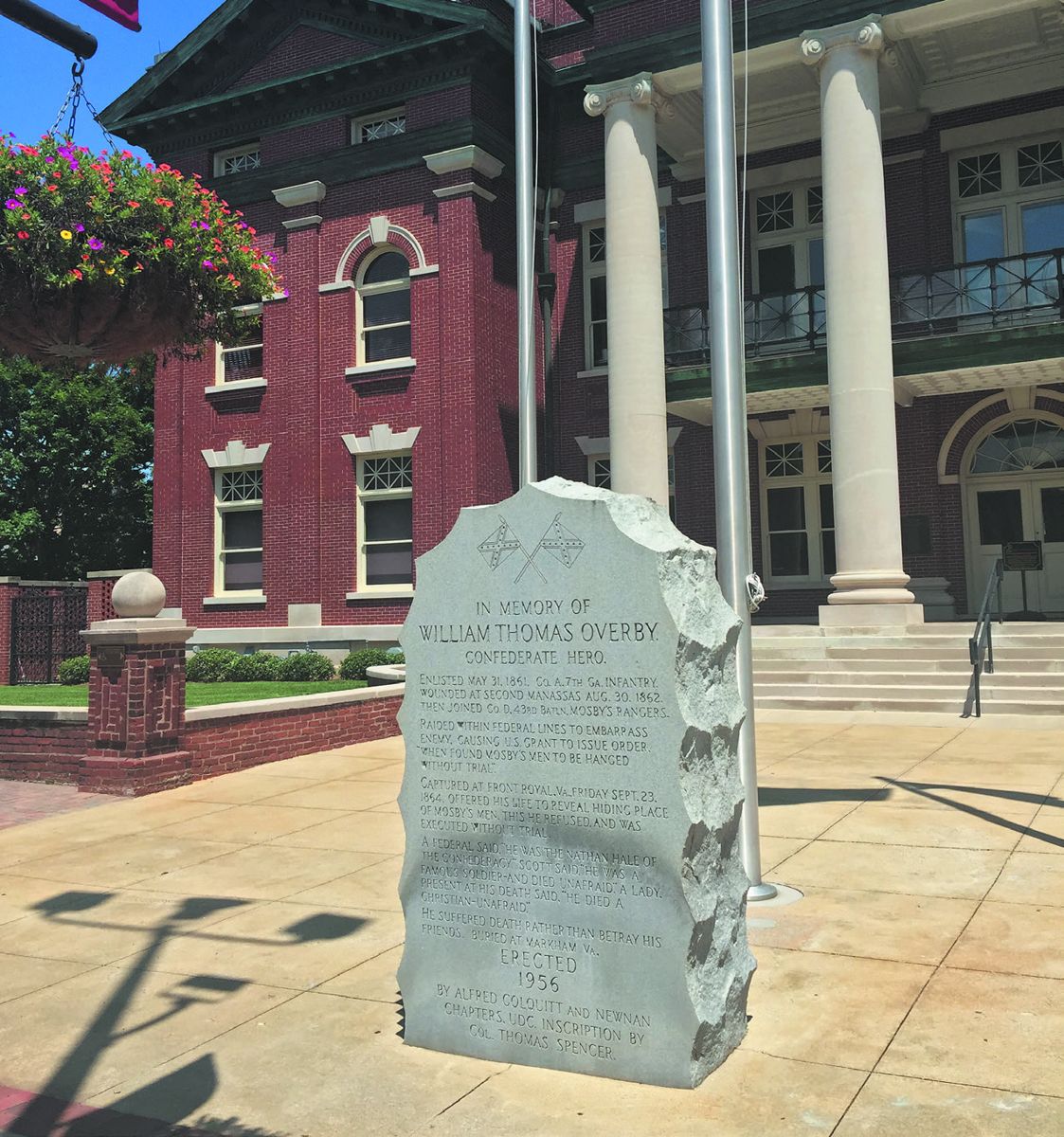
In the fall of 1864 angry Union officers began hanging Mosby’s men when they were captured. One of them was William T. Overby, a Georgian who refused to divulge the location of Mosby’s headquarters. At Newnan, his hometown, a monument to his memory is dedicated, which years ago I drove to see: “He suffered death rather than betray his friends,” it reads, under the heading “WILLIAM THOMAS OVERBY CONFEDERATE HERO.” After Union Gen. George Custer had six Rangers hanged, General Lee authorized Mosby to hang six of Custer’s men if they were captured. Mosby soon had his vengeance. In late November ’64, Sheridan ordered all forage, barns and mills in Mosby’s Confederacy to be burned, and all livestock driven off. The destruction was ruthlessly carried out, and civilians suffered. Mosby and his men, though, continued to elude capture. In early December, he was promoted colonel and authorized to split his command into two battalions. (He had at the time close to some 800, as men constantly volunteered to join him.) Two weeks later, when Federals came upon Mosby, shot and captured him, they didn’t know who they had, and left him behind, thinking his wound was mortal. Mosby was sufficiently recovered a month later to travel to Richmond and receive the thanks of the Confederate Congress. He shared a modest dinner with General Lee. The end of Mosby’s astonishing record of adventures came after Appomattox; he disbanded his command rather than surrender it. Mosby himself received the same kind of parole that Lee’s men had gotten. Thus ends Virgil Carrington Jones’ story, told in the colorful style of a journalist (which he was). The assessment of one reviewer, H.J. Eckenrode, back in 1945, still stands: “when you close the book you feel that you have been entertained by a fine yarn, and agreeably instructed as well.” Stephen Davis of Cumming, Ga., is Book Review Editor for Civil War News. He is currently writing a study of how the Atlanta Intelligencer, the city’s leading daily newspaper, covered the war, 1861–1865. His co-author is Bill Hendrick, veteran journalist of forty years, writing for the Atlanta Journal-Constitution, Associated Press and many other publications. Their book will be published by the University of Tennessee Press.