
Stonewall Jackson’s Legacy Still Embraced at Ellwood
By Bob Ruegsegger · Originally published September 2018 · p. 18
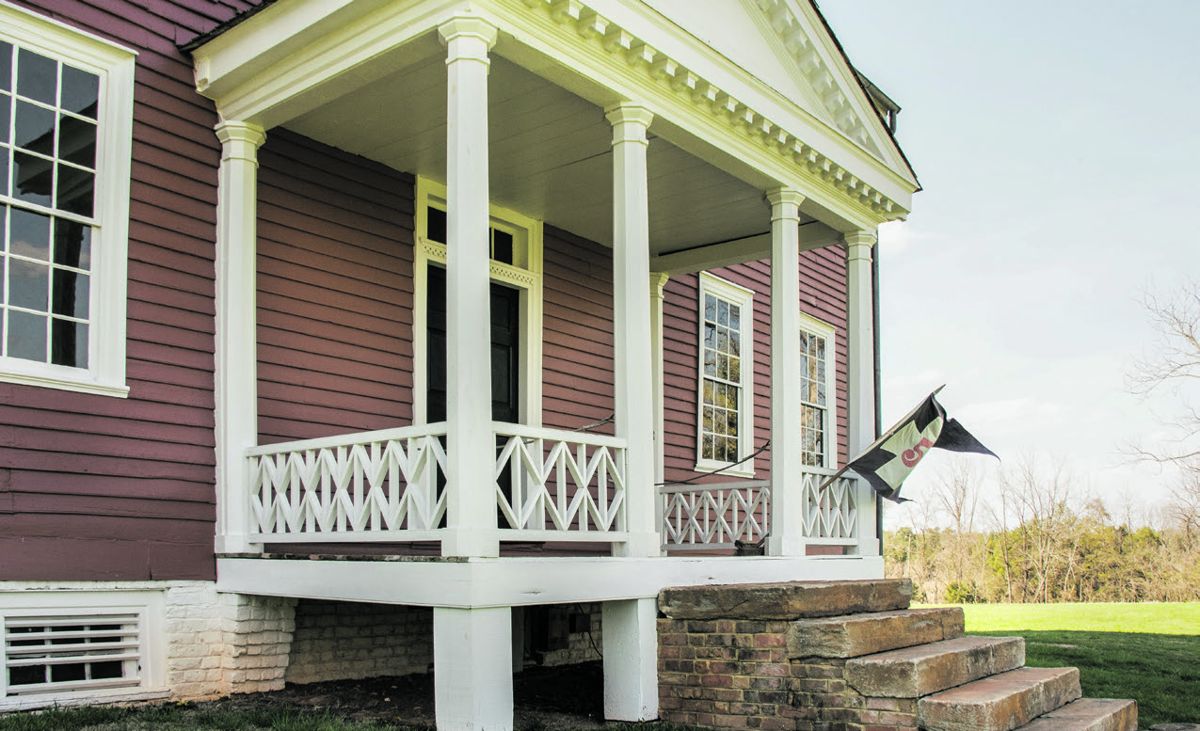
Ellwood was built by William Jones circa 1790 on 5,000 acres. It was, and still is, a quiet farm. Only two families have owned Ellwood in its 200-year plus history. In 1977, the National Park Service acquired the house and surrounding land. It is now part of Fredericksburg and Spotsylvania National Military Park. During the Civil War, Ellwood was owned by James Horace Lacy who also owned Chatham, an elegant residence across the Rappahannock River from Fredericksburg. Ellwood served as Lacy’s summer home. Major James Horace Lacy thought a lot of himself, according to Mark Leach. When the Civil War broke out, Lacy, an ardent secessionist, immediately volunteered to serve as an officer in the Confederate Army. “They started him off as a lieutenant – possibly a captain – but he told everybody that he was commissioned as a major from the get go,” said Leach. “That’s how he got the title.” Leach knows all about the Battle of Chancellorsville and how General Stonewall Jackson lost his arm. Hearing that story from Leach, or one of the other volunteers, is almost invariably part of sharing the Ellwood experience. Jackson decided after the day’s fighting slowed at Chancellorsville to ride up after sunset and check the lines to see if they had held through the evening. It was not a good decision. It was dark outside. Jackson and his entourage were mistaken for the enemy and North Carolina troops opened fire. They hit Jackson in three places; the upper left arm, the left forearm, and once in the palm of his right hand.
Ellwood was a thriving Virginia farm before the war. Corn and wheat were grown on the rolling farmland. The manor house was surrounded by outbuildings; among them a smokehouse and a dairy. Generals Gouveneur K. Warren and Ambrose E. Burnside, two of the Union Army’s four corps commanders, moved into Ellwood itself. Orderlies and staff officers overran the building during the Battle of the Wilderness.
Jackson was immediately removed by stretcher, loaded into an ambulance, and transported from the spot where he was shot to the Second Corps Field Hospital near Wilderness Tavern. The ambulance ride was a rough trip for the seriously wounded general. “His doctor, Dr. Hunter McGuire, performed the amputation late that evening. He amputated the arm just below the shoulder. It was basically a very high amputation,” said Leach. “The amputation went very well. They expected the general to fully recover even though he had lost a lot of blood.” The following morning, Reverend Beverly Tucker Lacy, Jackson’s chaplain, noticed the general’s arm laying beside the surgeon’s tent. “Reverend Lacy didn’t think it was proper for the general’s arm to be thrown out,” said Leach. “So he wrapped it up and brought it over here to his brother’s house and buried it in the family cemetery where it is today.” Captain James Power Smith, an aide-de-camp to Jackson, wrote a detailed account of Jackson’s wounding and the events that followed. Captain Smith’s narrative, according to Smith, was based upon remarks that came “from the lips of the wounded general himself” and was “confirmed and completed by eye-witnesses and near companions.” “His shattered arm was buried in the family burying ground of the Ellwood place, Major J.H. Lacy’s, near his last battlefield,” wrote Captain Smith. The Jones family cemetery is located three hundred yards south of the manor house at Ellwood. There is only one marker in the cemetery; a single stone referring to Stonewall Jackson’s arm. “There are actually 31 arms buried here. They are the arms of 15 family members plus Stonewall Jackson’s left arm,” said Leach. “But, as you’ll notice, there aren’t any headstones in the cemetery, other than the marker for THE arm,” he said. “We don’t know if there ever were any headstones here. We kind of doubt it. It was common practice in the old rural areas not to spend money on headstones.” The money could, it was thought, be better spent on the farming operation or in purchasing more property. Family members knew where everyone was buried. It was a general practice to keep a diagram of the burials in the back of the family bible. Interestingly, Captain James Power Smith married Major Lacy’s eldest daughter. He had access to the bible with the sketch in it that showed where everybody was buried. “One of the big questions we have was whether or not he placed the marker where the arm was located or purposely put it where he knew the arm wasn’t buried,” said Leach. In 1921 the United States Marine Corps “invaded” Ellwood. Four thousand, two hundred Marines bivouacked on the estate near Wilderness Run, a stream that runs through the property. General Smedley Butler, who was in charge of the Marine Expeditionary Force, did not believe, according to the family living at Ellwood in 1921, that General Jackson’s arm was buried in the Jones family cemetery. The Marines found the marker. They found the bones of the arm and reburied them; the story goes, in a metal ammunition box. The Marines did clean up the neglected cemetery and affixed a bronze plaque honoring General Stonewall Jackson to the monument. “When the Park Service first acquired the property, they started looking for the box. There was no sign of it anywhere,” said Leach. “They hooked a chain around the marker and dug four feet down and about three or four feet out looking for a box. They never found anything,” he said. As far as the National Park Service and the Friends of Wilderness Battlefield know, Stonewall Jackson’s left arm was buried at Ellwood in May 1863. “We know that the damn Yankees and I can say that because I are [sic] one, dug it up when they were here in May
- He had heard about it. It was still a fresh grave,” said Leach. Union soldiers wrote about it in their journals. They noted that they dug up Stonewall Jackson’s arm and reburied it where they had found it. “Except for those two occasions, we don’t know of anyone messing with it,” said Leach. If the National Park Service had found Jackson’s arm during their archaeological dig, things would be different at Ellwood today. “We wouldn’t be standing on grass. We’d be standing on concrete,” said Leach. “His arm is that popular. There are hundreds of people who still come to see the arm’s grave every year.” The Friends of Wilderness Battlefield is an all-volunteer, non-profit organization that was founded (1995) and chartered to assist the FRSP Park in the preservation of the Wilderness Battlefield Area in Spotsylvania and Orange counties. “We provide all the manpower to operate Ellwood Manor,” said Mark Leach, president of the Friends of Wilderness Battlefield. “We also do projects throughout the Wilderness and the Chancellorsville Battlefields.”
Note: For more information about Friends of the Wilderness Battlefield and volunteer opportunities see www.fowb.org. Bob Ruegsegger is an American by birth and a Virginian. His assignments frequently take him to historic sites throughout Virginia, the Mid-Atlantic, and the Southeast. His favorite haunts include sites within Virginia’s Historic Triangle—Jamestown, Yorktown, and Williamsburg. Bob served briefly in the U.S. Navy. He is a retired educator and has been an active newspaper journalist for the last twenty years.
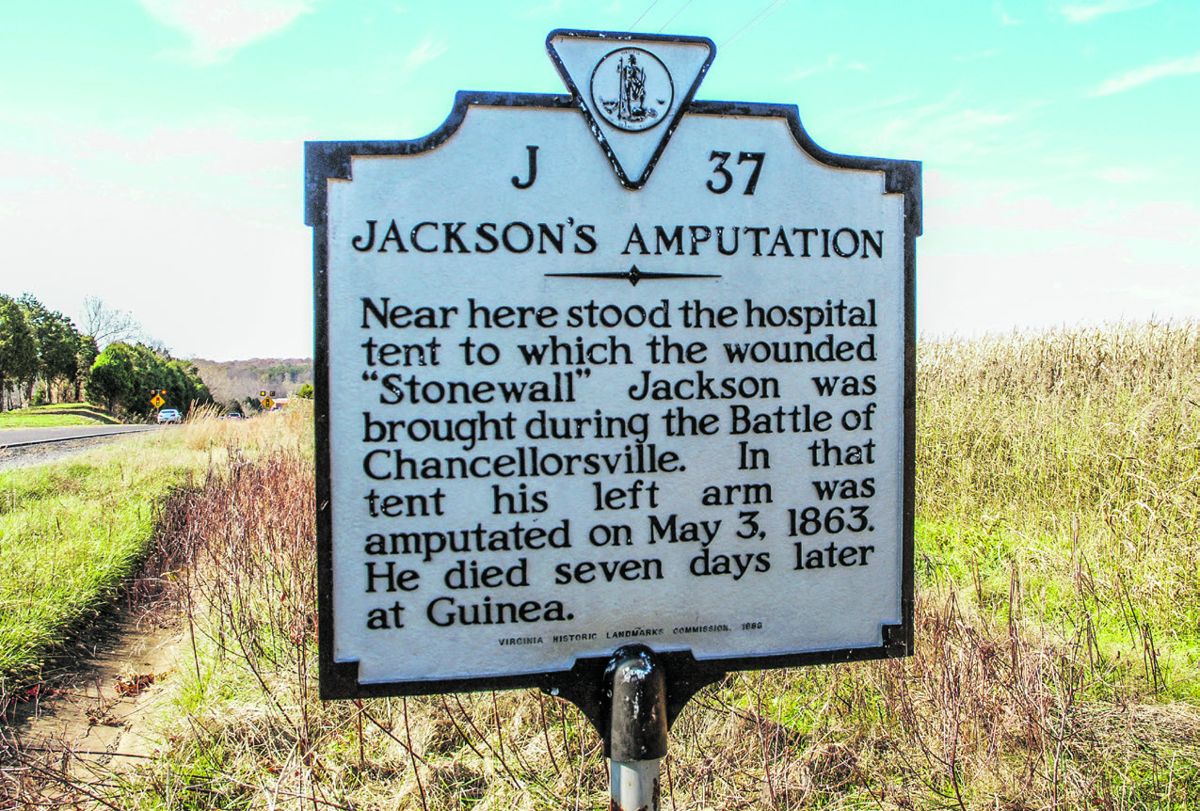
shattered arm.
Mark Leach is the president of the Friends of Wilderness Battlefield. His ancestors were Union sympathizers during the Civil War. His 3rd great uncle, Eben Manchester, served with the 20th Maine.
Arm of Stonewall Jackson This granite monument was erected in 1903 by Reverend James Power Smith to honor Stonewall Jackson. Rev. Smith served as an aide-decamp for General Jackson. He married Agnes Lacy, the eldest daughter of Major James Horace Lacy, owner of Ellwood.