Through The Lens
Never Be Afraid
By Stephanie Hagiwara · Originally published September 2018 · pp. 10–11
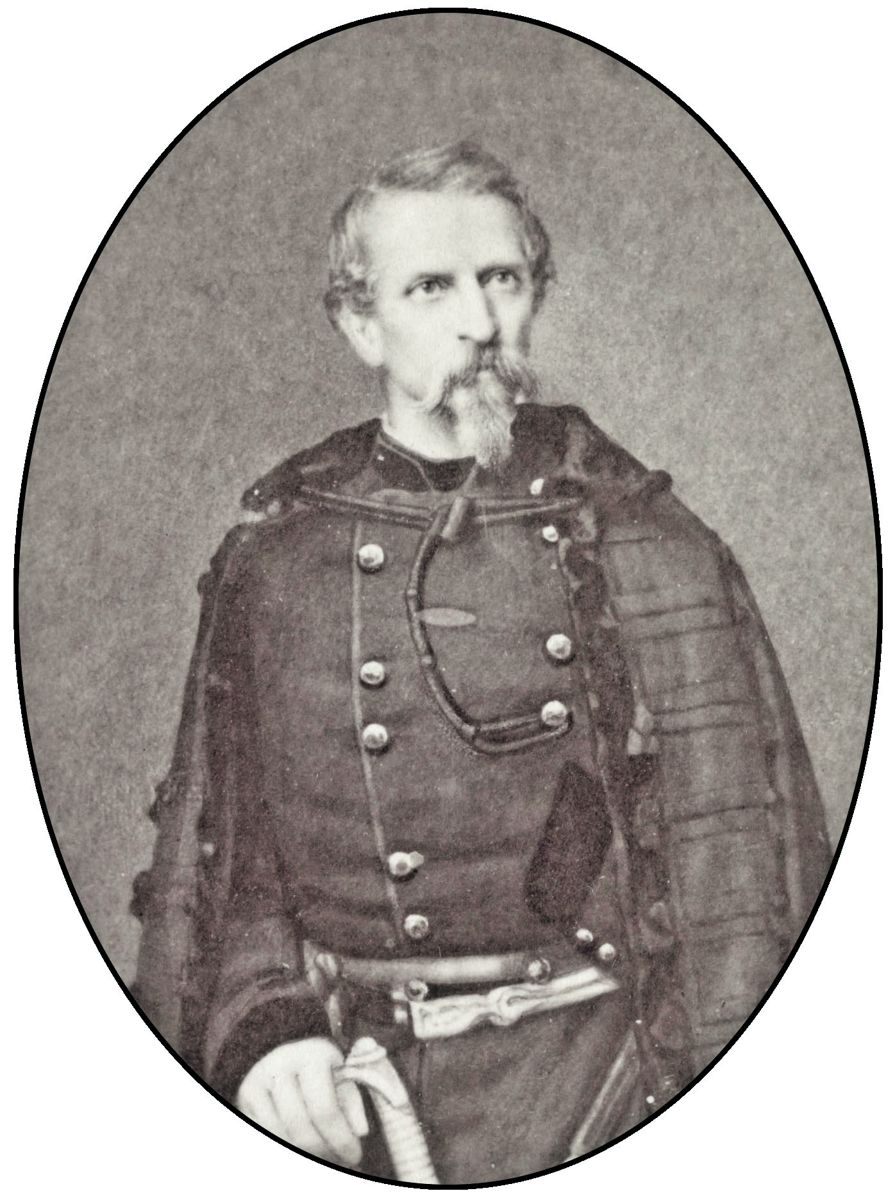
Gen. Philip Kearny.
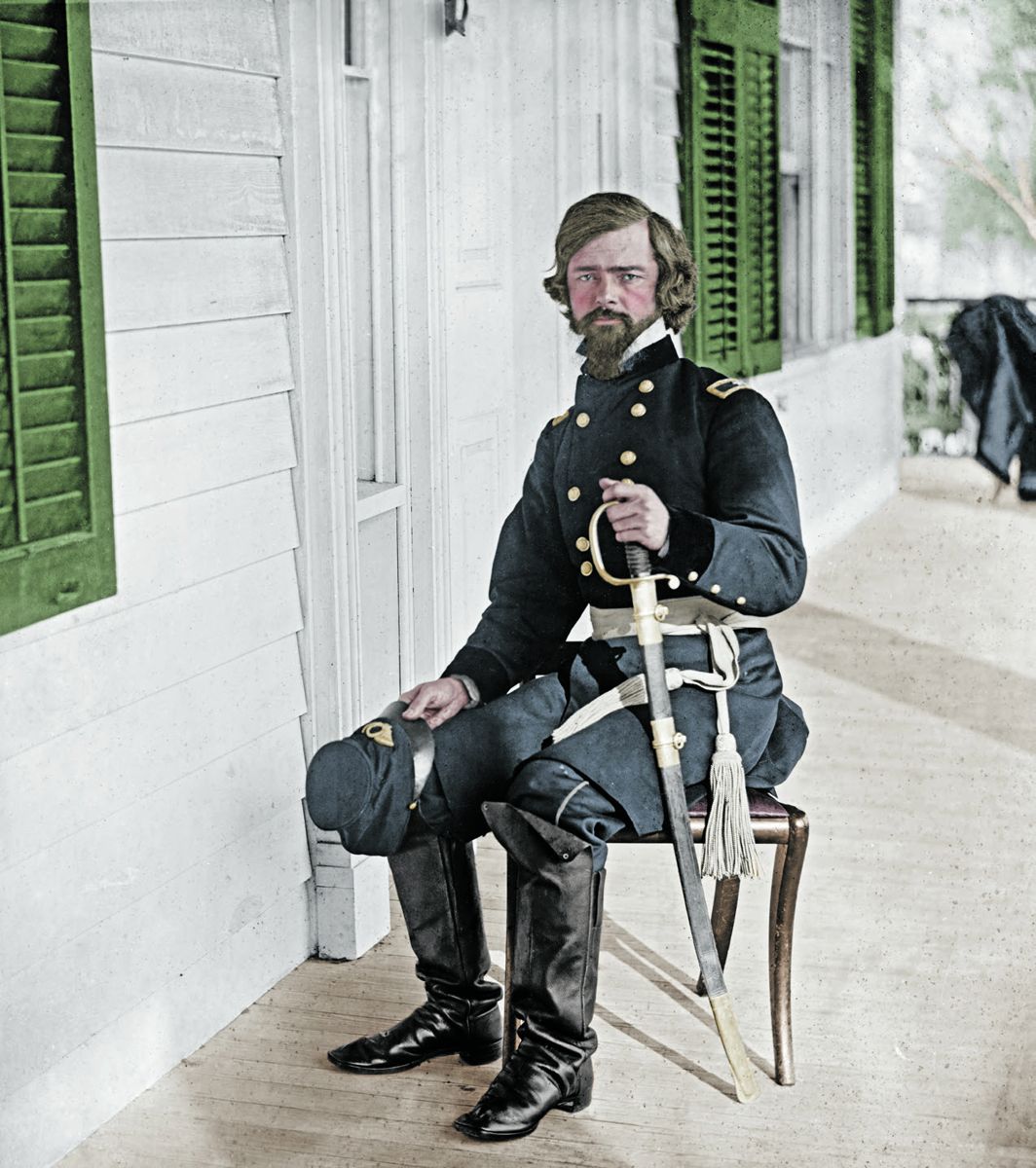
Never Be Afraid “The Rebel bullet that can kill me has not yet been molded.” – U.S. Gen. Philip Kearny On September 1, 1862, both sides were exhausted and slogging through the mud after fighting the Second Battle of Manassas, Va., two days earlier. U.S. Gen. John Pope’s Army of Virginia was retreating to where it started six weeks earlier, Washington. C.S. Gen. Thomas “Stonewall” Jackson was ordered to cut off Pope’s line of retreat. Two of Pope’s cavalry scouts reported the Confederate column about noon. U.S. Gen. Isaac Stevens was ordered to the Little River Turnpike to protect the retreating Army’s flank. West Point graduate Stevens “commanded with a firm and severe hand.” He fought during the Mexican-American War and “spent many years on the frontier fighting the Indians. I have been surrounded by the red devils, fighting for my scalp.” Stevens was appointed the colonel of the 79th N.Y. Volunteers aka the “Cameron Highlanders.” He quickly raised the discipline of the unit. His 19-year-old son, Capt. Hazard Stevens served as his aide. On Sept 28, 1861, Lincoln appointed Stevens Brig. General. The scouts led the Federals several miles along a winding cart road. On an elevated portion, the Warrenton Pike could be seen a half a mile away, crowded with retreating wagons, before the road sloped down into a wooded area. About 4 p.m., to the men’s astonishment, a rebel skirmish line was emerging from the woods, deploying into a field, less than a mile from the retreating army. Stevens sent his skirmishers running up the embankment and over the unfinished railroad line while exchanging fire. They ran towards a farmhouse and orchard in the middle of the field. From their home, an elderly couple emerged, proclaiming, “We haven’t seen any Southern soldiers about here at all, and we hope there won’t be any fighting about the house!” Rifles cracked as two skirmishers were hit, ending the “parley” before it began. As the men advanced into the orchard, the siren song of apples overhead called. It would be death to stand, so “between shots” trees were shaken, giving the rebels a target. Bullets, twigs, apples, and men came crashing to the ground. Meanwhile, to present the smallest front while crossing the open fields, Stevens was forming his men into “columns of brigades” (three columns of three brigades). At the point of attack, the columns would swing into a division battle front, horizontal to the enemy’s line. Lieutenant Samuel N. Benjamin, Battery E, 2nd U.S. Artillery and his 20-pdr. Parrott guns were positioned on Millan Ridge. When almost ready to move, Stevens’s superior officer, U.S. Gen. Jesse Reno arrived and was quickly consulted. The rebel force was growing. Stevens realized that he wasn’t facing a few regiments but Jackson’s entire wing. He pulled Lt. Horatio G. Belcher, 8th Mich. out of the column to race to the pike for reinforcements. The Battle of Chantilly, Va., began at 4:30 p.m. As Stevens strode to the front of his division, the sky darkened, wind rose, and a drizzle turned into a downpour. “Division … guide center … forward march,” ordered Stevens. The rebels could not be seen or heard as the men advanced. “There is no enemy there,” exclaimed Capt. William Lusk to Hazard Stevens, as they were marching side by side; “they have fallen back; we shall find nothing there.” Out sprang the Confederates from behind a fence with a “terrific volley”. Stevens fell, shot in the arm and hip. As he struggled to his feet, the Highlanders pressed forward. His father following the line on foot, paused, asked if he was badly injured and ordered his son helped off the field. Thunder competed with the roar of the guns. Lightening flashed. The men wavered under the hail of bullets. Five colorbears of Stevens’s Highlanders fell. Stevens “pushed to the front, seized the falling colors from the hands of the wounded bearer, unheeding his cry, “For God’s sake, don’t take the colors, general; they’ll shoot you if you do!” and calling aloud upon his old regiment, “Highlanders, my Highlanders, follow your general!” rushed forward with the uplifted flag. … The enemy broke and fled in disorder.” A bullet pierced Stevens’s skull, while “he still firmly grasped the flagstaff”. The torrential rain made igniting the cartridges difficult. A Confederate colonel asked if his regiment could be withdrawn. Jackson replied, “My compliments to the Colonel and tell him the enemy’s ammunition is just as wet as his.” At the pike, Belcher’s request for aid was repeatedly declined until he reached U.S. Gen. Philip Kearny, 1st Division, III Corps. Kearny exclaimed, “By God! I’ll support Stevens anywhere!” He ordered Gen. David Birney’s, Gen. John Robinson’s and Col. Orlando Poe’s brigades into the field. Wealthy, Kearny had studied
cavalry tactics in France, lost his arm during the MexicanAmerican War, and was the first American to be awarded the Legion of Honor. For many years he lived openly with his future second wife until his first agreed to a divorce. Between his disability and his scandalous past, it would take the necessity for experienced commanders before Kearny got a brigade. In battle, Kearny rode with a sword in his right hand and the reins in his teeth. He encouraged his raw troops yelling, “I’m a one-armed Jersey son-of-a-gun, follow me!” He would assure them, “Don’t worry, men, they’ll all be shooting at me!” He created the precursor of today’s unit patches by ordering his officers to wear a red piece of cloth on their caps. He told them, “You are marked men; you must ever be in the front.” The artillery held off the rebels as Kearny positioned his men. He had a hole in his right flank where Stevens’s men wandered, out of ammunition. Just in time, out of the woods came the 21st Mass. Waiting for orders, the 21st found themselves behind rebel lines and had fought their way out. Kearny ordered them across Ox Road to Birney’s right flank. The men “tried to steal a few minutes to get the wet charges out of our guns, but the general, in hot and angry impatience, would brook no delay, and under his sneers, threats, and curses, we again moved forward.” Stopping to return fire, “… an officer galloped up from the rear, and ordered a rapid advance to the indicated point, saying that General Kearney would turn a battery on us if we hesitated longer.” Kearny came back insisting the rebels were not near. As proof, two prisoners of the 49th Georgia were brought to him. Infuriated, Kearny cried, “You and your prisoners” and rode off into the corn. After riding ten or twelve yards, Kearny realized he was surrounded by men. “Whose troops are these?” Kearny quietly asked. Several voices answered, “The 49th Georgia.” Kearny calmly replied, “All right”. Turning his horse, digging in his spurs, grasping the horse’s neck with right arm while lying on its back “Indian style,” Kearny raced for safety of the cornfield. Someone shouted, “That’s a Yankee Officer!” Another called, “Shoot him, fire on him!” Dozens of shots rang out, but only one hit its mark. A minié ball traveled through his seat to the chest, killed Kearny instantly. His horse ran in terror as Kearny fell to the mud. Kearny died as he lived. A few days earlier he had advised an aid, “You must never be afraid of anything.” Sources: • Stevens, Hazard, The Life of Isaac Ingalls Stevens, Volume 2 (of 2) • Walcott, Charles F., History of the Twenty-first regiment, Massachusetts volunteers, in the war for the preservation of the union, 1861–1865: with statistics of the war and of Rebel prisons • Todd, William, The Seventyninth Highlanders, New York Volunteers in the War of Rebellion, 1861–1865 Stephanie Hagiwara is the editor for Civil War in Color.com and Civil War in 3D.com. She also writes a column for History in Full Color.com that covers stories of photographs of historical interest from the 1850’s to the present. Her articles can be found on Facebook, Tumblr and Pinterest.